

What Technology International Patients Find at Acibadem Hospitals

At Acibadem hospitals, international patients typically encounter advanced diagnostic imaging, laboratory systems, image-guided and robotic-assisted treatment platforms, and digital record systems that connect departments. Which of these touches your own journey depends on your diagnosis, your doctor's plan and the specific hospital. The most useful question is not what equipment exists, but how a given technology fits your case, your schedule and your follow-up at home.
You have booked flights, you have a short window in Turkey, and somewhere between the visa paperwork and the packing list you are wondering what the hospital itself will actually be like. Marketing pages tend to answer that question with equipment names. This guide takes a different approach: it explains the technology international patients find in hospitals like Acibadem’s, what each layer of it does for you in practice, and, just as importantly, what it does not do.
At a glance
- Best for: International patients who want to understand what hospital technology means for their own treatment journey
- What you will find: Diagnostic imaging, laboratory systems, operating room and interventional platforms, digital records and coordination tools
- Where it helps most: Diagnosis, treatment planning, coordination between departments, safety checks and follow-up documentation
- What it does not replace: Clinical judgement, clear communication and a treatment plan matched to your case
- What to ask about: Whether a specific technology is relevant for your condition and available at the hospital you will attend
- Support available: International patient coordinators, interpreters and help moving between departments
What technology international patients find in hospitals, and why the label matters less than the workflow
“Hospital technology” can sound abstract until you are standing in the middle of it. In practice, the technology international patients find in hospitals shapes the parts of the journey you actually feel: how quickly information moves between departments, how clearly your doctors can see what is happening inside your body, how precisely a procedure is planned, and how smoothly separate teams coordinate around one patient.
For international patients this matters more than it does for locals, because you are managing travel, timing, language and often a short treatment window all at once. Good systems mean you repeat yourself less. Your imaging travels to the specialist before you do. Your blood results reach the anaesthesia team without you carrying them down a corridor. Your discharge paperwork exists in a format your doctor at home can use.
At Acibadem hospitals, the technology you may encounter falls into four broad layers: diagnostic systems (imaging and laboratories), treatment platforms (operating rooms, interventional suites, radiotherapy planning), digital coordination (records, image sharing, medication workflows) and patient-support tools (scheduling, interpreting, documentation). The exact systems in use depend on your hospital, your condition and your doctor’s plan, no honest guide can promise you a specific machine before a specialist has reviewed your case. What we can do is explain each layer, so you know what to look for and what to ask. For a broader picture of how the hospitals themselves are organised, see what international patients can expect across our network.
Diagnostic technology: usually the first layer you meet
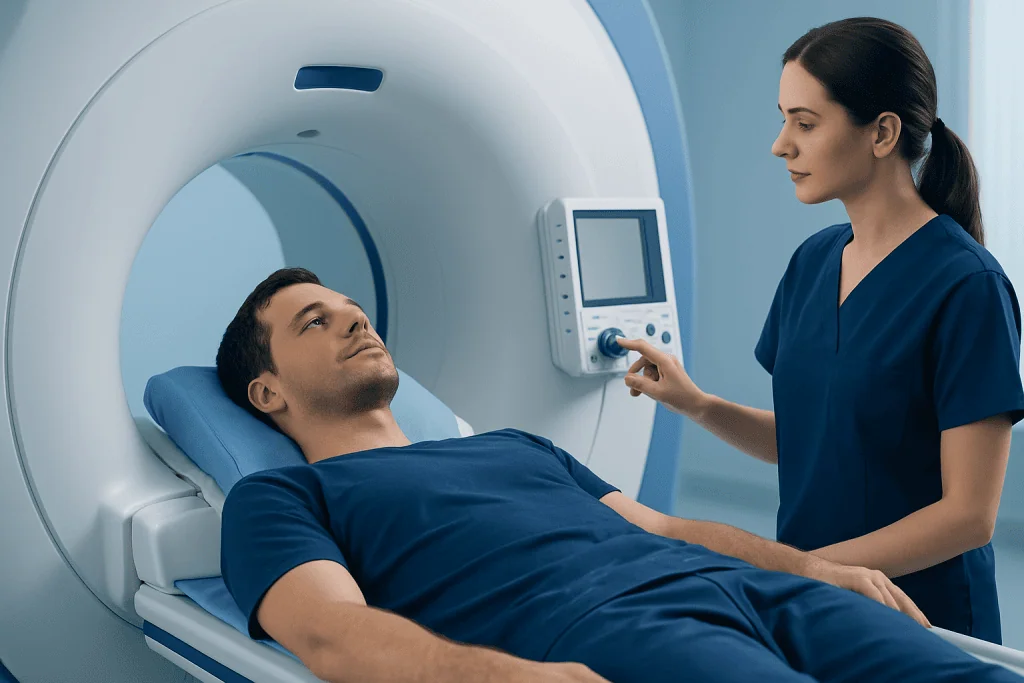
Most patient journeys begin with diagnosis, or with confirming a diagnosis made at home. This is where hospital technology is most visible to you. Depending on your case, your schedule may include imaging such as MRI, CT, PET-CT, ultrasound or mammography, alongside blood work and pathology review. Some of these tests require preparation, fasting, sedation, contrast agents, or pausing certain activities, and your team will tell you which apply to you.
The practical benefit is not that a scanner is new. It is that detailed, current imaging lets your team define the location, size or extent of a condition before committing to a treatment plan, and that laboratory systems process and cross-check results before decisions are made. When several specialists need to weigh in, shared access to the same images shortens the gap between “we have your results” and “here is the plan”.
If you are arriving with existing scans and reports, bring both digital and printed copies where possible. Hospitals with strong digital systems can often import outside records, but file formats vary, and image quality or protocol differences sometimes mean a scan needs repeating. That is not a sign anything went wrong; it is often a quality decision. Repeat testing is one of the most common reasons treatment timelines shift after arrival, which is why it helps to read about pre-op tests international patients may need before treatment while you plan your dates.
- Bring scan discs, cloud links or secure file access details, plus printed reports
- Carry a written list of recent blood tests, current medications and allergies
- Ask whether any of your previous reports need certified translation
- Leave room in your schedule in case updated tests are requested after review
Treatment and operating room technology: what it can change for you

Some patients travel to Turkey specifically because certain hospitals offer access to treatment platforms that are harder to find at home. Depending on the specialty, this can include robotic-assisted surgical systems, image-guided procedures, advanced radiotherapy planning, catheter-based cardiovascular technology, navigation tools used in orthopaedics or neurosurgery, and continuous monitoring in operating rooms and intensive care.
Here is the honest framing. A treatment platform is a tool. It can improve visualisation, planning and precision for the team using it, but it is only valuable when it suits your specific case and is operated by an experienced multidisciplinary team within an established workflow. Robotic-assisted surgery, for example, is one approach among several; whether it is appropriate for you is a clinical decision that depends on your anatomy, your diagnosis and your surgeon’s assessment, not on which machine sits in the building. No responsible hospital will promise you a specific technique before that assessment is complete.
The useful question, then, is not “What is the newest machine?” but “How does this technology fit my diagnosis, my treatment plan and my recovery expectations?” If your care involves more than one department, surgery plus radiation, for instance, or an interventional procedure followed by rehabilitation, ask how the teams coordinate, what preparation is expected from you, and whether the chosen approach affects your length of stay, your mobility after the procedure or your follow-up schedule. If general anaesthesia is part of the plan, it is worth reading about preparing for general anaesthesia in Turkey before you travel.
Digital records and coordination: the technology you barely see
The least visible layer of hospital technology is often the one that shapes your week the most. Electronic medical records, image-sharing platforms, laboratory information systems and medication-tracking workflows determine whether your Tuesday scan reaches your Wednesday consultation, whether the pharmacy knows about your allergy, and whether the second specialist you see has already read the first one’s notes.
Patients sometimes ask which electronic health record (EHR) system a hospital runs, often because they have read about big-name platforms. The honest answer is that the brand of the software matters far less to you than three practical questions: do all departments treating you work from one shared record, can outside imaging and reports be imported into it, and can you receive your own results and discharge documents in a usable format afterwards. A hospital with a well-integrated local system will serve you better than one with a famous platform used in silos.
For international patients seeing several specialists in a compressed timetable, integrated records mean less repetition and fewer gaps. They do not remove your own responsibilities. Keep a personal backup folder, passport copies, insurance documents if relevant, medical reports, a medication list and emergency contacts. Even in a highly digital hospital, organised paper saves time at admission and reassures the team that nothing has been missed. Before discharge, confirm how your results will be shared with you, whether you can access reports after you leave, and which documents your home doctor will need for follow-up.
Where technology meets safety and quality
Technology is most reassuring when it is tied to visible safety processes rather than presented as a substitute for them. In an accredited environment such as Acibadem’s JCI-accredited hospitals, the systems around you support routines like patient identification, medication cross-checking, infection control, imaging protocols and escalation pathways if a patient’s condition changes.
It is entirely reasonable to ask practical questions about these routines. How are allergies recorded and flagged? How are medications double-checked before administration? How are scan results reviewed across teams before a plan is finalised? Who reviews your case if something unexpected appears on a test? Good technology should make these processes more reliable and more traceable: it should never replace human judgement or clear communication, and a hospital that says otherwise is overselling.
One more honest point: technology cannot eliminate uncertainty. Plans sometimes change after an in-person review, a repeat scan or a new lab result. That is the system working, not failing. If the idea of a shifting plan worries you, our guide on unexpected test or treatment changes in Turkey explains how patients stay prepared for it.
How to read “smart hospital” lists and technology rankings
If you have been researching, you have probably met ranking lists: the world’s best smart hospitals, the most technologically advanced countries, the top hospitals of the year. Treat these as conversation starters, not decisions. Rankings are compiled by different publishers using different criteria, survey responses, technology adoption, research output, and the positions change from year to year. There is no single, settled answer to questions like “which country has the most advanced healthcare” because the answer depends entirely on what you measure and who is measuring.
A more useful exercise for a patient is narrower: does the specific hospital you would attend have the specific capability your condition needs, does the team there use it routinely for cases like yours, and does the whole pathway, records, language support, follow-up documentation, work for someone flying in from abroad? Our guide on how to compare hospitals in Turkey for complex treatment walks through that comparison in detail.
Questions worth asking before you travel
If technology is a significant part of why you are considering treatment abroad, ask focused questions early, in plain language, not equipment names. The technology international patients find in hospitals varies by site and department, so broad brochure claims are less useful than confirmation that a particular capability exists at the hospital you will attend and is recommended for your condition.
Examples of questions that produce useful answers: Will this scan replace one I already had, or sit alongside it? Is robotic-assisted surgery being considered for me, and what are the alternatives? Will planning imaging happen before I arrive or after I land? How many days should I keep free for tests and multidisciplinary review before treatment can start? How will my records reach my doctor at home?
These questions do two things. They help you build a realistic travel plan, and they lower frustration if the pathway changes after in-person review, which is common and usually reflects careful medicine rather than a problem. Your doctors may confirm the initial plan, refine it or recommend a different approach once they have examined you directly.
- Confirm the exact hospital and department where your care will take place
- Ask which tests are likely to be repeated on arrival, and why
- Check whether sedation, fasting or contrast is required for any scan
- Request expected timelines for reports, procedures and discharge documents
- Ask how your records will be formatted for home-country follow-up
What this means for your overall experience in Turkey
Advanced technology is reassuring because it signals structured, modern care. But your actual week in hospital is shaped by how that technology is integrated with communication, scheduling, language support and aftercare planning. The best experiences come from both together: capable systems and a team that explains each step in words you understand. If language is a concern, see how Acibadem hospitals support international patients in their own languageinterpreting support matters most precisely on the technology-heavy days, when preparation instructions and consent discussions carry real detail.
Think of technology as one part of the journey rather than the whole reason to choose a hospital. You also need clarity on transfers, accommodation, companion arrangements, estimated length of stay, and what happens if you need extra tests or a longer recovery period. Used well, the digital and clinical systems around you make those moving parts feel less overwhelming, so your attention stays where it belongs: on your appointments, your decisions and your recovery.
Step by step
- Share your medical records before you travel. Hospitals typically review reports, scan files and medication lists in advance to decide which tests and technologies may be relevant, and whether anything should be updated after you arrive. Ask which file formats work best.
- Ask which technology is actually relevant to your case. Not every advanced system applies to every patient. Ask your doctor or coordinator which diagnostic or treatment technologies may be used for your condition, and what each one changes in practical terms.
- Plan your schedule around testing and review time. Some pathways need same-week imaging, lab work or multidisciplinary review before treatment can begin. Keep your dates flexible enough to absorb repeat tests, result turnaround and plan refinements.
- Prepare both digital and paper documentation. Bring electronic copies of scans plus printed summaries, passport details and a medication list. Even in a digital hospital, organised backups save time and reduce stress at admission.
- Use international patient support services early. Interpreters, appointment coordination and help moving between departments make technology-heavy days far easier to navigate, especially when preparation instructions matter.
- Clarify your discharge and follow-up plan. Before leaving Turkey, confirm how reports, imaging and recommendations will be shared with you, which documents your home doctor will need, and whom you can reach with questions after discharge.
Your checklist
- Passport and travel documents
- Recent medical reports and imaging files, digital and printed
- Current medication and allergy list
- Written questions about the specific technologies proposed for you
- Contact details for your international patient coordinator
- A flexible travel timeline that allows for repeat testing
- Insurance or payment documents if relevant
- A plan for receiving reports and follow-up instructions after discharge
Key takeaways
- Technology at Acibadem hospitals spans four layers: diagnostic imaging and laboratories, treatment platforms, digital records and patient-support tools.
- For international patients, the practical gains are better planning, clearer diagnosis, smoother coordination between departments and traceable safety checks.
- No technology is universally appropriate; whether a given platform suits you is a clinical decision made after your case is reviewed.
- The brand of a record system matters less than whether your teams share one record and whether you receive usable documents afterwards.
- Rankings and “smart hospital” lists are starting points, not answers; compare specific capabilities against your specific condition.
- Bring organised records and allow schedule room for repeat tests or updated planning after arrival in Turkey.
Frequently asked questions
Will I automatically receive the most advanced technology available?
Not necessarily. Your doctor recommends the tests, equipment or treatment platform that best fits your diagnosis and overall plan. The newest option is not always the most appropriate one, and a responsible team will explain why a particular approach was chosen for you.
Can I rely on scans and reports from my home country?
Bring them: they are genuinely useful for initial review. Your team may still request repeat imaging or laboratory tests after arrival to confirm details, use compatible protocols or base decisions on the most current information. Build time for this into your travel plan.
What are the top EHR systems, and does the name matter for my care?
In the US market, platforms such as Epic, Oracle Health (formerly Cerner) and MEDITECH are among the most widely used. Hospitals elsewhere, including in Turkey, often run national or in-house systems. For you as a patient, the brand matters far less than whether all your departments share one record and whether you can receive your results in a usable format afterwards.
Can a US citizen get free healthcare in another country?
Generally, no. Public healthcare systems abroad are funded for their own residents or citizens, and planned treatment for visitors is usually paid privately. Standard travel insurance typically covers emergencies rather than planned procedures, so international patients should confirm cover and payment arrangements before travelling.
What is the number two hospital in the world?
There is no fixed answer. Several publishers release annual hospital and “smart hospital” rankings, each using different methods, and the positions change every year. Rankings can be a useful starting point, but a hospital’s suitability for your specific condition matters more than its position on any list.
Which country has the most technologically advanced healthcare?
It depends on what you measure, imaging density, digital record adoption, research output or something else, and different indices give different answers. A more useful question for a patient is whether the specific hospital you would attend has the specific capability your condition needs.
Does hospital technology make treatment safer?
Technology can support safety when it sits inside a strong system of trained teams, clear protocols and careful review. It helps with medication cross-checks, monitoring, imaging accuracy and coordination, but it works alongside clinical judgement and good communication, never instead of them.
Can I get my results and records after I return home?
In many cases, yes, but confirm the process before discharge. Ask how reports, imaging summaries and treatment notes will be shared, what format they will arrive in, and which documents your doctor at home will need for follow-up.
Add us as a Preferred Source to see more of our trusted health content across Google Search, AI Overviews and Discover.

Update history
- PublishedJune 22, 2026
- Medical review approvedSeptember 13, 2026
- Last content updateSeptember 12, 2026
References2
- CDC Travelers' Health: Medical Tourism wwwnc.cdc.gov
- MedlinePlus: Diagnostic Imaging medlineplus.gov
More Patient Guides

Medical Chaperones in Turkey: When Patients Can Request One
Medical chaperones in Turkey can be requested for sensitive exams or when you want added reassurance during care in Istanbul.

Medical Interpreter or Family Member: Who Should Help During Appointments in Turkey?
Medical interpreter or family member in Turkey? Use a trained interpreter for clinical communication and keep family involved for support and notes.

How to Plan for Prayer, Modesty, and Cultural Needs During Care in Turkey
Prayer, modesty, and cultural care needs in Turkey can be planned in advance by sharing your preferences with your care team and…

Interpreter Support in Turkish Hospitals: When to Request Help
Interpreter support in Turkish hospitals helps you understand appointments, consent and discharge clearly in Turkey or Istanbul.