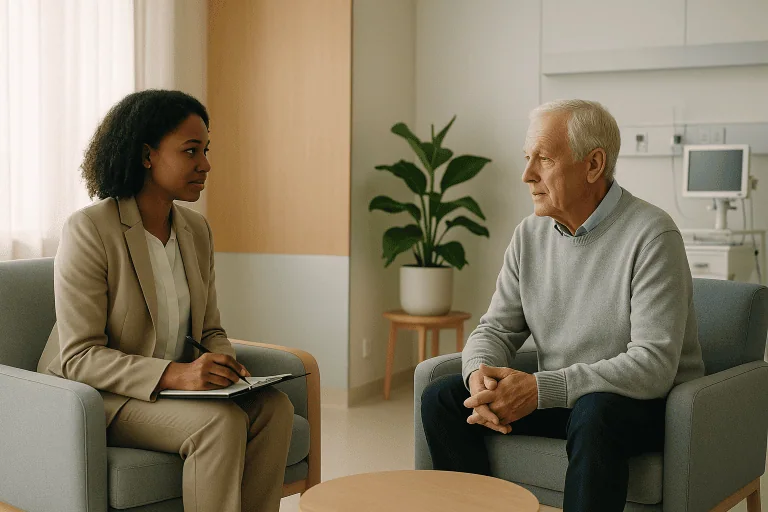
Couples Therapy
Couples therapy is a form of psychotherapy in which two partners attend sessions together with a trained clinician to address communication problems, repeated conflict, loss of intimacy, breaches of trust or the…

Quick answer
Couples therapy is structured talk therapy in which two partners meet a trained mental health professional together to improve communication, resolve recurring conflict, rebuild trust and make decisions about their relationship. Sessions usually last about an hour, occur weekly or every two weeks, and often continue for several months. There is no physical procedure or recovery period.
What is couples therapy?
Couples therapy is a form of psychotherapy, meaning talk-based treatment delivered by a trained mental health professional, in which two partners attend sessions together. Its goal is to help partners understand patterns in how they communicate, resolve conflict, rebuild trust and make decisions about the future of the relationship. It is sometimes called relationship counseling, marriage counseling or couple counseling. The partners do not need to be married, and the approach is used with couples of any gender, age or relationship length.
Unlike many medical treatments, couples therapy does not treat a disease in one person. Instead, the relationship itself is the focus. Even so, it is often used alongside treatment for individual conditions that strain a relationship, such as depression, anxiety disorders, post-traumatic stress disorder (a condition in which distressing memories and heightened alertness persist after a frightening event), substance use disorders, sexual health concerns or the emotional impact of a serious physical illness. Couples therapy is also commonly used for recurring arguments, emotional distance, difficulties after infidelity, disagreements about parenting or money, and transitions such as a new baby, retirement, migration or a major diagnosis in one partner.
Several structured approaches exist. Emotionally focused therapy looks at the attachment bond between partners and the emotions underneath repeated conflicts. Behavioral and cognitive behavioral couple therapy focuses on changing specific interaction patterns and unhelpful thoughts about a partner. Other models draw on systems theory, which views each partner’s behavior as part of a larger pattern rather than a fault in one person. In practice, many therapists combine elements of these approaches. Within a hospital setting, couples therapy is usually offered by a psychologist or psychiatrist working in a department such as Psychiatry & Psychology.
Who is a candidate for couples therapy?
People often search for who needs couples therapy, and the honest answer is that there is no single threshold. Couples therapy may be considered when both partners feel stuck in a pattern they cannot change on their own. Common reasons for referral or self-referral include:
- Frequent arguments that repeat without resolution, or a sense of walking on eggshells at home.
- Loss of emotional or physical intimacy, or feeling more like roommates than partners.
- Breakdown of trust after infidelity, secrecy or financial dishonesty.
- Difficulty coping together with infertility, pregnancy loss, chronic illness, disability or caregiving demands.
- Tension linked to one partner’s mental health condition, alcohol or drug use, or gambling.
- Major life decisions on which the partners strongly disagree, including whether to separate.
- A wish to strengthen a generally healthy relationship before marriage, a move abroad or another large change.
Couples therapy is not considered suitable in every situation. Most clinicians advise against joint sessions when there is ongoing physical violence, coercive control or a partner who is afraid to speak openly in the room. In these cases, safety planning and individual support are usually recommended first. Couples therapy may also be postponed when one partner is in an acute mental health crisis, is actively suicidal, or is intoxicated during sessions, because meaningful joint work is difficult until the individual condition is more stable. Therapy also tends to be less helpful when one partner has firmly decided to leave and is attending only to satisfy the other; in that situation, a therapist may suggest a different type of support, sometimes called discernment counseling, that helps the couple make a clear decision rather than repair the relationship.
How the couples therapy procedure works
The phrase couples therapy procedure can be misleading, because nothing physical is done to the body. Still, the process follows a recognizable sequence.
Before the first session. Most therapists begin with an assessment that takes one to three appointments. Typically, the couple meets the therapist together first. Many therapists then see each partner alone once, so that each person can describe concerns, personal history and any safety issues privately. Some clinics ask couples to complete standardized questionnaires about relationship satisfaction, communication and mood. The therapist uses this information to describe the main patterns they see and to agree on goals with the couple.
During sessions. A standard session lasts around 50 to 90 minutes, and couples typically attend weekly or every two weeks. The therapist acts as a neutral guide rather than a judge. In early sessions the focus is often on slowing down heated exchanges, helping each partner listen without interrupting, and identifying the cycle that keeps repeating, such as one partner pursuing and the other withdrawing. Later sessions work on expressing needs directly, repairing after arguments, rebuilding trust step by step and, where relevant, addressing sexual concerns or coordinating care for an individual condition. Between sessions, therapists usually assign practice tasks, such as structured conversations or shared activities.
After the active phase. A course of couples therapy commonly runs for several months, although shorter and longer courses are both normal. Toward the end, sessions may be spaced further apart. Many therapists offer a review appointment some weeks or months later to check that changes have held. If one partner has an individual diagnosis, the couples therapist may coordinate with that person’s psychiatrist or physician, with the couple’s consent.
Preparation for couples therapy
Preparation for couples therapy is practical and emotional rather than medical. There are no tests, fasting rules or medication changes required. The following steps often help couples get more from the process:
- Agree together that you both want to attend. Therapy usually works better when neither partner feels forced.
- Think about what you each hope will be different by the end. Goals can be simple, such as arguing less or feeling closer.
- Gather relevant medical information. If either partner has a diagnosed mental health condition, takes psychiatric medication or has a physical illness affecting the relationship, bring a brief summary and the names of treating clinicians.
- Ask practical questions in advance: how long sessions last, how often you will meet, whether individual sessions are part of the plan, how confidentiality works when partners are seen separately, and whether online sessions are available.
- Plan childcare and travel so that both of you can attend consistently. Frequent missed sessions tend to slow progress.
- Expect the first sessions to feel uncomfortable. Raising sensitive topics in front of a third person is difficult for most people, and this discomfort usually eases.
If you are traveling internationally for treatment, check whether the therapist works in your preferred language or whether an interpreter is available, because subtle wording matters a great deal in this kind of work.
Recovery time and aftercare after couples therapy
Searches for couples therapy recovery time reflect a natural question, but the concept works differently here than after an operation. There is no physical recovery, no downtime and no restriction on daily activities. You can return to work, driving and family life immediately after each session. What people usually mean by recovery is how long it takes for the relationship to feel better, and that varies widely.
Realistically, many couples notice small shifts within the first few sessions, such as arguments ending sooner or one partner feeling heard for the first time in years. Deeper changes in trust and intimacy typically take longer, often several months of consistent work. It is common for things to feel temporarily worse in the early phase, because issues that were avoided are now being discussed openly. Therapists generally view this as part of the process rather than a sign of failure, provided both partners still feel safe.
Aftercare focuses on maintaining what was learned:
- Continue the structured conversations or check-ins that were practiced in sessions, even when things are going well.
- Notice early signs of the old cycle returning, and name it together rather than blaming each other.
- Keep any planned review appointments, and consider a brief return to therapy during major stressors.
- Continue individual treatment for depression, anxiety or substance use if that was part of the plan; relationship gains are often fragile if an individual condition worsens.
Some couples choose occasional maintenance sessions, while others need no further contact. Both patterns are normal.
Couples therapy risks and side effects
Any balanced discussion of couples therapy risks and benefits should acknowledge that talk therapy is not risk-free, even though it involves no medication or physical intervention. Possible downsides include:
- Emotional distress. Sessions can bring up grief, anger or shame. Some people feel drained or unsettled for a day or two afterward.
- Temporary increase in conflict. Discussing long-avoided topics can lead to more arguments at home in the short term.
- Clarifying that the relationship will end. Therapy sometimes helps partners see clearly that they want different things. Many therapists regard a well-managed separation as a legitimate outcome, but it may not be what one partner hoped for.
- Feeling ganged up on. If a therapist appears to side with one partner, the other may disengage. A skilled therapist works to stay balanced, and it is reasonable to raise this concern directly in a session.
- Safety concerns. Where there is intimidation or violence, joint sessions can increase risk if one partner is punished afterward for what was said. This is why screening for safety is a standard part of assessment.
- Cost and time. Several months of regular appointments is a meaningful commitment, and results are not guaranteed.
There are no known physical side effects. Couples therapy does not interact with medications, and it can be undertaken during pregnancy or alongside treatment for physical illness.
Results and outlook
Research on structured couples therapy, particularly emotionally focused therapy and behavioral couple therapy, generally shows that many couples who complete a course report improved relationship satisfaction, better communication and reduced distress compared with couples who receive no treatment. Studies also suggest that couples therapy can support recovery from individual conditions, such as depression or alcohol use disorder, when relationship stress is a contributing factor. At the same time, not every couple improves, some gains fade over time, and outcomes are harder to predict when problems have been present for many years or when commitment to the relationship is uncertain.
Factors that tend to be associated with better outcomes include both partners attending willingly, starting before resentment has become entrenched, consistent attendance, willingness to complete tasks between sessions and, where relevant, parallel treatment of individual conditions. A therapist with specific training in couple work, rather than only individual therapy, is also generally considered important. Your therapist may be able to give you a realistic sense of what to expect after the initial assessment, but no professional can guarantee a particular result.
Cost considerations
The cost of couples therapy depends on several factors rather than a fixed procedure fee. The main drivers are the number of sessions in the course, the length of each session, and the qualifications and experience of the therapist, for example whether sessions are led by a psychiatrist, a clinical psychologist or a licensed counselor. Initial assessment appointments and individual sessions for each partner add to the total. Standardized questionnaires or psychological testing, if used, may be billed separately. Online sessions sometimes cost less than in-person appointments, and some clinics offer packages for a set number of visits.
Because couples therapy is outpatient care with no hospital stay, devices or medication, the largest variable is simply how long treatment continues. Insurance coverage varies considerably: some insurers cover couples therapy only when one partner has a diagnosed mental health condition, while others exclude relationship counseling entirely. It is sensible to confirm coverage, session fees and cancellation policies before the first appointment. In a hospital group such as Acibadem, these services are typically arranged through the psychiatry and psychology department, and the administrative team can explain how billing works.
Frequently asked questions
What happens in a couples therapy procedure?
A typical course begins with one or more assessment sessions, often including a private meeting with each partner. The therapist then helps the couple identify recurring patterns, practice new ways of communicating and work on specific goals such as rebuilding trust. Sessions are conversations, not examinations, and there is no physical procedure involved.
Who needs couples therapy, and how do we know it is time?
There is no medical test for this. Couples often seek therapy when the same conflict keeps repeating, when they feel emotionally distant, after a breach of trust, or when a life event has strained the relationship. Some attend early to prevent problems from deepening. If either partner is afraid of the other, individual support is usually advised first.
Is there a couples therapy recovery time?
No physical recovery is needed, and normal activities continue between sessions. Emotional improvement is gradual: some couples notice changes within a few sessions, while deeper shifts in trust and closeness often take several months. Feeling temporarily worse early on is common and not necessarily a sign that therapy is failing.
What are the main couples therapy risks and benefits?
Potential benefits include better communication, reduced conflict, renewed intimacy and support for individual mental health. Risks include emotional distress, a short-term rise in arguments, discovering that the relationship should end, and the time and cost involved. Joint sessions are generally not recommended where there is ongoing violence or intimidation.
Does couples therapy work if only one partner wants to go?
It can be difficult. Couples therapy relies on both people participating honestly. If one partner refuses, the other can still benefit from individual therapy focused on the relationship, and sometimes a reluctant partner becomes willing after seeing changes. A therapist may also offer a single consultation to explain what sessions involve.
How long does couples therapy usually last?
Session length is commonly around an hour, sometimes longer for couple work. The overall course varies widely; many couples attend for several months, with sessions spaced out toward the end. Short-term, goal-focused programs and longer open-ended work both exist, and your therapist may suggest a plan after the assessment.
Can couples therapy help with sexual problems or a partner’s depression?
In many cases, yes, as part of a broader plan. Relationship stress and sexual difficulties often influence each other, and therapists may address both or refer to a specialist. When one partner has depression, anxiety or a substance use problem, couples therapy is usually combined with individual treatment rather than replacing it.
When to see a doctor
Relationship distress itself does not require a physician, but certain situations mean that one or both partners should be assessed by a mental health specialist, such as a psychiatrist or clinical psychologist, before or alongside couples therapy. These include persistent low mood, loss of interest in daily life or changes in sleep and appetite lasting more than a few weeks; panic attacks or overwhelming anxiety; heavy or escalating use of alcohol or drugs; and difficulty functioning at work or caring for children. A doctor can also help when a physical condition, medication or hormonal change appears to be affecting mood, energy or sexual function.
Some warning signs call for urgent help rather than a scheduled appointment. Seek emergency care or contact local crisis services immediately if either partner expresses thoughts of suicide or self-harm, threatens to harm the other, or has been physically hurt. If sessions leave one partner feeling unsafe at home afterward, tell the therapist or another professional privately as soon as possible. Rapid worsening of a known psychiatric condition, confusion, or behavior that is markedly out of character also warrants prompt medical assessment. In these situations, individual safety takes priority over continuing joint sessions.
Preparation
- Agree together that both partners want to attend, and think about what each of you hopes will change. Bring a brief summary of any mental or physical health conditions and current medications, plus the names of treating clinicians. Ask in advance about session length, frequency, confidentiality for individual meetings and language or interpreter options, and arrange childcare and travel so you can attend consistently.
Aftercare
- Keep practicing the communication tools learned in sessions, and watch together for early signs of old patterns returning. Attend any planned review appointments and consider a brief return to therapy during major stressors. Continue individual treatment for conditions such as depression, anxiety or substance use if these were part of the plan.
Medically reviewed by the Acıbadem International Medical Board September 13, 2026
See our medical review board →
Update history
- PublishedSeptember 13, 2026
- Medical review approvedSeptember 13, 2026
- Last content updateSeptember 13, 2026