Calcium Score Test: What Patients Need to Know

A calcium score test looks for calcified plaque in the arteries that supply the heart. The test does not diagnose every heart problem, but it can refine cardiovascular risk assessment.
Key Takeaways
- A calcium score test looks for calcified plaque in the arteries that supply the heart.
- The test does not diagnose every heart problem, but it can refine cardiovascular risk assessment.
- Results are reported as a calcium score, with higher scores generally indicating more plaque burden.
- It is most often considered for people with borderline or intermediate risk of heart disease.
- The scan is quick, usually requires no needles or contrast dye, and involves a low dose of radiation.
A calcium score test is a noninvasive CT scan that measures calcium buildup in the coronary arteries. It helps doctors estimate future heart disease risk and decide whether preventive steps, such as lifestyle changes or medication, may be helpful.
What a calcium score test shows
A calcium score test is a special CT scan that measures calcium deposits in the coronary arteries, the blood vessels that bring oxygen-rich blood to the heart muscle. These calcium deposits are part of atherosclerotic plaque, which can narrow arteries over time. In practical terms, the test helps show whether there is evidence of silent coronary artery disease before symptoms develop.
For many patients, the main value of the scan is risk clarification. A person may feel well and still have early plaque buildup, while another person with similar age and cholesterol levels may have little or none. By adding this information to standard risk factors such as blood pressure, cholesterol, diabetes, smoking, and family history, clinicians can make more individualized prevention decisions.
The result is reported as a calcium score. A score of zero generally suggests no detectable calcified plaque at the time of the scan, while higher scores suggest increasing plaque burden. The test does not measure soft, non-calcified plaque directly and does not replace a full cardiovascular assessment, but it can be a useful tool when the next step is uncertain.
Who may benefit from this scan
A calcium score test is often most helpful for adults who do not have symptoms but may have borderline or intermediate risk for future heart disease. This can include people with elevated cholesterol, high blood pressure, diabetes, a history of smoking, or a strong family history of early cardiovascular disease. In these situations, the scan may help decide whether preventive treatment should be intensified.
It is not automatically needed for everyone. People who already have known coronary artery disease, a previous heart attack, or clear indications for intensive treatment may not gain much additional decision-making value from the test. Likewise, it is generally not used as a first-line test for active chest pain or other urgent symptoms, where other types of assessment may be more appropriate.
Age and overall context matter. Younger adults with very low short-term risk may not benefit from scanning, while older adults may already have risk factors that make treatment decisions straightforward. A doctor can help determine whether a coronary calcium scan fits into a broader heart risk review, especially for patients also being evaluated for coronary artery disease.
How the test is done and what to expect

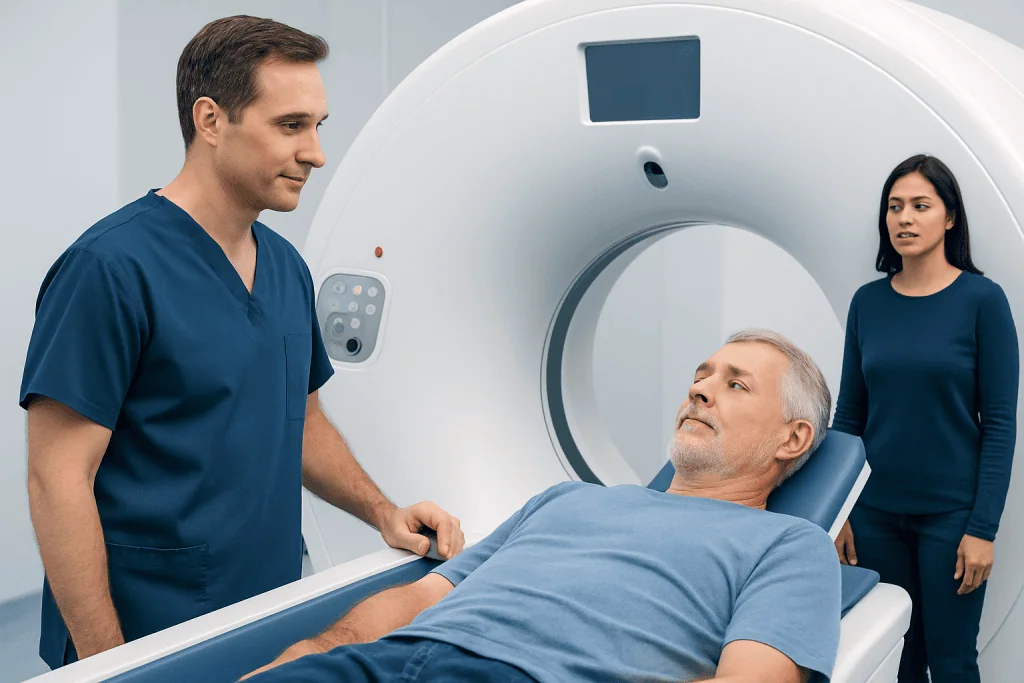
The calcium score test is simple and usually takes only a short time. During the scan, the patient lies on a table that moves through a CT scanner. Small sticky electrodes are placed on the chest to synchronize images with the heartbeat. The patient may be asked to hold their breath briefly while pictures are taken.
No exercise is required, and in most cases no contrast dye or intravenous line is needed. That makes the test different from other cardiac imaging studies that may involve stress testing or injected contrast material. The scan itself is painless, though some people may feel mildly uncomfortable lying still for several minutes.
Because this is a CT-based exam, it uses a low dose of radiation. For most patients, the amount is considered modest, but radiation exposure should still be weighed against the expected benefit of the information gained. If a patient is pregnant or could be pregnant, this should be discussed before the scan.
Understanding calcium score results
Calcium score results are usually grouped into broad ranges rather than viewed in isolation. A score of zero means no calcified plaque was detected, which generally suggests lower short-term risk of coronary events. A low but nonzero score indicates some plaque is present, while moderate or high scores suggest more extensive coronary calcification and a greater likelihood of atherosclerotic disease.
Even so, the number is only one part of the picture. A score of zero does not guarantee that a person has no heart disease, because some plaque may not yet be calcified. On the other hand, a higher score does not necessarily mean there is a dangerous blockage at that moment or that a procedure will be needed. It mainly signals that preventive management deserves careful attention.
Doctors often interpret the result together with age, sex, cholesterol profile, blood pressure, smoking status, diabetes, kidney health, and family history. In some cases, the result may support starting or continuing cholesterol-lowering treatment, improving blood pressure control, or strengthening lifestyle measures. If there are symptoms or other concerns, a clinician may recommend further evaluation such as a cardiac check-up or other heart tests.
Benefits, limits, and possible next steps
The main benefit of a calcium score test is that it can make prevention more precise. When standard risk calculators leave uncertainty, the scan may help identify patients who are more likely to benefit from earlier or stronger preventive treatment. It can also reassure some people when no calcified plaque is found, especially if they have been uncertain about whether medication is necessary.
However, the test has limits. It does not show every type of plaque, does not assess heart rhythm problems, and does not directly measure blood flow to the heart muscle. It should not be used as a stand-alone answer for symptoms such as ongoing chest pain, shortness of breath with exertion, or fainting. Those problems may need different evaluation, including cardiology assessment or testing aimed at detecting active ischemia.
Sometimes a calcium score result changes care, and sometimes it confirms an approach that was already planned. A clinician may recommend lifestyle counseling, lipid-lowering therapy, diabetes management, blood pressure treatment, or follow-up monitoring. The goal is not simply to label risk, but to reduce the chance of future cardiovascular events through timely prevention.
Reducing risk after a calcium score test
Whether the score is zero or elevated, heart-healthy habits remain important. A balanced eating pattern, regular physical activity, avoiding tobacco, maintaining a healthy weight, and prioritizing good sleep all support cardiovascular health. These measures help address the underlying process of atherosclerosis even when no symptoms are present.
Medication may also be part of prevention for some patients. Depending on the overall risk profile and calcium score, a doctor may discuss cholesterol-lowering therapy, blood pressure medicines, diabetes treatment, or other strategies. These decisions are individualized, and patients should not start or stop prescription medication without professional guidance.
Follow-up depends on the clinical situation. Some people may not need any additional testing right away, while others may require broader evaluation if symptoms, multiple risk factors, or a very high score are present. For patients who need structured cardiovascular prevention or further work-up, options may include a preventive health check-up or consultation focused on long-term heart risk reduction.
When to seek medical care
A calcium score test is not an emergency test. If a person has active chest pressure, pain that spreads to the arm or jaw, severe shortness of breath, sudden sweating, fainting, or other signs that could suggest a heart emergency, urgent medical care is needed rather than a screening scan. New or worsening symptoms should always be evaluated promptly by a qualified clinician.
Medical advice is also important if a patient has a strong family history of premature heart disease, very high cholesterol, diabetes, kidney disease, or several risk factors occurring together. In these cases, a doctor can explain whether a calcium score test is useful and what other assessments may be more appropriate. If needed, further evaluation may look for conditions such as heart disease in a more comprehensive way.
Near the end of the diagnostic pathway, care often involves more than one specialty. Acibadem International’s multidisciplinary specialists and JCI-accredited hospitals diagnose and treat cardiovascular conditions for international patients, helping coordinate imaging, prevention planning, and follow-up when appropriate.
Frequently asked questions
Is a calcium score test the same as a stress test?
No. A calcium score test looks for calcified plaque in the coronary arteries, while a stress test evaluates how the heart works during physical exertion or medication-induced stress. They answer different clinical questions and may be used in different situations.
What does a calcium score of zero mean?
A score of zero means no calcified plaque was detected on the scan at that time. This often suggests lower short-term risk of coronary events, but it does not completely rule out all heart disease or all types of plaque.
Can the test tell if an artery is blocked?
Not exactly. The test measures calcium burden, which reflects plaque presence, but it does not directly show how severe a narrowing is in every artery. If blockage is suspected, a doctor may recommend other imaging or functional tests.
Does the calcium score test require contrast dye or injections?
In most cases, no. A standard coronary calcium scan is usually done without contrast dye and without an intravenous line. This is one reason it is often considered a simple, convenient imaging test.
Who should talk to a doctor about getting a calcium score test?
Adults with borderline or intermediate cardiovascular risk may benefit most from discussing the test with a doctor. It can be especially useful when cholesterol treatment decisions are unclear or when family history raises concern despite few symptoms.
Can lifestyle changes still help if the calcium score is high?
Yes. Lifestyle measures such as not smoking, eating a heart-healthy diet, exercising regularly, and controlling blood pressure and diabetes remain important at every score level. A higher score may simply make these steps, and sometimes medication, more urgent and personalized.
References
- American Heart Association
- American College of Cardiology
- Radiological Society of North America
- National Heart, Lung, and Blood Institute
- Society of Cardiovascular Computed Tomography
This article is for general information only and is not a substitute for professional medical advice. Please consult a qualified doctor about your individual situation.
Heart care in Turkey — expert evaluation and treatment
JCI-accredited · board-certified surgeons · reply within 24h
Add us as a Preferred Source to see more of our trusted health content across Google Search, AI Overviews and Discover.
Check your numbers in seconds
BMI, calories, due date, blood pressure and 30+ more clinical calculators — free, instant, doctor-reviewed ranges.

More from the Health Library



Related Specialists

Assoc. Prof. Dr. Işıl Yıldız
Radiology
Prof. Dr. Aziz Kaya Alturfan
Orthopedic Surgery & Traumatology
Dr. Türker Ertürk
General Surgery
Prof. Dr. Tevfik Rıfkı Evrenkaya
Internal Medicine