Push Day Exercises — Explained by Medical Evidence, Not Myths

Push day exercises mainly involve pressing patterns for the chest, shoulders, and triceps. Good form, gradual progression, and enough recovery matter more than training myths or very high volume.
Key Takeaways
- Push day exercises mainly involve pressing patterns for the chest, shoulders, and triceps.
- Good form, gradual progression, and enough recovery matter more than training myths or very high volume.
- A balanced push day can include horizontal press, vertical press, and accessory work tailored to the individual.
- Pain in the shoulder, chest, neck, or wrist is not a normal sign of an effective workout and should be assessed.
- People with heart disease, joint problems, or recent injury may need a modified program and medical advice.
Push day exercises are strength-training movements that mainly work the chest, shoulders, and triceps. A medically sound push day emphasizes good technique, appropriate loading, joint-friendly exercise selection, and recovery rather than myths about needing pain, extreme volume, or “muscle confusion.”
Overview: what push day exercises are
Push day exercises are resistance-training movements that involve pushing a weight away from the body. In practical terms, they mainly train the chest muscles, the front and side of the shoulders, and the triceps at the back of the upper arm. Common examples include push-ups, bench press, chest press machines, overhead press, dips, and triceps extensions.
From a medical and exercise-science perspective, a useful push day is not defined by soreness, exhaustion, or social media trends. It is defined by whether the exercises match the person’s anatomy, skill level, health status, and goals while keeping joints and connective tissues under manageable stress. This approach supports muscle strength and function while lowering the chance of overuse problems.
Push day exercises are often part of a split routine, such as push-pull-legs. That structure can be effective, but it is not the only way to train. What matters most is total weekly training volume, exercise quality, and recovery. A beginner may do well with two to three full-body sessions per week, while a more experienced person may prefer a dedicated push day.
What muscles a push day trains and why that matters
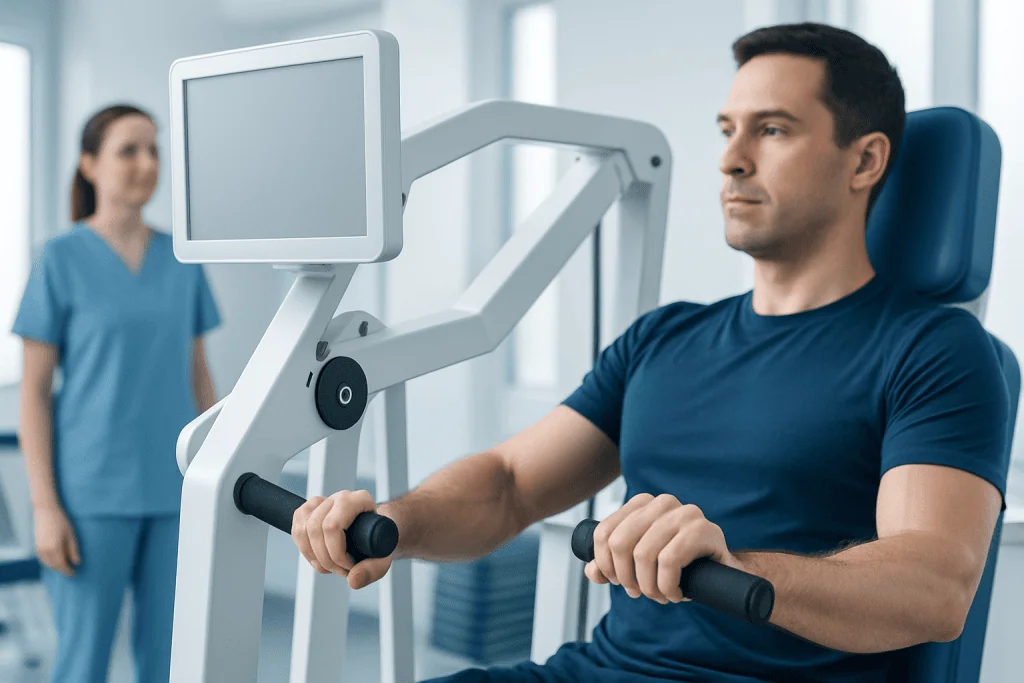
The main muscles involved in push day exercises are the pectoral muscles of the chest, the deltoid muscles of the shoulder, and the triceps. These muscles work together in pressing movements used in daily life, such as pushing up from a chair, opening a heavy door, placing an object on a shelf, or bracing during a fall.
Different push exercises emphasize different tissues. Horizontal pressing, such as a bench press or push-up, tends to place more demand on the chest and triceps. Vertical pressing, such as an overhead press, usually increases demand on the shoulders and upper back stabilizers. Accessory movements can then target specific areas, such as triceps pushdowns or lateral raises, to complement larger compound lifts.
Balanced programming matters because the shoulder is a mobile joint that depends heavily on muscle coordination. If a person performs high volumes of pushing without enough pulling, shoulder-blade control work, or rest, discomfort may develop over time. This is one reason some people with shoulder pain are evaluated for problems such as rotator cuff injury or related overuse conditions when symptoms persist.
Medical evidence versus common myths

Several common beliefs about push day exercises are not well supported by evidence. One myth is that a workout must cause pain to be effective. In reality, strength improvements come from progressive overload, meaning the body gradually adapts to an appropriate challenge. Mild muscle fatigue is expected, but sharp pain, joint pinching, numbness, or chest pressure are warning signs, not proof of a good session.
Another myth is that more exercises and more sets are always better. Research in resistance training shows that muscle and strength gains can occur across a range of training volumes, especially when a person uses good technique and enough effort. Very high volume may increase fatigue and reduce movement quality, particularly in beginners or people with limited recovery.
A third myth is that every person needs the same classic lifts. Some people tolerate barbell bench press well, while others do better with dumbbells, machines, or push-ups because these options allow a more comfortable range of motion or grip. A history of shoulder, wrist, or spine symptoms may justify modifying exercise choice. Technique coaching, gradual loading, and professional assessment are often more important than forcing a specific exercise variation.
How to build a safer and more effective push day
A sensible push day usually combines one or two compound pressing exercises with a small number of accessory movements. For many adults, this may include a horizontal press, a vertical press if tolerated, and one or two assistance exercises for the triceps or shoulders. The exact selection depends on training age, mobility, previous injury, and goals such as strength, general fitness, or muscle development.
Warm-up is helpful when it is specific rather than overly long. A few minutes of light whole-body activity followed by low-load practice sets and shoulder-blade control drills is often enough. During the session, the person should use a load that allows steady, controlled repetitions without losing shoulder position, flaring the elbows excessively, or arching the low back to compensate.
Recovery is part of the program, not an extra. Muscles and tendons need time to adapt, especially after harder sessions. Sleep, adequate dietary protein, hydration, and rest days all support training response. If ongoing shoulder pain, recurrent instability, or mechanical symptoms such as catching are present, evaluation may be needed, and in selected cases specialists may discuss options ranging from rehabilitation to shoulder arthroscopy.
- Choose exercises that can be performed with control and without pain.
- Increase weight, repetitions, or sets gradually rather than all at once.
- Include pulling and upper-back work elsewhere in the week for balance.
- Stop if technique breaks down repeatedly from fatigue.
Signs of poor form, overuse, and possible injury
Many exercise-related problems develop gradually. Early signs include shoulder soreness that lasts beyond normal muscle fatigue, pain at the front of the shoulder during pressing, elbow irritation with triceps work, wrist pain in push-ups, or neck tension that worsens through the session. These symptoms may reflect technique errors, excessive load, limited mobility, poor recovery, or an exercise choice that does not suit the person.
More concerning signs include sudden popping with pain, weakness after an acute strain, visible swelling, loss of motion, pain that wakes the person at night, or tingling and numbness into the arm or hand. These findings can occur with tendon, muscle, or joint injuries and should not be ignored. Persistent symptoms may require assessment for soft-tissue injury, joint irritation, or cervical spine-related causes.
It can also be difficult to separate exercise discomfort from symptoms coming from another part of the body. For example, chest pressure, unusual shortness of breath, dizziness, or pain spreading to the jaw or left arm should never be assumed to be simple post-workout soreness. Those symptoms need prompt medical evaluation because they may reflect a cardiovascular problem rather than a training issue.
Who should modify push day exercises
Push day exercises can be adapted for many people, but some groups benefit from more caution. Beginners often need a simpler program, lighter loads, and clear coaching on posture, shoulder position, and range of motion. Older adults may still train effectively, but they may need closer attention to balance, bone health, tendon tolerance, and recovery between sessions.
People with known joint disease, previous surgery, or chronic pain should not assume that a standard gym routine is appropriate. Shoulder impingement symptoms, arthritis, prior dislocation, tendon tears, or neck-related arm pain may require exercise selection changes or supervised rehabilitation. Depending on symptoms, clinicians may recommend imaging, physical therapy, or treatments focused on the shoulder and upper limb, such as physical therapy and rehabilitation.
Individuals with cardiovascular disease, uncontrolled high blood pressure, or recent chest symptoms should also be careful with heavy lifting, breath-holding, and straining. In some cases, a doctor may advise medical assessment before starting or advancing resistance training. If a person has ongoing chest complaints or reduced exercise tolerance, evaluation for coronary artery disease or other heart conditions may be appropriate.
When to seek medical care
Medical advice is appropriate if pain from push day exercises is severe, keeps returning, or does not improve after rest and technique adjustment. A doctor or physical therapist can help determine whether symptoms are due to training error, muscle strain, tendon irritation, joint dysfunction, or another cause. Early assessment may prevent a minor issue from becoming a longer-lasting problem.
Urgent medical care is needed for chest pain or pressure, fainting, marked shortness of breath, sudden one-sided weakness, severe swelling after injury, or loss of arm function. These are not routine workout effects. They should be treated as potentially serious symptoms until a healthcare professional says otherwise.
People who need specialist support may benefit from a multidisciplinary evaluation that includes sports medicine, orthopedics, cardiology, or rehabilitation as needed. Acibadem International’s multidisciplinary specialists and JCI-accredited hospitals diagnose and treat musculoskeletal and exercise-related conditions for international patients, including assessment with MRI when clinically indicated.
Frequently asked questions
What are push day exercises?
Push day exercises are strength-training movements that mainly work the chest, shoulders, and triceps. They include exercises such as push-ups, bench press, chest press, overhead press, dips, and triceps-focused movements.
How often should a person do push day exercises?
The right frequency depends on training experience, goals, and recovery. Many people do well training these muscle groups one to two times per week, with at least some recovery time between harder sessions.
Is soreness necessary after a push day workout?
No. Soreness can happen, especially with a new program, but it is not required for progress. Strength and muscle gains come from consistent training, appropriate effort, and recovery rather than from chasing soreness.
Are push day exercises safe for people with shoulder pain?
They may be safe only if the cause of pain is understood and exercises are adjusted. A person with ongoing shoulder pain should avoid painful movements and consider assessment by a qualified clinician or physical therapist.
What is the difference between normal exercise discomfort and injury pain?
Normal exercise discomfort is usually a feeling of muscle effort or fatigue that settles after the workout. Injury pain is more likely to be sharp, catching, unstable, associated with weakness or swelling, or severe enough to change how the movement is performed.
Can beginners do push day exercises?
Yes, but beginners usually benefit from simpler versions and lighter loads. Learning proper form, using controlled movement, and progressing gradually are more important than lifting heavy early on.
References
- World Health Organization
- American College of Sports Medicine
- National Institute of Arthritis and Musculoskeletal and Skin Diseases
- Centers for Disease Control and Prevention
- National Heart, Lung, and Blood Institute
This article is for general information only and is not a substitute for professional medical advice. Please consult a qualified doctor about your individual situation.
Joint and spine care in Turkey — expert assessment & treatment
JCI-accredited · board-certified surgeons · reply within 24h
Add us as a Preferred Source to see more of our trusted health content across Google Search, AI Overviews and Discover.