Understanding Dermatofibroma: A Complete Patient Guide

Dermatofibroma is usually a harmless, non-cancerous skin nodule. It often feels firm, may be brown, pink, or skin-colored, and can show a "dimple sign" when pinched.
Key Takeaways
- Dermatofibroma is usually a harmless, non-cancerous skin nodule.
- It often feels firm, may be brown, pink, or skin-colored, and can show a "dimple sign" when pinched.
- Many dermatofibromas do not need treatment unless they are bothersome, painful, or cosmetically unwanted.
- A dermatologist may diagnose it by examination and sometimes a skin biopsy.
- Any rapidly changing, bleeding, irregular, or newly concerning skin lesion should be checked by a doctor.
Dermatofibroma is a common benign skin growth that usually appears as a small, firm bump, often on the legs or arms. It is not dangerous in most cases, but it can resemble other skin lesions, so medical assessment may be helpful when the diagnosis is uncertain or the spot changes.
Overview
Dermatofibroma is a small, benign growth that develops in the skin, most often on the legs, arms, or upper body. It is made up of fibrous tissue and skin cells and usually feels firmer than the surrounding skin. In many people, it is found by chance and causes little more than a noticeable bump.
Although dermatofibroma is not usually a serious condition, it can look similar to other skin lesions. That is why the main issue is often not the growth itself, but making sure the diagnosis is correct. A doctor, especially a dermatologist, can usually recognize it during a skin examination and decide whether further testing is needed.
These lesions tend to remain stable over time, though they may slowly change in color or size. Some stay the same for years. Others may become more noticeable after shaving, friction from clothing, or repeated touching.
Because people often worry that any new skin bump could be cancer, reassurance is an important part of care. Most dermatofibromas are harmless. Still, any lesion with unusual features may need closer evaluation to distinguish it from other conditions, including skin cancer.
What a Dermatofibroma Looks and Feels Like
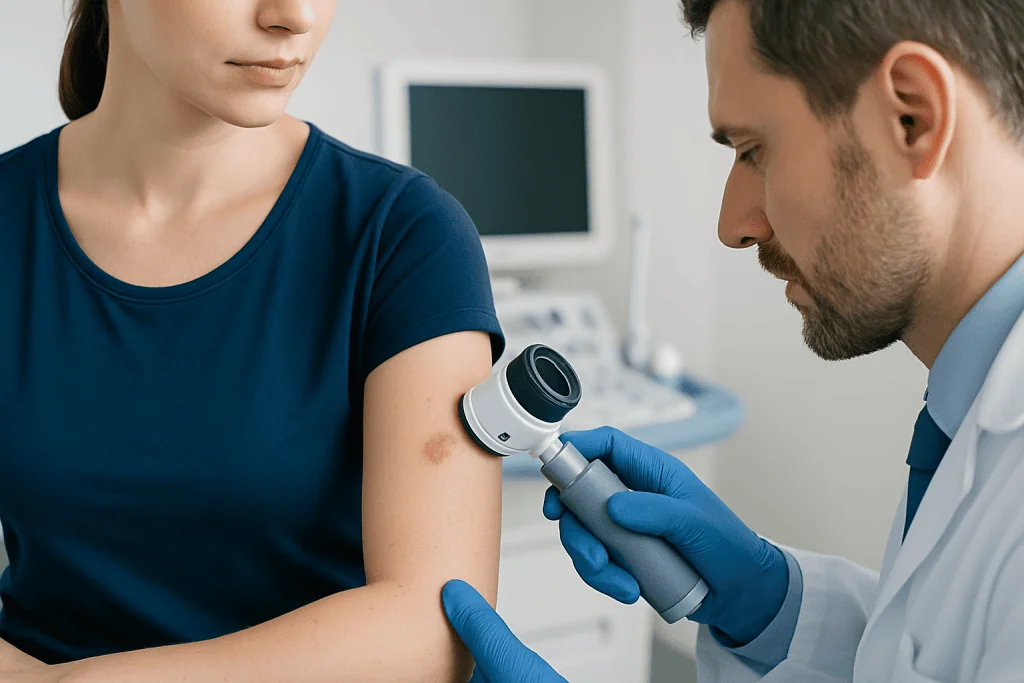
A dermatofibroma is typically a round or oval bump that measures a few millimeters to about a centimeter across, though some may be larger. It may be brown, reddish-brown, pink, tan, or close to the person’s natural skin tone. In darker skin tones, it may appear deeper brown or almost black.
One classic feature is firmness. Unlike a soft cyst or fatty lump, dermatofibroma often feels dense and fixed within the skin. When the area is gently pinched from the sides, the center may pull inward, creating a slight depression. This is sometimes called the dimple sign and can help support the diagnosis.
Most dermatofibromas are painless, but some can itch, feel tender, or become irritated, especially if they are located where clothing rubs or shaving occurs. A person may notice occasional sensitivity rather than constant discomfort.
- Usually small and firm
- Often found on the legs, especially the lower legs
- May be solitary, but some people have more than one
- Can remain for many years without causing health problems
Causes and Risk Factors

The exact cause of dermatofibroma is not always clear. In some cases, it seems to develop after minor skin injury, such as an insect bite, ingrown hair, splinter, or small cut. This has led experts to think that it may represent a localized overreaction of fibrous tissue as the skin heals.
Dermatofibromas can occur in adults of many ages, but they are most often recognized in young to middle-aged adults. They are seen more often in women than in men. People with multiple lesions may occasionally have an underlying factor affecting the immune system, though this is not the case for most patients.
There is usually nothing a person did wrong to cause a dermatofibroma. It is not considered contagious, and it does not spread from one person to another. It is also not the same as acne, a wart, or a bacterial infection.
Because many skin growths can look similar, a correct diagnosis matters. Benign conditions such as a skin cyst or other fibrous nodules may be considered, but so may less common lesions that require a different approach.
How Dermatofibroma Is Diagnosed
Diagnosis usually starts with a clinical examination. A doctor asks how long the lesion has been present, whether it has changed, and whether it causes symptoms like itching, bleeding, or pain. The appearance, color, borders, and texture all help guide the assessment.
Dermatologists may also use dermoscopy, a handheld device that magnifies the skin and helps reveal patterns not visible to the naked eye. This can improve confidence in diagnosing common benign lesions and deciding whether a biopsy is necessary.
If the spot has unusual features, grows quickly, repeatedly bleeds, becomes ulcerated, or does not look typical for dermatofibroma, a skin biopsy may be recommended. A biopsy involves removing part or all of the lesion so it can be examined under a microscope. This is the most reliable way to confirm the diagnosis.
When a doctor wants a very detailed view of a lesion before treatment planning, dermoscopy evaluation may be used as part of the skin assessment. In uncertain cases, a biopsy is especially important to rule out other conditions, including melanoma or uncommon soft tissue tumors.
Treatment Options
Many dermatofibromas do not require treatment. If the lesion is clearly benign, not changing, and not causing symptoms, simple observation is often enough. Some people choose to leave it alone once they understand that it is harmless.
Treatment may be considered if the dermatofibroma is painful, repeatedly irritated, cosmetically bothersome, or difficult to distinguish from another lesion. The most definitive option is complete surgical removal, which removes the lesion for both treatment and laboratory confirmation when needed. A doctor may discuss skin lesion removal if the bump is bothersome or uncertain in diagnosis.
It is important to know that removal may leave a scar, and in some cases the scar can be more noticeable than the original lesion. Because dermatofibromas often extend deeper into the skin than they appear on the surface, superficial treatments may not completely remove them. For selected lesions, skin biopsy may serve both diagnostic and therapeutic purposes.
People should avoid trying to cut, squeeze, or burn off a dermatofibroma at home. Home removal can lead to bleeding, infection, scarring, and incomplete treatment. A qualified clinician can explain the benefits and limits of each approach and help decide whether treatment is worthwhile.
Living With Dermatofibroma and Self-care
For most people, self-care is mainly about protecting the area and monitoring it over time. A dermatofibroma can become irritated by shaving, scratching, tight clothing, or friction from sports equipment. Reducing repeated trauma may help limit tenderness or inflammation.
Skin awareness is useful, but constant checking is usually not necessary. It can help to note the lesion’s size, color, and location or even take a photograph for future comparison. If it remains stable, there is often no need for active treatment.
General skin health measures are also sensible. These include using sun protection, avoiding unnecessary picking of skin lesions, and seeking medical advice for any new or unusual spot. People with several lesions or a complex skin history may benefit from periodic dermatology follow-up.
Near the end of evaluation and care, some patients may choose specialist review for confirmation or removal. Acibadem International’s multidisciplinary specialists and JCI-accredited hospitals diagnose and treat skin conditions, including lesions that need expert dermatologic assessment for international patients.
When to Seek Medical Care
A person should seek medical care if a suspected dermatofibroma is new and the diagnosis is uncertain, or if the lesion changes in a noticeable way. Changes that deserve attention include rapid growth, irregular shape, color variation, ulceration, bleeding, or persistent pain.
Medical review is also important when a lesion catches on clothing, becomes frequently inflamed, or causes concern because of its appearance. Even benign growths can affect comfort and quality of life, and a doctor can discuss safe treatment options.
It is especially wise to arrange an appointment if there is a personal or family history of skin cancer, or if the lesion does not fit the usual picture of a stable, firm, small bump. If needed, a dermatologist can recommend further examination or tissue testing to confirm what it is.
Prompt evaluation does not mean something serious is likely. It simply helps ensure that a harmless dermatofibroma is not being confused with another condition that requires different care.
Frequently asked questions
Is dermatofibroma cancerous?
Dermatofibroma is usually a benign, non-cancerous skin growth. It does not behave like skin cancer in most cases, but some lesions can look similar to other conditions, so a doctor may recommend evaluation if the appearance is not typical.
Can a dermatofibroma go away on its own?
A dermatofibroma usually does not disappear completely on its own. It often stays stable for years, though it may become less noticeable or change slightly in color over time.
Why does a dermatofibroma hurt or itch sometimes?
Some dermatofibromas become tender or itchy because they are irritated by friction, shaving, scratching, or pressure. Mild symptoms are not unusual, but persistent pain or a new change should be discussed with a doctor.
Should a dermatofibroma be removed?
Removal is not always necessary. It may be considered if the lesion is painful, repeatedly irritated, cosmetically unwanted, or if the diagnosis is uncertain and tissue confirmation is needed.
Can dermatofibroma come back after removal?
It can recur in some cases, especially if the lesion is not fully removed. A doctor can explain the chance of recurrence and whether complete excision is the most appropriate option.
How is dermatofibroma different from a mole?
A dermatofibroma is usually firmer and deeper in the skin than a typical mole. It may also show a dimple when pinched, while moles more often have a smoother or softer surface appearance.
When should someone worry about a skin bump that looks like dermatofibroma?
A skin bump should be checked if it grows quickly, bleeds, develops irregular borders, changes color, or becomes ulcerated. It is also sensible to seek medical advice if the diagnosis is unclear or if there is a history of skin cancer.
References
- American Academy of Dermatology
- National Health Service
- DermNet
- Mayo Clinic
- MedlinePlus
This article is for general information only and is not a substitute for professional medical advice. Please consult a qualified doctor about your individual situation.
Explore treatments in Turkey — costs, top hospitals & a free quote
JCI-accredited · board-certified surgeons · reply within 24h
Add us as a Preferred Source to see more of our trusted health content across Google Search, AI Overviews and Discover.