Salicylic Acid for Feet Warts — Explained by Medical Evidence, Not Myths

Salicylic acid is a common first-line treatment for plantar warts and has good clinical evidence behind it. It works gradually, so daily or regular use for weeks is usually needed.
Key Takeaways
- Salicylic acid is a common first-line treatment for plantar warts and has good clinical evidence behind it.
- It works gradually, so daily or regular use for weeks is usually needed.
- Results improve when thick dead skin is gently reduced before each application.
- Not every bump on the foot is a wart, so persistent or painful lesions should be checked by a clinician.
- People with diabetes, poor circulation, or reduced sensation should seek medical advice before self-treating foot lesions.
Salicylic acid for feet warts is one of the most evidence-based, widely recommended first treatments for plantar warts. It works by gradually softening and removing thickened skin, but it usually requires careful, regular use over several weeks for the best results.
Overview: What salicylic acid does for feet warts
Salicylic acid for feet warts is a medically established treatment, not a myth or internet shortcut. It is commonly recommended for plantar warts, which are warts that develop on the soles of the feet because of infection with certain types of human papillomavirus (HPV). Rather than “killing” the wart instantly, salicylic acid gradually breaks down the thickened outer skin and helps remove infected tissue over time.
This slow, layer-by-layer approach is why treatment often takes patience. Many people expect a wart remover to work in a few days, but plantar warts are often pushed inward by body weight and covered by hard skin. Because of this, they can be stubborn, and consistent use matters more than occasional treatment.
Medical evidence supports salicylic acid as a reasonable first step for many uncomplicated foot warts. It is available in different forms, such as liquids, gels, pads, and plasters. A clinician may also discuss other options if the wart is very painful, uncertain in diagnosis, widespread, or not improving with self-care.
Recognizing plantar warts and how they differ from other foot problems
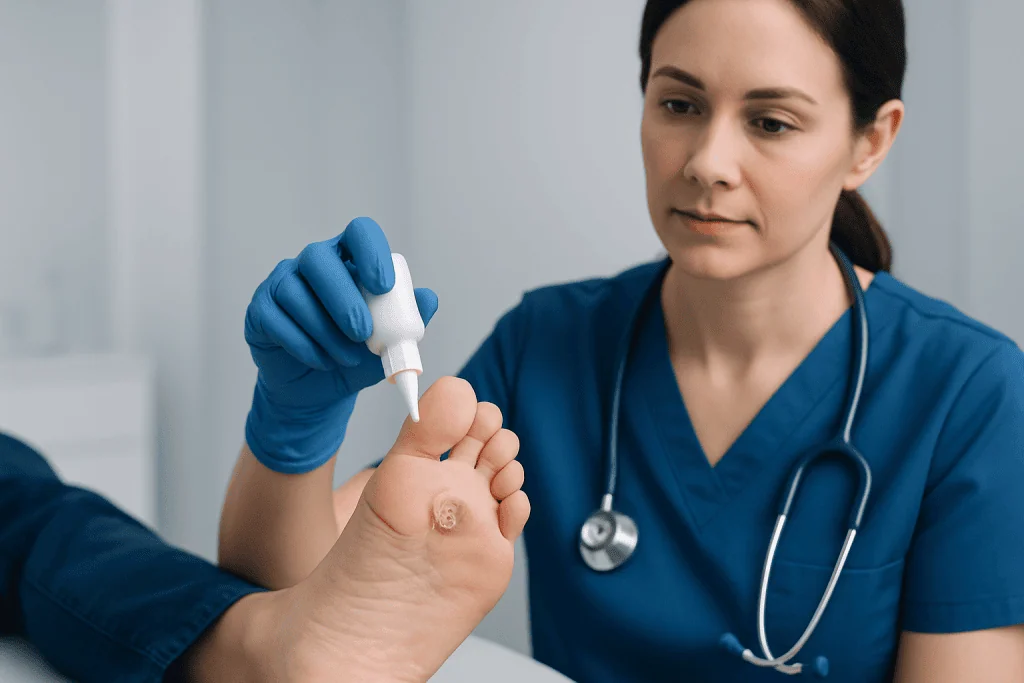
Feet warts, also called plantar warts, often appear as rough, grainy areas on the sole or heel. They may interrupt the normal skin lines of the foot and can contain tiny dark dots, which are small clotted blood vessels rather than “seeds.” Some are flat because pressure from walking pushes them inward, and this can make them more uncomfortable than warts in other body areas.
Symptoms vary. Some people notice only a small rough patch, while others feel tenderness when standing or walking. A plantar wart may hurt more when squeezed from the sides or when direct pressure is applied over a weight-bearing area. Thick callus can build up on top, making it harder to see the underlying lesion.
Not every bump on the foot is a wart. Corns, calluses, foreign-body reactions, cysts, and certain skin conditions can look similar. In some cases, a lesion that seems like a wart may need specialist evaluation, especially if it changes quickly, bleeds easily, or does not respond as expected. For readers wanting background on wart causes and diagnosis more generally, warts may be helpful.
- Common signs include rough texture, interrupted skin lines, and tenderness with pressure.
- Warts may occur alone or in clusters, sometimes called mosaic warts.
- Hard skin on top can hide the wart and make treatment slower.
How salicylic acid works, and what the evidence shows

Salicylic acid is a keratolytic medicine, meaning it helps dissolve and shed the outer layers of thickened skin. On a plantar wart, this action slowly removes the built-up dead skin that protects the wart and may also stimulate a local immune response as the tissue is peeled away. The result is usually gradual shrinking rather than immediate disappearance.
Clinical guidance generally considers salicylic acid a first-line treatment for common and plantar warts because it is accessible, noninvasive, and supported by evidence. Research has shown that salicylic acid can improve clearance rates compared with no treatment, although success depends heavily on correct use and enough time. It is not unusual for treatment to continue for several weeks or even longer before the wart fully resolves.
This evidence-based approach differs from many popular myths. Salicylic acid does not remove every wart overnight, and stronger is not always better if it causes significant irritation. It also does not guarantee a cure, since wart behavior depends on depth, location, immune response, and whether the diagnosis is truly a wart. If self-treatment fails, doctors may consider options such as cryotherapy or other office-based procedures.
How to use salicylic acid safely and effectively
For many patients, the best results come from a routine rather than a single application. Before applying salicylic acid, the foot is often soaked in warm water for several minutes to soften the thick skin. After drying the area, the loose surface layer can be gently reduced with an emery board, pumice stone, or similar tool used only for that wart. This step helps the medicine reach the affected tissue more effectively.
The product should then be applied exactly as directed on the packaging or by a clinician. Healthy surrounding skin should be protected when possible, because salicylic acid can also irritate normal skin. Covering the treated wart as instructed may improve contact time, depending on the product type.
Consistency is essential. Treatment is often repeated daily or on the schedule recommended for that formulation, with periodic gentle removal of dead skin. It is important not to cut, dig, or aggressively scrape the wart, since this can cause pain, bleeding, infection, or spread of the virus. If there is uncertainty about technique, a dermatologist or podiatry-focused clinician can advise. Some patients may ultimately need dermatology evaluation if the lesion is persistent or atypical.
- Soften the skin first if advised.
- Gently remove loose dead skin, without causing injury.
- Apply only to the wart unless the instructions say otherwise.
- Use regularly for the full recommended period.
Who should be cautious with self-treatment
Salicylic acid is not right for every person or every foot lesion. Individuals with diabetes, poor circulation, peripheral neuropathy, or reduced sensation in the feet should be especially careful. In these situations, self-treatment may increase the risk of skin injury or delayed healing, and medical assessment is usually safer before starting any acid-based remover.
Children, older adults, pregnant patients, and people with fragile or inflamed skin may also benefit from individualized advice. Even when over-the-counter treatment is available, that does not always mean it is the best option for a specific patient. A clinician can help confirm the diagnosis and choose the safest method.
It is also wise to pause self-treatment if the area becomes very red, swollen, increasingly painful, or shows signs of infection. These concerns do not necessarily mean something serious is happening, but they do mean the treatment plan should be reviewed. If another condition is suspected, more targeted care may be needed through skin specialist care.
Other treatment options if salicylic acid is not enough
Some plantar warts do not clear with salicylic acid alone. Reasons include deep location, heavy callus, ongoing friction, an inaccurate diagnosis, or a weaker local immune response. When that happens, a doctor may recommend another treatment or a combination approach rather than simply continuing the same treatment indefinitely.
Office-based options can include freezing the wart with cryotherapy, carefully paring thick skin, prescription topical treatments, or other methods chosen by a dermatologist. The best choice depends on factors such as pain level, wart size and number, age, overall health, and how long the lesion has been present.
Some people are tempted by home remedies promoted online, including household chemicals or aggressive scraping. These methods may irritate healthy skin without improving wart clearance and are not supported in the same way as standard medical treatment. A neutral, evidence-based approach is to use proven methods first and seek professional review if progress is limited.
Prevention, self-care, and when to seek medical care
Plantar warts are caused by HPV entering skin through tiny breaks, often in moist communal areas such as locker rooms and pool surrounds. Wearing footwear in shared wet areas, keeping feet clean and dry, and avoiding picking at warts may reduce spread. It also helps not to share nail tools, pumice stones, socks, or shoes used on an affected foot.
At home, it is sensible to avoid shaving or scraping the area aggressively and to wash hands after touching the wart. If there is pain from pressure, cushioning around the lesion may make walking more comfortable while treatment continues. Many warts eventually improve, but resolution can be slow even with proper care.
Medical care should be sought if the diagnosis is uncertain, the lesion is very painful, repeatedly bleeds, spreads quickly, or does not improve after a reasonable course of treatment. Professional assessment is also important for anyone with diabetes, poor circulation, immune suppression, or reduced feeling in the feet. Acibadem International’s multidisciplinary specialists in JCI-accredited hospitals diagnose and treat skin and foot lesions for international patients when further evaluation is needed.
Frequently asked questions
Is salicylic acid really effective for plantar warts?
Yes. Salicylic acid is one of the best-supported first treatments for plantar warts and is commonly recommended in clinical practice. It works gradually, so improvement often depends on correct and regular use over several weeks.
How long does salicylic acid take to remove a foot wart?
It usually does not work immediately. Many plantar warts need several weeks of regular treatment, and some may take longer depending on thickness, depth, and location.
Why does the wart sometimes look white or peel after treatment?
This often happens because salicylic acid softens and breaks down thick dead skin. Some whitening or peeling can be expected, but significant pain, swelling, or damage to surrounding skin should prompt a pause and medical advice.
Can salicylic acid make a wart spread?
The medicine itself does not usually spread the wart. However, picking, cutting, or sharing tools used on the wart can spread HPV to nearby skin or to other people.
Should salicylic acid be used on every bump on the foot?
No. Not all foot lesions are warts, and treating the wrong condition can delay proper care. If the diagnosis is uncertain or the lesion is unusual, a clinician should examine it before treatment continues.
Who should avoid self-treating foot warts with salicylic acid?
People with diabetes, poor circulation, reduced sensation, or fragile skin should be cautious and usually seek medical guidance first. These conditions can increase the risk of skin injury or poor healing on the feet.
This article is for general information only and is not a substitute for professional medical advice. Please consult a qualified doctor about your individual situation.
Explore treatments in Turkey — costs, top hospitals & a free quote
JCI-accredited · board-certified surgeons · reply within 24h
Add us as a Preferred Source to see more of our trusted health content across Google Search, AI Overviews and Discover.

More from the Health Library

Urine Smells Like Sulfur — Explained by Medical Evidence, Not Myths

Description of Borderline Personality — Explained by Medical Evidence, Not Myths

Aloe Vera Gel Burning: What Patients Need to Know

Lower Blood Sugar Fast: A Complete Medical Overview

Diabetic coma: Symptoms, Causes, and Treatment — Complete Patient Guide