Pyoderma Gangrenosum: What Patients Need to Know

Pyoderma gangrenosum is an inflammatory skin disease, not a contagious infection. It often begins as a small bump, pustule, or tender area that breaks down into a painful ulcer.
Key Takeaways
- Pyoderma gangrenosum is an inflammatory skin disease, not a contagious infection.
- It often begins as a small bump, pustule, or tender area that breaks down into a painful ulcer.
- Diagnosis is based on medical history, skin examination, and ruling out other causes of ulcers.
- Treatment usually focuses on calming inflammation, protecting the wound, and treating any related health condition.
- Early medical care may help limit tissue damage, pain, and delayed healing.
Pyoderma gangrenosum is a rare inflammatory skin condition that usually causes painful sores or ulcers, most often on the legs. It is not an infection, but it can worsen quickly and usually needs specialist assessment to confirm the diagnosis and guide treatment.
Overview
Pyoderma gangrenosum is a rare condition in which the immune system causes inflammation in the skin, leading to painful ulcers. Although the name may sound like an infection, it is usually not caused by bacteria and cannot be passed from one person to another. The condition needs medical attention because it can resemble an infected wound, vascular ulcer, or other serious skin problem.
The sores most often appear on the legs, especially the shins, but they can also develop on the arms, abdomen, around surgical sites, or near stomas. In some people, a minor injury such as a cut, needle puncture, or surgery can trigger a lesion. This tendency is called pathergy and is one reason careful handling of the skin is important.
Pyoderma gangrenosum may occur on its own, but it is also linked with some underlying inflammatory diseases. These include inflammatory bowel disease, certain forms of arthritis, and some blood disorders. Because the condition can vary widely from person to person, treatment is tailored to the location, size, severity, and associated medical history.
How it can look and feel

Pyoderma gangrenosum often starts as a tender bump, pustule, blister, or reddish-purple area of skin. Over a short time, the area may break down and form an open ulcer with a raw base. The borders are often irregular and may look undermined or violet-colored.
Pain is a common feature and can be significant, sometimes more severe than the size of the sore would suggest. The skin around the ulcer may be swollen, warm, or discolored. Some people also notice fatigue, low-grade fever, or a general feeling of being unwell, especially when the inflammation is active.
There are several clinical forms. The classic ulcerative type causes deeper painful ulcers, while other forms may appear as superficial blisters or clusters of pustules. Because appearance alone is not enough to confirm the diagnosis, a specialist usually considers pyoderma gangrenosum alongside other conditions such as vasculitis or difficult-to-heal skin ulcers.
- Painful rapidly enlarging sore
- Purple or bluish edge around the ulcer
- Drainage or crusting from the wound surface
- Skin breakdown after minor trauma
- Slow healing without the right treatment
Causes and risk factors
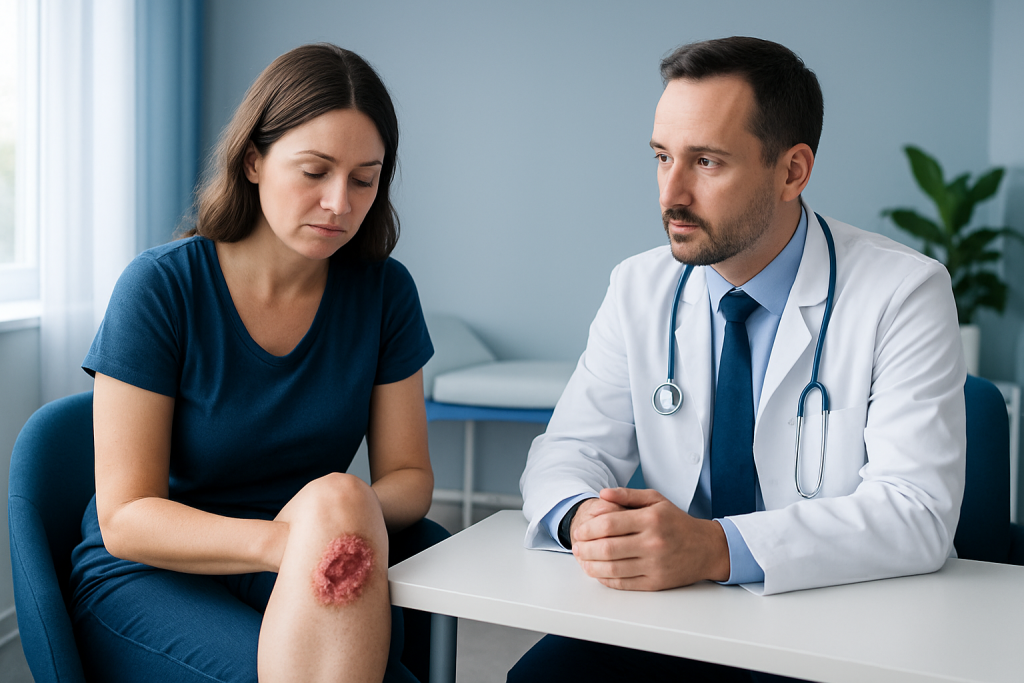
The exact cause of pyoderma gangrenosum is not fully understood, but it is considered an immune-mediated inflammatory disorder. In simple terms, the body’s inflammatory response becomes overactive in the skin. This causes tissue damage and ulcer formation even when there is no true infection.
Many people with pyoderma gangrenosum have another health condition that may be linked to abnormal immune activity. Common associations include inflammatory bowel disease such as ulcerative colitis or Crohn’s disease, inflammatory arthritis, and some blood-related conditions. In other cases, no associated disease is found.
Risk may also be influenced by skin injury. A small trauma, biopsy, or operation can sometimes trigger a new lesion or worsen an existing one. For this reason, invasive procedures are approached carefully when pyoderma gangrenosum is suspected. Doctors also think about other causes of ulcers, including circulation problems, infection, diabetes-related wounds, and certain autoimmune disorders, before making the diagnosis.
How doctors diagnose pyoderma gangrenosum
There is no single test that proves pyoderma gangrenosum. Diagnosis usually depends on a detailed history, a close skin examination, and tests to exclude other causes of ulcers. This step is important because treatment for pyoderma gangrenosum is very different from treatment for an infected wound or poor circulation.
A doctor may ask when the sore started, how quickly it changed, whether there was any injury beforehand, and whether there are bowel symptoms, joint pain, or a history of autoimmune disease. Blood tests may be used to look for signs of inflammation, anemia, or associated disease. Wound cultures can help identify whether a secondary infection is present, even though infection is not usually the root cause.
A skin biopsy is sometimes recommended. A biopsy cannot always confirm pyoderma gangrenosum on its own, but it can help rule out cancer, vasculitis, and infection. In selected cases, imaging or vascular assessment may be needed if blood flow problems are also being considered. Evaluation may involve dermatology, rheumatology, gastroenterology, wound care, or dermatology care depending on the person’s symptoms.
Treatment options
Treatment aims to reduce inflammation, relieve pain, support wound healing, and manage any related illness. For smaller or more limited lesions, doctors may use topical or injected anti-inflammatory medicines. These can help calm the skin and reduce progression without exposing the whole body to stronger medication.
When ulcers are larger, deeper, multiple, or rapidly worsening, systemic treatment is often needed. This may include corticosteroids or other immune-modulating medicines chosen by a specialist. The exact plan depends on the severity of the ulcers, the person’s overall health, and whether there is an associated condition such as inflammatory bowel disease. If there is concern about a related digestive disorder, assessment through gastroenterology evaluation may be part of care.
Wound care is also a key part of treatment. Dressings are selected to protect the area, manage drainage, and reduce irritation. Pain control and gentle handling are important because trauma can worsen lesions. Surgical debridement is not routine and may aggravate pyoderma gangrenosum in some people, so any procedure should be planned carefully. If the appearance overlaps with another inflammatory skin disease such as psoriasis, specialist review helps guide the safest treatment path.
In complex cases, care may involve more than one specialty. A coordinated plan can be helpful when ulcers are extensive, when there is diagnostic uncertainty, or when an underlying inflammatory disorder needs treatment at the same time.
Daily care, prevention, and living with the condition
Because the exact cause is not preventable in a simple way, prevention focuses on reducing triggers and supporting healing. People who have had pyoderma gangrenosum before may be advised to protect the skin from unnecessary trauma, friction, or scratching. Even small injuries can matter in some cases.
Home care should follow the doctor’s wound-care plan. Dressings should be changed as instructed, and the ulcer should not be treated with harsh cleansers or home remedies unless a clinician recommends them. Rest, elevation of the affected leg when appropriate, and attention to pain control may improve comfort.
It is also important to manage any related health condition. Keeping inflammatory bowel disease, arthritis, or blood disorders well controlled may help reduce flares. Follow-up appointments matter because treatment often needs adjustment over time. For international patients who need multidisciplinary assessment, Acibadem International’s JCI-accredited hospitals provide diagnosis and treatment through coordinated specialist teams, including wound care support when needed.
When to seek medical care
Medical review is important for any painful skin ulcer that develops quickly, especially if it has a purple edge, is enlarging, or is not improving. Early assessment may help avoid unnecessary procedures and may shorten the time to the right treatment. A person should not assume the problem is only a simple skin infection, even if the wound looks inflamed.
Urgent care is needed if there is rapidly increasing pain, spreading redness, fever, heavy bleeding, a bad odor, or signs that the person is becoming generally unwell. These symptoms can suggest a secondary infection or another serious condition that needs prompt attention.
People should also seek medical advice if they have recurrent ulcers, slow-healing wounds, bowel symptoms, joint swelling, or new sores after surgery or minor injury. A dermatologist or another qualified doctor can assess whether pyoderma gangrenosum or a different cause is more likely and recommend the next steps safely.
Frequently asked questions
Is pyoderma gangrenosum an infection?
Usually, no. Pyoderma gangrenosum is generally an inflammatory immune-related skin disease rather than a contagious bacterial infection. However, open ulcers can sometimes develop a secondary infection, which is why medical assessment is important.
What does pyoderma gangrenosum usually look like?
It often begins as a tender bump, pustule, blister, or red-purple patch that breaks down into a painful ulcer. The sore may enlarge quickly and often has an irregular, violaceous border. The legs are the most common site, but other areas can be affected.
Can pyoderma gangrenosum be cured?
Many people improve with treatment, but the condition can be chronic or recur. The goal is to control inflammation, help the ulcer heal, and manage any underlying disease. Follow-up care is often needed because treatment may need to be adjusted over time.
Why is pyoderma gangrenosum sometimes hard to diagnose?
It can look similar to infected wounds, vascular ulcers, vasculitis, skin cancer, or other inflammatory skin disorders. There is also no single test that confirms it in every case. Doctors usually diagnose it by combining the clinical picture with tests that rule out other causes.
Should pyoderma gangrenosum ulcers be surgically cleaned out?
Not always. In some patients, trauma from aggressive debridement or surgery can worsen the lesion because of pathergy. Decisions about procedures should be made carefully by clinicians familiar with the condition.
Is pyoderma gangrenosum linked to other diseases?
Yes, it can be associated with inflammatory bowel disease, inflammatory arthritis, and some blood disorders. Still, some people develop pyoderma gangrenosum without any known related illness. Doctors may recommend further evaluation if symptoms suggest an underlying condition.
References
- American Academy of Dermatology
- National Organization for Rare Disorders
- British Association of Dermatologists
- DermNet
- Mayo Clinic
This article is for general information only and is not a substitute for professional medical advice. Please consult a qualified doctor about your individual situation.
Persistent digestive symptoms? Get evaluated in Turkey
JCI-accredited · board-certified surgeons · reply within 24h
Add us as a Preferred Source to see more of our trusted health content across Google Search, AI Overviews and Discover.

More from the Health Library

Patent Ductus Arteriosus: An Evidence-Based Guide for Patients

Biting of Lips: A Complete Medical Overview

Holosystolic Murmur: What Patients Need to Know

Pectoralis Minor Muscle — Explained by Medical Evidence, Not Myths

Omeprazole: What Patients Need to Know