Quick answer
Pyoderma gangrenosum is a rare inflammatory skin disease that causes painful ulcers, usually due to an abnormal immune response rather than an infection. Treatment focuses on controlling inflammation, protecting the wounds, and managing any related underlying condition, typically with coordinated care from dermatology, wound care, and other specialists when needed.
What is pyoderma gangrenosum?
Pyoderma gangrenosum is a rare inflammatory skin condition that causes painful sores, called ulcers, to develop on the skin. Despite its name, it is not an infection and it is not related to gangrene (the death of body tissue caused by a loss of blood supply or a severe infection). The name is historical and can be misleading. Pyoderma gangrenosum is classified under the medical code ICD-10 L88, and it belongs to a group of conditions known as neutrophilic dermatoses. This means the skin becomes inflamed because of an unusual buildup of neutrophils, a type of white blood cell that normally helps the body fight infection.
For many people asking “what is pyoderma gangrenosum,” the simplest answer is this: it is a condition in which the immune system appears to attack the skin, producing ulcers that can grow quickly and are often very painful. It most commonly affects adults between roughly 20 and 60 years of age, and it appears somewhat more often in women in many reports, although anyone can develop it, including, rarely, children. The ulcers most often appear on the legs, but they can occur anywhere on the body, including around surgical wounds or stoma sites (openings created on the abdomen during certain bowel surgeries).
Pyoderma gangrenosum is frequently associated with other underlying conditions, particularly inflammatory bowel disease (such as ulcerative colitis and Crohn’s disease), inflammatory arthritis, and certain blood disorders. However, in a significant proportion of cases, no associated condition is ever found. Because it is rare and can resemble other causes of skin ulcers, it is often misdiagnosed at first, which is one reason specialist evaluation is important.
Symptoms of pyoderma gangrenosum
Pyoderma gangrenosum symptoms usually begin suddenly and can worsen quickly, sometimes over just a few days. The most common early sign is a small, tender bump, blister, or pus-filled spot (pustule) that may look like an insect bite. This then breaks down into an open ulcer that enlarges. Common symptoms include:
- A rapidly enlarging skin ulcer, often on the lower legs, with a ragged or undermined edge (the edge overhangs the wound like a shelf).
- A violet, blue, or purplish border around the ulcer, which is a characteristic feature doctors look for.
- Severe pain that is often out of proportion to the size of the wound. Pain is one of the most consistent and distressing symptoms.
- A wound base that may contain dead tissue, pus, or exposed deeper layers of skin.
- New ulcers forming at sites of minor injury, such as a needle stick, a cut, or a surgical incision. This reaction is called pathergy, and it is an important clue to the diagnosis.
- General symptoms in some people, such as fever, tiredness, and joint or muscle aches, especially during flare-ups.
Symptoms can differ depending on the type of pyoderma gangrenosum. The classic (ulcerative) type is the most common and follows the pattern described above, typically on the legs. The bullous type causes fragile blisters that break down into shallow erosions, often on the arms or face, and is more often linked to blood disorders. The pustular type produces multiple painful pustules, frequently in people with active inflammatory bowel disease. The vegetative (superficial) type tends to be a single, less painful, slower-growing wound and often responds to milder treatment. A further form, peristomal pyoderma gangrenosum, develops around a stoma and can be mistaken for simple irritation from the stoma appliance.
As ulcers heal, they often leave a distinctive thin, wrinkled scar sometimes described as “cribriform” (having a sieve-like, pitted pattern). Because pyoderma gangrenosum symptoms overlap with those of infections, poor circulation, and other ulcer causes, an accurate diagnosis is essential before treatment begins.
Causes and risk factors
The exact cause of pyoderma gangrenosum is not fully understood. It is generally considered an autoinflammatory or immune-mediated condition, meaning the body’s immune system becomes overactive and drives inflammation in the skin without an infection being present. Research points to abnormal function of neutrophils and to imbalances in inflammatory signaling molecules called cytokines. In some people, genetic factors may contribute, particularly in rare inherited syndromes that combine pyoderma gangrenosum with acne and joint inflammation.
When people search for pyoderma gangrenosum causes, it is important to distinguish between the underlying mechanism (immune dysregulation) and the conditions and triggers that are associated with it. Recognized associations and risk factors include:
- Inflammatory bowel diseaseulcerative colitis and Crohn’s disease are among the most common associated conditions.
- Inflammatory arthritisincluding rheumatoid arthritis and related joint diseases.
- Blood and bone marrow disorderssuch as certain leukemias, myelodysplastic syndromes, and abnormal protein conditions (monoclonal gammopathies), which are more often linked to the bullous type.
- Skin trauma or surgerybecause of pathergy, minor injuries, biopsies, injections, or surgical wounds can trigger new lesions in susceptible people.
- Age and sexit most often appears in young to middle-aged adults and is reported somewhat more frequently in women.
- Certain medicationsin rare cases, some drugs have been reported as possible triggers; your doctor may review your medication list.
It is important to understand that pyoderma gangrenosum is not contagious. You cannot catch it from another person or spread it to others. It is also not caused by poor hygiene. In roughly a quarter to a half of people, depending on the population studied, no associated disease is identified at all; these cases are called idiopathic, meaning the cause is unknown.
Diagnosis
There is no single laboratory test that proves someone has pyoderma gangrenosum. Instead, pyoderma gangrenosum diagnosis is what doctors call a diagnosis of exclusion: the clinical picture must fit, and other causes of skin ulcers must be carefully ruled out. This matters greatly, because some treatments for pyoderma gangrenosum (which suppress the immune system) could worsen an ulcer that is actually caused by infection, and surgical cleaning of a wound (debridement) can make true pyoderma gangrenosum worse through pathergy.
The diagnostic process usually includes several steps:
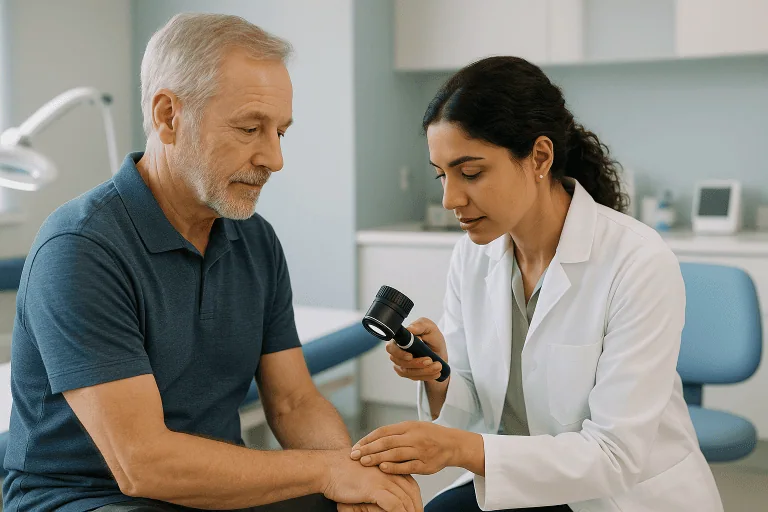
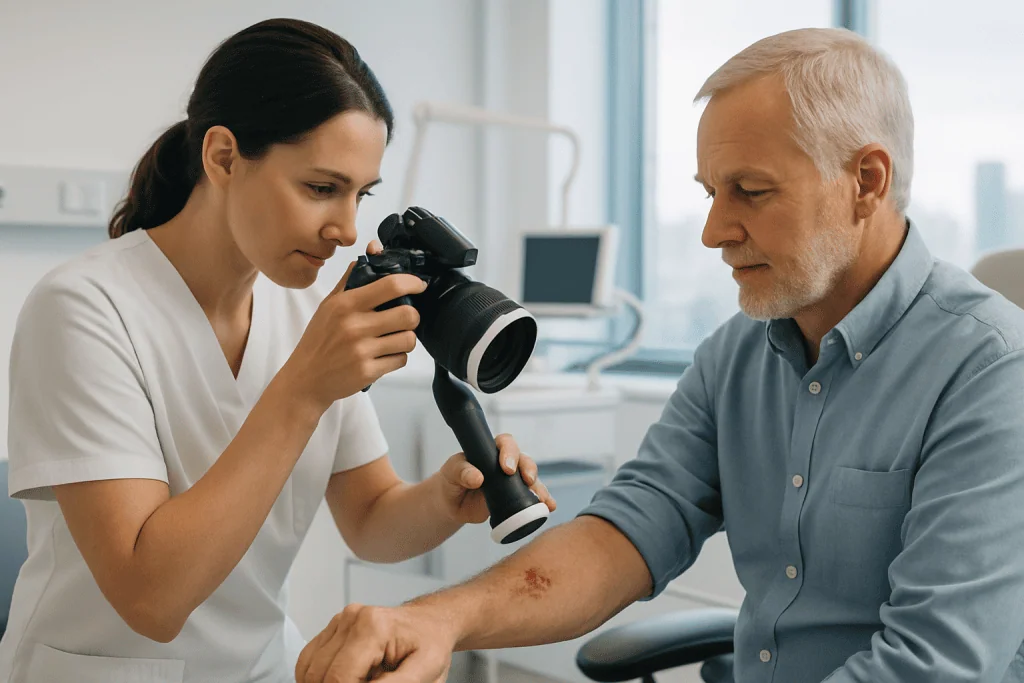
- Medical history and physical examination. The doctor looks at the appearance of the ulcer, its border, how quickly it developed, how painful it is, and whether it started after minor injury. A history of inflammatory bowel disease, arthritis, or blood disorders is an important clue.
- Skin biopsy. A small sample of tissue is taken from the edge of the ulcer and examined under a microscope. The biopsy cannot confirm pyoderma gangrenosum on its own, but it helps exclude other diagnoses such as skin cancer, vasculitis (inflammation of blood vessels), or unusual infections. Typical findings include dense collections of neutrophils in the skin.
- Wound and tissue cultures. Samples may be tested for bacteria, fungi, and other organisms to rule out infection as the primary cause.
- Blood tests. These may include a complete blood count, inflammation markers, tests for autoimmune diseases, and screening for blood or protein abnormalities linked to the bullous type.
- Vascular assessment. For leg ulcers, doctors often check the blood circulation, for example with Doppler ultrasound (a painless scan of blood flow), to exclude ulcers caused by poor arterial or venous circulation.
- Investigation for associated conditions. Depending on the findings, your doctor may recommend a colonoscopy to check for inflammatory bowel disease or additional blood tests to look for a bone marrow disorder.
Dermatologists sometimes use published diagnostic criteria that combine a compatible biopsy with clinical features such as the appearance of the ulcer border, the exclusion of infection, a history of pathergy, associated diseases, and a rapid response to immune-suppressing medication. Because misdiagnosis is common, studies suggest a substantial share of patients initially receive a different diagnosis: a second opinion from a dermatologist experienced in inflammatory skin disease is often valuable.
Treatment options
Pyoderma gangrenosum treatment aims to calm the immune-driven inflammation, relieve pain, help the ulcer heal, and prevent new lesions. There is no single cure, and treatment usually needs to be tailored to the individual, taking into account how severe the disease is, how fast it is progressing, and whether an associated condition such as inflammatory bowel disease is present. Care is typically led by a dermatology team; at Acibadem, this condition is managed within the dermatology department, often in coordination with gastroenterology, rheumatology, or hematology specialists when an underlying disease is involved.
Wound care and pain control
Gentle wound care is a foundation of treatment. This usually means non-adherent, moisture-retaining dressings, avoiding harsh cleaning, and protecting the wound from further injury. Aggressive surgical debridement (cutting away tissue) is generally avoided in active disease because of the risk of pathergy making the ulcer larger. Pain is often significant, and your doctor may prescribe pain medication alongside disease-directed treatment.
Topical and local treatments
For small, single, or early lesions, doctors may start with treatments applied directly to the skin or injected around the wound. These can include strong corticosteroid creams or ointments (anti-inflammatory medicines), calcineurin inhibitors such as tacrolimus ointment (medicines that dampen local immune activity), and corticosteroid injections into the ulcer edge. In mild cases, this local approach, combined with careful wound care and a period of close observation, may be enough.
Systemic medication
For larger, multiple, or rapidly worsening ulcers, treatment that works throughout the body is usually needed. Options your doctor may consider include:
- Systemic corticosteroids (such as prednisone), which are often the first choice because they can act quickly to stop ulcer progression. They are typically used for a limited time because of side effects with long-term use.
- Cyclosporine, an immune-suppressing medicine that is also commonly used, either alone or when steroids are unsuitable.
- Biologic medicines, particularly TNF inhibitors (such as infliximab and adalimumab), which block a specific inflammatory signal. These can be especially useful when pyoderma gangrenosum occurs together with inflammatory bowel disease, since one medicine may help both conditions. Other biologic and targeted therapies are sometimes used in cases that do not respond.
- Other immune-modulating drugs, such as dapsone, methotrexate, azathioprine, or mycophenolate, which may be used as steroid-sparing options in selected patients.
All of these medicines carry potential side effects, including an increased risk of infection, and require monitoring with regular checkups and blood tests. Your medical team will weigh benefits and risks for your specific situation.
Surgery and skin grafting
Surgery for pyoderma gangrenosum is approached with great caution. Operating on an active ulcer can trigger pathergy and enlarge the wound. However, once the inflammation is well controlled with medication, procedures such as skin grafting may be considered in selected cases to speed the healing of large wounds, usually under continued immune-suppressing cover. Decisions about surgery are made carefully by the treating team.
Treating associated conditions
When pyoderma gangrenosum is linked to another disease, treating that disease is an important part of care. For example, controlling inflammatory bowel disease often helps skin lesions improve, and identifying a blood disorder allows it to be managed appropriately.
Living with pyoderma gangrenosum and outlook
The outlook for pyoderma gangrenosum varies from person to person. With appropriate treatment, many ulcers heal over weeks to months, although deep or large wounds may take longer and often leave scars. Some people experience a single episode that resolves and never returns; others have a relapsing course, with new flares appearing months or years later, sometimes triggered by skin injury or by flares of an associated disease. Because relapse is possible, ongoing follow-up with your dermatology team is generally recommended even after healing.
Day-to-day life with pyoderma gangrenosum often involves protecting the skin from injury, since even minor trauma can provoke new lesions in some people. Practical steps that doctors commonly suggest include avoiding unnecessary skin procedures where possible, informing any surgeon or healthcare professional about your diagnosis before injections or operations, keeping wounds covered as advised, and attending regular monitoring appointments if you take immune-suppressing medicines. Chronic pain, visible wounds, and scarring can affect mood, sleep, and quality of life, and it is reasonable to discuss these effects openly with your care team; psychological support can be a legitimate part of treatment.
Honest prognosis language matters here: pyoderma gangrenosum is a serious condition, but it is treatable, and most people achieve healing with modern therapy. At the same time, no treatment can guarantee that the condition will never return, and finding the right medication sometimes takes time and adjustment.
Frequently asked questions
What is pyoderma gangrenosum in simple terms?
Pyoderma gangrenosum is a rare skin condition in which the immune system causes painful open sores, usually on the legs. It is not an infection and not true gangrene, despite the name. It often occurs alongside conditions such as inflammatory bowel disease or arthritis, although in many people no underlying cause is found.
Is pyoderma gangrenosum contagious?
No. Pyoderma gangrenosum cannot be passed from person to person by touch, shared items, or any other route. It is driven by the body’s own immune system, not by bacteria or viruses, so there is no risk of spreading it to family members or caregivers.
Can pyoderma gangrenosum heal on its own?
Occasionally, mild lesions improve without aggressive treatment, but most active ulcers tend to enlarge and become more painful if left untreated. Early treatment generally leads to better outcomes and less scarring, so it is not advisable to wait and see without medical guidance.
How serious is pyoderma gangrenosum?
It can be serious. Ulcers may become large, deep, and very painful, and open wounds carry a risk of secondary infection. In addition, pyoderma gangrenosum can be the first visible sign of an underlying condition that itself needs treatment. With proper diagnosis and therapy, however, most people improve, and many achieve complete healing.
How is pyoderma gangrenosum diagnosed?
There is no single confirmatory test. Doctors combine the appearance and behavior of the ulcer, a skin biopsy, cultures to exclude infection, blood tests, and often circulation studies to rule out other causes. Pyoderma gangrenosum diagnosis is confirmed when the picture fits and other explanations have been excluded, which is why specialist assessment is important.
How long does recovery from pyoderma gangrenosum take?
Healing times vary widely. Small lesions treated early may heal within weeks, while large or deep ulcers can take several months, even with effective medication. Pain often improves before the wound fully closes. Because flares can recur, your doctor may continue some treatment or monitoring after the skin has healed.
What is the best pyoderma gangrenosum treatment?
There is no single best treatment for everyone. Mild cases may respond to strong topical anti-inflammatory medicines and careful wound care, while more severe disease usually requires systemic medicines such as corticosteroids, cyclosporine, or biologic drugs. The most suitable option depends on disease severity, your overall health, and any associated conditions, so treatment is individualized by your medical team.
When to see a doctor
Any painful skin sore that grows quickly or does not begin to heal within a reasonable time deserves medical evaluation, particularly if you have inflammatory bowel disease, arthritis, or a blood disorder. If you have already been diagnosed with pyoderma gangrenosum, seek prompt medical attention if you notice any of the following warning signs:
- A rapidly enlarging or deepening ulcer, or a wound edge turning purple or breaking down further.
- Signs of infection, such as spreading redness, warmth, increasing swelling, foul-smelling discharge, or pus.
- Fever, chills, or feeling generally very unwell, which can indicate a serious infection needing urgent care.
- Severe or suddenly worsening pain that is not controlled by your usual medication.
- New sores appearing after a cut, injection, or surgery, which may indicate pathergy and a disease flare.
- Significant bleeding from the wound that does not stop with gentle pressure.
- New digestive symptoms, such as persistent diarrhea, blood in the stool, or abdominal pain, which may point to associated inflammatory bowel disease.
Early assessment by a dermatologist can shorten the path to an accurate diagnosis and effective treatment, and can help prevent complications such as large scars or serious wound infections. If you are taking immune-suppressing medicines for pyoderma gangrenosum, do not stop or change them on your own; discuss any concerns or side effects with your treating doctor first.
Medically reviewed by the Acıbadem International Medical Board September 2, 2026
See our medical review board →
Update history
- PublishedJune 14, 2026
- Medical review approvedSeptember 2, 2026
- Last content updateSeptember 2, 2026