Reverse Crunches: What Patients Need to Know

Reverse crunches target the abdominal muscles through a controlled pelvic curl rather than large swinging leg movements. Good technique helps reduce strain on the lower back, neck, and hip flexors.
Key Takeaways
- Reverse crunches target the abdominal muscles through a controlled pelvic curl rather than large swinging leg movements.
- Good technique helps reduce strain on the lower back, neck, and hip flexors.
- The exercise can be useful in a balanced core program, but it does not specifically burn fat from one body area.
- Pain during reverse crunches is not normal and may signal poor form, overuse, or an underlying problem.
- Modifications and professional guidance can make abdominal training safer for people with injuries or medical conditions.
Reverse crunches are an abdominal exercise that can help strengthen the core, especially the lower portion of the rectus abdominis, when performed with controlled movement and proper form. They are not suitable for everyone, however, and people with back, neck, hip, pelvic floor, or post-surgical concerns may need modifications or medical advice before trying them.
Overview: what reverse crunches are and why people do them
Reverse crunches are a floor-based core exercise in which the pelvis gently curls upward while the knees move toward the chest. Unlike a traditional crunch, which mainly lifts the head, neck, and shoulders, a reverse crunch focuses more on bringing the lower body in with control. This makes it a common choice for people who want to strengthen the abdominal muscles without repeatedly pulling the neck forward.
Patients often ask whether reverse crunches are “good for lower abs.” In practical terms, no exercise isolates only one small part of the abdominal wall, but reverse crunches can emphasize the lower portion of the rectus abdominis while also engaging the deep core and hip-stabilizing muscles. The movement is most effective when it is slow and controlled, not when the legs swing or momentum is used.
From a health perspective, stronger core muscles may support posture, trunk stability, and everyday movement. However, reverse crunches are only one part of a complete fitness plan. They do not treat medical back pain on their own, and they do not reduce fat in one specific area. For some people, especially those with ongoing spine symptoms, back pain or abdominal exercise discomfort may need medical evaluation before starting or progressing core training.
How reverse crunches work in the body

The main muscles involved in reverse crunches include the rectus abdominis, the transverse abdominis, and the obliques. These muscles help stabilize the trunk and control the tilt of the pelvis. When the exercise is done well, the abdominal wall does the work of curling the pelvis off the floor, rather than the hip flexors simply pulling the knees in.
This distinction matters because many people unintentionally turn reverse crunches into a leg-lifting exercise. When that happens, the front of the hips may dominate the movement, and the lower back may arch or press forcefully into the floor. Either pattern can make the exercise less comfortable and less effective.
Breathing also plays a role. Exhaling during the upward part of the movement can help engage the deep abdominal muscles, while inhaling as the pelvis returns to the starting position encourages control. A smooth, steady pattern usually works better than breath-holding, particularly for people with high blood pressure, pelvic floor symptoms, or recent surgery.
Proper form, common mistakes, and safer modifications
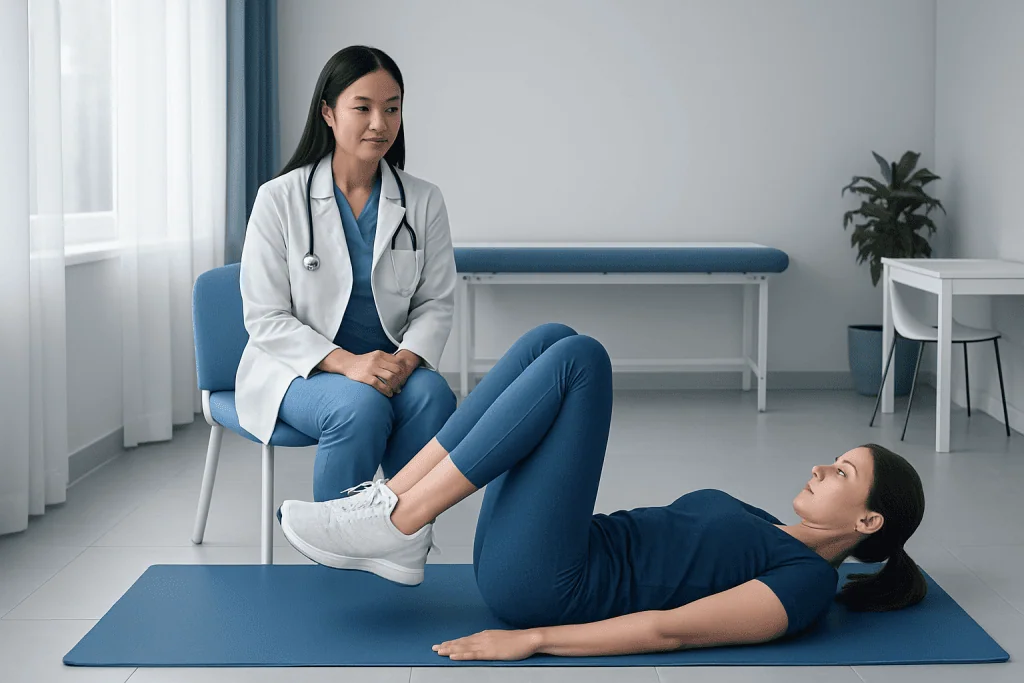
A typical starting position is to lie on the back with knees bent and hips flexed, keeping the lower legs relaxed and the arms by the sides for support. The key action is a small posterior pelvic tilt: the tailbone and pelvis gently lift as the knees move toward the chest. The movement range does not need to be large. In many cases, a short, precise curl is more useful than trying to lift the hips high off the floor.
Common mistakes include swinging the legs, pulling the knees in too quickly, arching the lower back, pushing hard with the hands, and tensing the neck and shoulders. These patterns can increase strain and shift the effort away from the abdominal muscles. If the exercise causes pinching in the front of the hips or pressure in the lower back, technique should be reviewed and the movement simplified.
Safer modifications may include keeping the feet closer to the floor, reducing the lifting range, placing the lower legs on a bench before beginning, or performing a pelvic tilt without lifting the knees much at all. Some people benefit from professional guidance in physical therapy and rehabilitation to learn how to activate the core without aggravating pain. For individuals recovering from injury or deconditioning, gentler alternatives such as abdominal bracing, heel slides, or supported marching may be more appropriate initially.
Who may benefit from reverse crunches
Reverse crunches may be useful for generally healthy adults who want to build core strength as part of a broader exercise routine. Because the movement can be performed without equipment and can be scaled in difficulty, it may fit into home exercise programs as well as supervised rehabilitation or conditioning plans.
Some people find reverse crunches more comfortable than standard crunches because they involve less repeated bending of the upper spine and less strain on the neck. They may also help people become more aware of pelvic control, which is an important part of trunk stability during walking, lifting, and exercise.
That said, “benefit” depends on the individual. For one person, reverse crunches may be a practical strengthening exercise; for another, a plank variation or a therapist-guided stabilization drill may be more suitable. People with recurrent musculoskeletal issues, including a herniated disc, should choose core exercises based on symptoms, physical examination findings, and medical advice rather than fitness trends alone.
Who should be cautious or avoid them
Reverse crunches are not the right choice for everyone. They may aggravate symptoms in people with acute lower back pain, hip flexor irritation, neck strain, abdominal wall injury, recent abdominal or pelvic surgery, or some pelvic floor conditions. Pregnancy, particularly in later stages, may also require a different approach to abdominal exercise depending on comfort and medical guidance.
People with osteoporosis, balance limitations when getting down to the floor, or significant deconditioning may need other exercise formats. Those with uncontrolled blood pressure or heart concerns should also be cautious about breath-holding and straining during any resistance-based movement. In these situations, a clinician may recommend a modified program that focuses on gentle stabilization and breathing.
If pain is persistent or linked to nerve symptoms such as numbness, tingling, shooting leg pain, or weakness, exercise should not simply be “pushed through.” Evaluation may be needed to rule out a structural problem affecting the spine or nerves. When clinically indicated, assessment in services such as orthopedics and traumatology can help clarify whether symptoms are exercise-related strain or part of a broader musculoskeletal condition.
How reverse crunches fit into a healthy exercise plan
Core training is usually most effective when it is varied and balanced. Reverse crunches can complement other movements that build endurance, control, and whole-body strength, such as walking, resistance training, flexibility work, and exercises for the gluteal and back muscles. A stronger core works best when the rest of the body is also conditioned.
It is also important to set realistic expectations. Reverse crunches may help strengthen muscles, but they do not “spot reduce” abdominal fat. Changes in body composition depend more on overall physical activity, nutrition, sleep, stress, and metabolic health than on any single abdominal exercise.
For many patients, progress is safest when it is gradual. Starting with fewer repetitions and a smaller range of motion helps the body adapt. If tolerated, the exercise can later be advanced with slower tempo, longer control, or a structured program developed by a rehabilitation or fitness professional. In some cases, if chronic symptoms suggest a more complex spinal issue, consultation with neurosurgery or another relevant specialty may be part of a wider care plan, although most exercise-related discomfort does not require surgery.
When to seek medical care
Mild muscle effort during reverse crunches can be normal, but pain is not a sign of a better workout. Medical advice is sensible if the exercise causes sharp lower back pain, hip pain, groin pain, neck pain, dizziness, shortness of breath, or a feeling of pressure or bulging in the abdomen or pelvic floor. Symptoms that continue after stopping the exercise also deserve attention.
Urgent evaluation is especially important if pain is accompanied by weakness, loss of sensation, pain radiating down the leg, changes in bowel or bladder control, chest symptoms, or recent trauma. These features may point to a problem that should not be managed only with home exercise changes.
People who have had recent surgery, childbirth-related pelvic floor concerns, or a known spine disorder should ask a qualified clinician when it is safe to resume abdominal training. Near the end of the care pathway, patients seeking coordinated assessment may be reassured to know that Acibadem International’s multidisciplinary specialists and JCI-accredited hospitals diagnose and treat musculoskeletal and spine-related conditions for international patients.
Frequently asked questions
Are reverse crunches better than regular crunches?
Neither exercise is universally better; they challenge the core in slightly different ways. Reverse crunches may feel more comfortable for some people because they place less emphasis on lifting the head and shoulders, but proper form matters in both.
Do reverse crunches target only the lower abs?
No exercise works only one small section of the abdominal wall. Reverse crunches can place more emphasis on the lower portion of the rectus abdominis, but the whole core works together during the movement.
Why do reverse crunches hurt the lower back?
Lower back pain during reverse crunches can happen when the legs swing, the back overarches, the range is too large, or an underlying spine or hip issue is present. The exercise should be stopped if it causes pain, and technique or medical factors should be reviewed.
Can beginners do reverse crunches?
Yes, many beginners can do a simplified version if they start with a small range of motion and good control. A modified pelvic tilt or supported leg position may be a better first step for people with weak core control or discomfort.
How many reverse crunches should a person do?
There is no single correct number for everyone. In general, quality matters more than quantity, so it is better to perform a small number of controlled repetitions than many poorly performed ones. A clinician or qualified trainer can help tailor the amount to the person's condition and goals.
Should reverse crunches be avoided after surgery or during pregnancy?
They may need to be modified or postponed depending on the type of surgery, the stage of pregnancy, symptoms, and medical advice. A doctor or physiotherapist can recommend safer abdominal exercises for that period.
This article is for general information only and is not a substitute for professional medical advice. Please consult a qualified doctor about your individual situation.
Explore treatments in Turkey — costs, top hospitals & a free quote
JCI-accredited · board-certified surgeons · reply within 24h
Add us as a Preferred Source to see more of our trusted health content across Google Search, AI Overviews and Discover.
Check your numbers in seconds
BMI, calories, due date, blood pressure and 30+ more clinical calculators — free, instant, doctor-reviewed ranges.

More from the Health Library

Prom Premature — Explained by Medical Evidence, Not Myths

Feta Cheese — Explained by Medical Evidence, Not Myths

Petechiae When to Worry: A Complete Medical Overview
Gigantic Eyes: A Complete Medical Overview

Venous Reflux: A Complete Medical Overview