Removable Appliances
Removable appliances are custom-made dental devices used to guide tooth movement, jaw growth, or retention, especially in children and teens. They are non-surgical and can be taken out for eating and cleaning.
Quick answer
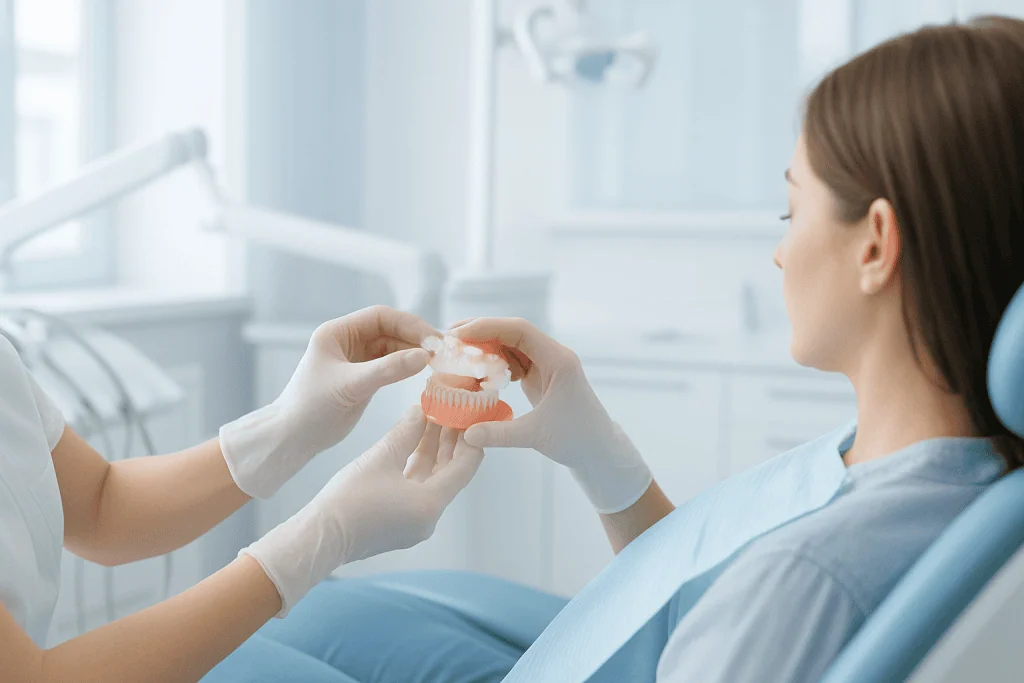
Removable appliances are custom-made orthodontic devices that can be taken out of the mouth for eating and cleaning. Depending on the design, they guide selected tooth movements, hold space for erupting permanent teeth, influence jaw growth in children, discourage habits such as thumb sucking, or keep teeth in position after braces or aligners. Treatment is non-surgical, and the appliance only works while it is being worn as prescribed.
Removable Orthodontic Appliances: What They Are and Who They Help
Removable appliances are custom-made orthodontic appliances that you or your child can take out of the mouth for meals, brushing, flossing, sports or cleaning. Depending on the design, they guide selected tooth movements, hold space for permanent teeth that have not yet erupted, influence jaw growth in children, discourage habits such as thumb sucking, or keep teeth in their improved positions after braces or aligners. They are used most often in children and teenagers whose teeth and jaws are still developing, although certain designs — particularly retainers — are worn at every age.
Parents usually arrive at this topic through something they have noticed. A front tooth is tipping forward. There does not seem to be enough room for the permanent teeth coming through. The upper and lower jaws do not meet the way they should. Teeth have started to drift after a previous course of orthodontic treatment. The questions that follow are practical ones: will treatment hurt, will it affect eating and speaking, and will a child actually cooperate with wearing a device every day?
These are fair questions, and the honest answer is that removable orthodontic appliances are among the most established tools in orthodontics precisely because they answer most of them well. They are non-surgical. Routine fitting and adjustment need no anaesthesia. Because the device comes out, normal brushing and flossing continue as before. The trade-off is equally plain: a removable appliance works only while it is in the mouth. Cooperation is not a minor detail of this treatment — it is the treatment. That single fact shapes who is a good candidate, how the plan is explained, and how families are involved from the first visit.
What is considered an orthodontic appliance?
An orthodontic appliance is any device designed to move teeth, hold teeth in position, or influence the growth and function of the jaws. That definition covers two broad families. Fixed appliances — braces, bonded retainers, fixed expanders — are attached to the teeth and stay in place until a clinician removes them. Removable appliances are made to be inserted and taken out by the patient. Both families work on the same biological principle: sustained, gentle pressure on a tooth causes the surrounding bone to remodel, allowing the tooth to move gradually into a new position. The difference lies in how the force is delivered, how much it depends on the wearer, and which problems each design can realistically solve.
What is an orthodontic device?
An orthodontic device is simply another name for an orthodontic appliance; the two terms are used interchangeably in clinical writing and in everyday conversation. Orthodontic devices range from a simple plastic retainer worn at night to a functional appliance shaped to change the way a growing child’s jaws meet. What unites them is purpose: each one is prescribed for a specific, diagnosed problem, made to fit an individual mouth, and monitored over time. A device chosen without a clear diagnosis is unlikely to achieve anything useful, which is why every appliance described on this page begins with an examination rather than a catalogue.
What Are Removable Appliances?
A removable dental appliance is a custom device made from records of the patient’s own teeth, gums and bite, designed so that the wearer can insert and remove it without help. Most designs share a common architecture. An acrylic base rests against the palate or along the inside of the lower teeth. Wire clasps grip selected back teeth to hold the appliance securely in place. Onto this foundation, the design adds whatever the treatment goal requires: springs that press gently on individual teeth, a labial bow that controls the front teeth, bite planes that alter how the jaws close, or an expansion screw that is turned gradually — usually at home, following a written schedule — to widen a dental arch or create space.
You may occasionally see these devices described as removal appliances; the phrase refers to the same thing, though removable appliances is the standard clinical term. The term is a category rather than a single treatment. It covers removable retainers, space maintainers, expansion plates, active plates designed to move one or a few teeth, habit-breaking appliances, and functional appliances used to guide jaw growth. The right design depends entirely on the diagnosis, which is why two children with superficially similar teeth may leave the clinic with entirely different appliances — or with no appliance at all.
Removable appliances are especially valuable in what orthodontists call interceptive orthodontics: identifying and managing a developing problem while the jaws and teeth are still changing. Interceptive treatment can reduce the complexity of later care, improve the eruption path of permanent teeth, or nudge growth in a more favourable direction. It is worth being clear about the limits here. Interceptive treatment does not always eliminate the need for braces or aligners later. What it can do, in well-chosen cases, is improve the foundation on which any later treatment is built.
Because the appliance comes out of the mouth, oral hygiene is usually easier to maintain than with fixed braces. Teeth can be brushed and flossed normally, and the appliance itself can be cleaned separately. Removability, however, is also the design’s central weakness. An appliance sitting in a school bag moves nothing. Careful patient selection, family involvement and clear, practical instructions are therefore not extras — they are what separates a successful course of treatment from a frustrating one.
What are the different types of orthodontic appliances?
Orthodontic appliances divide into fixed and removable types, and the removable family itself contains several distinct designs. The main removable types are:
- Removable retainers — including wire-and-acrylic designs and clear vacuum-formed plates — which hold teeth in position after active treatment.
- Space maintainers, which preserve the gap left by a prematurely lost baby tooth until the permanent tooth is ready to erupt.
- Expansion plates, which use a screw mechanism to widen a dental arch gradually.
- Active plates, which use springs, bows or screws to tip or move a small number of teeth.
- Habit-breaking appliances, which interrupt thumb sucking, finger sucking or tongue thrusting.
- Functional appliances, which alter jaw posture in growing patients to guide the way the upper and lower jaws relate.
Clear aligners are technically removable as well, though they belong to a different treatment approach and are usually discussed separately from the plate-style appliances covered here. On the fixed side sit conventional braces, bonded retainers and fixed expanders, which do not depend on daily cooperation but make cleaning more demanding.
What is the most common orthodontic appliance?
Fixed braces remain the most widely used appliance for comprehensive orthodontic treatment, because they can control tooth position in three dimensions without relying on the wearer to keep them in. Within the removable family, the retainer is by far the most common, for a simple reason: almost every patient who completes treatment with braces or aligners is asked to wear one afterwards. Teeth have a lifelong tendency to drift back towards their original positions, so retention is prescribed almost universally, while active removable appliances are prescribed only for the specific, limited problems they suit.
Who May Need a Removable Dental Appliance?
A removable dental appliance may be recommended for a child, a teenager or occasionally an adult when the orthodontic problem suits removable treatment and the patient is likely to wear the device consistently. Both conditions matter. The recommendation rests on the type of bite problem, the stage of dental development, how much growth remains, and how complex the required tooth movement is — but it also rests on an honest assessment of whether this particular child, at this particular age, will keep the appliance in the mouth for the prescribed hours.
Families usually seek an evaluation because they have noticed something: visible crowding, protruding upper front teeth, gaps, a crossbite, early or late loss of baby teeth, persistent thumb sucking, mouth breathing, or difficulty biting certain foods. A child may say that the teeth feel uneven, that a retainer from earlier treatment no longer fits, or that a tooth is coming through in an odd place. Quite often, though, the problem is picked up during a routine dental check before anyone at home has noticed a thing.
Diagnosis begins with a clinical examination. The orthodontist assesses the bite, the relationship between the jaws, the position of individual teeth, facial symmetry, oral habits, and the health of the gums and teeth. Understanding dental anatomy and eruption sequence is central here: the question is never only where the teeth are today, but where the unerupted permanent teeth are heading. The examination also weighs cooperation and maturity, because removable appliance therapy stands or falls on the patient’s ability to follow instructions.
Records confirm and refine the diagnosis. These may include intraoral scans or conventional impressions, clinical photographs, a panoramic dental X-ray, cephalometric analysis when jaw relationships or growth must be assessed, and, in selected cases, three-dimensional imaging. Together they show what the eye cannot: root positions, developing teeth still inside the bone, missing or impacted teeth, and the skeletal pattern beneath the smile.
Removable appliances are chosen when the treatment goal is limited and clearly defined — creating space for one permanent tooth, correcting a mild dental crossbite, discouraging a sucking habit, holding teeth after braces, or guiding jaw function during a growth spurt. When the problem demands complex three-dimensional tooth movement, precise root control, significant bite correction, or continuous force that cannot depend on daily compliance, fixed braces or clear aligners are usually the more honest recommendation. A good clinician will say so plainly rather than fit an appliance that cannot deliver.
Conditions and Indications Treated with Removable Appliances
Removable appliances address a defined range of orthodontic and developmental concerns, most commonly during childhood and adolescence while the dental arches are still forming and permanent teeth are erupting. Each indication has a matching appliance design, and the match matters more than the appliance itself.
Space maintainers after early tooth loss
Space maintainers preserve the gap left when a baby tooth is lost earlier than nature intended — through decay, trauma or extraction. Without that placeholder, neighbouring teeth drift into the empty space and can block the permanent successor from erupting correctly, sometimes forcing it to come through crooked or to remain impacted in the bone. A removable space maintainer holds the space open until the permanent tooth is ready. Because untreated decay is one of the commonest reasons a baby tooth is lost early, timely dental fillings and routine care are quietly one of the best forms of orthodontic prevention available.
Expansion plates and active plates for crowding
Expansion plates and active plates are used for mild to moderate crowding during the mixed dentition — the years when baby teeth and permanent teeth share the mouth. An expansion plate carries a small screw that is turned on a set schedule, gradually widening the arch to create room. An active plate uses springs or bows to tip one or several teeth into better positions. Selection needs care: these appliances tip teeth rather than moving roots bodily, so not all crowding can be managed this way, and pretending otherwise wastes months of a child’s cooperation.
Crossbite correction
Crossbite correction with a removable appliance suits cases where a small number of teeth bite inside or outside their normal position. Left alone, a crossbite can encourage a child to shift the jaw to one side when closing, and may contribute to uneven tooth wear or localised gum stress over time. Correcting a simple dental crossbite early — often with a plate carrying a spring or screw plus bite planes to open the way — can help the bite develop more symmetrically. Skeletal crossbites involving the jaw itself need different assessment and sometimes different appliances entirely.
Functional appliances for jaw growth
Functional appliances are used in growing patients when the upper and lower jaws do not relate ideally — most typically when the lower jaw sits noticeably back relative to the upper. These appliances hold the lower jaw in a forward posture and harness the child’s own muscle function and growth. They do not force the jaw to grow; no appliance can. What they can do, at the right stage of growth, is guide jaw posture and development in a more favourable direction. Timing is everything here, which is why growth assessment sits at the heart of the treatment decision. Prominent upper front teeth are also more exposed to injury during falls and sport — one of the situations covered under dental emergency and trauma care — and reducing that prominence during growth is one recognised reason to treat.
Habit-breaking appliances
Habit-breaking appliances help manage thumb sucking, finger sucking, tongue thrusting and prolonged dummy or pacifier use. When these habits persist beyond early childhood, they can push the front teeth forward, hold them apart, and reshape the developing arches. A habit appliance works partly as a physical reminder and partly by removing the satisfaction the habit provides. It is prescribed alongside supportive, matter-of-fact behavioural guidance — never as a punishment, which tends to entrench the habit rather than end it.
Removable retainers after braces or aligners
Removable retainers hold teeth in their corrected positions after active orthodontics. Teeth are not set in stone once braces come off; the surrounding bone, gum fibres and lip and tongue muscles all need time to adapt, and some drift pressure persists for life. Retention is therefore written into the treatment plan from the start, not added as an afterthought, and the wearing schedule — typically fuller wear at first, then nights — is tailored to the individual and often continues long term.
How Removable Appliance Treatment Is Performed
Treatment follows a sequence that is broadly the same whatever the appliance, though the detail varies with the design and the patient’s age. In outline:
- Examination and diagnosis — clinical assessment of teeth, bite, jaws, habits and gum health.
- Records — scans or impressions, photographs, and X-rays where indicated.
- Planning — choosing the appliance, the wear schedule and the review intervals, and explaining all three.
- Fabrication — the laboratory builds the appliance to the individual’s anatomy.
- Fitting — the clinician checks the fit and teaches insertion, removal, cleaning and storage.
- Wear and review — daily use at home, with periodic adjustment visits.
- Completion or retention — the appliance is discontinued, replaced, or converted to a retention schedule.
The first visit covers dental history, general health, growth stage, any previous orthodontic treatment, and the family’s own concerns. The mouth is examined for cavities, gum inflammation, tooth mobility, eruption patterns, bite relationships and oral habits. If dental disease is found, it is usually treated before any appliance is made, because healthy teeth and gums are the foundation on which safe orthodontic treatment rests.
Records follow. In many cases an intraoral scanner captures a precise digital model of the teeth with no impression material at all — a genuine improvement for children who gag on conventional impressions — though some appliance types and clinical situations still call for impressions. Photographs document the bite and facial features. X-rays, where indicated, show developing teeth, root positions, missing or impacted teeth, jaw relationships and remaining growth. For children and adolescents, timing carries real weight: an appliance that is exactly right at one age can be far less effective started too early or too late.
Once the records have been reviewed, the clinician explains the diagnosis and the options. This conversation should leave the family knowing what the appliance is expected to do, how many hours a day it must be worn, how often adjustments are needed, what discomfort is normal, and which signs are worth mentioning at a review. For families who live far from the clinic, the plan can also set out how follow-up will be sequenced and which parts of routine monitoring can reasonably be shared with a local dentist.
Fabrication is individual. The laboratory works from the scan or model to build a device that fits one mouth and no other. Components are chosen by function: a retainer is built primarily to hold, an active plate carries springs or a screw to apply gentle pressure, and a functional appliance takes a more complex shape to reposition the jaws when the mouth closes.
At the fitting appointment, the appliance is checked methodically. It should seat fully, feel secure, and press nowhere sharply on the gums. The bite is assessed with the appliance in place. The patient is taught to insert and remove it with the correct hand position — gripping the clasps, not levering the wires — because bent wires are the fastest route to an appliance that no longer works. Children often need several practice runs in the chair before it feels natural, and it is worth taking that time.
The first days are an adaptation period, and it helps to know this in advance. Speech may sound different, saliva may increase, and the appliance may feel bulky. All of this usually settles with consistent wear — indeed, wearing the appliance more, not less, is what shortens the adjustment. Mild pressure on the teeth is expected when an active appliance is first fitted or activated. Significant pain, ulcers, bleeding or a genuine inability to wear the device are not part of normal adaptation. The appliance should never be altered at home unless a specific instruction has been given — such as turning an expansion screw to a written schedule.
Wear time depends on the appliance and the goal. Some retainers are worn full time initially and then at night only. Some active plates must be worn most of the day and night, coming out only for meals and cleaning. Functional appliances follow schedules set by growth goals and tolerance. Whatever the prescription, it will be stated clearly, because inconsistent wear is the single most common reason removable treatment stalls or falls short.
Cleaning is simple but non-negotiable. The appliance is rinsed after removal and brushed gently with a soft toothbrush. Out of the mouth, it lives in its protective case — never wrapped in a tissue, which is how appliances end up in bins, and never loose in a bag. Heat distorts acrylic, so no hot water, no direct sun on a car dashboard, no dishwasher. Teeth are brushed before the appliance goes back in, which keeps plaque and odour down; the habits covered under everyday dental hygiene matter just as much during appliance wear as at any other time.
Review appointments monitor tooth movement, appliance fit, hygiene, the eruption of permanent teeth and the health of the soft tissues. Adjustments may mean activating a screw, changing spring pressure, tightening clasps, smoothing acrylic or modifying bite surfaces. In growing children, the plan itself may be updated as new teeth erupt or growth shifts. Some appliance phases last only a few months; others — retention above all — continue much longer. Duration depends on the diagnosis, the biological response and, always, cooperation.
Technology supports each of these steps without replacing judgement. Digital scans produce accurate appliance designs and reduce repeat impressions. Imaging clarifies tooth development and jaw relationships. Digital records allow honest comparison over time, which is particularly valuable in a mouth that is changing month by month. In selected cases, three-dimensional planning helps with impacted teeth or complex anatomy. The appliance-fitting itself remains what it has always been: non-surgical, needing no anaesthesia for routine fitting or adjustment, and brief. The real commitment happens at home.
Why Acting Early Matters
Timing is one of the central principles of orthodontic care in children. Some problems are far easier to guide while the jaws are growing and the permanent teeth are still on their way. A developing crossbite, ongoing space loss, a persistent sucking habit or an emerging jaw discrepancy, left unmonitored, can become considerably harder to correct later.
The consequences of delay are concrete. Teeth drift into spaces that permanent successors need, so a baby tooth lost too early can end in crowding or impaction. A thumb habit that continues keeps reshaping the front teeth and the arches for as long as it lasts. A crossbite can teach a child to close the jaw off to one side, affecting function and comfort. Markedly protruding front teeth remain more vulnerable to injury during falls and sport for every year they protrude.
Acting early does not mean rushing in. Early treatment is not necessary for every child, and in good orthodontic practice the recommendation is sometimes simply to watch and wait for a more favourable moment. The value of an early evaluation is clarity: knowing what needs treatment now, what can safely wait, and what should be watched closely. That knowledge costs a child nothing and can spare a family both unnecessary treatment and a missed window.
Benefits of Removable Appliance Treatment
The benefits depend on the diagnosis and on cooperation, but for the right indication a removable appliance offers a genuinely conservative option.
| Benefit | What It Means for You |
|---|---|
| Non-surgical treatment | Removable appliances guide teeth, space, habits or growth without surgery, injections or a hospital stay. |
| Custom fit | The appliance is built from the patient’s own dental records, supporting comfort, stability and accurate function. |
| Easier oral hygiene | Because the device comes out, brushing, flossing and cleaning around the gums are usually simpler than with fixed braces. |
| Useful during growth | In selected children and teens, treatment can guide developing teeth and jaws at a stage when change is more favourable. |
| Supports long-term stability | Removable retainers protect the result of braces or aligners by limiting unwanted tooth movement afterwards. |
| Flexible daily use | The appliance can be removed for meals, cleaning, contact sports or special occasions, within the prescribed wear schedule. |
Recovery and Adjustment Timeline
There is no surgical recovery with a removable appliance, but there is a real adaptation period, and knowing its shape in advance makes it easier to get through.
| Time Period | What to Expect |
|---|---|
| Day 1 | The appliance may feel bulky or tight. Speech may be slightly affected and saliva may increase. The clinician checks the fit and teaches insertion, removal, cleaning and storage. |
| First week | Mild pressure on the teeth is common, especially after activation. Speech and comfort usually improve with consistent wear. Persistent sore spots usually mean the acrylic needs a small professional adjustment. |
| First month | The routine becomes familiar. The clinician may adjust springs, clasps, screws or acrylic and assess early tooth movement or bite changes. |
| Active treatment period | Regular monitoring continues. Progress depends on the appliance design, growth stage, biological response and daily wear time. The plan may be modified as teeth erupt. |
| Longer term | Once the active goal is reached, the appliance may be discontinued, replaced or converted to a retention schedule. Long-term retainer wear is often recommended after orthodontic treatment. |
What Influences a Good Result?
The single most important factor is correct, consistent wear. Unlike fixed braces, a removable appliance exerts force only while it is in the mouth. Worn mainly at night when full-time wear is prescribed, or regularly forgotten at school, it delivers less than it was designed to — sometimes much less. For children, parental support in the first weeks is often what carries the habit until it becomes automatic.
Diagnosis matters just as much. A good result begins with the right appliance for the right problem. Mild tooth movements, space maintenance, habit control, retention and selected growth-related problems respond well. Severe crowding, complex rotations, significant bite discrepancies and movements requiring precise root control generally do not; they need braces, aligners or a combined approach, and a plan that admits this from the outset saves everyone time.
Growth timing is the third pillar. Functional appliances in particular work best when a child is approaching or entering a period of active growth. Started too early, the child may outgrow the appliance before it achieves its purpose; started too late, the growth response may be limited. Orthodontic evaluation weighs dental age, skeletal development, tooth eruption and facial growth pattern precisely because chronological age alone is a poor guide.
Oral health underpins safety and comfort throughout. Cavities, inflamed gums, poor brushing and frequent sugary snacks all interfere with orthodontic care. A removable appliance makes cleaning easier than a fixed one, but plaque still accumulates on both the appliance and the teeth if hygiene slips, bringing bad breath, irritation and decay risk with it.
The appliance itself must stay accurate and intact. A distorted wire, cracked acrylic base, lost clasp or broken screw reduces effectiveness and can irritate the mouth; continuing to wear a damaged appliance can do more harm than good. A lost or broken device generally has to be repaired or remade, sometimes from new records, before treatment can continue. Bringing the appliance to every appointment — worn or not — lets the clinician see exactly what is happening.
Finally, realistic expectations make the whole experience easier. Some appliances produce visible change quickly; others work gradually over months. There may be observation phases between active stages. Often, removable appliance therapy is one chapter in a longer orthodontic story rather than the whole book. Families who understand this from the start tend to stay the course.
Where Removable Appliances Sit Among Types of Orthodontic Treatment
It helps to see removable appliances in context, because the main types of orthodontic treatment each occupy a different place. Fixed braces offer the fullest three-dimensional control of tooth position and do not depend on daily cooperation, at the cost of harder cleaning and fixed presence in the mouth. Clear aligners move teeth through a sequence of removable trays and suit many alignment problems in patients disciplined enough to wear them. Plate-style removable appliances — the subject of this page — occupy the interceptive and supportive ground: guiding growth, managing space and habits in children, correcting limited problems, and holding results after other treatment ends.
These approaches are not rivals so much as stages. A child might wear a functional appliance during a growth spurt, move to fixed braces in adolescence, and finish with a removable retainer worn for years. Another might need only a space maintainer and careful watching. The sequence is set by diagnosis and development, not preference, and it is reviewed as the child grows rather than fixed once and forgotten.
How Removable Appliance Care Is Organised at Acibadem
Removable appliance treatment looks simple from the outside, but it draws on diagnosis, growth assessment, appliance design, patient education and sustained follow-up. At Acibadem, this work sits within the wider dental and oral health service, which means an orthodontic question is never assessed in isolation from the rest of a child’s oral development.
Where the clinical picture calls for it, planning involves other specialties. A child with persistent mouth breathing may warrant airway evaluation by ear, nose and throat colleagues. A patient with missing or impacted teeth may need coordinated imaging and a surgical opinion. A teenager finishing braces needs a retention plan that takes account of wisdom tooth development and long-term stability. Digital scans, photographic records and radiographic assessment support these decisions, and digital records allow honest comparison over time in a mouth that is changing quickly.
For patients who live far from the clinic, follow-up is planned rather than improvised. Some removable appliances need periodic in-person adjustment; others can be monitored at longer intervals after the initial fitting. The clinician can set out in advance which steps must happen in person, which aspects a local dentist can reasonably observe, and how the wearing schedule runs between visits — so that distance becomes a factor in the plan rather than a threat to it.
The tone of the fitting appointment matters more than it might seem. Children and teenagers wear appliances they understand and feel some ownership of; a rushed explanation tends to produce poor cooperation, broken appliances and friction at home. Unhurried demonstrations, written instructions and genuine involvement of the child — not just the parents — are part of how the treatment is delivered, because with removable appliances the patient is half the treatment team.
Living With a Removable Appliance Day to Day
Most of appliance treatment happens in ordinary life, not in the clinic, so the practical routines deserve as much attention as the clinical ones. Meals are straightforward: the appliance comes out, goes into its case, and goes back in after the teeth are brushed or at least rinsed. Eating with an active plate in place is usually neither comfortable nor good for the appliance.
School is where appliances are most often lost. A case in the school bag, a named case, and a fixed habit — appliance out, straight into the case, case straight into the bag — prevent the classic sequence of tissue-wrapped appliance meeting lunchtime bin. At home, the case also protects the device from a less obvious hazard: dogs are strongly attracted to the smell of worn acrylic and will chew a retainer beyond repair in minutes if it is left within reach.
Sport depends on the appliance and the instruction given. Many removable devices are taken out for contact sports and swimming; the clinician will say which applies. Travel needs only the case, the cleaning routine, and — for expansion appliances — the written turning schedule, so that the programme continues uninterrupted away from home.
Speech deserves a final word of reassurance. Almost every new wearer lisps slightly for a few days, and almost every new wearer adapts. Reading aloud with the appliance in place speeds the process. The pattern across all of these routines is the same: the appliance rewards consistency and punishes improvisation, gently but reliably.
Moving Forward
Removable appliances are a valuable, conservative part of orthodontic care, above all for children and teenagers whose teeth and jaws are still developing. They offer a non-surgical, custom-made answer to a defined set of problems: space maintenance, mild tooth movement, habit control, growth guidance, and retention after braces or aligners. Their success rests on four things that no appliance can supply by itself — the right diagnosis, the right timing, a well-made device, and consistent daily wear at home.
For some children, early intervention with a removable appliance genuinely changes the path of their dental development. For others, the wiser course is careful monitoring until growth or eruption reaches the right stage, followed by a different treatment altogether. A thorough specialist evaluation is what tells these situations apart, and understanding the reasoning behind the recommendation — not just the recommendation itself — is what allows a family to carry the treatment through with confidence.
Preparation
- A dentist or orthodontic specialist evaluates the teeth, bite, and jaw growth, often using dental impressions or digital scans. The appliance is custom-made and checked for comfort and fit. Patients receive instructions on daily wear time, cleaning, and when to remove it.
Aftercare
- The appliance should be worn exactly as prescribed and cleaned daily to prevent plaque buildup and odors. Follow-up visits are needed for adjustments and to monitor tooth or jaw movement. Patients should avoid wrapping the appliance in tissue or exposing it to heat to prevent loss or distortion.
Turkey vs UK, Germany & USA
Removable appliances are custom dental devices used to support tooth movement, jaw guidance or retention, most often in growing patients. Costs and patient experience vary by appliance type, clinic setting, laboratory work and the amount of follow up required.
For international patients, the total cost is shaped by clinical planning, appliance fabrication, visit scheduling and travel logistics, not only by the device itself.
| Factor | Turkey | UK | Germany | USA |
|---|---|---|---|---|
| Price drivers | Private care packages may combine consultation, records and appliance fitting; lab complexity and follow up affect the quote. | Costs vary between public pathways and private orthodontic care; eligibility and timing can influence access. | Private and insurance based pathways differ; diagnostic records, specialist fees and laboratory standards influence cost. | Private fees commonly reflect provider setting, laboratory work, records and appointment schedule. |
| Hospital and specialist factors | International hospitals may offer coordinated dental and orthodontic services, with specialist review and treatment planning. | Care may be delivered through orthodontic practices, dental hospitals or private clinics depending on need. | Specialist orthodontic practices and university linked services are common routes for assessment and treatment. | Care is often provided in private orthodontic offices or multidisciplinary dental centers. |
| Accreditation and quality | Patients may choose JCI accredited hospital groups and clinics with international patient protocols. | Quality oversight depends on national regulation and the provider setting. | Quality systems are shaped by national regulation, professional standards and clinic protocols. | Quality oversight varies by state regulation, professional accreditation and clinic policies. |
| Waiting time experience | Private appointments for assessment and appliance fitting may be arranged around travel plans, subject to clinical and lab timing. | Public pathways can involve waiting, while private scheduling is usually more flexible. | Waiting times vary by region, specialist availability and insurance route. | Private scheduling can be flexible, depending on provider availability and appliance production. |
| Travel and language logistics | International patient teams may assist with appointment coordination, translation and travel related planning. | Language support may be available in larger centers; travel planning is usually arranged by the patient. | Language support varies by clinic; international patients may need to confirm translation options. | Language and travel support depend on the provider and location. |
| Typical package content | May include consultation, dental records, appliance design, fitting, instructions and planned adjustments. | Private packages may include records, fitting and reviews; inclusions should be confirmed in writing. | Quotes may separate diagnostics, appliance fabrication and review visits. | Quotes may separate consultation, records, laboratory fabrication and follow up appointments. |
What affects your final cost
- Type and complexity of the removable appliance.
- Whether the appliance is for tooth movement, growth guidance or retention.
- Diagnostic records such as scans, photographs and bite registration.
- Specialist orthodontist assessment and treatment planning.
- Laboratory fabrication, materials and replacement needs if the appliance is lost or damaged.
- Number of adjustment and monitoring visits required by the treatment plan.
- Need for additional dental care before or during orthodontic treatment.
- International patient services such as translation, scheduling support and care coordination.
Compare your options
Removable appliances can serve different purposes, from small tooth movements to retention after orthodontic treatment. Suitability is decided by a specialist after examination, growth assessment and diagnostic records.
| Option | What it is | Typical use | Key considerations |
|---|---|---|---|
| Active removable appliance | A custom plate with springs, screws or acrylic components that apply gentle force. | Selected minor tooth movements, space management or bite guidance in suitable cases. | Requires consistent wear and regular adjustment; not suitable for all tooth movements. |
| Functional appliance | A removable device designed to influence jaw position during growth. | Used in selected growing patients where jaw relationship guidance may be appropriate. | Timing, growth pattern and cooperation are important; specialist monitoring is essential. |
| Expansion plate | A removable appliance with an expansion screw to guide arch width in selected cases. | May be used for mild arch development needs or bite correction planning. | Effect depends on age, anatomy and wear time; some cases need fixed expansion instead. |
| Removable retainer | A custom device worn after orthodontic movement to help maintain tooth position. | Retention after braces, aligners or other orthodontic treatment. | Long term use as instructed is important; replacement may be needed if worn, broken or lost. |
| Clear removable aligner | A series of transparent trays that move teeth gradually. | Selected mild to moderate orthodontic correction in patients who can comply with wear instructions. | May not be the best choice for complex growth or bite issues; refinements and retention can affect overall cost. |
General information only — not medical or financial advice. Final costs depend on the factors above and your individual case; request a free, personalised quote.
Frequently Asked Questions
What affects the cost of removable appliances?
The main factors are the appliance type, complexity of tooth or jaw guidance, diagnostic records, laboratory work, specialist fees, adjustment visits and whether any additional dental treatment is needed before fitting.
How can I get a personalised quote?
A personalised quote usually requires a specialist review, dental photographs, scans or impressions, and information about the child or teen patient’s growth and dental history. Acibadem International can arrange a free consultation to guide the next steps.
Are removable appliances usually included in a package?
Packages may include consultation, records, appliance design, fitting, wear instructions and planned reviews. Inclusions vary, so patients should ask what is covered and whether replacements or extra visits are charged separately.
Does treatment require multiple visits?
Removable appliances often need fitting, instructions and periodic checks to adjust the device and monitor progress. The visit plan depends on the appliance type, treatment goal and patient cooperation.
Can travel plans affect the total cost?
Yes. International patients should consider travel, accommodation, translation support, appointment timing and the possibility of follow up visits. Coordinated scheduling can help reduce inconvenience.
Is a removable appliance suitable for every orthodontic problem?
No. Some cases require fixed braces, clear aligners, growth modification, or combined approaches. A specialist decides suitability after assessing the bite, growth stage, oral health and treatment goals.
Medically reviewed by the Acıbadem International Medical Board — August 30, 2026
See our medical review board →
Update history
- PublishedJune 8, 2026
- Medical review approvedAugust 30, 2026
- Last content updateAugust 30, 2026
Trusted care for international patients
Doctors Performing This Treatment

Assoc. Prof. Dr. Ferit Bayram
Oral & Dental Health
Dr. Ezgi Gülüm
Oral Dental & Maxillofacial Surgery
Dr. Emre Çengelli
Oral Dental & Maxillofacial Surgery
Dr. Arzu Morçiçek
Oral & Dental HealthDr. Deniz Turgut
Oral & Dental Health
Dr. Ceyda Sabancı
Oral & Dental Health
Dr. Çağla Su Doğangün Ayduk
Oral & Dental Health
Dr. Begüm Öykü Kesim
Oral & Dental Health
Dr. Eylül Türsen
Oral & Dental Health
Dr. Metin Kınacı
Oral & Dental Health
Dr. Duygu Yavuzer Karadeniz
PeriodontolgyDr. Ali Riza Özdurmuş
Oral & Dental Health
Dr. Bedii Ender Topçu
Oral & Dental Health
Dr. Sebiha Nihal Yılmaz
Oral Dental & Maxillofacial SurgeryDr. Seda Saygılı Özaydın
Oral & Dental Health
Dr. Zeynep Ekin Kılınç
Oral & Dental Health
Dr. Uğur Önder
Oral & Dental Health
Dr. Helin Kuşsever Topçu
Oral & Dental Health
Dr. Pelin Açık
Oral & Dental Health
Dr. İpek Saygılı
Oral & Dental Health
Dr. Halime Bayram
Oral & Dental Health
Dr. Havva Gölalan
Oral & Dental Health
Dr. Merve Ağartıoğlu
Oral & Dental Health
Dr. Mücahit Güner
Oral & Dental HealthMedical Units
Available at These Hospitals