

Hinge Joint: An Evidence-Based Guide for Patients

A hinge joint primarily moves in one plane, allowing flexion and extension. Common examples include the elbow, knee, interphalangeal joints of the fingers, and toes.
Key Takeaways
- A hinge joint primarily moves in one plane, allowing flexion and extension.
- Common examples include the elbow, knee, interphalangeal joints of the fingers, and toes.
- Pain or stiffness in a hinge joint may result from injury, arthritis, tendon problems, or inflammation.
- Diagnosis often involves a physical exam and sometimes imaging such as X-ray or MRI.
- Treatment depends on the cause and may include rest, physiotherapy, medication, injections, or surgery.
- Persistent swelling, instability, reduced motion, or severe pain should be medically assessed.
A hinge joint is a type of synovial joint that mainly allows bending and straightening in one direction. It helps create controlled, stable movement in areas such as the elbow, knee, fingers, and toes, and it can be affected by injury, overuse, arthritis, or inflammation.
Overview: what a hinge joint is
A hinge joint is a joint that mainly moves like a door hinge: it bends and straightens in one main direction. In medical terms, it is a type of synovial joint designed for flexion and extension, which means bringing two body parts closer together or straightening them again. This structure supports everyday movements such as walking, gripping, lifting, kneeling, and reaching.
Patients often hear the term in anatomy classes or after a musculoskeletal injury, but understanding it can also help make sense of symptoms. If a person has pain, swelling, or reduced motion in the knee, elbow, fingers, or toes, the problem may involve a hinge joint and the tissues around it, such as cartilage, ligaments, tendons, or the joint lining.
Although hinge joints are built for controlled motion rather than wide rotation, they are not simple structures. They depend on smooth cartilage surfaces, lubricating synovial fluid, and strong soft tissues to move comfortably. When any of these parts becomes irritated or damaged, the joint may feel stiff, painful, weak, or unstable.
Where hinge joints are found and how they work
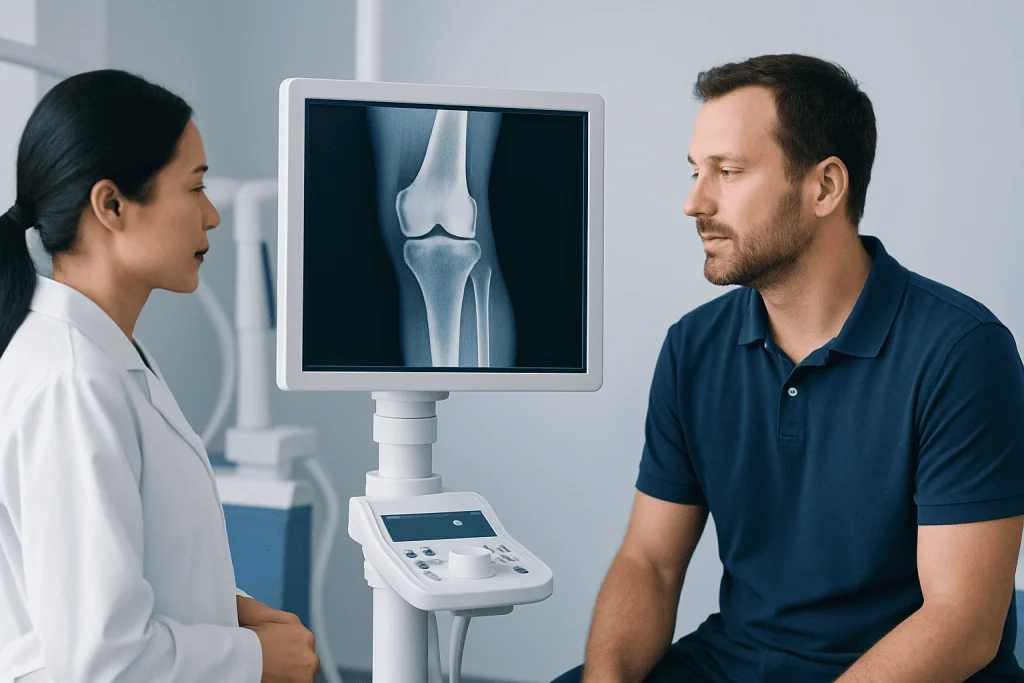
The best-known hinge joints are the elbow and the knee, though the knee is anatomically more complex than a basic hinge because it also allows a small amount of rotation. Smaller hinge joints are found in the fingers and toes, where they help with precise movement and support tasks such as typing, grasping, walking, and balancing.
Each hinge joint is covered by articular cartilage at the ends of the bones. This smooth, low-friction surface helps the bones glide against one another. Around the joint is a capsule lined with synovial membrane, which produces fluid that nourishes cartilage and supports easy movement. Ligaments help keep the joint aligned, while muscles and tendons generate force and guide motion.
Because hinge joints are meant to be stable, their range of movement is more limited than that of ball-and-socket joints such as the shoulder. This is useful in areas where the body needs strength and control. At the same time, repeated load, sports injuries, falls, or age-related wear can still affect the joint and lead to symptoms over time.
- Elbow: helps with reaching, lifting, and positioning the hand
- Knee: supports standing, walking, climbing, and shock absorption
- Finger joints: enable grasping and fine motor control
- Toe joints: assist balance and push-off during walking
Common symptoms when a hinge joint has a problem

Symptoms vary depending on the specific joint and the underlying cause, but patients commonly notice pain during movement or after activity. Some feel discomfort only at the end of the day, while others experience morning stiffness, tenderness, or a dull ache that gradually worsens. Joint symptoms can be mild and short-lived, or persistent enough to interfere with work, exercise, or sleep.
Swelling is another common sign. It may develop after an injury, with inflammation, or as part of arthritis. A hinge joint may also feel warm, look enlarged, or produce sounds such as clicking or grinding. These noises are not always serious, but they should be interpreted in context with pain, loss of motion, or instability.
Some people report weakness, locking, catching, or the sensation that the joint may give way. In the knee, this can make walking or climbing stairs difficult. In the fingers, swelling and stiffness may reduce grip strength. If symptoms continue, an orthopedic evaluation may be helpful, especially when conditions such as osteoarthritis or tendon injury are possible.
Causes and risk factors
Many hinge joint problems are linked to injury or repetitive strain. Sudden trauma, such as a fall, twisting movement, sports collision, or direct blow, can damage cartilage, ligaments, tendons, or bone. Overuse can also irritate the joint over time, particularly in athletes, manual workers, musicians, and people whose jobs require frequent kneeling, lifting, or repetitive hand motion.
Degenerative conditions are another major cause. With age, cartilage can gradually wear down, leading to pain, stiffness, and reduced function. This process is often called osteoarthritis and commonly affects the knee, fingers, and sometimes the elbow. Inflammatory conditions, including rheumatoid arthritis and some crystal-related joint disorders, may also affect hinge joints and lead to swelling, warmth, and prolonged stiffness.
Additional risk factors include excess body weight, poor muscle support around the joint, previous injuries, certain anatomical differences, and underlying systemic disease. In the knee, meniscal tears and ligament injuries are frequent causes of pain and instability. In the hand, tendon irritation and small-joint arthritis may become more likely with repetitive use.
Not every painful joint problem is a structural injury. Bursitis, tendinitis, infection, and referred pain from nearby structures can mimic primary joint disease. This is one reason a careful assessment matters before assuming that all pain is simply due to aging or overuse.
How doctors diagnose hinge joint conditions
Diagnosis starts with a medical history and physical examination. A doctor will usually ask when the symptoms began, whether there was an injury, which movements make symptoms worse, and whether swelling, locking, numbness, fever, or morning stiffness are present. These details help narrow the possible causes.
During the examination, the doctor checks range of motion, tenderness, swelling, joint alignment, and stability. They may compare one side with the other and assess how the surrounding muscles and tendons are functioning. In a knee complaint, for example, the exam may include tests for ligament or meniscus injury. In the hand or elbow, grip strength and tendon movement may be assessed.
Imaging is often used when symptoms are ongoing, severe, or linked to trauma. X-rays can show bone injury, joint space narrowing, or arthritic changes. Ultrasound may help assess tendons, fluid, or soft tissue inflammation. MRI is useful when cartilage, ligaments, menisci, or other internal structures are suspected to be damaged. Blood tests may be recommended if inflammatory arthritis or infection is a concern.
In more complex cases, patients may be referred for specialist care in orthopedics, rheumatology, or rehabilitation medicine. Depending on the findings, care may involve orthopedic evaluation or a structured rehabilitation plan.
Treatment options for hinge joint pain and dysfunction
Treatment depends on the cause, severity, and the patient’s daily needs. Many mild problems improve with relative rest, temporary activity modification, cold packs, and a gradual return to movement. Pain-relieving or anti-inflammatory medicines may be used when appropriate, but they should be guided by a clinician, especially for people with stomach, kidney, or cardiovascular concerns.
Physiotherapy is often a central part of care. Strengthening the muscles around a hinge joint can improve stability and reduce load on painful tissues. Stretching, balance training, and movement retraining may also help. In some cases, splints, braces, taping, or shoe modifications are recommended to support healing and reduce strain during activity.
If conservative treatment is not enough, doctors may consider injections or procedures depending on the diagnosis. For example, some joint conditions may benefit from image-guided injection, while more significant cartilage, meniscal, tendon, or ligament damage may require surgery. Patients with persistent knee pain related to internal joint damage may need assessment for knee surgery, and hand symptoms affecting function may sometimes be managed with hand surgery.
Advanced arthritis or severe structural injury may lead to longer-term treatment planning. This could include rehabilitation, lifestyle changes, or in selected cases, joint-preserving procedures or reconstruction. The most suitable approach is individualized and should aim to improve pain, movement, and daily function rather than focus on imaging findings alone.
Prevention and self-care
Not every hinge joint problem can be prevented, but healthy habits can lower strain and support joint function. Regular physical activity helps keep joints mobile and strengthens the muscles that protect them. Low-impact exercise, such as walking, swimming, cycling, or guided strengthening work, is often easier on painful joints than repeated jumping or high-force twisting movements.
Good technique matters during sports, exercise, and manual work. Warm-ups, gradual progression in training, and proper footwear can reduce unnecessary stress on the knees, ankles, and toes. For hand and elbow health, taking breaks during repetitive tasks and adjusting posture or workspace setup may help limit overuse symptoms.
Body weight also affects hinge joints, especially the knees and toes. Maintaining a weight that is healthy for the individual may help reduce pressure on weight-bearing joints. People with previous injuries should follow rehabilitation advice carefully, because incomplete recovery can increase the risk of ongoing instability or repeat injury.
Self-care has limits. If pain is persistent, worsening, or linked to significant swelling or loss of motion, it is sensible to seek medical guidance rather than continuing through discomfort. In some patients, early management can reduce long-term stiffness and help preserve joint function.
When to seek medical care
Medical assessment is important if a hinge joint becomes suddenly swollen after an injury, cannot bear weight, will not straighten or bend properly, or feels unstable. Prompt care is also advisable if there is severe pain, visible deformity, numbness, or a popping injury followed by weakness or rapid swelling.
A person should also see a doctor if joint pain lasts more than a few weeks, keeps returning, or interferes with sleep, exercise, work, or basic daily tasks. Warmth, redness, fever, or general illness together with joint pain may suggest infection or significant inflammation and should be evaluated promptly.
Specialist care can be useful when symptoms are complex or do not improve with basic treatment. Acibadem International’s multidisciplinary specialists and JCI-accredited hospitals diagnose and treat joint conditions for international patients, including cases that may require physical therapy and rehabilitation or further orthopedic review.
Frequently asked questions
What is a hinge joint in simple terms?
A hinge joint is a joint that mainly bends and straightens in one direction. It works similarly to a door hinge, providing controlled movement and stability.
What are examples of hinge joints in the body?
Common examples include the elbow, knee, finger joints, and toe joints. The knee is more complex than a simple hinge, but it is often grouped with hinge-type joints because bending and straightening are its main actions.
Why does a hinge joint hurt?
Pain can happen because of injury, overuse, arthritis, tendon problems, bursitis, or inflammation inside the joint. The exact cause depends on symptoms, examination findings, and sometimes imaging tests.
Can a hinge joint heal on its own?
Minor strains or overuse-related irritation may improve with rest, activity changes, and time. However, persistent pain, swelling, locking, or instability should be assessed by a qualified doctor to rule out more significant damage.
How is a hinge joint problem diagnosed?
Doctors usually begin with a history and physical examination. If needed, they may recommend X-rays, ultrasound, MRI, or blood tests depending on whether injury, arthritis, or inflammation is suspected.
What is the best treatment for hinge joint pain?
There is no single best treatment because the right option depends on the cause. Common approaches include physiotherapy, medicines, braces or splints, injections, and sometimes surgery for more serious structural problems.
This article is for general information only and is not a substitute for professional medical advice. Please consult a qualified doctor about your individual situation.
Joint and spine care in Turkey — expert assessment & treatment
JCI-accredited · board-certified surgeons · reply within 24h
Add us as a Preferred Source to see more of our trusted health content across Google Search, AI Overviews and Discover.

More from the Health Library

Hsc: Symptoms, Causes, and Treatment — Complete Patient Guide

Sorghum Molasses — Explained by Medical Evidence, Not Myths

Brca Gene: An Evidence-Based Guide for Patients

Ginger Tea for Sore Throat: An Evidence-Based Guide for Patients

Ginger: What Patients Need to Know

Hypervigilance: What Patients Need to Know
Orthopedic Surgery & Traumatology Specialists at Acibadem

Dr. Ali Koç
Orthopedic Surgery & Traumatology
Dr. Ali Osman Çiçek
Orthopedic Surgery & Traumatology
Assoc. Prof. Dr. Ali Şahin
Orthopedic Surgery & Traumatology
Dr. Alp Er Tunga Bölükbaşı
Orthopedic Surgery & Traumatology