Do Women Have Adam’s Apples? Here Is What the Evidence Says

Women have a laryngeal prominence too; it is often just less visible. A more noticeable Adam’s apple in women is often a normal variation in anatomy.
Key Takeaways
- Women have a laryngeal prominence too; it is often just less visible.
- A more noticeable Adam’s apple in women is often a normal variation in anatomy.
- Puberty, body shape, weight loss, and hormone-related changes can affect how visible it looks.
- A new or changing neck lump, pain, hoarseness, or trouble swallowing needs medical review.
- Doctors may use an examination, laryngoscopy, blood tests, or imaging to find the cause.
Yes. Women do have the same laryngeal structure often called the Adam’s apple, but it is usually smaller and less noticeable. In most cases, a visible bump in the front of the neck is a normal anatomical variation, though new changes, pain, swallowing trouble, or voice changes should be checked by a doctor.
Overview: Do Women Have Adam’s Apples?
Yes—women do have Adam’s apples. The term “Adam’s apple” refers to the laryngeal prominence, which is the front part of the thyroid cartilage of the voice box. Everyone has this structure because everyone has a larynx, but its size, angle, and visibility vary from person to person.
In women, the laryngeal prominence is usually smaller and less sharply angled than in men, so it may not stand out as much. Even so, some women naturally have a visible bump in the middle of the neck. This is often harmless and simply reflects normal differences in anatomy.
What matters most is whether the appearance has always been present or whether it is new, enlarging, painful, or linked to other symptoms. A stable, painless neck contour is commonly normal. By contrast, a newly noticed lump or one that comes with hoarseness, swallowing difficulty, or breathing symptoms deserves medical attention.
What an Adam’s Apple Actually Is
The Adam’s apple is not a separate organ. It is the front projection of the thyroid cartilage, a firm protective structure that surrounds the larynx. The larynx houses the vocal cords and plays a key role in breathing, speaking, and protecting the airway during swallowing.
During puberty, growth of the larynx and thyroid cartilage usually becomes more pronounced in boys because of testosterone-related changes. This often leads to a larger, more visible Adam’s apple and a deeper voice. In girls, the larynx also grows, but usually to a lesser degree.
That difference is why many people associate Adam’s apples mainly with men, even though the underlying anatomy exists in women too. A visible neck contour in a woman may simply mean the cartilage sits closer to the skin, the neck is slender, or the angle of the cartilage is naturally more prominent.
Why It May Be More Visible in Some Women

There are several normal reasons an Adam’s apple may be easier to see in women. Natural body variation is the most common. A person with a thinner neck, less soft tissue over the larynx, or a more defined cartilage angle may have a more noticeable prominence without any disease being present.
Weight loss can also make the structures of the neck easier to see. When the soft tissue under the skin becomes thinner, the thyroid cartilage, thyroid gland, tendons, and other normal contours may look more obvious than before. This can be surprising but is not necessarily abnormal.
Hormonal influences may play a role as well. Changes related to puberty, certain endocrine conditions, or differences in sex hormone exposure can affect laryngeal growth and voice changes. In some cases, people may also confuse an Adam’s apple with a thyroid-related swelling or another neck lump, which is why a medical review is helpful if the area seems new or unusual.
- Normal anatomical variation
- Slender neck shape or lower body fat
- Weight loss making neck structures more visible
- Puberty-related or hormone-related changes
- Mistaking another neck lump for the laryngeal prominence
When a Visible Neck Bump May Not Be the Adam’s Apple
Not every bump in the front of the neck is the laryngeal prominence. The thyroid gland sits lower in the neck, in front of the windpipe, and enlargement of this gland can sometimes look like or be mistaken for an Adam’s apple. A thyroid enlargement may occur with iodine imbalance, inflammation, nodules, autoimmune thyroid disease, or other causes.
Other possibilities include cysts, enlarged lymph nodes, lipomas, benign growths, or less commonly tumors involving the thyroid, larynx, or nearby tissues. If the area feels uneven, grows over time, or appears off-center, it is more important to have it examined. A doctor may evaluate for conditions such as goiter or other causes of a neck mass.
Voice changes may offer another clue. Because the larynx contains the vocal cords, hoarseness, a weaker voice, throat discomfort, or a sensation of something stuck in the throat can point toward a laryngeal issue rather than a simple normal anatomical variation. If concern centers on the voice box itself, an ENT specialist may assess for problems such as vocal cord nodules or other laryngeal conditions.
Red Flags and When to Seek Medical Care
In many women, a visible Adam’s apple is harmless. Still, some symptoms should not be ignored. Medical review is important if the neck bump is new, rapidly changing, painful, hard, or clearly getting larger over time.
A doctor should also assess associated symptoms such as persistent hoarseness, trouble swallowing, shortness of breath, choking sensations, throat pain, unexplained cough, or unexplained weight loss. These symptoms do not always mean something serious, but they do mean the neck and throat should be examined carefully.
It is also sensible to seek advice if there are signs of hormone imbalance, such as menstrual changes, new facial hair growth, acne, or major voice deepening. These changes can sometimes point to endocrine issues that need evaluation rather than being explained by normal anatomy alone.
- New or enlarging neck lump
- Pain, tenderness, or firmness
- Persistent hoarseness or voice change
- Trouble swallowing or breathing
- Symptoms of thyroid or hormone imbalance
How Doctors Evaluate It
The first step is usually a clinical examination. A doctor will ask when the bump was first noticed, whether it has changed, and whether there are symptoms involving the voice, breathing, swallowing, or hormones. The neck is then examined for location, size, mobility, tenderness, and whether the structure moves with swallowing.
If the concern seems related to the larynx, the doctor may recommend a scope test to look directly at the voice box. This is commonly done with laryngoscopy, which allows the specialist to see the larynx and vocal cords. It can help distinguish normal anatomy from inflammation, nodules, or other structural changes.
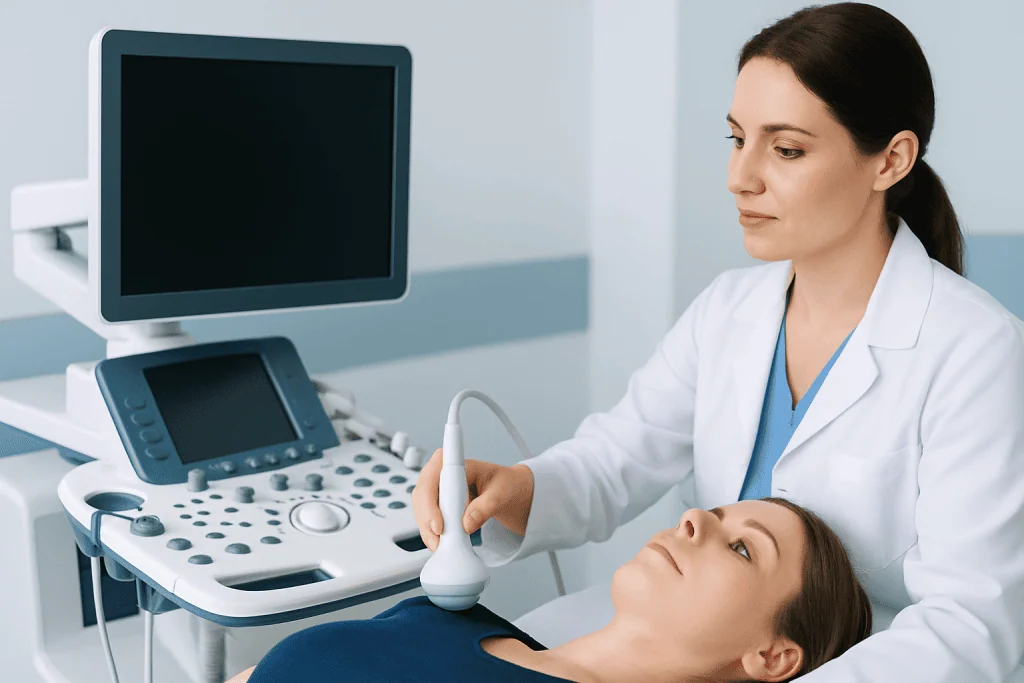
When thyroid disease is suspected, blood tests and imaging may be used. Thyroid hormone testing can help assess gland function, and thyroid ultrasound can show whether a swelling is coming from the thyroid gland or surrounding tissues. If the finding is more complex or extends deeper into the neck, additional imaging such as MRI may be considered to clarify the anatomy.
Treatment and Management Options
Treatment depends entirely on the cause. If the prominent area is simply a normal laryngeal prominence and there are no other symptoms, no medical treatment is needed. Reassurance and observation are often enough.
If a thyroid disorder, laryngeal condition, or another neck mass is found, treatment is directed at that problem. This may involve monitoring, medication, voice care, speech therapy, or in selected cases surgery. The right approach depends on the diagnosis, symptom severity, and the person’s overall health.
Some women seek help because the prominence causes cosmetic concern rather than medical symptoms. In that situation, consultation with an experienced ENT, endocrine, or surgical team may help clarify safe options and realistic expectations. Care should begin with a proper diagnosis, since treatment for appearance alone is very different from treatment for a thyroid or voice-box condition.
Self-Care, Monitoring, and Specialist Support
Self-care begins with paying attention to changes rather than assuming the worst. A longstanding, stable, painless prominence is often just part of normal anatomy. Taking note of whether the area changes in size, becomes painful, or is linked to voice or swallowing symptoms can help provide useful information for a doctor.
It may also help to avoid repeated pressing or checking of the neck, which can increase anxiety and sometimes create soreness. If there is ongoing uncertainty, a routine medical visit can provide reassurance and determine whether specialist review is needed. People with voice symptoms may benefit from an ENT assessment, while those with menstrual, thyroid, or hormone-related symptoms may need endocrine evaluation.
For international patients who need assessment or treatment, Acibadem International’s multidisciplinary specialists and JCI-accredited hospitals evaluate neck, thyroid, and laryngeal concerns using appropriate imaging, laboratory tests, and ENT or endocrine consultation. The most suitable next step depends on whether the visible area is normal anatomy or a separate medical condition.
Frequently asked questions
Is it normal for a woman to have an Adam’s apple?
Yes. Women have the same laryngeal structure as men, but it is often smaller and less noticeable. In many cases, a visible bump is simply a normal variation in neck anatomy.
Why is my Adam’s apple more visible after weight loss?
Weight loss can make normal neck structures easier to see because there is less soft tissue covering them. The thyroid cartilage, tendons, and thyroid area may all appear more defined. If the area is new, growing, or uneven, it is still worth having it checked.
Can hormone changes make an Adam’s apple more noticeable in women?
They can in some cases. Puberty, endocrine disorders, and changes in sex hormone levels may affect the larynx and voice. If a more visible neck prominence comes with voice deepening, menstrual changes, or excess hair growth, medical evaluation is a good idea.
How can someone tell the difference between an Adam’s apple and a thyroid lump?
It can be difficult to tell at home because both are located in the front of the neck. A doctor can examine the area and may use ultrasound or other tests to identify whether the visible bump is normal cartilage, thyroid enlargement, or another type of lump.
Should a woman worry about a visible Adam’s apple?
Usually not, especially if it has always looked that way and there are no other symptoms. Concern is higher when the prominence is new, changing, painful, or associated with hoarseness, swallowing trouble, or breathing symptoms.
What doctor should evaluate a noticeable Adam’s apple in a woman?
A primary care doctor can often begin the evaluation. Depending on the findings, they may refer to an ENT specialist for the larynx and voice box or to an endocrinologist if thyroid or hormone issues are suspected.
References
- American Academy of Otolaryngology–Head and Neck Surgery
- National Institute on Deafness and Other Communication Disorders
- American Thyroid Association
- Mayo Clinic
- MedlinePlus
This article is for general information only and is not a substitute for professional medical advice. Please consult a qualified doctor about your individual situation.
Explore treatments in Turkey — costs, top hospitals & a free quote
JCI-accredited · board-certified surgeons · reply within 24h
Add us as a Preferred Source to see more of our trusted health content across Google Search, AI Overviews and Discover.
Check your numbers in seconds
BMI, calories, due date, blood pressure and 30+ more clinical calculators — free, instant, doctor-reviewed ranges.