Goiter
Goiter is an enlarged thyroid gland. Learn about goiter symptoms, causes, diagnosis, treatment options and when to see a doctor.

Quick answer
Goiter is an enlargement of the thyroid gland, often linked to iodine imbalance, thyroid nodules, or hormone disorders, and it may cause visible neck swelling, swallowing difficulty, or breathing discomfort. Treatment depends on the cause and size of the gland and can include monitoring, medication, radioactive iodine, or thyroid surgery, with diagnosis based on examination, blood tests, and imaging.
What is goiter?
A goiter is an enlargement of the thyroid gland, the butterfly-shaped gland located at the front of the neck, just below the voice box. The thyroid produces hormones that help regulate metabolism, which is the way the body uses energy. When the gland grows larger than normal, the swelling it causes is called a goiter. Understanding what is goiter and what it is not can be reassuring: a goiter is a description of the gland’s size, not a diagnosis of cancer, and many goiters are benign, meaning not cancerous.
Goiters vary widely. The entire gland may enlarge evenly, which doctors call a diffuse goiter, or the gland may develop one or more lumps, known as nodules, which is called a nodular or multinodular goiter. A goiter can occur whether the thyroid is producing too much hormone (hyperthyroidism), too little hormone (hypothyroidism), or a normal amount (a euthyroid or nontoxic goiter). The code E04.9 refers to a nontoxic goiter, meaning the enlargement is not associated with excess thyroid hormone.
Goiter can affect people of any age, but it is more common in women, in people over 40, in those with a family history of thyroid disease, and in regions of the world where iodine, a mineral the thyroid needs to make its hormones, is scarce in the diet. In many countries, iodized salt has made iodine-deficiency goiter far less common than it once was, but the condition still occurs worldwide.
Symptoms of goiter
Many goiters cause no symptoms at all, especially when they are small. In such cases the enlargement is often discovered by chance during a routine physical examination or on an imaging scan performed for another reason. When goiter symptoms do occur, they usually relate either to the physical size of the gland pressing on nearby structures or to abnormal levels of thyroid hormone, if hormone production is also affected.
Common goiter symptoms related to the size of the gland include:
- Visible swelling at the base of the neck, which may be more noticeable when swallowing or shaving, or when applying makeup
- A feeling of tightness or fullness in the throat
- Difficulty swallowing (dysphagia), particularly with solid foods, if the goiter presses on the esophagus, the tube that carries food to the stomach
- Difficulty breathing or a sense of pressure on the windpipe (trachea), especially when lying flat or raising the arms
- Hoarseness or a change in the voice, if the goiter affects the nerves that control the vocal cords
- Coughing or throat clearing without another explanation
Symptoms tend to differ by the stage and type of goiter. A small, early goiter is often invisible and painless. As a goiter grows, the cosmetic swelling usually appears first, followed later by pressure symptoms such as swallowing or breathing difficulty. A goiter that grows downward behind the breastbone, called a substernal or retrosternal goiter, may cause breathing symptoms even when little swelling is visible in the neck.
If the goiter is associated with an overactive thyroid, additional symptoms may include a rapid or irregular heartbeat, unintended weight loss, heat intolerance, tremor, anxiety, and sleep problems. If it is associated with an underactive thyroid, people may notice fatigue, weight gain, cold intolerance, dry skin, constipation, and low mood. A nontoxic goiter, by definition, does not cause these hormone-related symptoms, but hormone levels can change over time, which is one reason ongoing follow-up matters.
Sudden pain or rapid enlargement of a goiter is uncommon and should always be evaluated promptly, as it can indicate bleeding into a nodule, inflammation, or, rarely, a more serious condition.
Causes and risk factors
There are many possible goiter causes, and often more than one factor contributes. The most important include:
- Iodine deficiency. Worldwide, a lack of dietary iodine remains the most common cause of goiter. Without enough iodine, the thyroid cannot make sufficient hormone and enlarges as it works harder to compensate.
- Autoimmune thyroid disease. In Hashimoto’s thyroiditis, the immune system attacks the thyroid, which can lead to enlargement and, over time, an underactive gland. In Graves’ disease, immune antibodies overstimulate the thyroid, causing both enlargement and excess hormone production.
- Thyroid nodules. Single nodules or multiple nodules (multinodular goiter) are common, particularly with increasing age. Most nodules are benign, but each new or growing nodule generally deserves evaluation.
- Hormonal changes. Pregnancy, puberty, and menopause can influence thyroid size, partly because hormonal shifts increase demands on the gland.
- Thyroiditis. Inflammation of the thyroid, whether caused by infection, autoimmune disease, or certain medications, can cause temporary or lasting enlargement.
- Medications and substances. Certain drugs, such as lithium (used for mood disorders) and amiodarone (a heart rhythm medication), can affect thyroid function and size.
- Genetics and family history. Goiter and thyroid disease often run in families, suggesting inherited factors play a role.
- Radiation exposure. Previous radiation to the head, neck, or chest, particularly in childhood, increases the risk of thyroid nodules and thyroid cancer.
Additional risk factors include being female, being over 40, smoking, and, in some populations, a diet very high in certain raw foods known as goitrogens (such as large quantities of raw cabbage or cassava), although this is rarely a significant cause in people with adequate iodine intake.
Diagnosis
Goiter diagnosis begins with a medical history and a physical examination. The doctor will feel (palpate) the neck to assess the size, texture, and symmetry of the thyroid, check for nodules, and ask about swallowing, breathing, voice changes, and symptoms of hormone imbalance, as well as family history and medication use.
Because a goiter itself is only a sign, the goal of testing is to answer three questions: how well is the thyroid working, what is the structure of the gland, and is there any suspicion of cancer. Commonly used tests include:
- Blood tests. Thyroid-stimulating hormone (TSH) is usually the first test; it shows whether the thyroid is overactive, underactive, or functioning normally. Free thyroxine (free T4) and sometimes triiodothyronine (T3) may be measured as well. Thyroid antibody tests can help identify autoimmune causes such as Hashimoto’s thyroiditis or Graves’ disease.
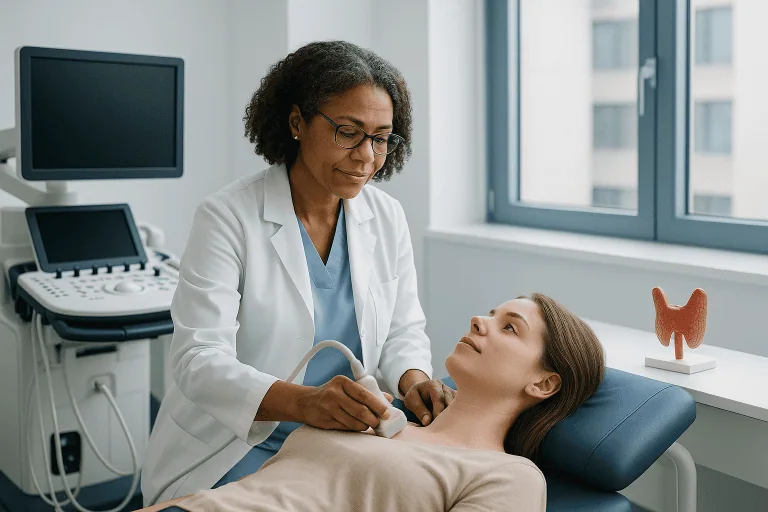
- Thyroid ultrasound. This painless scan uses sound waves to create images of the gland. It measures the size of the thyroid, identifies and characterizes nodules, and helps doctors decide whether a nodule needs further testing. Ultrasound is the standard imaging tool for goiter diagnosis.
- Fine-needle aspiration (FNA) biopsy. If a nodule has features that raise concern, a very thin needle is used, often with ultrasound guidance, to take a small sample of cells for examination under a microscope. This is the most reliable way to determine whether a nodule is benign or suspicious for cancer.
- Radioactive iodine uptake scan. If blood tests show an overactive thyroid, this scan can show which parts of the gland are producing excess hormone.
- CT or MRI scans. Cross-sectional imaging may be used for large goiters, especially those extending behind the breastbone, to assess whether the windpipe or esophagus is being compressed and to plan surgery if needed.
Not every patient needs every test. In many cases, a normal TSH result and a reassuring ultrasound are enough to confirm a benign, nontoxic goiter that can simply be monitored.
Treatment options for goiter
Goiter treatment depends on the size of the gland, whether it causes symptoms, whether hormone levels are abnormal, and whether there is any concern about cancer. There is no single approach that fits everyone, and in many cases the best option is simply careful observation. Goiter is typically managed by an endocrinologist, a doctor who specializes in hormone-related conditions; at Acibadem, for example, this falls under the Endocrinology & Metabolism department, often working together with thyroid surgeons when procedures are considered.
Watchful waiting
If a goiter is small, hormone levels are normal, and there are no pressure symptoms or suspicious nodules, doctors often recommend monitoring rather than active treatment. This usually involves periodic physical examinations, blood tests, and ultrasound scans to check whether the gland or any nodules are changing. Many goiters remain stable for years and never require intervention.
Medication
When a goiter is linked to abnormal hormone levels, treating the underlying problem is the priority. An underactive thyroid is treated with levothyroxine, a synthetic form of thyroid hormone taken as a daily tablet; in some cases this can also modestly reduce gland size. An overactive thyroid may be treated with antithyroid drugs, which reduce hormone production. If iodine deficiency is the cause, correcting iodine intake, under medical guidance, may help. Doctors generally do not recommend taking iodine supplements without testing, because excess iodine can worsen some thyroid conditions.
Radioactive iodine therapy
For some overactive goiters, radioactive iodine taken as a capsule or liquid is absorbed by the thyroid and gradually shrinks the overactive tissue. This treatment often leads to an underactive thyroid afterward, which is then managed with hormone replacement tablets. Radioactive iodine is not suitable for everyone, including people who are pregnant.
Minimally invasive procedures
In selected patients with benign nodules, techniques such as radiofrequency ablation, which uses heat delivered through a thin needle to shrink a nodule, may be considered. Availability and suitability vary, and these procedures are typically an option only after a biopsy has confirmed the nodule is benign.
Surgery
Surgery to remove part or all of the thyroid (thyroidectomy) may be recommended when a goiter is large enough to compress the windpipe or esophagus, when it extends behind the breastbone, when cancer is confirmed or strongly suspected, or occasionally for cosmetic reasons or when other treatments have not worked. If the entire gland is removed, lifelong thyroid hormone replacement is needed. As with any operation, thyroid surgery carries risks, including temporary or, less often, lasting effects on the voice and on the parathyroid glands, which control calcium levels; your surgical team will discuss these with you before any decision.
Living with goiter and outlook
For most people, the outlook with a goiter is good. Many goiters are benign, grow slowly or not at all, and never cause significant problems. When treatment is needed, the underlying cause can usually be managed effectively, whether through medication, radioactive iodine, or surgery.
Living well with a goiter generally means attending scheduled follow-up appointments, having blood tests and ultrasounds as advised, taking any prescribed thyroid medication consistently, and reporting new symptoms, such as increasing swelling, swallowing difficulty, breathing changes, or voice changes, without delay. If you take levothyroxine, your doctor may adjust the dose over time based on blood tests, and it is important not to stop the medication on your own.
A balanced diet with adequate but not excessive iodine, usually achieved simply by using iodized salt where recommended, supports normal thyroid function. Not smoking may also reduce the risk of goiter progression. It is honest to say that no treatment can guarantee a goiter will never return or change; even after surgery on part of the gland, remaining thyroid tissue can occasionally enlarge again, which is why long-term follow-up is often advised.
Frequently asked questions
What is goiter, in simple terms?
A goiter is simply an enlarged thyroid gland, the hormone-producing gland at the front of the neck. It is a physical finding rather than a single disease, and it can occur with normal, high, or low thyroid hormone levels. Most goiters are benign, but each one deserves evaluation to identify the cause and rule out anything more serious.
Is a goiter the same thing as thyroid cancer?
No. The great majority of goiters are not cancerous. However, some goiters contain nodules, and a small proportion of nodules turn out to be malignant. That is why doctors often use ultrasound and, when indicated, a needle biopsy to check nodules. Having a goiter evaluated does not mean cancer is suspected; it is a routine and cautious approach.
Can a goiter go away on its own?
Sometimes. Goiters caused by temporary factors, such as pregnancy, puberty, or a passing episode of thyroid inflammation, may shrink without treatment. Goiters caused by iodine deficiency can improve when iodine intake is corrected. Long-standing multinodular goiters, however, rarely disappear on their own, although many remain stable and harmless for years.
How serious is a goiter?
In most cases, a goiter is not dangerous, particularly when it is small and hormone levels are normal. It becomes more serious if it grows large enough to press on the windpipe or esophagus, if it produces too much or too little hormone, or if a nodule within it is suspicious for cancer. Regular monitoring is the main way doctors catch these changes early.
What is the best goiter treatment?
There is no single best goiter treatment; the right approach depends on the cause, the size of the gland, your symptoms, and your overall health. Options range from simple observation to medication, radioactive iodine, minimally invasive procedures, or surgery. An endocrinologist can explain which options apply in your situation and what each involves.
What is recovery like after thyroid surgery for goiter?
Recovery experiences vary, but many people go home within a day or two of surgery and return to normal activities within a few weeks, following their surgeon’s guidance. Temporary hoarseness, neck soreness, or fatigue can occur. If the whole thyroid is removed, daily hormone replacement tablets are needed for life, with periodic blood tests to fine-tune the dose.
Can diet prevent or treat a goiter?
Adequate iodine intake, commonly achieved through iodized salt, helps prevent iodine-deficiency goiter, which is why the condition is now less common in many countries. However, diet alone cannot treat goiters caused by autoimmune disease or nodules, and taking iodine supplements without medical advice can be harmful in some thyroid conditions. Discuss any dietary changes or supplements with your doctor first.
When to see a doctor
See a doctor if you notice any swelling at the front of your neck, even if it is painless, or if you develop symptoms of a hormone imbalance such as unexplained weight change, a racing heart, persistent fatigue, or feeling unusually hot or cold. Early evaluation makes goiter diagnosis straightforward and helps identify the cause before complications develop.
Seek urgent medical attention if you experience any of the following red-flag warning signs:
- Difficulty breathing, noisy breathing, or a feeling of choking, especially when lying down
- Sudden, rapid enlargement of a neck swelling over days or weeks
- Severe pain in the neck or thyroid area, particularly with fever
- Increasing difficulty swallowing, or food feeling stuck in the throat
- A persistent change in your voice or new hoarseness lasting more than a few weeks
- A hard, fixed lump in the neck, or swollen lymph nodes that do not go away
- A very fast or irregular heartbeat, chest discomfort, or fainting, which can signal severe thyroid hormone excess
These signs do not necessarily mean something serious is happening, but they should always be assessed promptly by a medical professional so that any needed goiter treatment can begin without delay.
Medically reviewed by the Acıbadem International Medical Board September 2, 2026
See our medical review board →
Update history
- PublishedJune 8, 2026
- Medical review approvedSeptember 2, 2026
- Last content updateSeptember 2, 2026