Leser Trelat Sign: What Patients Need to Know

Leser Trelat sign describes a sudden eruption or rapid increase in seborrheic keratoses, not a single isolated spot. Seborrheic keratoses themselves are benign skin growths, but the pattern of sudden appearance may matter.
Key Takeaways
- Leser Trelat sign describes a sudden eruption or rapid increase in seborrheic keratoses, not a single isolated spot.
- Seborrheic keratoses themselves are benign skin growths, but the pattern of sudden appearance may matter.
- Doctors may evaluate for skin disease as well as possible internal conditions, including some cancers, depending on the full clinical picture.
- Diagnosis usually involves a skin exam, review of symptoms, and sometimes biopsy or further testing.
- Prompt medical review is especially important if the skin changes occur with weight loss, fatigue, abdominal symptoms, or other new health concerns.
Leser Trelat sign refers to the sudden onset or rapid increase of multiple seborrheic keratoses, often with itching. While these growths are usually harmless, this pattern can sometimes be associated with an underlying medical condition, so timely medical assessment is recommended.
Overview: what Leser Trelat sign means
Leser Trelat sign is the term used when many seborrheic keratoses appear suddenly or increase quickly over a short period of time. Seborrheic keratoses are common, noncancerous skin growths that often look waxy, rough, or “stuck on” the skin. The sign does not mean that the spots themselves are dangerous, but it may prompt doctors to look more carefully at the person’s overall health.
This sign is discussed because, in some patients, it has been reported alongside internal illnesses, including certain cancers. At the same time, seborrheic keratoses are very common with aging, and not every cluster of new lesions means something serious is present. The key issue is the pattern: a sudden eruption, rapid increase, or change associated with other symptoms such as itching, unexplained weight loss, or fatigue.
Because the term can sound alarming, it helps to keep the message balanced. Leser Trelat sign is best understood as a clinical clue, not a diagnosis by itself. A doctor considers the skin findings together with age, medical history, physical examination, and any other symptoms before deciding whether more testing is needed.
What the skin changes can look and feel like
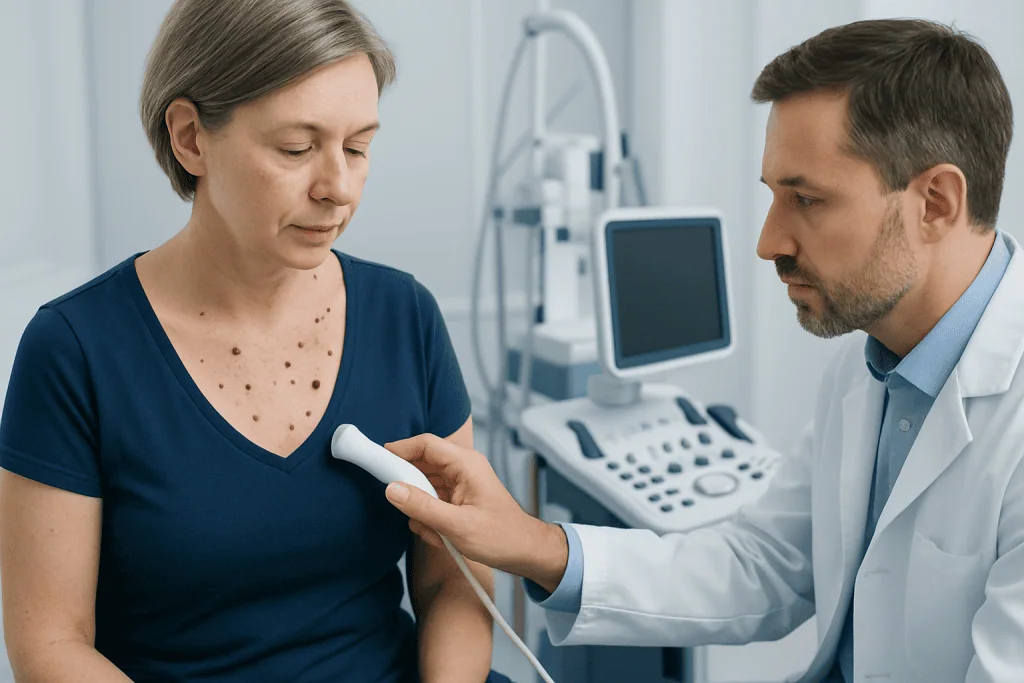
The lesions seen in Leser Trelat sign are usually seborrheic keratoses. These growths may be tan, brown, or dark in color and can range from flat to raised. Their surface may feel smooth, waxy, velvety, or rough, and they often seem as though they are sitting on top of the skin.
They most often appear on the chest, back, abdomen, neck, or face, but they can occur in other areas as well. In the setting of Leser Trelat sign, the main feature is not just their appearance but how quickly they emerge or multiply. Some people notice dozens of new spots over weeks or months rather than years.
Itching is commonly described, and the skin may feel irritated where the lesions cluster. However, these spots are not the same as moles, skin tags, or skin cancer. A clinician may also look for related skin findings, such as darkened, velvety patches in body folds called acanthosis nigricans, which can occasionally appear in the same broader medical context.
Possible causes and why doctors take it seriously

The exact cause of Leser Trelat sign is not fully understood. One proposed explanation is that certain internal diseases may release growth factors or other signals that stimulate the skin, leading to the sudden eruption of seborrheic keratoses. This is why the sign is often described as a possible paraneoplastic skin finding, meaning a skin change that can occur in association with an internal cancer.
Cancers most often discussed in relation to Leser Trelat sign include gastrointestinal adenocarcinomas, especially stomach and colon cancers, as well as some cancers of the pancreas, breast, or lung. Blood cancers have also been reported in some cases. For this reason, the sign may lead to an evaluation for cancer when the overall clinical picture suggests that possibility.
Still, there is important debate in medicine because seborrheic keratoses are so common, especially in older adults. Some people develop many lesions over time without any serious underlying disease. Infections, inflammatory states, pregnancy, or ordinary age-related skin changes may also be considered in the differential diagnosis. The safest interpretation is that a sudden eruption deserves assessment, but it does not prove that cancer is present.
How doctors evaluate Leser Trelat sign
Evaluation starts with a careful medical history and skin examination. The doctor usually asks when the lesions first appeared, how quickly they spread, whether they itch or bleed, and whether there are other symptoms such as weight loss, appetite change, abdominal pain, persistent cough, or fatigue. This broader history helps determine whether the skin findings may be part of a larger medical issue.
A dermatologist may examine the spots closely, sometimes with a dermatoscope, to confirm that they look like seborrheic keratoses rather than another skin condition. If a lesion appears unusual, irritated, or atypical, a biopsy may be recommended to confirm the diagnosis and rule out other possibilities. In some patients, doctors may also evaluate for skin cancer if there are suspicious lesions mixed in with otherwise benign growths.
Additional tests depend on the individual situation rather than a single standard checklist for everyone. Based on symptoms, age, medical history, and examination findings, a doctor may suggest blood tests, age-appropriate cancer screening, imaging, or referral to relevant specialists. If the concern is mainly dermatologic, a specialist may help with lesion assessment and treatment planning, including options used in dermatology care.
Treatment options and what happens after diagnosis
Treatment depends on what the evaluation shows. If the lesions are confirmed to be seborrheic keratoses and no concerning underlying condition is found, care may focus on symptom relief, reassurance, and observation. These growths are benign, and they do not always need to be removed unless they are bothersome, irritated, or cosmetically unwanted.
When removal is appropriate, common methods include cryotherapy, curettage, electrosurgery, or other minor dermatologic procedures chosen by the treating clinician. If itching is present, skin care measures or medications may be suggested to reduce discomfort. Removal treats the visible lesions, but it does not address the reason they appeared suddenly if there is an underlying trigger.
If testing identifies another medical condition, treatment is directed at that cause. In reported paraneoplastic cases, the skin eruption may stabilize or improve after treatment of the associated illness. Depending on findings, patients may be referred for medical oncology assessment or, if imaging is needed as part of the workup, radiology services. The care plan is individualized and may involve several specialties working together.
Self-care, monitoring, and practical tips
There is no proven home remedy that can diagnose or treat Leser Trelat sign, so self-care should support medical follow-up rather than replace it. Patients may find it helpful to take clear photos of the skin changes over time and note when new lesions appear. This simple record can help a doctor understand how rapidly the eruption developed.
It is also wise to avoid picking, scratching, or trying to remove lesions at home. Irritation can cause bleeding, infection, or scarring and may make medical assessment more difficult. Gentle skin care, moisturizers, and avoiding friction from tight clothing may help if the spots are itchy or sensitive.
General health maintenance remains important. Keeping up with age-appropriate screening, reporting new symptoms promptly, and attending recommended follow-up visits can make the evaluation more complete. Near the end of the care pathway, some patients may seek multidisciplinary assessment; Acibadem International’s specialists at JCI-accredited hospitals diagnose and treat patients with complex skin findings and related underlying conditions.
When to seek medical care
A person should arrange medical evaluation if many wart-like, waxy, or stuck-on skin lesions appear over a short period of time or if existing lesions suddenly increase in number. Even though seborrheic keratoses are usually harmless, the abrupt pattern is what deserves attention. A dermatologist or primary care doctor can decide whether any further testing is needed.
More urgent review is appropriate if the skin changes come with unexplained weight loss, persistent fatigue, reduced appetite, abdominal pain, change in bowel habits, new cough, swollen lymph nodes, or any other concerning symptom. Medical advice should also be sought if a lesion bleeds easily, changes in an unusual way, becomes painful, or looks different from the others.
Seeking care promptly does not mean expecting the worst. In many cases, evaluation brings reassurance. The goal is simply to make sure the skin findings are correctly identified and that any associated health issue, if present, is recognized early and managed appropriately.
Frequently asked questions
Is Leser Trelat sign always a sign of cancer?
No. Leser Trelat sign can be associated with internal cancer in some patients, but it is not a diagnosis of cancer by itself. Because seborrheic keratoses are also common with aging, a doctor needs to interpret the skin changes in the context of the whole person.
What is the difference between Leser Trelat sign and ordinary seborrheic keratoses?
Ordinary seborrheic keratoses usually develop gradually over time. Leser Trelat sign refers to a sudden eruption or rapid increase in the number of these lesions, often over weeks or months. That sudden pattern is why medical review is advised.
Are the lesions themselves dangerous?
Seborrheic keratoses are benign skin growths and are not skin cancer. The main concern is not the lesions themselves but whether their sudden appearance may be linked to another condition. A clinician can confirm the diagnosis and decide whether any further workup is appropriate.
How is Leser Trelat sign diagnosed?
Diagnosis is based on the history of sudden onset or rapid increase in lesions together with a skin examination. A dermatologist may use dermoscopy, and a biopsy may be done if a lesion looks atypical. Additional tests depend on symptoms, age, and the overall clinical picture.
Can the spots be removed?
Yes. If seborrheic keratoses are bothersome, itchy, irritated, or cosmetically unwanted, they can often be removed with common dermatologic procedures. The best method depends on the size, location, and number of lesions.
Should someone with sudden new seborrheic keratoses go to the emergency room?
Usually, this is not an emergency, but it should not be ignored. A prompt appointment with a doctor or dermatologist is usually the right next step. Emergency care may be needed only if there are severe associated symptoms or another urgent medical problem.
This article is for general information only and is not a substitute for professional medical advice. Please consult a qualified doctor about your individual situation.
Explore treatments in Turkey — costs, top hospitals & a free quote
JCI-accredited · board-certified surgeons · reply within 24h
Add us as a Preferred Source to see more of our trusted health content across Google Search, AI Overviews and Discover.

More from the Health Library

Ear Clogged: A Complete Medical Overview

Circle of Willis: A Complete Medical Overview

Valgus Stress Test: A Complete Medical Overview

Can you survive without kidneys? A Doctor-Reviewed Answer

Concussion Test: A Complete Medical Overview