Corn Callus vs Wart: Key Differences and How Doctors Tell Them Apart

Corns and calluses are caused by pressure or friction; warts are caused by human papillomavirus (HPV). A wart often interrupts normal skin lines and may show tiny black dots, while a callus usually keeps skin lines running through it.
Key Takeaways
- Corns and calluses are caused by pressure or friction; warts are caused by human papillomavirus (HPV).
- A wart often interrupts normal skin lines and may show tiny black dots, while a callus usually keeps skin lines running through it.
- Corns are often painful with direct pressure; plantar warts may hurt more when the area is squeezed from the sides.
- Home treatment depends on the cause, so it is important not to cut or aggressively scrape a lesion before knowing what it is.
- People with diabetes, poor circulation, nerve problems, or a weakened immune system should seek medical advice early for any foot lesion.
Corn callus vs wart can usually be separated by cause, appearance, and how the spot behaves under pressure. Corns and calluses develop from repeated friction or pressure, while warts are viral skin growths, and clinicians distinguish them by looking at skin lines, surface texture, tenderness, and any tiny black dots from clotted capillaries.
Overview: corn callus vs wart at a glance
When people compare corn callus vs wart, the most important difference is the cause. Corns and calluses are the skin’s response to repeated rubbing or pressure, often from shoes, walking patterns, or bony pressure points. Warts are caused by infection with certain types of human papillomavirus (HPV), which enters through tiny breaks in the skin.
These conditions can look similar, especially on the feet, where thickened skin can hide a wart’s typical features. That is why a lesion on the sole may be mistaken for a corn or callus at first. In practice, clinicians do not rely on one sign alone; they look at the pattern of the skin, the shape of the lesion, where it sits, and how it feels when pressed.
The table below summarizes the differences doctors commonly use:
| Feature | Corn | Callus | Wart |
|---|---|---|---|
| Main cause | Localized pressure or friction | Repeated friction or pressure over a broader area | HPV infection |
| Typical location | Toes, tops/sides of toes, pressure points on feet | Soles, heels, palms, areas of repeated rubbing | Soles of feet, toes, hands, around nails, other skin areas |
| Shape | Small, well-defined, often with a hard central core | Broader, flatter thickened skin | Rough or grainy bump; may be flat on weight-bearing skin |
| Skin lines | Usually continue through lesion | Usually continue through lesion | Often interrupted or distorted |
| Black dots | Absent | Absent | May be present from tiny clotted blood vessels |
| Pain pattern | Often hurts with direct downward pressure | May feel tender or burn with pressure/friction | Often tender when squeezed from the sides; can hurt with walking |
| Contagious? | No | No | Yes, potentially through skin contact or shared damp surfaces |
Although many cases are straightforward, some lesions are mixed or misleading. A plantar wart can become covered by callused skin, and a pressure-related corn can look surprisingly irregular. A proper diagnosis helps guide treatment and reduces the risk of unnecessary pain or delayed care.
How a clinician tells them apart
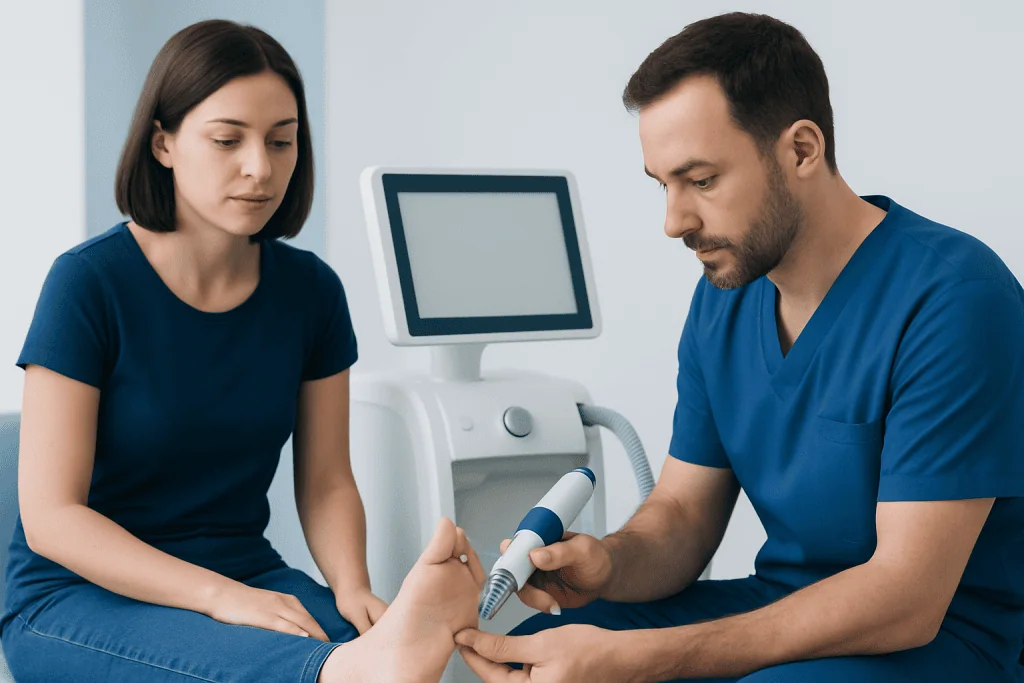
Doctors usually diagnose a corn, callus, or wart by taking a careful history and examining the skin closely. They ask when the lesion appeared, whether it is painful, if footwear or sports may be contributing, and whether there has been spread to other areas. They also look for risk factors such as sweating, frequent use of communal showers, immune suppression, foot deformities, or conditions that affect circulation and sensation.
One of the most useful clues is the way normal skin lines behave. On a callus or corn, the natural lines of the skin often run across the thickened area. On a wart, these lines are often broken or pushed aside because the lesion grows from within the skin rather than simply thickening on the surface.
Another clue comes from gentle paring or trimming of overlying thick skin in the clinic. When a wart is pared down, small pinpoint dark or red dots may become visible; these represent tiny blood vessels. Corns and calluses usually show compact layers of dead skin instead of these punctate vessels. Clinicians may also press directly downward and then squeeze the lesion from side to side, since the pattern of tenderness can help distinguish a wart from a corn.
If the diagnosis remains uncertain, a dermatologist or podiatrist may use dermoscopy, a magnified lighted tool that helps reveal vascular patterns and disrupted skin markings. Rarely, if a spot has an unusual appearance, bleeds easily, changes rapidly, or does not respond as expected, a biopsy may be considered to rule out other skin conditions. For related concerns affecting the skin more broadly, a specialist may also assess for skin cancer or other lesions that can mimic benign thickened skin.
What corns and calluses look and feel like
Corns and calluses are both areas of thickened skin, but they are not exactly the same. A callus is usually a larger, flatter patch of thick skin that forms where repeated rubbing or pressure occurs. It commonly develops on the heel, the ball of the foot, or the palms. The skin may look yellowish or dull and can feel rough, dry, or slightly cracked.
A corn is typically smaller and more focused than a callus. It often forms on or between the toes or over a bony prominence where shoes rub. Many corns have a hard center or “core” that presses inward, which is why they may cause sharp discomfort with walking or direct pressure. Soft corns can develop between toes where moisture is trapped.
These lesions are usually not contagious and do not spread from one body area to another. Instead, they tend to persist or worsen if the underlying pressure continues. Common contributors include tight shoes, high heels, abnormal foot mechanics, bunions, hammertoes, long periods of standing, or repetitive manual work.
Because foot pressure is involved, self-care often focuses on reducing friction and protecting the area rather than treating an infection. Evaluation may be especially helpful if a person has structural foot issues or recurring pain related to walking. In some cases, supportive care overlaps with services used in orthopedics and traumatology, especially when gait, deformity, or pressure redistribution needs attention.
What warts look and feel like
Warts are benign skin growths caused by HPV. The virus infects the outer layer of skin, often after entering through tiny cuts or areas softened by moisture. Warts can occur in different places, but on the feet they are called plantar warts. Because walking presses them inward, plantar warts may look flatter than warts on the hands.
A wart may have a rough, irregular, or grainy surface. It can appear skin-colored, slightly gray, or brownish, and it may interrupt the normal pattern of skin lines. Tiny black dots are a classic clue, though they are not always visible to the naked eye. These dots are not dirt; they are small clotted blood vessels within the wart.
Warts can occur singly or in clusters. Some remain small, while others slowly enlarge. They may be painless, but plantar warts often cause discomfort while standing or walking. Some people describe the sensation as if they are stepping on a pebble. Warts are also more likely than corns or calluses to recur after incomplete treatment because the underlying viral tissue remains in the skin.
Since warts are contagious, they can spread through direct contact, shared nail tools, or moist communal surfaces such as pool decks and locker rooms. They are more common in children and young adults, but they can affect people of any age. A doctor may also consider whether another skin problem, such as eczema, has weakened the skin barrier and made irritation or secondary changes harder to interpret.
What to do for each case
If the spot is a corn or callus, treatment focuses on removing the source of pressure and gradually softening thickened skin. This may include roomier shoes, cushioning pads, insoles, moisture control, and careful soaking followed by gentle filing with an emery board or pumice stone. Moisturizing creams can help dry, thick skin, and some people benefit from products containing salicylic acid or urea, though these should be used cautiously and not without medical advice in higher-risk feet.
If the lesion is a wart, treatment aims to destroy or remove the infected tissue and allow healthy skin to replace it. Options may include topical salicylic acid, cryotherapy, cantharidin-based treatment where appropriate, minor office procedures, or other dermatologist-directed methods. Warts sometimes resolve on their own, but this can take months or longer, and treatment may be preferred if they are painful, spreading, or bothersome.
It is usually best not to cut, shave, or dig into a lesion at home. This can lead to bleeding, infection, scarring, and spread if the spot is a wart. The risk is higher in people with diabetes, numbness, poor circulation, or immune suppression. For persistent or uncertain lesions, assessment by dermatology or foot specialists can help confirm the diagnosis and select the safest treatment plan.
When a lesion is causing significant walking pain, a clinician may also address the mechanics behind it, not only the surface skin. That can include off-loading devices, custom orthotics, or treatment of a toe deformity. If the appearance is unusual or there is concern about infection or deeper tissue involvement, imaging or surgical evaluation may occasionally be needed, but this is not routine for ordinary corns, calluses, or common warts.
Prevention and self-care
Preventing corns and calluses usually means reducing friction and pressure over time. Shoes should fit well, with enough room in the toe box and support that matches activity level. Socks that keep feet dry and reduce rubbing can also help. For people with recurring pressure spots, an evaluation of gait, foot shape, or sports technique may identify a correctable trigger.
Good skin care is also useful. Regular moisturizing can reduce cracking, while gentle filing after bathing may keep thickened skin from building up too much. However, aggressive scraping can irritate the area and should be avoided. Corn pads that contain medicated acids should be used carefully and only if a clinician says they are appropriate.
To lower the risk of warts, it helps to keep feet clean and dry, avoid sharing razors or nail tools, and wear sandals in communal showers or pool areas. Picking at a wart can spread the virus to nearby skin. Covering the lesion and washing hands after touching it may reduce transfer.
People with diabetes, peripheral artery disease, or reduced sensation need extra caution with any foot lesion. They should avoid self-surgery and seek professional foot care early. Near the end of the care journey, some international patients may choose assessment at Acibadem International, where multidisciplinary specialists in JCI-accredited hospitals evaluate skin and foot lesions and plan treatment according to the underlying cause.
When to seek medical care
Medical care is advisable if the diagnosis is unclear, the lesion is very painful, or home care is not helping. A doctor should also assess any spot that bleeds repeatedly, changes color, develops ulceration, or returns quickly after treatment. These features do not necessarily mean something serious is present, but they deserve a closer look.
Prompt evaluation is especially important for people with diabetes, poor circulation, nerve damage, immune suppression, or a history of skin cancer. In these groups, even a small foot lesion can become more complicated, and treatments that are safe for others may not be appropriate. Signs of infection, such as increasing redness, warmth, swelling, pus, or fever, also warrant timely care.
Children and adults with spreading warts, clusters of plantar lesions, or pain that affects walking may benefit from earlier treatment rather than repeated self-care attempts. Similarly, recurring corns or calluses may indicate a shoe-fit issue or a structural foot problem that needs correction. If the lesion is on the sole and there is uncertainty between a wart and a pressure lesion, a clinician can often clarify this quickly with examination.
Specialist input may come from primary care, podiatry, or dermatology, depending on the location and complexity. Seeking guidance early can prevent unnecessary discomfort and reduce the chance of treating the wrong condition.
Frequently asked questions
What is the main difference between a corn, a callus, and a wart?
Corns and calluses form because the skin is protecting itself from repeated pressure or friction. Warts are caused by HPV, a viral infection of the skin. That difference in cause is why the treatments are not exactly the same.
How can someone tell if a lesion on the foot is a wart or a callus?
A callus usually looks like a broad patch of thick skin with normal skin lines running through it. A wart may interrupt the skin lines and can show tiny black dots when examined closely. Pain pattern can also help, but a clinician is often the best person to confirm the diagnosis.
Do plantar warts always have black dots?
No. Black dots are common, but they are not always easy to see, especially if thick callused skin covers the wart. Their absence does not rule out a wart.
Can a wart be mistaken for a corn?
Yes, especially on the sole of the foot where both can look thick and flattened by pressure. A plantar wart may even develop a callus over it, which makes the distinction harder. This is one reason persistent foot lesions are often worth having checked.
Is it safe to cut off a corn, callus, or wart at home?
It is generally not recommended. Cutting into the skin can cause bleeding, infection, pain, and scarring, and if the spot is a wart it may also spread the virus. People with diabetes, poor circulation, or numb feet should avoid home removal and seek medical care.
Do warts go away on their own?
Some do, because the immune system may eventually clear the virus. However, this can take a long time, and plantar warts may remain painful or spread while waiting. Treatment may be helpful if the wart is bothersome, persistent, or affecting daily activities.
When should someone see a doctor for a possible corn, callus, or wart?
A doctor should be seen if the spot is very painful, keeps coming back, is growing, or does not improve with simple measures. Medical advice is also important if there is bleeding, signs of infection, or any history of diabetes, poor circulation, nerve damage, or immune suppression.
References
- American Academy of Dermatology
- American Podiatric Medical Association
- National Health Service
- Mayo Clinic
- DermNet
This article is for general information only and is not a substitute for professional medical advice. Please consult a qualified doctor about your individual situation.
Explore treatments in Turkey — costs, top hospitals & a free quote
JCI-accredited · board-certified surgeons · reply within 24h
Add us as a Preferred Source to see more of our trusted health content across Google Search, AI Overviews and Discover.