Tens vs Ems: Key Differences and How Doctors Tell Them Apart

TENS targets pain relief by stimulating sensory nerves rather than producing a strong muscle contraction. EMS is intended to activate muscles and may be used in rehabilitation, recovery, or muscle re-education.
Key Takeaways
- TENS targets pain relief by stimulating sensory nerves rather than producing a strong muscle contraction.
- EMS is intended to activate muscles and may be used in rehabilitation, recovery, or muscle re-education.
- Doctors tell TENS and EMS apart by the treatment goal, the pattern of stimulation, and whether the muscle visibly contracts.
- The best choice depends on the underlying condition, such as pain, weakness after injury, or reduced muscle function.
- Home devices may be helpful for some people, but a clinician should guide use when symptoms are new, severe, or unexplained.
- Medical review is important if symptoms involve sudden weakness, numbness, chest pain, or loss of bladder or bowel control.
TENS and EMS are both electrical stimulation therapies, but they are used for different goals. In simple terms, TENS is mainly used to help relieve pain, while EMS is designed to trigger muscle contraction for rehabilitation, muscle re-education, or strengthening under professional guidance.
TENS vs EMS at a glance
For most patients, the simplest way to understand tens vs ems is this: TENS stands for transcutaneous electrical nerve stimulation and is mainly used to help reduce pain, while EMS stands for electrical muscle stimulation and is used to make muscles contract. Although both use electrodes placed on the skin and send mild electrical impulses, they are not interchangeable in every situation.
Doctors usually choose between them based on the main problem being treated. If the priority is comfort and pain control, TENS may be considered. If the goal is to activate weak muscles, improve muscle re-education after injury, or support rehabilitation, EMS may be more appropriate.
Side-by-side comparison:
- Main purpose: TENS helps manage pain; EMS stimulates muscle contraction.
- Primary target: TENS targets sensory nerves; EMS targets motor nerves and muscle response.
- What a patient feels: TENS often feels like tingling or buzzing; EMS usually causes visible or noticeable muscle tightening.
- Typical use: TENS may be used for back pain, joint pain, or nerve-related discomfort; EMS may be used after injury, surgery, or periods of immobility when muscle activation is reduced.
- Expected result: TENS aims to ease symptoms; EMS aims to improve muscle function or support rehabilitation.
- Need for guidance: Both benefit from proper instruction, but EMS especially should match a clear rehabilitation goal.
Because these devices can look similar, confusion is common. A clinician does not rely on the device name alone; they consider the symptoms, examination findings, and treatment objective before recommending one approach over the other.
How doctors tell them apart in practice
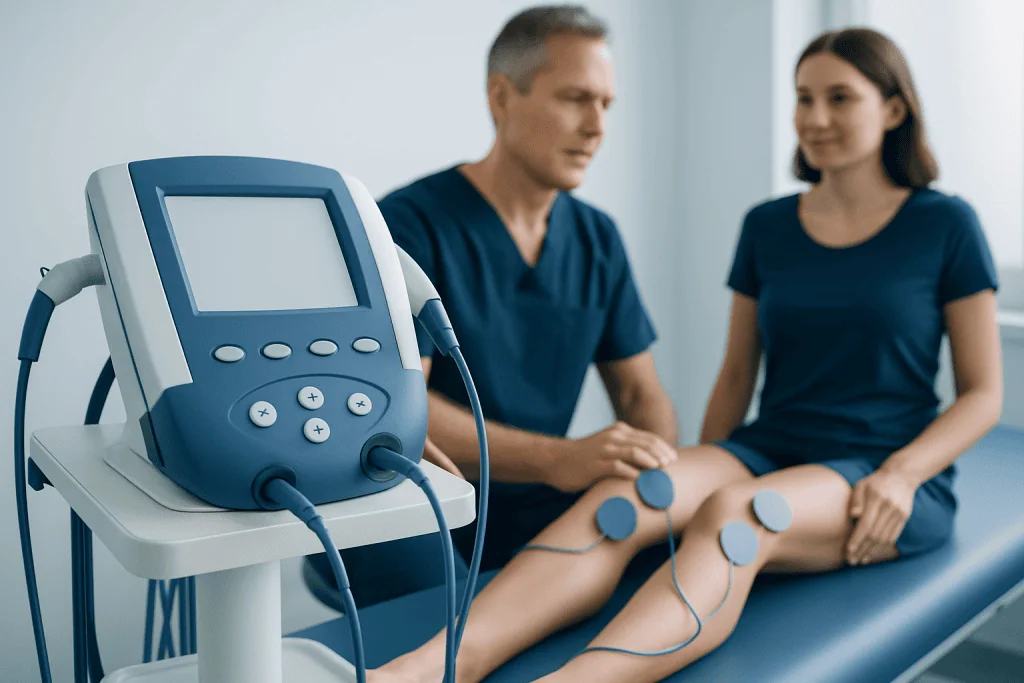
In clinical practice, doctors and rehabilitation specialists distinguish TENS from EMS by asking what needs to change in the body. If the problem is pain without a major loss of strength, TENS may be used to help modify how pain signals are perceived. If the problem is poor muscle activation, weakness after injury, or difficulty recruiting a muscle during recovery, EMS is more likely to be considered.
They also look at the body response during treatment. TENS is typically adjusted to produce a comfortable sensory feeling such as tingling, with little or no visible muscle contraction. EMS, by contrast, is adjusted to create a controlled muscle contraction. That visible or palpable contraction is one of the clearest practical differences.
Another clue is the treatment plan around the device. TENS may be part of a broader pain-management strategy that includes activity modification, physical therapy, and evaluation for causes such as a herniated disc or joint irritation. EMS is more often paired with exercise therapy, movement retraining, and structured rehabilitation when restoring function is the main goal.
A clinician may also review safety factors, including skin sensitivity, implanted devices, pregnancy, seizure history, or whether symptoms could reflect a more serious neurological or cardiovascular problem. This is why professional assessment matters when pain, weakness, or numbness is new or unexplained.
What TENS is used for

TENS is most commonly used as a noninvasive method to help reduce pain. It does not cure the underlying condition, but it may make symptoms easier to manage so a person can move more comfortably or participate better in rehabilitation. Some people use it for musculoskeletal pain, such as neck pain, shoulder pain, knee discomfort, or lower back pain.
The exact way TENS helps is still described in terms of pain modulation. In general, electrical stimulation of sensory nerves may reduce the intensity of pain signals and may also encourage the body’s own pain-relieving responses. Results vary from person to person, and some people notice more benefit than others.
TENS may be considered as part of a broader plan for pain conditions related to overuse, injury, arthritis, or nerve irritation. In some cases, doctors will first evaluate whether symptoms may relate to sciatica or another source of radiating pain before recommending a home-based pain-relief tool. TENS is generally a symptom-management approach, not a substitute for diagnosis.
When appropriate, TENS can complement physical therapy, stretching, posture correction, and general rehabilitation. Patients should remember that persistent pain deserves medical review, especially if it disrupts sleep, limits daily activity, or is accompanied by weakness or numbness.
What EMS is used for
EMS is used when the aim is to stimulate a muscle so it contracts. This can support rehabilitation after injury or surgery, help with muscle re-education when normal activation has been reduced, and in some cases assist recovery during periods of reduced movement. EMS is not simply a stronger version of TENS; it has a different therapeutic purpose.
Doctors or physiotherapists may consider EMS when a muscle is not activating effectively after a joint injury, after immobilization, or during recovery from certain orthopedic or neurological conditions. It is often combined with active exercise rather than used alone. The goal is usually to improve function, not just sensation.
For example, after some orthopedic procedures or injuries, a rehabilitation program may include targeted exercises and supportive therapies such as physical therapy and rehabilitation. In selected cases, EMS may help a patient reconnect with a weak muscle and improve movement patterns under professional supervision.
EMS should be individualized because stimulation that is too low may not achieve the desired contraction, while stimulation that is too strong may be uncomfortable. Electrode placement, timing, and treatment goals matter. A rehabilitation specialist can help determine whether EMS is appropriate and how it fits into a safe recovery plan.
How clinicians choose the right option for each case
Choosing between TENS and EMS starts with diagnosis, not the device. A doctor will usually ask about the location of symptoms, how long they have been present, what makes them better or worse, and whether there are signs of nerve compression, muscle injury, joint disease, or systemic illness. The same symptom, such as leg discomfort, may call for different treatment depending on whether the main issue is pain, weakness, or both.
The physical examination is important. Clinicians assess strength, reflexes, sensation, joint movement, posture, gait, and whether symptoms can be reproduced with certain motions. If a person reports pain but has normal strength and no serious warning signs, TENS may be discussed as one supportive measure. If there is clear muscle inhibition or difficulty activating a muscle group, EMS may be considered within a rehabilitation program.
Testing may be recommended when the cause is uncertain. Imaging, laboratory tests, or nerve studies can help in selected situations. For ongoing spine, joint, or nerve-related problems, treatment may involve broader non-surgical care such as pain management or a targeted rehabilitation strategy rather than relying on electrical stimulation alone.
In more complex cases, specialists may coordinate care across neurology, orthopedics, physiatry, and rehabilitation medicine. Near the end of the care pathway, if international patients need evaluation, Acibadem International’s multidisciplinary specialists in JCI-accredited hospitals diagnose and treat pain, musculoskeletal, and rehabilitation-related conditions with individualized planning.
Safety, limitations, and what to do at home
Both TENS and EMS are generally considered noninvasive, but they are not suitable for everyone. A patient should not assume that an over-the-counter device is safe in every context. People with implanted electrical devices, certain heart rhythm concerns, uncontrolled epilepsy, impaired skin sensation, or skin breakdown in the treatment area may need special caution or should avoid use unless a doctor specifically advises otherwise.
Neither method should be used over broken skin, the front of the neck, or areas where stimulation could be unsafe. It is also important not to place electrodes over areas of active infection, unexplained swelling, or regions where a doctor has told the patient to avoid electrical modalities. If there is uncertainty about placement or settings, professional instruction is best.
At home, patients should follow the exact directions provided with the device and stop if the treatment causes pain, dizziness, palpitations, worsening symptoms, or skin irritation. TENS may be used to support comfort, while EMS should usually be linked to a specific exercise or recovery goal. People recovering from injury may also benefit from a structured plan that includes orthopedic rehabilitation when recommended.
It is also important to be realistic about limitations. TENS may not relieve every type of pain, and EMS will not replace active rehabilitation, strength training, or treatment of the underlying cause. If symptoms are progressing, professional reassessment is more useful than repeatedly changing device settings at home.
When to seek medical care
Medical care is advisable when pain, weakness, or numbness is new, severe, recurrent, or difficult to explain. A doctor should assess symptoms that interfere with walking, work, sleep, exercise, or daily activities, especially if they have lasted more than a short period or are steadily worsening.
Urgent medical attention is needed if symptoms are accompanied by chest pain, shortness of breath, fainting, sudden severe weakness, facial drooping, difficulty speaking, loss of bladder or bowel control, significant trauma, fever, or rapidly spreading numbness. These features suggest a problem that should not be managed with a home stimulation device.
Patients should also seek review if a device causes unexpected discomfort, skin reactions, or no meaningful improvement despite correct use. A clinician can help decide whether the symptom pattern points toward a pain condition, a muscle activation problem, or another disorder that needs a different form of treatment.
In short, the safest next step depends on the reason the device is being considered. TENS may help with pain relief, and EMS may support muscle rehabilitation, but unexplained symptoms deserve a proper diagnosis before any home therapy becomes part of the routine.
Frequently asked questions
Is TENS the same as EMS?
No. TENS and EMS both use electrical stimulation through the skin, but they are designed for different purposes. TENS is mainly used to help relieve pain, while EMS is used to create muscle contractions for rehabilitation, muscle re-education, or strengthening support.
Which is better for pain, TENS or EMS?
TENS is usually the more appropriate choice when the main goal is pain relief. EMS may be uncomfortable if used only for pain because its purpose is to stimulate a muscle contraction rather than provide sensory pain modulation. A doctor or physiotherapist can help decide which option fits the symptom pattern.
Can EMS build muscle?
EMS can help activate muscles and may support muscle re-education or strengthening as part of a rehabilitation program. However, it does not replace exercise, movement training, or treatment of the underlying cause of weakness. Results depend on the condition being treated and how the therapy is used.
Can a person use TENS or EMS at home?
Some people can use these devices at home, but correct use matters. Electrode placement, settings, and the treatment goal should be clear, especially with EMS. If symptoms are new, severe, or unexplained, medical advice is recommended before starting home treatment.
Who should avoid TENS or EMS?
People with certain implanted devices, significant skin problems in the treatment area, or other specific medical conditions may need to avoid electrical stimulation or use it only under medical guidance. It may also be unsafe to place electrodes over certain body areas. A clinician can review individual risks and provide safe instructions.
How does a doctor decide whether symptoms need more than a stimulation device?
Doctors look at the whole picture, including pain location, weakness, numbness, reflex changes, mobility, and how symptoms affect daily life. They may recommend further evaluation if there are warning signs, progressive symptoms, or concern for a nerve, spine, joint, or systemic condition. The device is only one part of treatment, not a diagnosis.
References
- World Health Organization
- National Institute of Neurological Disorders and Stroke
- National Institute of Arthritis and Musculoskeletal and Skin Diseases
- American Physical Therapy Association
- MedlinePlus
This article is for general information only and is not a substitute for professional medical advice. Please consult a qualified doctor about your individual situation.
Explore treatments in Turkey — costs, top hospitals & a free quote
JCI-accredited · board-certified surgeons · reply within 24h
Add us as a Preferred Source to see more of our trusted health content across Google Search, AI Overviews and Discover.