Gamma knife vs Traditional brain surgery: Which Is Right for You?

Gamma Knife is a precise form of radiation treatment, not an operation involving an incision or surgical blade. Traditional brain surgery may be preferred when a lesion is large, causing pressure on the brain, bleeding, or requires a tissue diagnosis.
Key Takeaways
- Gamma Knife is a precise form of radiation treatment, not an operation involving an incision or surgical blade.
- Traditional brain surgery may be preferred when a lesion is large, causing pressure on the brain, bleeding, or requires a tissue diagnosis.
- Gamma Knife is often suitable for small, well-defined targets and usually involves a shorter recovery than open surgery.
- The effects of Gamma Knife develop gradually, while surgery can sometimes provide more immediate decompression or removal of tissue.
- A neurosurgeon, radiation oncologist, and other specialists should review imaging and individual goals before recommending treatment.
Gamma Knife radiosurgery and traditional brain surgery can both treat certain brain tumors, vascular abnormalities, and nerve-related conditions, but they work in very different ways. The best choice depends on the diagnosis, the size and location of the target, overall health, symptoms, and whether tissue needs to be removed or examined.
Gamma Knife vs Traditional Brain Surgery: Which Is Right for You?
When comparing Gamma Knife vs traditional brain surgery, neither option is automatically better for every person. Gamma Knife may be appropriate for a small, clearly defined target that can be treated with focused radiation, while traditional surgery may be needed to remove tissue, obtain a biopsy, control bleeding, or relieve pressure on the brain.
The decision is individualized. Specialists consider the exact diagnosis, lesion size and location, whether there are symptoms requiring urgent relief, previous treatments, age, general health, and personal priorities. In many situations, the two approaches can also be used at different stages of care rather than being competing alternatives.
Gamma Knife is commonly discussed for selected brain tumors, metastases, arteriovenous malformations (AVMs), trigeminal neuralgia, and some other conditions. Traditional brain surgery, also called craniotomy in many cases, remains an important treatment when direct access to the brain is necessary.
How the Two Approaches Work
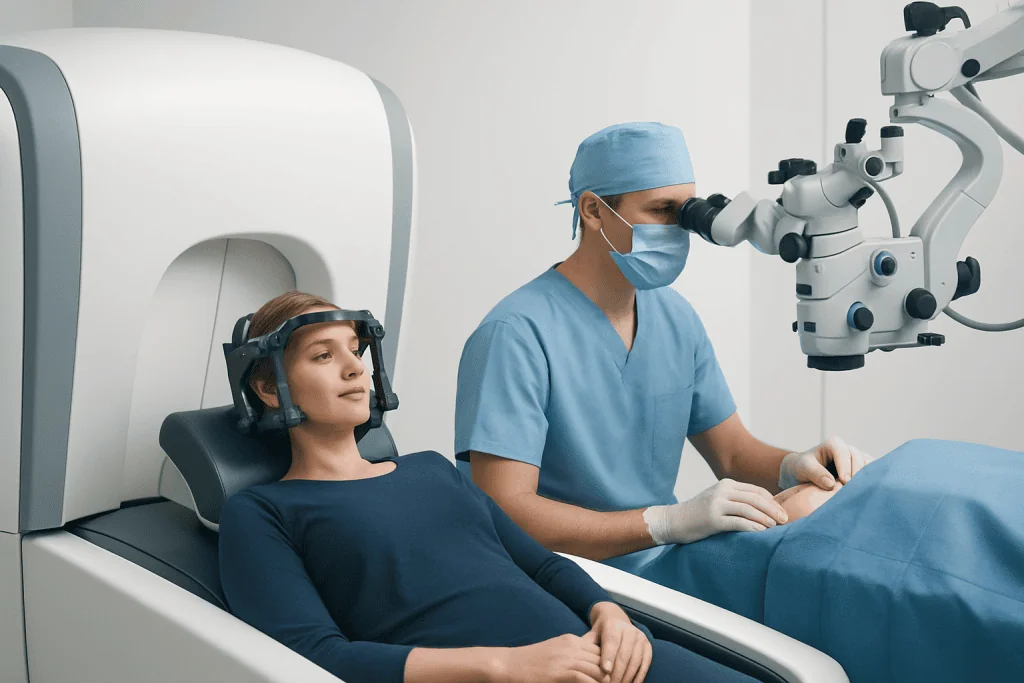
Gamma Knife is a type of stereotactic radiosurgery. Despite its name, it does not use a knife and does not require an incision into the skull. Many small beams of radiation are precisely directed toward a target in the brain. Each beam delivers a low dose along its path, while the point where the beams meet receives the planned treatment dose.
This approach aims to damage abnormal cells or blood vessels while limiting radiation exposure to nearby healthy brain tissue. The treatment effect is usually gradual. For example, a tumor may stop growing or shrink over time, and an AVM may close slowly over months or years.
Traditional brain surgery involves making an opening in the skull to reach the area of concern. The surgeon may remove all or part of a tumor, drain fluid, repair a blood vessel problem, take a biopsy, or reduce pressure caused by swelling or bleeding. Depending on the condition, surgery may use microscopes, image guidance, endoscopic techniques, or awake brain mapping to protect important functions.
For a fuller explanation of focused radiation treatment, patients can read about Gamma Knife radiosurgery. Information about brain tumor surgery may also help clarify why open surgery is recommended in some situations.
Who May Be a Candidate?

Gamma Knife may be considered when the target is relatively small, well-defined, and visible on high-quality imaging. It can be particularly useful for lesions located deep in the brain or close to important structures, where open surgery may carry a higher risk. It may also be an option for people who are not suitable candidates for major surgery because of other health conditions.
It is not always the best choice for a large lesion, a mass causing significant pressure, a problem that needs immediate decompression, or a diagnosis that remains uncertain. Radiation does not provide a tissue sample. If doctors need to identify the exact tumor type or molecular features to guide treatment, a biopsy or surgical removal may be necessary.
Traditional surgery may be recommended for a lesion that can be safely reached and removed, especially when it is causing seizures, weakness, fluid buildup, severe headaches from pressure, or other concerning symptoms. Surgery may also be used before or after radiosurgery as part of a wider treatment plan.
For example, treatment planning for brain tumors often involves reviewing the tumor type, location, behavior on imaging, and the person’s neurological function. A multidisciplinary team can explain whether observation, surgery, radiosurgery, medication, systemic cancer treatment, or a combination is most appropriate.
What Happens During Each Procedure?
Before Gamma Knife treatment, the care team reviews MRI, CT, or other scans and creates a detailed treatment plan. A rigid head frame or a custom-fitted mask may be used to keep the head still and allow precise targeting. Imaging is then used to confirm the target, and the radiation plan is calculated specifically for that person.
During treatment, the person lies on a treatment couch while the Gamma Knife unit delivers radiation. The procedure itself is painless, although remaining still can be tiring. Treatment duration varies according to the number, size, and shape of targets. Most people go home on the same day after a period of observation.
Traditional brain surgery begins with preoperative planning, anesthesia, and careful positioning. The surgeon creates an opening in the skull and uses specialized tools and imaging to treat the affected area. Some operations require an overnight stay in intensive monitoring, followed by several days in hospital, although the exact length of stay varies greatly.
After either approach, the team may arrange follow-up MRI scans, neurological examinations, and other care. In cancer treatment, additional therapies may be advised depending on the diagnosis and response to treatment.
Benefits, Limitations, and Possible Risks
A major benefit of Gamma Knife is that it is noninvasive: there is no surgical incision, no removal of skull bone, and generally no need for a prolonged hospital stay. It can often preserve daily independence and may be useful for targets that are difficult to reach with open surgery. It may also be used after surgery if a small remaining or recurrent lesion needs focused treatment.
Its limitation is that it does not remove a mass immediately. If a lesion is pressing on nearby brain structures, causing obstruction of fluid flow, or producing severe symptoms, waiting for a radiation effect may not be safe or sufficient. Some conditions also need repeated imaging because treatment response takes time.
Possible short-term effects after Gamma Knife include headache, fatigue, nausea, scalp tenderness, or temporary swelling in the treated area. Less commonly, delayed radiation-related swelling, changes in neurological function, injury to nearby structures, or treatment failure can occur. The likelihood depends strongly on the target and treatment plan.
Traditional surgery can offer immediate removal or decompression and may provide a definitive tissue diagnosis. However, it is more invasive and carries risks such as infection, bleeding, blood clots, seizures, cerebrospinal fluid leak, anesthesia-related complications, and changes in speech, movement, vision, memory, or other neurological functions. Surgeons discuss the expected benefits and specific risks based on the planned operation.
- Gamma Knife may favor: small, discrete targets; difficult-to-reach locations; and people seeking a nonincisional option when clinically appropriate.
- Traditional surgery may favor: large or symptomatic masses, uncertain diagnosis, bleeding, substantial brain pressure, or a need for rapid physical removal.
- Combined care may favor: selected cases where surgery addresses a larger problem and radiosurgery treats a remaining, recurrent, or separate small target.
Recovery Timeline and Follow-Up
Recovery after Gamma Knife is usually shorter than recovery after traditional brain surgery. Many people return home the same day and may resume light activities within a few days, depending on their condition and the instructions from the care team. Fatigue can last longer for some people, especially when treatment is part of cancer care.
The response to Gamma Knife is monitored rather than judged immediately after treatment. Follow-up MRI scans are often scheduled over the following months to assess whether a tumor is stable or smaller, whether an AVM is closing, or whether there is treatment-related swelling. New or worsening symptoms should be reported promptly.
Recovery from a craniotomy commonly takes weeks to months. Early recovery focuses on wound care, pain control, gradual activity, and monitoring for neurological changes. Some people benefit from rehabilitation services such as physiotherapy, occupational therapy, speech and language therapy, or neuropsychological support.
Return to work, driving, exercise, and travel should be discussed with the treating team. These recommendations differ according to the underlying condition, seizure risk, medications, extent of surgery, and recovery progress.
How to Make the Treatment Decision
A useful consultation should include a clear explanation of the diagnosis and the goal of treatment. The goal may be cure, long-term control, symptom relief, prevention of future bleeding, protection of neurological function, or obtaining a diagnosis. Understanding the goal helps place each option in context.
Patients may wish to ask whether a biopsy is needed, what could happen without treatment, whether observation is reasonable, how quickly treatment is needed, and whether Gamma Knife can provide the intended result. It is also reasonable to ask about expected recovery, potential effect on speech or movement, follow-up imaging, and alternatives such as other radiation techniques or minimally invasive procedures.
For complex cases, a second opinion or multidisciplinary review can be helpful. Acibadem International’s multidisciplinary specialists and JCI-accredited hospitals evaluate and treat neurological and oncological conditions for international patients, with treatment recommendations based on individual clinical findings.
The final decision should be made with qualified clinicians who have reviewed the scans, medical history, and personal treatment goals. Online information can support informed questions, but it cannot replace an individualized assessment.
When to Seek Medical Care
Medical advice should be sought promptly for new or worsening neurological symptoms, particularly after a diagnosis of a brain lesion or following treatment. Symptoms that deserve timely assessment include persistent or worsening headache, new seizures, weakness or numbness on one side, trouble speaking, changes in vision, loss of balance, confusion, or marked changes in behavior or alertness.
Emergency care is appropriate for sudden severe headache, a first seizure, loss of consciousness, sudden weakness or facial drooping, trouble speaking, severe confusion, or rapidly worsening symptoms. These symptoms can have several causes and should be assessed urgently.
After Gamma Knife or traditional brain surgery, patients should contact their care team for fever, worsening headache, repeated vomiting, drainage or redness around a surgical wound, new neurological symptoms, or concerns about medication side effects. Early communication allows the team to determine whether urgent evaluation is needed.
Frequently asked questions
Is Gamma Knife safer than traditional brain surgery?
Gamma Knife avoids an incision and is generally associated with a shorter physical recovery, but it is not automatically safer for every diagnosis. Its risks and benefits depend on the target’s size, location, and relationship to important brain structures. Traditional surgery may be safer or more effective when immediate removal, pressure relief, or tissue diagnosis is needed.
Is Gamma Knife really surgery?
Gamma Knife is called stereotactic radiosurgery because it delivers highly focused radiation with surgical precision. It does not involve cutting into the skull or removing tissue during the treatment session. The radiation effect develops gradually after treatment.
Can Gamma Knife remove a brain tumor?
Gamma Knife does not physically remove a tumor. It aims to control tumor cells so the lesion may stop growing or shrink over time. Surgical removal may be preferred when a tumor is large, causing pressure, or needs to be examined in the laboratory.
How long does it take to recover from Gamma Knife treatment?
Many people return home on the day of treatment and resume light routine activities within a few days. Recovery varies with the underlying condition, symptoms, and any temporary radiation-related swelling. Follow-up imaging is important because the treatment response is not immediate.
Can Gamma Knife and traditional surgery be used together?
Yes. In selected cases, surgery may remove or reduce a larger lesion, while Gamma Knife treats a small remaining area, a recurrence, or another separate target. The order and timing depend on the diagnosis and overall treatment plan.
Will a biopsy be needed before Gamma Knife?
Not always, but it may be needed when the diagnosis is uncertain or when tumor tissue is required to guide treatment. Some lesions have imaging features that allow treatment planning without biopsy, while others need tissue confirmation. The treating team will explain why biopsy is or is not recommended.
References
- National Cancer Institute
- American Association of Neurological Surgeons
- American Society for Radiation Oncology
- National Institute of Neurological Disorders and Stroke
- Mayo Clinic
This article is for general information only and is not a substitute for professional medical advice. Please consult a qualified doctor about your individual situation.
Gamma Knife in Turkey — costs, top hospitals & a free quote
JCI-accredited · board-certified surgeons · reply within 24h
Add us as a Preferred Source to see more of our trusted health content across Google Search, AI Overviews and Discover.

Neurology
Diagnosis and treatment of disorders of the brain, spinal cord, nerves and muscles.
51 specialists in this unitMore from the Health Library



Related Specialists

Dr. Parvana Seyidova
Gynecology & Obstetrics
Prof. Dr. Öner Gülcan
Cardiovascular Surgery
Asst. Prof. Dr. Mustafa Sungur
Orthopedic Surgery & Traumatology
Asst. Prof. Dr. Ezgi Yakupoğlu
Neurology