Can You Fly after Cataract Surgery: Procedure, Recovery and Results

Flying is usually possible after routine cataract surgery once the surgeon approves travel, often after the first postoperative review. A gas bubble inside the eye is an important exception: flying or going to high altitude can dangerously raise eye pressure until the bubble has fully disappeared.
Key Takeaways
- Flying is usually possible after routine cataract surgery once the surgeon approves travel, often after the first postoperative review.
- A gas bubble inside the eye is an important exception: flying or going to high altitude can dangerously raise eye pressure until the bubble has fully disappeared.
- Blurred vision, mild irritation, light sensitivity and dryness are common early recovery concerns and usually improve over days to weeks.
- During the first week, patients should use prescribed drops, avoid rubbing the eye and follow individual advice about strenuous activity and water exposure.
- Sudden vision loss, increasing pain, marked redness, flashes, floaters or a curtain-like shadow require urgent eye assessment.
Most people can fly after cataract surgery when their eye surgeon has examined the eye and confirmed that recovery is progressing normally. Air travel itself usually does not harm the new intraocular lens, but timing depends on the type of surgery, the presence of any complications, and whether a gas bubble was placed in the eye.
Can You Fly After Cataract Surgery?
Most people can fly after cataract surgery once their ophthalmologist has checked the operated eye and confirmed that healing is uncomplicated. For routine surgery, this may be possible after the first follow-up appointment, but the safest timing is individual and should be agreed with the treating surgeon before travel is booked.
Cabin pressure in a commercial aircraft does not normally affect the artificial intraocular lens placed during cataract surgery. However, flying is not safe if a gas bubble has been used inside the eye, which may occur when cataract surgery is combined with or followed by retinal treatment. The bubble expands at altitude and can cause a dangerous rise in eye pressure. Patients should not fly, travel to high altitude, or receive nitrous oxide anaesthesia until their eye specialist confirms that the bubble has completely gone.
Travel planning should also account for practical needs. Patients may need a next-day or early postoperative review, regular eye drops, protection from dust and rubbing, and access to urgent eye care at their destination. A surgeon may advise postponing travel if vision is still unstable, eye pressure needs monitoring, or there are concerns such as inflammation, infection, corneal swelling or retinal disease.
How Cataract Surgery Works and Who May Benefit
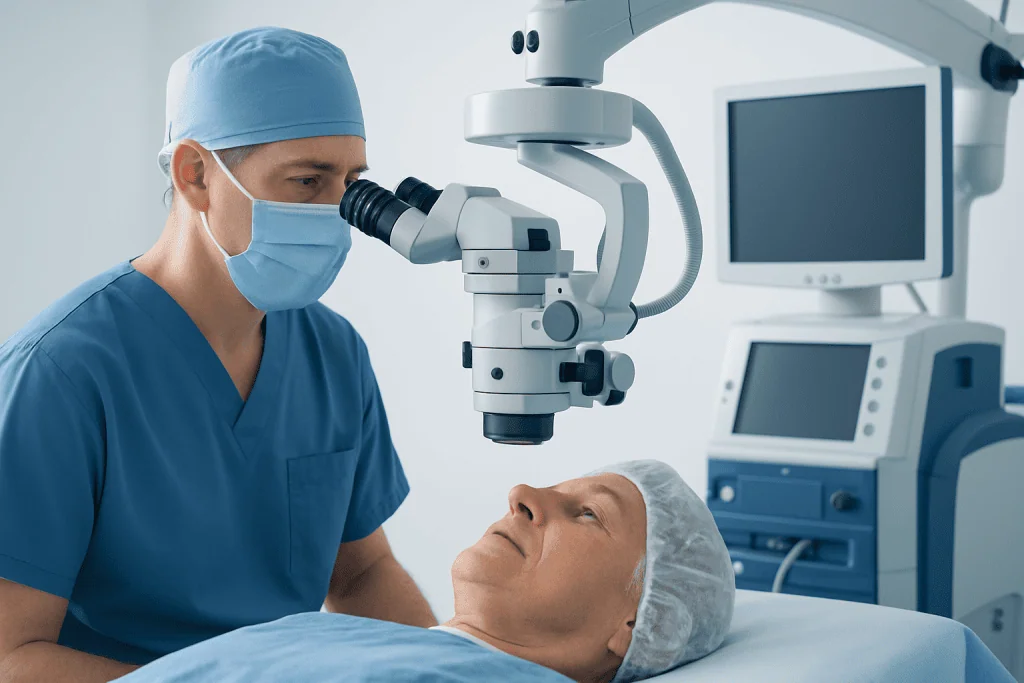
A cataract is clouding of the eye’s natural lens. It can make vision hazy, reduce contrast and colour clarity, increase glare from lights, and make reading or driving more difficult. Cataracts commonly develop with age, although they can also be associated with diabetes, previous eye injury, long-term steroid use, smoking, or certain eye conditions.
Cataract surgery removes the cloudy natural lens and replaces it with a clear artificial lens, called an intraocular lens (IOL). The aim is to improve vision affected by the cataract. The selected IOL can also help address some focusing needs, although glasses may still be needed for close work, distance tasks, or both.
People may be candidates when cataract-related vision changes interfere with daily activities or when the cataract prevents monitoring or treatment of another eye condition. An eye examination assesses the cataract, cornea, retina, optic nerve, eye pressure and overall visual potential. This also helps identify conditions such as glaucoma or macular disease that may affect visual outcomes.
Cataract surgery is usually performed one eye at a time. The choice of timing, lens type and postoperative plan should be made with an ophthalmologist after discussion of visual goals, general health, medications and any previous eye procedures.
The Procedure: What Happens Step by Step

Modern cataract surgery is most often performed as an outpatient procedure using local anaesthetic eye drops, sometimes with additional medication to help the person relax. The patient remains awake but should not feel pain. The eye is cleaned and covered with a sterile drape, and the eyelids are gently kept open.
Through a very small incision, the surgeon uses ultrasound energy to break up the cloudy lens and remove it. This established technique is called phacoemulsification. The folded artificial lens is then inserted into the remaining lens capsule, where it opens and stays in position. In many cases, stitches are not needed.
The operation itself commonly takes a short time, though preparation and recovery at the clinic take longer. Afterward, the eye may be covered briefly or protected with a shield. Patients generally need someone to accompany them home because vision can be temporarily blurred and driving is not advised immediately after surgery.
More information about the operation and lens planning is available through cataract surgery. The ophthalmology team will provide personalized instructions about eye drops, protective measures, follow-up appointments and when travel is appropriate.
Recovery Timeline, Benefits and Possible Risks
Many people notice brighter, clearer vision within a few days, but vision can fluctuate during early healing. Mild grittiness, watering, itching, light sensitivity, redness and temporary blurring are common. The eye often feels more comfortable after several days, while vision and refraction may continue to stabilize over several weeks.
The expected benefit is clearer vision where the cataract is the main cause of visual impairment. The degree of improvement varies because other eye conditions, such as glaucoma, diabetic retinopathy or age-related macular degeneration, can limit vision even when surgery is technically successful. Some people need updated glasses after the eye has healed.
Serious complications are uncommon, but patients should understand them. They include infection inside the eye, bleeding, swelling of the cornea or retina, raised or low eye pressure, retinal detachment, lens displacement and persistent inflammation. Later, the lens capsule can become cloudy, sometimes called a secondary cataract; this can often be treated with a brief laser procedure.
Following prescribed drops and attending follow-up visits helps the clinical team detect concerns early. People should not stop or change eye medications without advice from their surgeon.
What Is the Biggest Complaint After Cataract Surgery?
The most common early complaint is blurred or fluctuating vision, often accompanied by a dry, gritty or irritated feeling. The surface of the eye can become temporarily dry after surgery, and mild corneal swelling or inflammation may also affect clarity during the first days. Glare, halos around lights and light sensitivity can occur while the eye adjusts.
These symptoms are usually mild and improve with healing and prescribed treatment. Artificial tears may be recommended by the eye team, but patients should ask which product is suitable and how to space it from prescription drops. Vision may also seem uneven if only one eye has been operated on and the other still has a cataract or a different glasses prescription.
Increasing pain is not an expected routine symptom. New or worsening redness, a sharp fall in vision, increasing discharge, nausea with severe eye pain, flashes, many new floaters, or a dark curtain across vision should be assessed urgently.
What Are the Restrictions 1 Week After Cataract Surgery?
Restrictions during the first week vary by surgeon and by the person’s eye health, but the main goals are to avoid injury, reduce infection risk and support comfortable healing. Patients should use their prescribed drops exactly as directed, avoid rubbing or pressing on the eye, and wear the protective shield if instructed, particularly while sleeping.
Many people can walk, read, watch television and do gentle daily activities soon after surgery. They are commonly advised to avoid heavy lifting, strenuous exercise, swimming, hot tubs and dusty environments during the early recovery period. Avoiding water, soap or shampoo directly in the operated eye is also usually recommended. Driving should wait until vision meets legal requirements and the ophthalmologist says it is safe.
Travel may be reasonable within a week for an uncomplicated case if the surgeon agrees, but it can be better to remain close to the surgical team until the first review is complete. Patients travelling by air should carry their drops in hand luggage, avoid touching the eye unnecessarily, use clean hands before applying drops and know how to access care at their destination.
Individual advice takes priority. Restrictions can be longer after combined procedures, difficult surgery, pre-existing retinal disease, glaucoma, corneal disease or a complication during recovery.
How Long Does It Take for the Lens to Settle After Cataract Surgery?
The artificial lens is placed into the lens capsule, which holds it in position. In uncomplicated surgery, the lens is generally stable immediately after the procedure, but the eye needs time to heal and for vision to settle. Many people experience useful vision quickly, while clearer and more consistent vision may take several weeks.
The capsule gradually adapts around the lens over the following weeks. During this period, small changes in focusing, glare or visual quality can occur. The final glasses prescription is often assessed after the eye has had time to stabilize, although the exact timing depends on the surgical technique, healing pattern and the other eye.
Rarely, an intraocular lens can shift from its intended position. Symptoms may include a new change in vision, double vision in one eye, edge effects, or increasing glare. Anyone noticing a sudden or significant change should contact the ophthalmology team rather than assuming it is normal settling.
Can You Go to High Altitude After Cataract Surgery? When to Seek Medical Care
High altitude is usually not a problem after uncomplicated cataract surgery, once the ophthalmologist has approved travel. This includes commercial flying and visits to higher-elevation locations. The key exception is an intraocular gas bubble: altitude changes can make the bubble expand and sharply increase pressure in the eye. In that situation, patients must avoid flying and high-altitude travel until the retina or eye surgeon confirms it is safe.
Before travelling, patients should ask directly whether a gas bubble was used, when follow-up is due, and what symptoms require urgent care. They should take enough prescribed medication for the trip, keep it accessible, and avoid skipping appointments that are needed to monitor recovery.
Medical care should be sought promptly for worsening or severe eye pain, rapidly declining vision, increasing redness or swelling, pus-like discharge, persistent nausea or vomiting with eye pain, flashes of light, a sudden shower of floaters, or a curtain or shadow in the field of vision. These symptoms do not always indicate a serious problem, but they need urgent assessment to protect vision.
For international patients, Acibadem International’s multidisciplinary specialists and JCI-accredited hospitals provide assessment and treatment for cataract and related eye conditions. A treating ophthalmologist remains the best source of advice on flying, altitude and activity restrictions after an individual procedure.
Frequently asked questions
How soon can you fly after cataract surgery?
For uncomplicated cataract surgery, many people can fly after the first postoperative check, if their ophthalmologist confirms that healing is satisfactory. The exact timing varies, so the surgeon's recommendation should guide travel plans. Flying must be delayed if there is a gas bubble in the eye or another reason for close monitoring.
Does cabin pressure affect an artificial lens after cataract surgery?
Commercial cabin pressure does not normally affect a properly positioned intraocular lens. The important concern is not the lens itself, but an intraocular gas bubble that may have been used during retinal treatment. A gas bubble can expand at altitude and requires specific travel restrictions.
Can I travel alone after cataract surgery?
Immediately after surgery, patients usually need someone to take them home because vision can be blurred and sedating medication may have been used. Later travel alone may be possible if the surgeon approves, vision is adequate and the person can manage eye drops safely. It is helpful to have a plan for urgent eye care while away.
Can I carry cataract eye drops on a plane?
Yes, prescribed eye drops should be kept in hand luggage so they are available during travel and are not exposed to extreme temperatures in checked baggage. Patients should keep labels intact and follow airline security requirements for liquids. The surgical team can provide documentation if needed.
Can flying cause cataract surgery complications?
Flying does not usually cause complications after uncomplicated cataract surgery. However, travel can make it harder to attend follow-up care or seek timely assessment if symptoms develop. Patients should delay flying when their surgeon recommends observation, when complications are present, or when a gas bubble remains in the eye.
When can I resume exercise after cataract surgery?
Gentle walking is often acceptable soon after surgery, but strenuous exercise, heavy lifting and activities that could expose the eye to sweat, dust or injury are commonly limited during the first week. Swimming and hot tubs may need to be avoided for longer because of infection risk. The surgeon can give an individualized return-to-exercise plan.
References
- American Academy of Ophthalmology
- National Eye Institute
- Royal College of Ophthalmologists
- Mayo Clinic
This article is for general information only and is not a substitute for professional medical advice. Please consult a qualified doctor about your individual situation.
Cataract Surgery in Turkey — costs, top hospitals & a free quote
JCI-accredited · board-certified surgeons · reply within 24h
Add us as a Preferred Source to see more of our trusted health content across Google Search, AI Overviews and Discover.

Ophthalmology
Comprehensive eye care from laser vision correction to retina, cornea and cataract surgery.
74 specialists in this unit