

Lamellar Cataract: An Evidence-Based Patient Guide

Lamellar cataract usually describes a ring-like or layered opacity within the natural lens. It is commonly associated with congenital or childhood cataracts, although severity varies widely.
Key Takeaways
- Lamellar cataract usually describes a ring-like or layered opacity within the natural lens.
- It is commonly associated with congenital or childhood cataracts, although severity varies widely.
- An eye examination determines whether observation, glasses, amblyopia treatment, or cataract surgery is appropriate.
- Cataract surgery removes the cloudy natural lens and usually replaces it with an artificial intraocular lens.
- New or worsening blurred vision, glare, or visual difficulties in a child should be assessed promptly by an eye specialist.
Lamellar cataract is a type of cataract in which a distinct layer of the eye’s natural lens becomes cloudy, often around a clearer central area. It may be present from birth or develop in childhood, and treatment depends on how much it affects vision and daily activities.
Overview: What is lamellar cataract?
A lamellar cataract is a lens opacity that affects a particular layer, or lamella, of the eye’s natural lens. It often appears as a circular or disc-shaped cloudy zone surrounding a relatively clear center. Because the cloudy layer may interfere with light entering the eye, it can reduce visual clarity to different degrees.
Many lamellar cataracts are congenital, meaning they are present at birth, or become apparent during infancy or childhood. They may affect one eye or both eyes. Some remain stable and cause few symptoms, while others interfere with visual development or later cause troublesome blur, glare, or reduced contrast.
The term describes the cataract’s pattern rather than a single cause. An ophthalmologist assesses the lens appearance, vision, eye alignment, and overall eye health to decide whether observation is safe or whether treatment is needed.
Are lamellar and zonular cataracts the same?
Yes. In clinical use, lamellar cataract and zonular cataract usually refer to the same general pattern: clouding located in a defined layer or zone of the lens. The words reflect the layered structure of the lens and may be used interchangeably in medical records and eye-care discussions.
A lamellar cataract is different from a lamellar cortical cataract, which may be used less consistently to describe clouding involving the lens cortex, the outer part of the lens. An ophthalmologist can clarify the exact location and type of opacity during a slit-lamp examination.
It is also important not to confuse lamellar cataract with lamellar keratectomy. Cataract affects the lens inside the eye, whereas lamellar keratectomy is a procedure involving the cornea, the clear front surface of the eye. A lamellar keratectomy CPT code is therefore a billing term for a corneal procedure, not a diagnosis or treatment code for lamellar cataract.
Symptoms, visual effects and causes

Symptoms depend on the opacity’s size, density, and location. A person may notice blurred or hazy vision, reduced contrast, sensitivity to bright light, glare from headlights, difficulty reading, or poorer vision in dim settings. In children, signs can include poor visual attention, an eye that turns inward or outward, nystagmus (involuntary eye movements), or difficulty recognizing faces and objects.
Lamellar congenital cataracts can occur on their own or as part of an inherited pattern. A family history may be present, particularly when both eyes are affected. Other possible associations include developmental changes in the lens, metabolic conditions, certain infections during pregnancy, medication exposure, or eye inflammation, although an exact cause is not always identified.
When a cataract limits vision during early childhood, the main concern is amblyopia, sometimes called lazy eye. This occurs when the brain does not learn to process visual input properly from one or both eyes. Early assessment helps protect visual development when treatment is indicated.
- Symptoms may be mild, stable, and detected only during a routine eye examination.
- One-eye cataracts may be easier to miss because the stronger eye can compensate.
- Children with a white pupil reflex, a new eye turn, or reduced visual attention need prompt ophthalmic review.
Diagnosis and the meaning of lamellar cataract ICD-10
An ophthalmologist diagnoses lamellar cataract with a detailed eye examination. This typically includes measuring vision, checking how the pupils respond to light, examining the lens with a slit lamp, assessing eye alignment, and evaluating the retina and optic nerve after pupil dilation when appropriate. In infants and young children, assessment is adapted to the child’s age and ability to cooperate.
The clinician will also ask about pregnancy and birth history, medical conditions, medication use, previous eye injury or inflammation, and family history of childhood cataracts. If the cataract pattern or medical history suggests an underlying condition, further pediatric, genetic, or laboratory assessment may be considered.
People sometimes search for “lamellar cataract ICD 10.” ICD-10 coding can vary according to whether the cataract is congenital or acquired, whether one or both eyes are affected, and the coding system used in a particular country or healthcare setting. A clinician or coding professional should select the code from the documented diagnosis rather than relying on a general online term.
Treatment options and how cataract surgery works
Treatment is individualized. If the opacity is small, stable, and does not reduce vision or threaten visual development, regular monitoring may be all that is needed. Glasses can correct refractive errors, and children may need treatment for amblyopia, such as patching or blurring the stronger eye under the supervision of an eye specialist.
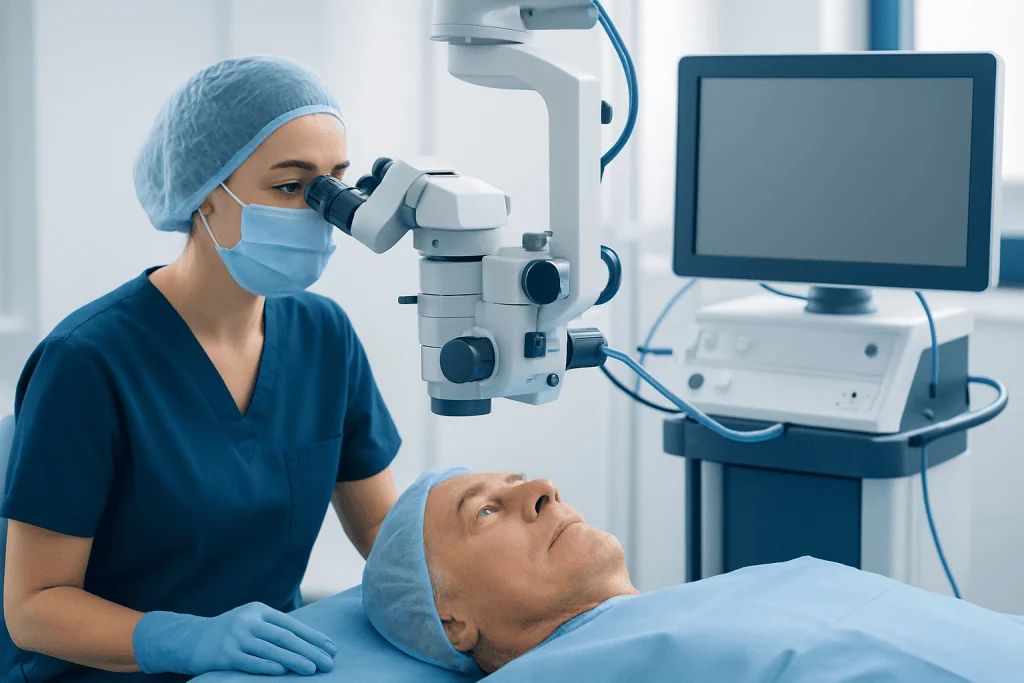
When a lamellar cataract significantly affects vision, cataract surgery may be recommended. During surgery, the ophthalmic surgeon makes a tiny incision, opens the thin capsule surrounding the lens, and removes the cloudy lens material, commonly using ultrasound-assisted phacoemulsification in adults. In many cases, an artificial intraocular lens is placed inside the remaining capsule to provide focusing power.
In infants and young children, the surgical approach differs because the eye is still developing and the lens capsule can cloud again more easily. The surgeon may perform additional capsule and vitreous procedures and will decide whether an intraocular lens is appropriate based on the child’s age, eye measurements, and clinical needs. Cataract surgery is planned after a full discussion of expected visual benefit, lens options, and follow-up requirements.
Acibadem International’s multidisciplinary ophthalmology specialists and JCI-accredited hospitals evaluate and treat cataracts for international patients, with care plans tailored to age, eye findings, and visual needs.
What is the new treatment for cataracts in 2026?
As of 2026, cataract surgery remains the only established treatment that removes a cataract and restores a clear optical pathway when the lens clouding affects vision. No eye drop, vitamin, supplement, or laser treatment has been proven to reverse an existing cataract in routine clinical care.
Modern cataract care continues to improve through more accurate eye measurements, refined surgical equipment, and a wider range of intraocular lenses. Depending on eye health and lifestyle goals, some adults may be candidates for lenses designed to improve distance vision, astigmatism, or vision at more than one range. These options are not suitable for everyone and do not eliminate the need for a careful eye assessment.
Researchers are studying ways to prevent or slow lens clouding, but these approaches should not be viewed as replacements for evidence-based monitoring or surgery. For lamellar cataracts, particularly in children, timely decisions about visual development remain more important than pursuing unproven treatments.
Candidacy, procedure steps, recovery and risks
A person may be a candidate for surgery when vision loss affects school, work, driving, reading, independence, or other daily activities. In children, candidacy is based on whether the cataract blocks the visual axis or causes enough blur to risk amblyopia. The decision considers the cataract itself as well as refractive error, retinal health, glaucoma risk, and the health of the other eye.
Before surgery, the eye is measured to help select an intraocular lens where one is planned. On the day of the procedure, anesthesia is selected according to age and medical needs. The surgeon removes the cloudy lens through a small opening and may implant an artificial lens. The procedure is commonly performed as day surgery for adults, while children may need general anesthesia and more specialized follow-up.
Recovery after uncomplicated adult cataract surgery often involves improved vision over days to weeks, although final stabilization can take longer. Eye drops are generally prescribed to reduce inflammation and infection risk, and follow-up visits check healing and eye pressure. Children require especially close long-term follow-up for refraction changes, amblyopia treatment, capsule clouding, and other developmental concerns.
Benefits can include clearer vision, less glare, and improved daily functioning. Possible risks include infection, inflammation, raised or lowered eye pressure, retinal swelling or detachment, lens-position concerns, and clouding of the capsule behind an artificial lens. Serious complications are uncommon, but prompt review of pain, marked redness, sudden vision loss, flashes, or a curtain-like shadow is important.
When to seek medical care
New or progressive blurred vision, glare, halos, or difficulty with everyday tasks should be discussed with an eye-care professional. Cataracts are usually not an emergency, but a complete eye examination is important because similar symptoms can also occur with other treatable eye conditions.
Parents and caregivers should arrange urgent ophthalmic assessment if a baby or child has a white, gray, or unusual pupil appearance, poor fixation on faces or objects, a persistent eye turn, or involuntary eye movements. These signs do not always indicate a cataract, but early evaluation is essential for protecting vision.
After cataract surgery, immediate medical advice is needed for increasing pain, significant redness, rapidly worsening vision, nausea with eye pain, injury to the eye, or new flashes and floaters. Following the surgeon’s activity, drop-use, and appointment instructions supports safe recovery.
Frequently asked questions
Can lamellar cataract go away on its own?
A true cataract is clouding within the natural lens and does not usually clear on its own. Some lamellar cataracts remain stable and may only need monitoring, but an ophthalmologist should assess their effect on vision over time.
Is lamellar cataract hereditary?
Some lamellar cataracts, especially those present in childhood and affecting both eyes, can be inherited. However, not every case has a family history or an identifiable genetic cause. An ophthalmologist may recommend genetic assessment when the clinical pattern suggests it.
Do all children with lamellar cataracts need surgery?
No. Surgery is usually considered when the cataract significantly obstructs vision or threatens normal visual development. Small, non-central, stable opacities may be monitored with regular vision and eye examinations.
How long does recovery take after cataract surgery?
Many adults notice better vision within several days, with healing and visual stabilization continuing over weeks. Recovery in children includes longer-term monitoring because the eye grows and visual development needs ongoing support.
Can cataract surgery treat both eyes at once?
Most cataract operations are performed on one eye at a time, with timing based on the person’s needs and the surgeon’s recommendation. In selected circumstances, bilateral surgery may be considered, but this requires individualized risk assessment and planning.
Is a lamellar cataract the same as a corneal problem?
No. A lamellar cataract affects the lens inside the eye. Corneal conditions affect the clear outer surface of the eye and are assessed and treated differently.
References
- American Academy of Ophthalmology
- National Eye Institute
- American Association for Pediatric Ophthalmology and Strabismus
- World Health Organization
This article is for general information only and is not a substitute for professional medical advice. Please consult a qualified doctor about your individual situation.
Explore treatments in Turkey — costs, top hospitals & a free quote
JCI-accredited · board-certified surgeons · reply within 24h
Add us as a Preferred Source to see more of our trusted health content across Google Search, AI Overviews and Discover.

More from the Health Library



Related Specialists

Dr. Münür Selçuk Kendir
Aesthetic Plastic & Reconstructive Surgery
Assoc. Prof. Dr. Ferda Çağavi
Neurosurgery
Prof. Dr. Turgut Aydın
Gynecology & Obstetrics
Ody. Özlem Gedik Soyuyüce
Audiology