Door to Device Time for Endovascular Therapy: How It Works, Results and What to Expect

Door to device time tracks hospital speed from arrival to the start of clot-removal treatment for acute ischemic stroke. For eligible patients, mechanical thrombectomy is commonly pursued as quickly as possible, with many stroke systems aiming for device access within about 90 minutes of arrival.
Key Takeaways
- Door to device time tracks hospital speed from arrival to the start of clot-removal treatment for acute ischemic stroke.
- For eligible patients, mechanical thrombectomy is commonly pursued as quickly as possible, with many stroke systems aiming for device access within about 90 minutes of arrival.
- Endovascular therapy may benefit selected patients within 6 hours of stroke onset and, based on advanced imaging, up to 24 hours in some cases.
- Door to needle time is different: it refers to arrival-to-start time for intravenous clot-busting medicine.
- Not every stroke is suitable for thrombectomy; brain imaging and vessel imaging guide urgent treatment decisions.
- Sudden stroke symptoms require emergency services immediately, even if symptoms improve or disappear.
Door to device time for endovascular therapy is the interval from a patient’s arrival at hospital to the start of an endovascular stroke procedure, usually mechanical thrombectomy. It is an important quality measure because faster assessment, imaging, and treatment can improve the chance of preserving brain function in eligible patients with a large-vessel ischemic stroke.
Overview: Why Door to Device Time Matters
Door to device time for endovascular therapy describes the time between a patient arriving at hospital and the moment a specialist begins the catheter-based procedure used to remove a clot from a blocked brain artery. It is mainly used in acute ischemic stroke care, when a blockage cuts off blood flow to part of the brain. Because brain tissue is highly sensitive to reduced blood flow, hospitals work to shorten every safe step in this pathway.
The measure does not mean that every patient should undergo a procedure immediately or without testing. A stroke team must first confirm the type of stroke, identify whether a major artery is blocked, estimate the amount of brain tissue at risk, and assess whether the potential benefit outweighs the risks. Rapid, coordinated care helps these decisions happen without avoidable delay.
Endovascular therapy, also called mechanical thrombectomy, is an emergency treatment for selected patients with a large-vessel occlusion. A neurointerventional specialist guides a thin catheter through an artery, usually from the groin or wrist, to remove or retrieve the clot. It is not a treatment for bleeding strokes, and it is different from intravenous thrombolysis, which uses medication to dissolve a clot.
What Is the Typical Door-to-Device Time for Endovascular Therapy in Stroke Patients?
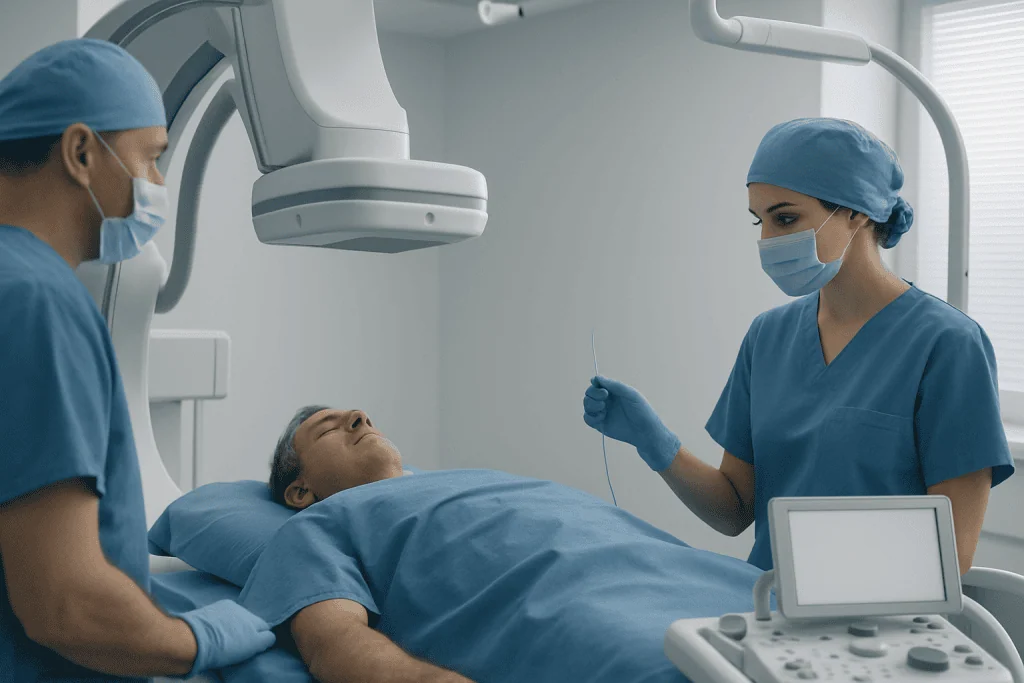
There is no single universal door-to-device time because patients arrive with different symptoms, transfer routes, imaging needs, and medical circumstances. However, many organized stroke centers use a target of about 90 minutes or less from arrival to arterial puncture or device-treatment initiation for patients arriving directly at a thrombectomy-capable hospital. Some systems may measure door-to-groin puncture time, while others use device deployment or reperfusion-related measures.
These benchmarks are operational goals rather than guarantees or a reason to bypass essential safety checks. Time can be affected by uncertainty about symptom onset, the need to stabilize breathing or blood pressure, anticoagulant use, difficult vascular access, or the need to transfer a patient from another hospital. The priority is rapid treatment that remains appropriate for the individual patient.
Hospitals improve door-to-device performance through advance emergency medical service notification, parallel assessment and imaging, early activation of the stroke and neurointerventional teams, and clear transfer protocols. Faster treatment is generally associated with better outcomes in appropriately selected patients, but the quality of imaging and clinical judgment remains essential.
How Endovascular Therapy Works and Who May Be Eligible

Mechanical thrombectomy is designed for an ischemic stroke caused by a clot blocking a large artery, most often in the front circulation of the brain. A CT scan first helps exclude bleeding. CT angiography or another vessel study can show whether a major artery is blocked, while additional imaging may help identify brain tissue that could still be saved.
Potential candidates usually have a disabling neurologic deficit and imaging evidence of a treatable large-vessel blockage. Eligibility depends on factors such as the location of the clot, the extent of early brain injury seen on imaging, the time when the person was last known well, pre-stroke function, and other medical conditions. Age alone does not automatically exclude treatment.
Many patients can receive thrombectomy within 6 hours of symptom onset. Carefully selected patients may still benefit between 6 and 24 hours after they were last known well when advanced imaging suggests that salvageable brain tissue remains. This assessment is especially relevant for strokes noticed on waking or when the onset time is uncertain.
Stroke care may involve neurology, emergency medicine, radiology, anesthesiology, intensive care, rehabilitation, and interventional specialists. In the context of an eligible blocked artery, mechanical thrombectomy may be considered alongside other urgent stroke treatments rather than as a replacement for comprehensive assessment.
Step by Step: What Happens During the Procedure
On arrival, the emergency team rapidly evaluates symptoms, checks blood glucose and vital signs, establishes when the patient was last known to be well, and performs brain imaging. When a large-vessel occlusion is confirmed or strongly suspected, the interventional team can be alerted while other preparation continues. If appropriate and within its treatment window, intravenous clot-busting medicine may be started without waiting for thrombectomy.
In the procedure room, clinicians use local anesthesia with sedation or general anesthesia depending on the patient’s condition and ability to remain still. A small puncture is made in an artery, usually in the groin and sometimes in the wrist. Using continuous X-ray guidance, the specialist advances a catheter through the blood vessels toward the blocked brain artery.
A stent retriever, aspiration catheter, or a combination of devices is then used to capture or suction out the clot. Contrast imaging is used during the procedure to assess blood flow. More than one pass may be needed, and in some cases the vessel cannot be fully reopened despite technically appropriate treatment.
Afterward, the puncture site is closed or compressed, and the patient is monitored in a stroke unit or intensive care setting. Further tests look for the cause of stroke, such as an irregular heart rhythm, narrowing in a neck artery, or a blood-clotting condition, so the team can plan prevention after the emergency phase.
What Is a Good Door to Needle Time?
Door to needle time is the interval between hospital arrival and the start of intravenous thrombolysis, often called clot-busting treatment. It is not the same as door to device time. Door to needle time applies to eligible patients with ischemic stroke who can receive intravenous medication, while door to device time applies to patients going on to catheter-based clot removal.
Many stroke programs aim to begin intravenous thrombolysis within 60 minutes of arrival for eligible patients, and some have faster internal targets. Whether medication is appropriate depends on the timing of symptoms, brain imaging, bleeding risk, current medicines, blood pressure, and other clinical factors.
When both intravenous thrombolysis and thrombectomy are appropriate, treatment teams generally do not delay one solely to wait for the other. Medication can be given promptly while the endovascular team prepares. However, the exact approach is individualized, and patients should not self-administer aspirin or other medications when stroke symptoms begin unless emergency clinicians advise it.
What Is the Ideal Time Frame for Endovascular Therapy?
The ideal timeframe is as soon as possible after an eligible patient reaches medical care. For many patients with a proven large-vessel occlusion, thrombectomy is most effective when performed early, commonly within the first 6 hours after the person was last known well. This is why emergency evaluation, rapid imaging, and efficient transfer to a thrombectomy-capable center are so important.
Time alone does not determine eligibility. Some people can be treated later, up to 24 hours after they were last known well, when advanced imaging shows a mismatch between the small area of already injured brain tissue and a larger area that may still be at risk but viable. These later-window decisions require specialist interpretation and are not appropriate for every patient.
A person who wakes with stroke symptoms should still seek emergency help immediately. A stroke may have happened during sleep, but imaging may show that treatment remains possible. Delaying because the onset time is unclear can reduce available options.
What Is the Timeframe for Administration of Endovascular Therapy?
Endovascular therapy is administered after urgent imaging confirms a suitable clot pattern and the patient is considered an appropriate candidate. In practical terms, hospitals strive to begin the procedure quickly after arrival, often with a door-to-puncture target around 90 minutes for direct arrivals when feasible. For transferred patients, teams also track the time spent at the first hospital and the transfer interval.
The overall treatment window is generally up to 6 hours for many eligible patients and can extend to 24 hours for selected patients based on imaging. The procedure itself may take less than an hour in some circumstances, but its duration varies according to clot location, vascular anatomy, anesthesia needs, and how readily blood flow can be restored.
For the patient and family, the most useful message is simple: call emergency services at the first sign of possible stroke and state when the person was last known well. Emergency teams can begin routing and notification before hospital arrival, which may help avoid delays in assessment.
Benefits, Risks, Recovery and When to Seek Medical Care
For appropriately selected patients, thrombectomy can restore blood flow and may reduce disability after a large-vessel ischemic stroke. Results vary considerably. They depend on how much brain tissue was affected before treatment, the location and size of the blockage, how quickly blood flow is restored, other health conditions, and complications that may occur after stroke.
Possible risks include bleeding in or around the brain, damage to a blood vessel, clot movement, reaction to contrast material, bleeding or bruising at the catheter site, infection, anesthesia-related complications, kidney problems related to contrast in susceptible individuals, and failure to reopen the artery. The stroke team weighs these risks against the likely harms of leaving a treatable vessel blockage in place.
Recovery begins immediately with neurologic monitoring, swallowing assessment, prevention of medical complications, and investigation of the stroke cause. Some people need short-term observation only; others require inpatient rehabilitation for movement, speech, thinking, vision, or swallowing changes. Early rehabilitation and follow-up can support recovery and reduce the risk of another stroke.
When to seek medical care: sudden facial drooping, arm or leg weakness or numbness, speech difficulty, confusion, vision loss, severe imbalance, or a sudden severe headache requires emergency medical care immediately. Even symptoms that resolve may represent a transient ischemic attack and need urgent assessment. Acibadem International’s multidisciplinary specialists and JCI-accredited hospitals provide diagnostic evaluation and stroke treatment for international patients.
Frequently asked questions
What does door to device time mean in stroke treatment?
Door to device time is the period from a patient’s arrival at hospital to the start of catheter-based clot-removal treatment for an eligible ischemic stroke. It helps stroke services assess how efficiently they move from emergency arrival through imaging and preparation to endovascular therapy.
Is door to device time the same as door to groin puncture time?
The terms are related but may be measured differently between hospitals and quality programs. Door-to-groin puncture measures time until arterial access begins, while door-to-device may refer to the start of clot-retrieval treatment. Patients can ask their care team which measure is being used.
Can a patient receive clot-busting medicine and thrombectomy together?
Yes, some eligible patients receive intravenous thrombolysis before thrombectomy. The medication should generally be started promptly when appropriate and should not unnecessarily delay transfer or preparation for endovascular treatment.
Why can thrombectomy sometimes be offered up to 24 hours after stroke symptoms began?
Some people have brain areas with reduced blood flow that may still be viable despite a later presentation. Advanced imaging can identify selected patients who may benefit from thrombectomy in the 6- to 24-hour window, but this does not apply to every stroke.
What happens if a patient is not eligible for endovascular therapy?
The stroke team will provide the most appropriate alternative care based on the stroke type and the patient’s clinical findings. This may include intravenous thrombolysis when suitable, careful medical management, treatment of complications, and rehabilitation planning.
How can families help reduce treatment delays?
They should call emergency services rather than drive the person to hospital when possible, note the time the person was last seen well, and bring or share information about medicines and medical conditions. Families should avoid giving food, drink, or medications unless emergency clinicians recommend them.
References
- American Heart Association/American Stroke Association
- European Stroke Organisation
- World Stroke Organization
- National Institute of Neurological Disorders and Stroke
This article is for general information only and is not a substitute for professional medical advice. Please consult a qualified doctor about your individual situation.
Explore treatments in Turkey — costs, top hospitals & a free quote
JCI-accredited · board-certified surgeons · reply within 24h
Add us as a Preferred Source to see more of our trusted health content across Google Search, AI Overviews and Discover.
Check your numbers in seconds
BMI, calories, due date, blood pressure and 30+ more clinical calculators — free, instant, doctor-reviewed ranges.

More from the Health Library



Related Specialists

Dr. Coşkun Akalın
Ftr Pain Management
Dr. Buğra Alpan
Orthopedic Surgery & Traumatology
Assoc. Prof. Dr. Bahadir Osman Bozkirli
General Surgery
Dt. İrem Coşar Tüfekçi
Oral & Dental Health