Reanimation Surgery for Facial Nerve Paralysis: Procedure, Recovery and Results

Facial reanimation may use nerve repair, nerve grafting, nerve transfer, muscle transfer, eyelid procedures or a combination of approaches. Timing matters: procedures that reconnect or transfer nerves are generally considered earlier, while long-standing paralysis may require muscle transfer.
Key Takeaways
- Facial reanimation may use nerve repair, nerve grafting, nerve transfer, muscle transfer, eyelid procedures or a combination of approaches.
- Timing matters: procedures that reconnect or transfer nerves are generally considered earlier, while long-standing paralysis may require muscle transfer.
- Recovery is gradual because nerves regenerate slowly; visible movement may take months and rehabilitation is an important part of treatment.
- The goals are individual and may include protecting the eye, improving smile movement, reducing facial asymmetry and supporting speech and eating.
- Results vary with the cause, duration and severity of paralysis, as well as the selected technique and rehabilitation.
Reanimation surgery for facial nerve paralysis is a group of reconstructive procedures designed to improve facial movement, symmetry, eye closure and everyday facial expression after facial nerve damage. The most appropriate approach depends on the cause of paralysis, which muscles and nerves remain viable, and how long the weakness has been present.
Overview: how facial reanimation works
Reanimation surgery for facial nerve paralysis aims to restore movement or improve function in a face affected by weakness. The facial nerve controls muscles used for blinking, smiling, closing the lips, raising the eyebrows and making many expressions. When this nerve is injured or does not recover after inflammation, trauma, tumor treatment, stroke-related central weakness, or another condition, the face may appear uneven and some important functions can be difficult.
Facial reanimation is not one single operation. It is an individualized plan that may repair an injured facial nerve, bridge a nerve gap with a graft, borrow input from another functioning nerve, or bring in a healthy muscle with its own nerve and blood supply. Static procedures can also support the eyelid, cheek or corner of the mouth when dynamic movement cannot be restored.
The main goals are practical as well as cosmetic: protecting the cornea by improving eyelid closure, helping the lips seal for speech and drinking, restoring a more balanced resting appearance, and creating movement for smiling when possible. A facial nerve team usually includes reconstructive surgeons, ear, nose and throat specialists, neurologists, ophthalmologists, physical therapists and speech or swallowing professionals as needed.
Who may be a candidate for facial reanimation surgery?
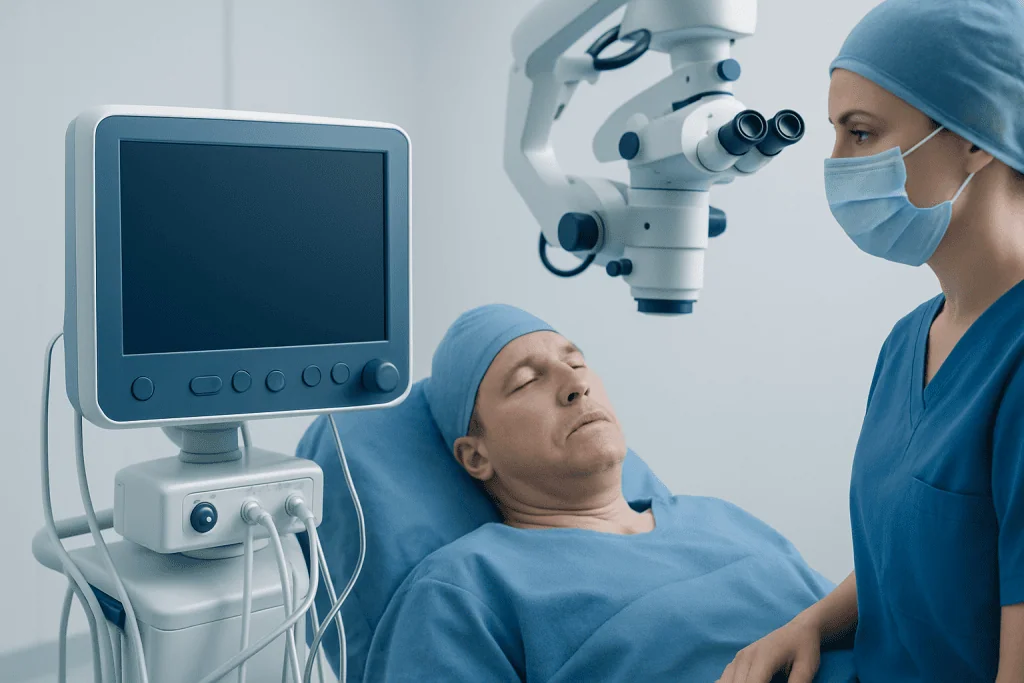
Candidacy depends on a detailed assessment rather than facial appearance alone. Specialists consider the cause of paralysis, whether it is complete or partial, how long it has been present, prior treatments, hearing and eye symptoms, general health, and the patient’s own priorities. Imaging and electrical tests may help determine whether the facial muscles can still respond to a nerve signal.
When facial paralysis is recent and the facial nerve has been cut, compressed, or damaged during removal of a lesion, direct repair or grafting may be considered if technically possible. In selected cases, a nerve transfer can provide a new source of signals to facial muscles. Common donor nerves may include branches involved in chewing or tongue movement; the surgical team plans carefully to preserve useful donor-nerve function.
With long-standing complete paralysis, facial muscles may no longer be able to respond effectively even if a nerve is reconnected. In this situation, a free functional muscle transfer, often using muscle from another part of the body, may be considered to create dynamic smile movement. The evaluation also includes eye protection needs and can overlap with care for related facial paralysis.
- Persistent weakness with limited recovery after an appropriate observation period
- Known facial nerve injury from trauma, surgery, or tumor involvement
- Difficulty closing the eye, retaining food or liquid, speaking clearly, or smiling
- Stable health for anesthesia and a commitment to follow-up rehabilitation
Step by step: what happens during the procedure?
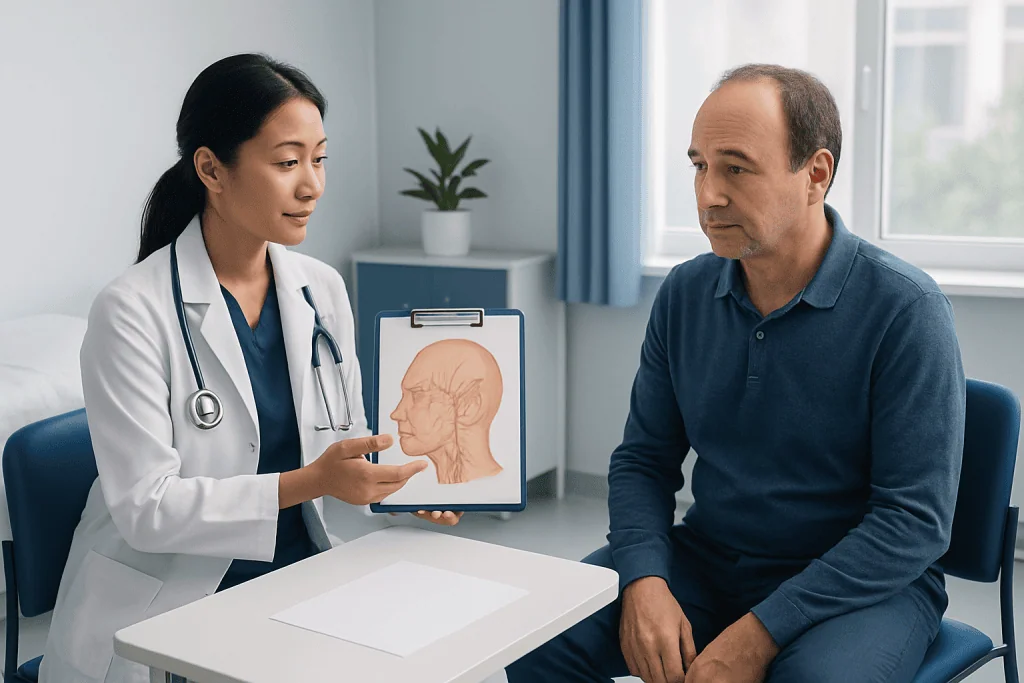
Before surgery, the team documents facial movement using photographs and videos, checks eye health, and reviews scans or nerve testing when appropriate. The surgeon discusses the expected goals, scars, number of stages, possible donor sites, and whether a procedure is intended to restore movement, improve support, or both. Surgical planning is highly personalized, particularly after tumor treatment or previous facial surgery.
For direct nerve repair, the surgeon identifies the separated ends of the facial nerve and reconnects them without tension when possible. If a gap is too large, a nerve graft may bridge it. In a nerve transfer, a carefully selected nearby donor nerve is connected to a facial nerve branch, allowing new nerve fibers to grow toward facial muscles over time.
A cross-facial nerve graft may carry signals from the unaffected side of the face to the affected side. It is sometimes performed as part of a staged plan, particularly before a free muscle transfer. During free functional muscle transfer, a small muscle and its blood vessels are moved to the face and connected under a microscope to local vessels and a nerve source. This is a complex reconstructive operation and may require a hospital stay.
Some people also benefit from procedures focused on protection and balance, such as eyelid loading, tightening or support, brow lifting, or static suspension of the mouth corner. These approaches may be offered alone or alongside facial reanimation surgery to address the aspects of facial function most important to the individual.
Recovery timeline and rehabilitation
Early recovery focuses on wound healing, swelling control, pain management and eye protection. Depending on the operation, patients may go home the same day or remain in hospital for monitoring, especially after microsurgical tissue transfer. The care team gives individualized instructions about incision care, activity limits, sleeping position, medication and signs that require prompt contact.
Nerve recovery is gradual. After a nerve repair, graft or transfer, nerve fibers must grow into the target muscles; new movement commonly takes several months to appear and may continue to improve over a year or longer. Recovery after muscle transfer also occurs in stages, with the transplanted tissue needing time to heal, establish a nerve connection and then be trained to move.
Facial rehabilitation is central to the process. A therapist experienced in facial neuromuscular retraining can teach gentle, targeted exercises and strategies for reducing unwanted linked movements, called synkinesis. Not everyone should begin exercises at the same time, so rehabilitation should follow the surgical team’s guidance rather than an unsupervised online program.
Eye care remains important while blinking is weak. Lubricating drops or ointment, protective taping at night, moisture chambers or other measures may be recommended by an eye specialist. If eye irritation, pain, redness, blurred vision or light sensitivity develops, urgent medical advice is needed.
Benefits, limitations and possible risks
Potential benefits of facial reanimation include better eyelid closure, improved facial balance at rest, more effective lip closure, enhanced smile movement and greater confidence in social communication. For some people, the most meaningful improvement is eye comfort or the ability to eat and drink with less leakage. For others, it is the return of a visible expression or improved symmetry.
No operation can guarantee a fully natural or identical smile. Movement may initially require concentration or activation of a donor nerve, and some people develop spontaneous or more natural movement with time and therapy. The final result is influenced by the original cause of paralysis, age, muscle condition, surgical technique, scarring, nerve regrowth and participation in follow-up care.
Risks vary by procedure and may include bleeding, infection, fluid collection, scarring, delayed wound healing, persistent asymmetry, incomplete improvement, nerve pain or numbness, and the need for additional treatment. Nerve transfer procedures can cause temporary or lasting weakness, altered sensation or other effects in the donor area. Free muscle transfer also carries risks related to microsurgery, including compromise of the transferred tissue’s blood supply.
A clear discussion of benefits, trade-offs and realistic goals helps people make informed decisions. Surgeons usually compare surgical options with nonsurgical support, including eye protection, facial therapy and treatment for synkinesis where appropriate.
How successful is facial reanimation surgery?
Facial reanimation surgery can be successful in improving specific functions, but success should be defined around the individual’s goals rather than a single measure. Many patients achieve meaningful improvement in eye protection, facial symmetry, lip control or smile movement. The degree of recovery differs substantially between people and between procedures.
Earlier treatment of a repairable nerve injury may offer the opportunity to preserve or restore existing facial muscles. In long-standing paralysis, free functional muscle transfer can create dynamic movement even when original facial muscles no longer function. Static procedures may provide reliable support and symmetry but do not create voluntary facial movement.
Specialists assess outcomes through facial movement, resting symmetry, eye safety, functional tasks and patient-reported quality of life. Follow-up over time is important because nerve regeneration and retraining are slow. A surgeon can explain which outcomes are realistic for a particular pattern and duration of paralysis.
How long does it take to recover from facial paralysis?
Recovery from facial paralysis varies widely because the underlying cause matters. Some temporary forms of weakness improve over weeks to months without surgery, while severe nerve injuries may recover incompletely or not at all. A clinician can assess the likely course using the examination, timing of symptoms, imaging when needed and, in selected cases, nerve testing.
After facial reanimation surgery, initial healing typically takes weeks, but recovery of movement often takes months. Nerve-based procedures depend on slow nerve regeneration, while muscle-transfer procedures require both tissue healing and rehabilitation. Improvements may continue for 12 to 18 months or longer, depending on the technique and the individual.
Persistent weakness should not be assumed to be permanent without assessment. Early referral to a clinician with facial nerve expertise can help identify eye-protection needs and time-sensitive options. Rehabilitation may remain helpful at many stages, including when paralysis has been present for a long time.
When to seek medical care
Sudden facial weakness should be assessed urgently, especially when it occurs with arm or leg weakness, trouble speaking, severe headache, confusion, dizziness, vision changes or difficulty walking. These symptoms can indicate a time-sensitive neurological emergency. New inability to close the eye also needs prompt attention to prevent corneal injury.
Medical evaluation is also appropriate for facial weakness that is worsening, lasts beyond the expected recovery period, follows head or facial trauma, occurs after surgery, or is accompanied by ear pain, hearing change, a rash, a lump, unexplained weight loss or recurrent episodes. A clinician can investigate the cause and recommend suitable treatment or referral.
People considering surgery benefit from assessment by a multidisciplinary facial nerve service. Acibadem International’s multidisciplinary specialists and JCI-accredited hospitals diagnose and treat facial nerve conditions for international patients, with treatment plans based on clinical evaluation and personal functional goals.
Can you show me pictures of facial reanimation surgery before and after?
Before-and-after photographs can help explain the types of change that may be possible, but they cannot predict an individual result. Images may show different lighting, facial positions, recovery stages, procedures and causes of paralysis. A useful consultation includes standardized photographs and videos that document resting symmetry, eye closure and smile movement.
For privacy and ethical reasons, clinical teams should use patient photographs only with appropriate consent. During a consultation, a surgeon may be able to discuss representative examples that match a similar type and duration of paralysis, while explaining the limitations of comparison. Personal outcomes should be based on an examination rather than photographs alone.
It is also helpful to ask whether images were taken before treatment, soon after surgery or after full rehabilitation. Nerve-related movement can evolve gradually, so an early image may not reflect the eventual result. A clinician can explain what features are most relevant to the proposed procedure.
Does insurance cover facial reanimation surgery?
Insurance coverage for facial reanimation surgery depends on the insurer, policy, country, medical indication and the planned procedures. Reconstructive treatment for functional problems such as inability to close the eye, facial nerve injury, impaired eating or speech may be evaluated differently from procedures considered primarily cosmetic. Coverage rules and authorization requirements vary.
Before scheduling treatment, patients can ask their insurer whether the consultation, imaging, rehabilitation, hospital care, anesthesia, surgeon fees and possible staged procedures require prior approval. It can be useful to request written information about coverage, exclusions, network requirements and out-of-pocket responsibilities.
The treating team can provide clinical documentation describing the diagnosis, functional limitations and recommended treatment, but it cannot determine an insurer’s final decision. International patients should also clarify payment arrangements and insurance processes before travel or treatment planning.
Frequently asked questions
What is the best surgery for facial nerve paralysis?
There is no single best operation for every person. The appropriate procedure depends on the cause and duration of paralysis, the condition of facial muscles, eye-protection needs and the movements a person hopes to regain. Options can include nerve repair, grafting, nerve transfer, muscle transfer and static support procedures.
Is facial reanimation surgery painful?
Discomfort is expected after surgery, but pain is usually managed with an individualized plan during the early healing period. The amount of discomfort depends on the procedure and whether tissue or a nerve is taken from another area of the body. Patients should discuss pain-control options and expected recovery with their surgical team.
Can facial reanimation restore a natural smile?
Surgery may create or improve smile movement, but a fully natural and identical smile cannot be guaranteed. Some techniques initially require deliberate activation of a donor nerve, while training and nerve healing may make movement easier over time. Facial therapy is often important for optimizing coordination and symmetry.
What happens if facial paralysis is left untreated?
The effects depend on the cause and severity. Incomplete eye closure can damage the cornea, while prolonged weakness may lead to muscle changes, asymmetry, speech or eating difficulties and unwanted linked movements. Medical assessment is important to identify the cause, protect the eye and discuss treatment options.
Can surgery still help after years of facial paralysis?
Yes, surgery can still help some people with long-standing paralysis. When original facial muscles are no longer able to respond, a free functional muscle transfer or static support procedure may be considered. An experienced facial nerve team can assess which options are realistic.
Will I need physical therapy after facial reanimation surgery?
Many patients benefit from facial neuromuscular retraining after surgery, although the timing and type of therapy differ by procedure. Therapy can help develop new movement patterns, improve coordination and manage synkinesis. It should be guided by clinicians familiar with facial nerve recovery.
References
- American Academy of Otolaryngology–Head and Neck Surgery
- American Society of Plastic Surgeons
- National Institute of Neurological Disorders and Stroke
- Facial Nerve Center, Johns Hopkins Medicine
- Mayo Clinic
This article is for general information only and is not a substitute for professional medical advice. Please consult a qualified doctor about your individual situation.
Oncology care in Turkey — second opinion and treatment plan
JCI-accredited · board-certified surgeons · reply within 24h
Add us as a Preferred Source to see more of our trusted health content across Google Search, AI Overviews and Discover.