Refractive Errors: Nearsightedness, Farsightedness, and Astigmatism Explained
Refractive errors are focusing problems, not eye infections or eye diseases in themselves. Myopia causes difficulty seeing far away, while hyperopia often affects near vision and may cause eye strain.
Key Takeaways
- Refractive errors are focusing problems, not eye infections or eye diseases in themselves.
- Myopia causes difficulty seeing far away, while hyperopia often affects near vision and may cause eye strain.
- Astigmatism results from an uneven curve of the cornea or lens and can blur vision at all distances.
- A comprehensive eye exam is the safest way to diagnose the type and degree of refractive error.
- Treatment may include eyeglasses, contact lenses, orthokeratology, or refractive surgery depending on age, eye health, and lifestyle.
Refractive errors are among the most common causes of blurred vision and occur when the eye cannot focus light clearly on the retina. Nearsightedness, farsightedness, and astigmatism can usually be managed effectively with glasses, contact lenses, or carefully selected surgical options.
Overview
Refractive errors are vision problems that happen when the shape of the eye prevents light from focusing sharply on the retina, the light-sensitive layer at the back of the eye. When light is not focused correctly, images may appear blurred, distorted, or uncomfortable to view. The most common refractive errors are nearsightedness, also called myopia; farsightedness, also called hyperopia; astigmatism; and presbyopia, the age-related difficulty with near focus.
These conditions are very common and can affect children, teenagers, and adults. A refractive error does not usually mean that the eye is unhealthy. Rather, it means that the eye’s focusing system needs optical correction, much like a camera lens that needs adjustment to produce a sharp image.
Most people with refractive errors can see clearly with appropriate glasses or contact lenses. Some adults may also be candidates for procedures such as laser vision correction or lens-based surgery. The right option depends on the person’s prescription, corneal shape, age, general health, eye health, daily activities, and personal preferences.
Types of Refractive Errors
Myopia, or nearsightedness, occurs when distant objects look blurry while close objects are easier to see. This usually happens because the eye is slightly too long from front to back, or because the cornea is too steeply curved. As a result, light focuses in front of the retina instead of directly on it.
Hyperopia, or farsightedness, occurs when near objects may appear blurry or require extra effort to focus on. In some people, distance vision may remain clear, especially at younger ages when the focusing muscles can compensate. Hyperopia often happens when the eye is shorter than average or the cornea is flatter than needed, causing light to focus behind the retina.
Astigmatism is caused by an uneven curvature of the cornea or, less commonly, the natural lens inside the eye. Instead of being evenly round, the focusing surface may be shaped more like a rugby ball than a basketball. This can cause blurred, shadowed, or distorted vision at both near and far distances. Many people have astigmatism together with myopia or hyperopia.
Presbyopia is different from the other refractive errors because it develops with age. The natural lens gradually becomes less flexible, making it harder to focus on close objects. It typically becomes noticeable in adulthood and may require reading glasses, multifocal lenses, or other near-vision solutions.
Symptoms
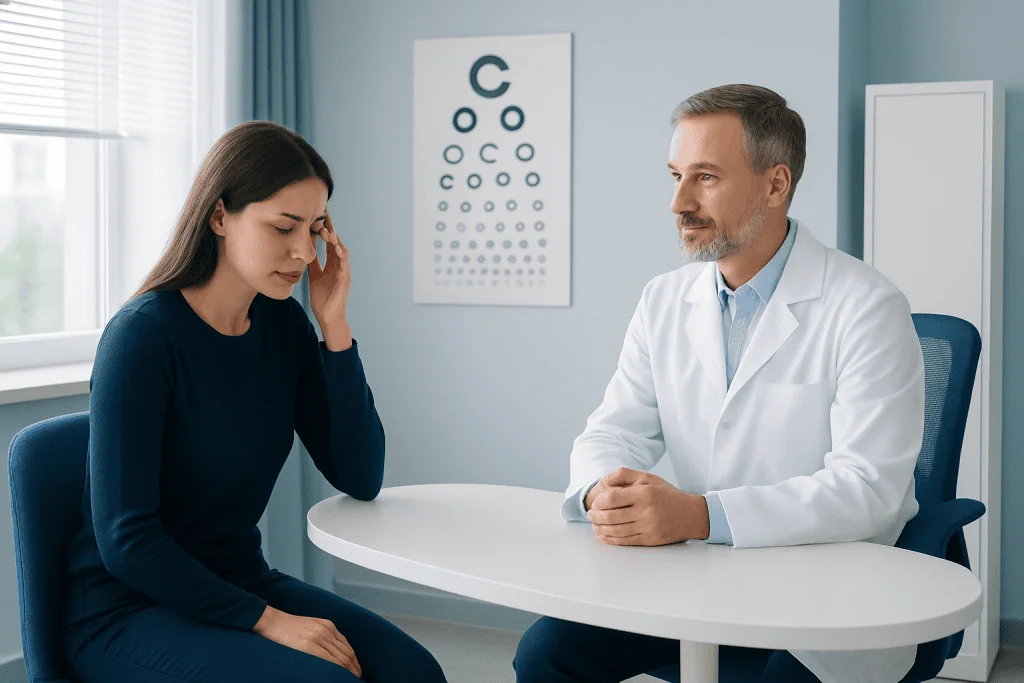
The main symptom of a refractive error is blurred vision, but the way it appears can vary. A person with myopia may squint to read signs or recognize faces at a distance. A person with hyperopia may hold reading material farther away or feel tired after near work. A person with astigmatism may notice ghosting, glare, or difficulty seeing clearly at night.
Symptoms may be subtle at first, especially in children who may not realize that their vision is different from others. They may sit close to the television, avoid reading, complain of headaches, rub their eyes, or have difficulty at school. Adults may notice eye strain during computer work, driving, reading, or using a smartphone.
- Blurred vision at near, far, or all distances
- Squinting or closing one eye to see better
- Headaches or eye fatigue after visual tasks
- Difficulty with night driving or glare from lights
- Frequent changes in glasses or contact lens needs
Sudden changes in vision, flashes of light, new floaters, eye pain, or loss of part of the visual field are not typical simple refractive symptoms. These signs need prompt medical attention because they may indicate another eye condition.
Causes and Risk Factors
Refractive errors are mainly related to the size and shape of the eye, the curvature of the cornea, and the focusing power of the eye’s natural lens. These features are influenced by genetics and by normal growth and development. For example, myopia often begins in childhood and may progress during the school years as the eye grows.
Family history is an important risk factor. Children are more likely to develop myopia or other refractive errors if one or both parents have them. Environmental and lifestyle factors may also play a role, particularly for myopia. Long periods of near work and limited outdoor time have been associated with a higher risk of developing or progressing myopia in children, although individual risk varies.
Other factors can affect refraction over time. Pregnancy, diabetes, certain medications, cataracts, eye injury, corneal disorders, and previous eye surgery may change the way the eye focuses light. For this reason, a prescription change should be evaluated in context, especially if it is rapid or occurs with other symptoms.
Diagnosis
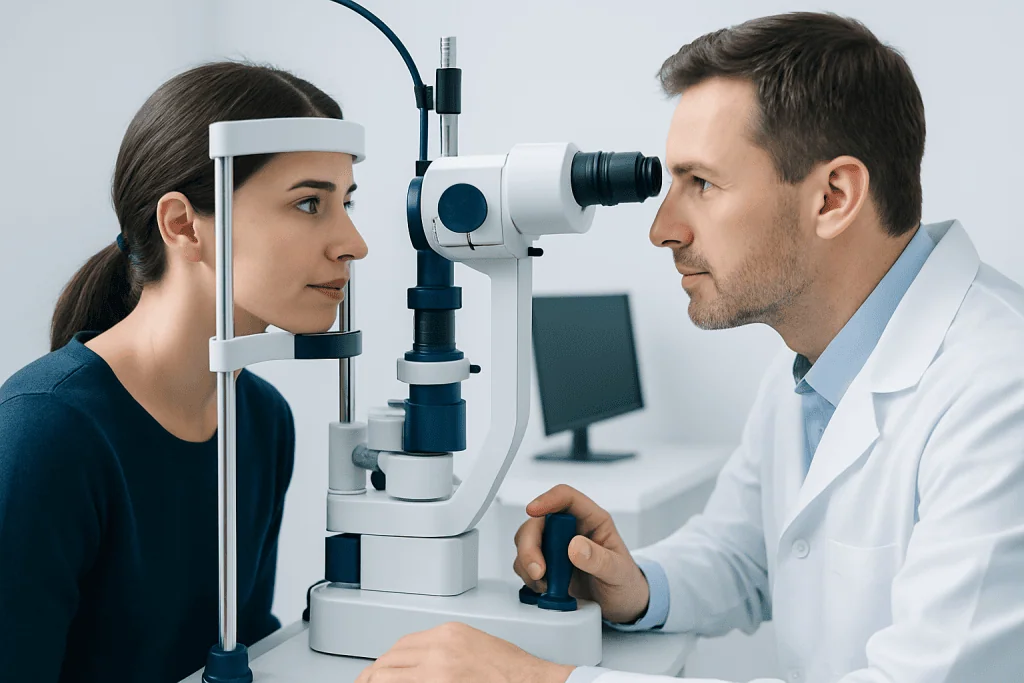
Refractive errors are diagnosed through an eye examination performed by an eye care professional. The exam usually includes a visual acuity test, where the person reads letters or symbols on a chart, and refraction testing, where lenses are placed in front of the eye to determine which prescription provides the clearest vision.
Objective tests may also be used, especially for young children or people who cannot easily describe what they see. Autorefraction uses an instrument to estimate the prescription, while retinoscopy allows the clinician to observe how light reflects from the retina. In children, eye drops may sometimes be used to temporarily relax the focusing muscles so the true refractive error can be measured more accurately.
A complete eye exam may also assess eye pressure, eye alignment, pupil responses, corneal health, the lens, and the retina. This is important because blurred vision is not always due to a refractive error. Conditions such as cataract, keratoconus, diabetic eye disease, glaucoma, or retinal problems can also affect vision and may need different treatment.
Treatment Options
Eyeglasses are the simplest and most widely used treatment for refractive errors. They work by bending light before it enters the eye so that images focus correctly on the retina. Glasses are safe, adjustable, and suitable for most ages, including children. Lens designs may be single-vision, bifocal, progressive, or task-specific, depending on the person’s needs.
Contact lenses sit directly on the surface of the eye and can provide a wider field of vision for some people. Soft lenses, rigid gas-permeable lenses, toric lenses for astigmatism, and multifocal lenses are among the available types. Contact lenses require careful hygiene, correct handling, and regular follow-up because improper use can increase the risk of irritation or infection.
Some people may be candidates for orthokeratology, also called ortho-k, which uses specially fitted rigid lenses worn overnight to temporarily reshape the cornea. This can provide clearer daytime vision without glasses or daytime contact lenses. It may also be considered in selected children with progressing myopia, under specialist supervision.
Refractive surgery may be an option for adults with stable prescriptions and healthy eyes. Procedures such as LASIK, PRK, SMILE, or implantable lenses aim to reduce dependence on glasses or contact lenses. Not everyone is suitable for surgery, and a detailed assessment of corneal thickness, corneal shape, dry eye status, prescription stability, and overall eye health is essential before any procedure.
Prevention, Self-care, and When to See a Doctor
Not all refractive errors can be prevented, especially when genetics and eye shape are involved. However, healthy visual habits can support comfort and may help reduce eye strain. Children should have regular vision screening and eye exams as recommended by their doctor or eye care professional, particularly if there is a family history of myopia or if school performance or behavior suggests a possible vision problem.
For daily eye comfort, people can take breaks during prolonged reading or screen use, keep screens at a comfortable distance, use good lighting, and wear the correct prescription. Time outdoors is encouraged for children as part of a balanced, active routine. People who wear contact lenses should follow cleaning and replacement instructions, avoid sleeping in lenses unless specifically advised, and seek care for redness, pain, or sudden blurred vision.
An eye doctor should be consulted if vision becomes blurred, headaches or eye strain are frequent, a child squints or struggles at school, or the current glasses no longer seem effective. Urgent care is needed for sudden vision loss, eye injury, severe eye pain, new flashes or floaters, or a curtain-like shadow in vision. Acibadem International’s multidisciplinary eye specialists and JCI-accredited hospitals diagnose and treat refractive errors for international patients, including those considering advanced vision correction options.
Frequently asked questions
Are refractive errors eye diseases?
Refractive errors are usually focusing problems rather than eye diseases. They occur when the eye’s shape or focusing structures do not direct light precisely onto the retina. However, an eye exam is important because other eye conditions can also cause blurred vision.
What is the difference between myopia and hyperopia?
Myopia, or nearsightedness, makes distant objects look blurry because light focuses in front of the retina. Hyperopia, or farsightedness, often makes near tasks harder because light focuses behind the retina. Both can be corrected with properly prescribed lenses.
Can astigmatism be corrected?
Yes. Astigmatism can usually be corrected with eyeglasses, toric contact lenses, or certain refractive surgery procedures. The best option depends on the degree of astigmatism, corneal health, prescription stability, and the person’s daily needs.
How often should someone have an eye exam?
The ideal schedule depends on age, symptoms, risk factors, and existing eye conditions. Children need vision checks during development, and adults should have periodic comprehensive eye exams. Anyone with sudden vision changes, eye pain, diabetes, or a strong family history of eye disease should follow a doctor’s advice closely.
Do glasses make eyesight weaker?
No, wearing correctly prescribed glasses does not make the eyes weaker. Glasses help the eyes focus light properly so vision is clearer and more comfortable. If a prescription changes over time, it is usually due to eye growth, aging, or another underlying factor rather than the glasses themselves.
Is laser eye surgery suitable for everyone with refractive errors?
No. Laser eye surgery is generally considered only for adults with stable prescriptions and suitable corneal and eye health. A detailed preoperative evaluation is needed to check for factors such as dry eye, thin corneas, irregular corneal shape, or other conditions that may make surgery unsuitable.
References
- American Academy of Ophthalmology
- World Health Organization
- National Eye Institute
- American Optometric Association
- International Myopia Institute
This article is for general information only and is not a substitute for professional medical advice. Please consult a qualified doctor about your individual situation.
Farsightedness in Turkey — costs, top hospitals & a free quote
JCI-accredited · board-certified surgeons · reply within 24h
Add us as a Preferred Source to see more of our trusted health content across Google Search, AI Overviews and Discover.

Ophthalmology
Comprehensive eye care from laser vision correction to retina, cornea and cataract surgery.
75 specialists in this unitMore from the Health Library



Related Specialists
Dr. Zeynep Ece Demirbaş
Internal Medicine
Damla Tuncay
Physical Medicine & Rehabilitation
Fzt. Melek Ateş
Physical Medicine & Rehabilitation
Prof. Dr. Tuğbay Tuğ
General Surgery