Cerebrum vs Cerebellum: What’s the Difference?

The cerebrum is the largest part of the brain and is responsible for higher mental functions. The cerebellum mainly fine-tunes movement, balance, coordination, and motor learning.
Key Takeaways
- The cerebrum is the largest part of the brain and is responsible for higher mental functions.
- The cerebellum mainly fine-tunes movement, balance, coordination, and motor learning.
- These two brain regions work together during everyday tasks such as walking, speaking, writing, and using the hands.
- Problems in the cerebrum often affect thinking, speech, sensation, or strength, while cerebellar problems more often cause unsteady movement and poor coordination.
- Brain symptoms such as sudden weakness, severe dizziness, trouble speaking, or loss of balance should be assessed by a doctor promptly.
The cerebrum and cerebellum are two major parts of the brain with different but closely connected roles. The cerebrum supports thinking, memory, language, sensation, and voluntary movement, while the cerebellum helps coordinate balance, posture, and smooth, accurate motion.
Overview: What Are the Cerebrum and Cerebellum?
When comparing the cerebrum vs cerebellum, it helps to think of the brain as a highly organized control center with different regions performing specialized jobs. The cerebrum is the largest part of the brain and occupies the upper portion. It is involved in conscious thought, memory, language, emotion, sensation, and voluntary movement. The cerebellum is smaller and sits at the back and lower part of the brain, underneath the cerebrum. Its main role is to coordinate movement and help the body stay balanced and steady.
Although they have different functions, the cerebrum and cerebellum work as a team. For example, when a person decides to pick up a cup, the cerebrum plans and initiates the action. The cerebellum then refines the movement so the hand reaches the cup smoothly and accurately. Without this coordination, movements may become clumsy, shaky, or poorly timed.
Understanding the difference between cerebrum and cerebellum can make it easier to recognize why certain symptoms occur after injury or disease. A condition affecting the cerebrum may change thinking, speech, memory, or strength. A condition affecting the cerebellum is more likely to disturb balance, posture, and the precision of movement.
Structure and Location in the Brain
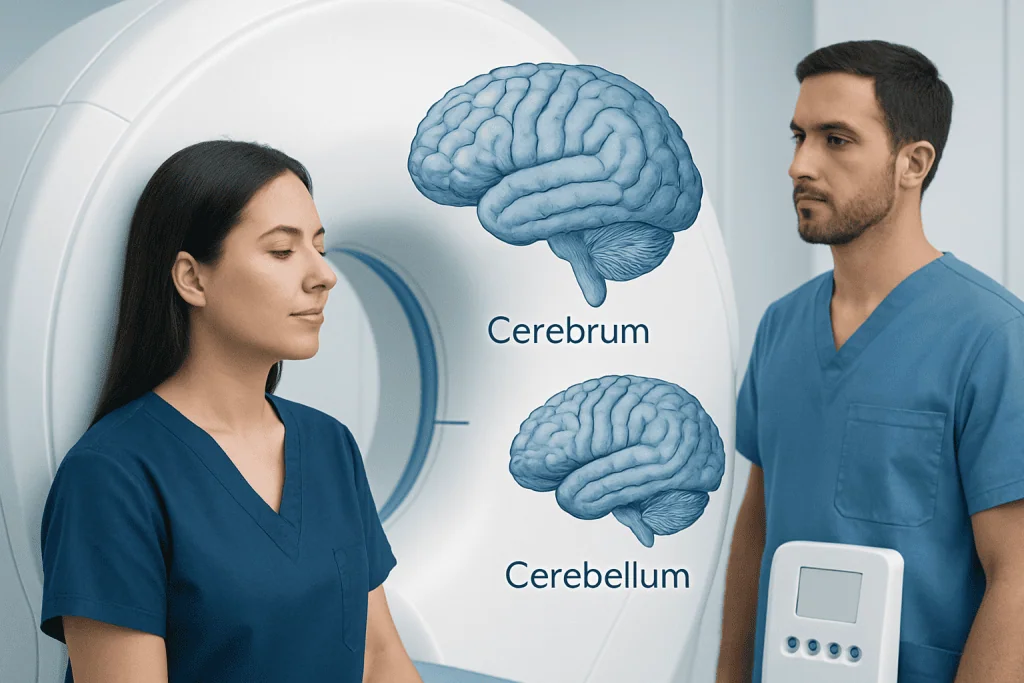
The cerebrum forms the largest visible part of the brain. It is divided into right and left hemispheres, connected by bundles of nerve fibers that allow the two sides to communicate. Each hemisphere contains lobes with different tasks: the frontal lobe supports planning and decision-making, the parietal lobe processes touch and spatial awareness, the temporal lobe helps with hearing and memory, and the occipital lobe is mainly involved in vision.
The cerebellum is located behind the brainstem and below the cerebrum. It also has two hemispheres, but its internal organization is different because it specializes in processing movement-related information. The cerebellum receives signals from the cerebrum, spinal cord, inner ear, muscles, and joints. It rapidly compares intended movement with actual movement and makes small adjustments in real time.
Even though the cerebellum is smaller than the cerebrum, it contains a very large number of nerve cells. This reflects how much detailed processing is needed to keep the body stable and movements coordinated. Both structures are essential, but they contribute in different ways to daily function.
Main Functions: How They Differ

The cerebrum is responsible for many of the functions people most closely associate with the brain. These include thinking, problem-solving, attention, memory, language, interpretation of sensory information, and voluntary control of muscles. It allows a person to understand what they see and hear, make plans, express thoughts, and carry out purposeful actions.
The cerebellum does not create thoughts or make decisions in the same way the cerebrum does. Instead, it supports the quality and timing of movement. It helps maintain posture, balance, and muscle tone. It also contributes to motor learning, which is the process of improving physical skills through practice, such as writing, typing, riding a bicycle, or playing an instrument.
A simple way to compare them is this: the cerebrum decides what to do, and the cerebellum helps the body do it smoothly. In reality, the relationship is more complex, but this summary is useful for understanding their different roles. Modern research also suggests the cerebellum may contribute to some aspects of attention and language, though movement coordination remains its best-known function.
- Cerebrum: thought, memory, language, sensation, emotion, voluntary movement
- Cerebellum: balance, posture, coordination, timing, precision, motor learning
How Symptoms Can Differ When One Area Is Affected
Because the cerebrum and cerebellum control different functions, problems in these areas often look different. Disorders involving the cerebrum may cause weakness on one side of the body, numbness, trouble speaking, confusion, memory changes, vision problems, or difficulty understanding language. Depending on the specific location, symptoms can range from subtle concentration problems to major neurological deficits.
When the cerebellum is affected, the most common issues involve coordination. A person may feel unsteady while walking, have a wide-based gait, miss a target when reaching for something, or notice shaky movements that worsen near the end of an action. Speech may become slurred or scanning in quality, and rapid alternating movements may be difficult. Dizziness can occur, although true dizziness has many possible causes and is not always cerebellar.
Symptoms can overlap because the brain functions as an integrated system. For example, a stroke, tumor, infection, inflammation, or head injury can affect more than one brain region at the same time. Some serious neurological conditions, including stroke and brain tumor, may involve either the cerebrum or cerebellum and require prompt medical attention.
Common Conditions That Can Affect the Cerebrum or Cerebellum
Many health conditions can affect either part of the brain. The cerebrum is commonly involved in stroke, traumatic brain injury, seizures, dementia-related changes, infections, inflammatory disorders, and tumors. Because the cerebrum manages higher brain functions, these conditions may change cognition, behavior, speech, sensation, or movement control.
The cerebellum can be affected by stroke, bleeding, tumors, multiple sclerosis, inherited or degenerative ataxias, alcohol-related injury, medication side effects, and certain infections or autoimmune conditions. Problems in the cerebellum often lead to ataxia, a term used for poor coordination. People with ataxia may have difficulty walking straight, controlling hand movements, or speaking clearly.
In some situations, symptoms develop suddenly, such as with stroke or bleeding. In others, they appear gradually over time, as can happen with certain tumors, degenerative disorders, or chronic inflammation. When doctors need detailed imaging of the brain, they may use MRI scanning or CT scanning to evaluate brain structure and look for the cause of symptoms.
How Doctors Diagnose Problems in These Brain Regions
Diagnosis starts with a careful medical history and neurological examination. The doctor asks when symptoms began, whether they started suddenly or gradually, and what body functions are affected. They may test strength, reflexes, sensation, eye movements, balance, coordination, speech, memory, and attention. This exam often gives important clues about whether the cerebrum, cerebellum, or another part of the nervous system may be involved.
Brain imaging is often an important next step. CT scans are commonly used in urgent settings because they are fast and can identify bleeding or major structural changes. MRI provides more detailed images and is particularly useful for detecting many strokes, tumors, inflammatory changes, and abnormalities in the cerebellum or cerebrum. Additional tests may include blood tests, hearing and balance assessment, or spinal fluid analysis, depending on the suspected cause.
If seizures are a concern, doctors may recommend an electroencephalogram to assess the brain’s electrical activity. In complex cases, evaluation by specialists in neurology, neuroradiology, rehabilitation, or neurosurgery may be appropriate. The diagnosis guides treatment, so prompt assessment is especially important for sudden neurological symptoms.
Treatment, Recovery, and Rehabilitation
Treatment depends on the underlying cause rather than on the brain region alone. For example, a stroke may require emergency care, a tumor may need surgery or other therapies, an infection may need antimicrobial treatment, and an inflammatory condition may be treated with medicines that reduce immune activity. For some structural conditions, doctors may consider brain tumor surgery if it is appropriate and safe.
Recovery also depends on the type, size, and location of the problem, as well as how quickly treatment begins. The brain has some ability to adapt through neuroplasticity, which means healthy areas can sometimes take over part of a lost function with time and training. This is one reason rehabilitation can be so helpful after injury or illness.
Rehabilitation may include physical therapy for balance and walking, occupational therapy for hand use and daily activities, and speech therapy for communication or swallowing issues. People with cerebellar problems often benefit from exercises that improve stability and coordination. Those with cerebrum-related problems may need support for language, cognition, or one-sided weakness. Near the end of the care journey, some patients may seek treatment in specialized centers; Acibadem International’s multidisciplinary specialists in JCI-accredited hospitals diagnose and treat neurological conditions for international patients.
When to Seek Medical Care
Sudden neurological symptoms should never be ignored. Emergency care is important if a person develops sudden weakness, numbness, facial drooping, trouble speaking, severe imbalance, new confusion, sudden vision loss, a severe unexplained headache, or loss of consciousness. These symptoms can be caused by serious conditions that need urgent treatment.
Medical review is also recommended for persistent or gradually worsening problems such as frequent falls, ongoing dizziness, coordination difficulties, memory changes, tremor, new headaches, or changes in personality or behavior. Although many symptoms have non-serious causes, it is safest to have new neurological issues assessed by a qualified doctor.
For day-to-day brain health, general self-care still matters. Managing blood pressure, diabetes, and cholesterol, avoiding smoking, limiting excessive alcohol use, wearing seatbelts and helmets when appropriate, staying physically active, and getting enough sleep can all support long-term neurological health. These steps cannot prevent every brain disorder, but they can lower the risk of some common conditions.
Frequently asked questions
What is the main difference between the cerebrum and cerebellum?
The cerebrum is mainly responsible for conscious functions such as thinking, memory, language, sensation, and voluntary movement. The cerebellum mainly helps coordinate movement, balance, posture, and the timing of muscle activity. Both are essential and work together during most daily tasks.
Is the cerebellum part of the cerebrum?
No. They are separate parts of the brain with different structures and roles. The cerebrum is the largest upper part of the brain, while the cerebellum sits lower and toward the back.
Can a person live without part of the cerebellum or cerebrum?
In some cases, people can survive after surgery or injury involving part of either region, but the effects depend on how much tissue is involved and where it is located. Some functions may be partly compensated for over time, especially with rehabilitation. However, both regions are very important, and damage can cause lasting symptoms.
What symptoms suggest a cerebellum problem?
Common signs include poor balance, an unsteady or wide-based walk, clumsy hand movements, tremor during purposeful movement, and slurred speech. Some people also have dizziness or trouble with rapid alternating movements. These symptoms should be medically assessed, especially if they begin suddenly.
What symptoms suggest a cerebrum problem?
Problems affecting the cerebrum may cause weakness, numbness, trouble speaking, confusion, memory changes, personality changes, or vision difficulties. The exact symptoms depend on which part of the cerebrum is affected. Sudden symptoms need urgent medical evaluation.
How do doctors tell whether symptoms come from the cerebrum or cerebellum?
Doctors use the person's history, a neurological examination, and often brain imaging such as CT or MRI. The pattern of symptoms gives important clues. For example, balance and coordination problems may point toward the cerebellum, while language or memory changes may suggest cerebrum involvement.
References
- National Institute of Neurological Disorders and Stroke
- National Institute on Aging
- MedlinePlus
- Mayo Clinic
- World Health Organization
This article is for general information only and is not a substitute for professional medical advice. Please consult a qualified doctor about your individual situation.
Joint and spine care in Turkey — expert assessment & treatment
JCI-accredited · board-certified surgeons · reply within 24h
Add us as a Preferred Source to see more of our trusted health content across Google Search, AI Overviews and Discover.

More from the Health Library



Related Specialists

Assoc. Prof. Dr. Berkin Toker
Orthopedic Surgery & Traumatology
Prof. Dr. Ahmet Keskinoğlu
Pediatric Nephrology
Dr. Fatmanur Yildirim
Physical Medicine & Rehabilitation
Prof. Dr. Pınar Yalınay Dikmen
Neurology