Stroke Thrombectomy in Turkey: When Traveling for Urgent Care May Be Considered

Stroke thrombectomy is time-sensitive and is not a substitute for calling local emergency services at the first sign of stroke. Travel for urgent stroke care may be considered only after rapid assessment, imaging, and stabilization by a qualified medical team.
Key Takeaways
- Stroke thrombectomy is time-sensitive and is not a substitute for calling local emergency services at the first sign of stroke.
- Travel for urgent stroke care may be considered only after rapid assessment, imaging, and stabilization by a qualified medical team.
- Not every stroke is treated with thrombectomy; eligibility depends on brain imaging, timing, and the location of the blockage.
- Safe transfer planning requires coordination between hospitals, doctors, and transport teams, especially for patients with ongoing symptoms.
- Recovery often continues after the procedure and may include stroke unit care, rehabilitation, and follow-up imaging.
Stroke thrombectomy is an emergency procedure used to remove a blood clot from a blocked brain artery in selected cases of ischemic stroke. For international patients, travel to Turkey is generally considered only after immediate local stabilization and specialist confirmation that transfer is medically safe and appropriate.
Overview
Stroke thrombectomy in Turkey refers to traveling for a specialized emergency procedure called mechanical thrombectomy, in which doctors remove a clot from a blocked artery in the brain. This treatment is used for some ischemic strokes, which happen when blood flow to part of the brain is suddenly interrupted. The goal is to reopen the artery as quickly as possible and help preserve brain function.
Because stroke is a medical emergency, the first priority is always immediate care at the nearest appropriate hospital. People with sudden facial drooping, arm weakness, speech difficulty, confusion, vision loss, or severe balance problems should not delay to arrange international travel. They need urgent ambulance-based evaluation, brain imaging, and treatment decisions where they are.
In some situations, international transfer may be considered after the patient has already been assessed and stabilized locally. This usually applies when a thrombectomy-capable center is not readily available nearby, when transfer can be organized safely, or when ongoing advanced neurovascular and rehabilitation care is needed after the emergency phase. Whether travel is suitable depends on timing, the patient’s condition, and specialist review of scans and medical records.
When Travel for Urgent Stroke Care May Be Considered
Travel may be considered only in carefully selected situations. Typically, a local medical team first confirms that the patient has a suspected or proven large-vessel ischemic stroke, obtains urgent imaging, and begins emergency treatment. A receiving stroke center then reviews the patient’s scans, symptoms, timing, and overall stability to decide whether transfer is medically reasonable.
In practical terms, international travel is usually more realistic when it can happen very quickly and safely, or when the patient has passed the most unstable phase and still needs advanced stroke care. The exact time window for thrombectomy is not the same for every patient. Some people may benefit within a standard early window, while others may still be candidates later if brain imaging shows salvageable tissue.
Doctors weigh several questions before recommending transfer:
- Has the patient had immediate emergency assessment and brain imaging?
- Is the stroke ischemic rather than bleeding-related?
- Is there a clot in a large artery that may respond to thrombectomy?
- Is the patient stable enough for air or ground medical transport?
- Will transfer time still allow meaningful treatment benefit?
- Does the receiving center have a stroke team ready on arrival?
If the answer to any of these questions is unclear, local emergency treatment should continue without delay. Travel should support, not postpone, time-critical care.
Who May Be a Candidate for Thrombectomy

Mechanical thrombectomy is not used for every stroke. It is generally considered for people with ischemic stroke caused by a clot in a major brain artery, often called a large-vessel occlusion. Doctors use clinical examination and urgent imaging to determine whether the blocked vessel can be reached and whether brain tissue may still be saved.
Eligibility depends on more than the clock alone. Specialists look at the patient’s neurological symptoms, the size and location of the blockage, how much brain tissue is already injured, and whether there is still an area at risk that could recover if blood flow returns. Age, previous health status, and the presence of bleeding or other serious illness may also affect the decision.
Many patients are evaluated for both clot-dissolving medication and thrombectomy, while some may receive one treatment but not the other. People with hemorrhagic stroke, certain bleeding risks, or extensive irreversible brain injury may not benefit from thrombectomy. For this reason, careful imaging and stroke specialist review are essential before any transfer plan is made.
Families may hear terms such as stroke, ischemic stroke, large-vessel occlusion, or endovascular therapy during this process. These terms describe related parts of the same emergency pathway and help guide whether transfer to a center offering interventional neuroradiology is appropriate.
How Evaluation and Transfer Planning Work
Before transfer, the medical team usually gathers key information: the exact time symptoms started or were last known to be absent, current neurological findings, blood pressure and oxygen levels, medications, anticoagulant use, and the results of CT, CT angiography, or other imaging. These details help the receiving specialists decide whether thrombectomy remains feasible and safe.
Transfer planning also involves practical and safety issues. The patient may need physician-supervised air ambulance or advanced ground transport, depending on distance and condition. During travel, monitoring is important because stroke symptoms can change, blood pressure may need close control, and airway support may sometimes be required.
Families often focus on speed, but continuity of care matters just as much. The safest transfers occur when there is direct communication between the referring and receiving hospitals, pre-arranged handover of imaging and records, and a confirmed team ready to assess or treat the patient immediately on arrival. Delays caused by incomplete records or unclear medical status can reduce the potential benefit.
For some patients, doctors may advise remaining in the nearest qualified stroke center rather than traveling farther abroad. This does not mean options are limited; it means the decision is being made according to what is safest and most likely to help in a time-sensitive emergency.
What the Procedure Involves
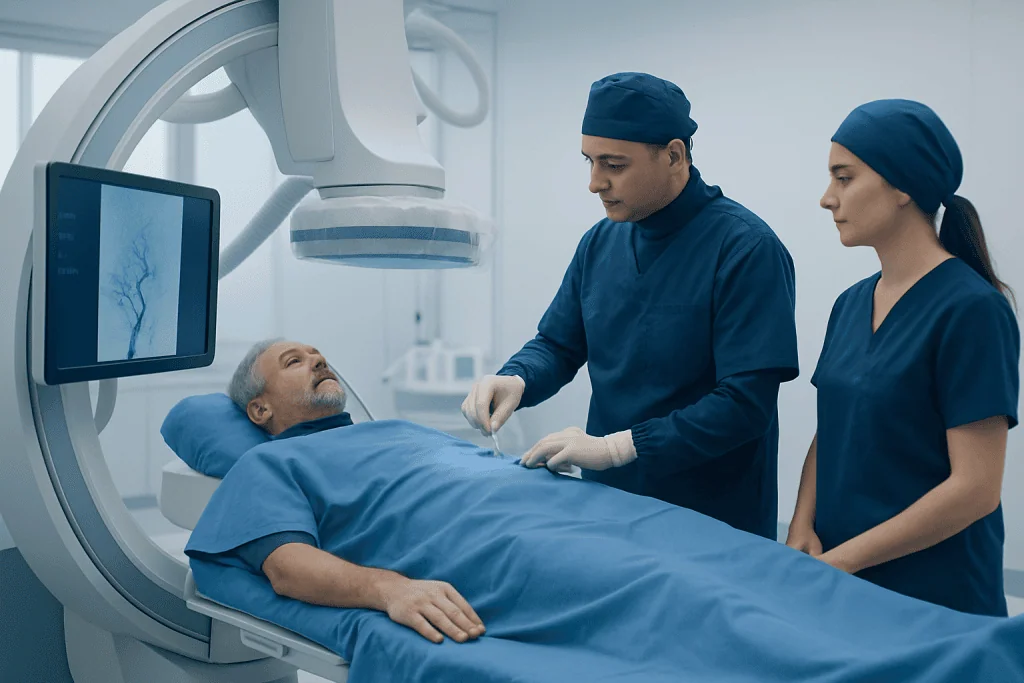
Mechanical thrombectomy is a minimally invasive procedure performed by a specially trained physician, often in a neuroangiography suite. A small tube called a catheter is usually inserted through an artery in the groin or wrist and guided to the blocked brain vessel using imaging. The clot is then removed with specialized devices, with the aim of restoring blood flow.
The procedure may be done with sedation or anesthesia, depending on the patient’s condition and the team’s judgment. Before proceeding, doctors confirm the location of the blockage and assess the risks and expected benefit. Like all emergency procedures, thrombectomy has potential complications, including bleeding, vessel injury, or incomplete reopening of the artery, but in appropriate patients it can significantly improve the chance of recovery.
After the procedure, the patient is usually monitored in a stroke unit or intensive care setting. Follow-up care may include repeat imaging, blood pressure control, swallowing assessment, prevention of complications, and planning for rehabilitation. Some patients also need evaluation for the underlying cause of the stroke, such as heart rhythm problems or carotid artery disease.
Patients traveling to Turkey may receive this care through teams experienced in stroke treatment and advanced neurovascular imaging such as MRI. The exact pathway depends on the urgency of the case and the patient’s neurological status on arrival.
Benefits, Limits, and Risks of Traveling Abroad
The main reason families consider stroke thrombectomy in Turkey is access to a comprehensive stroke center with interventional expertise, around-the-clock imaging, and coordinated inpatient rehabilitation. For carefully selected patients, this may support rapid decision-making and continuity of specialist care. However, the possible benefit must always be balanced against transfer time and the patient’s medical stability.
Travel has real limits in acute stroke. A long journey can consume precious treatment time, and some patients are simply too unstable to move safely. If a patient is eligible for thrombectomy at a closer local center, receiving treatment there is usually preferable to delaying for overseas transfer.
There are also financial, legal, and logistical considerations. Families may need to discuss insurance coverage, medical transport arrangements, passport or visa issues where relevant, translation of records, and plans for return travel or longer-term rehabilitation. In emergencies, these details are secondary to immediate treatment, but they can affect whether transfer is practical.
When travel is possible, it helps to ask clear questions about the receiving hospital’s stroke pathway, expected timeline from arrival to imaging or procedure, intensive care support, and rehabilitation services. Some international patients continue recovery with neurological rehabilitation after the emergency phase, especially if weakness, speech difficulty, or balance problems persist.
Recovery, Follow-Up, and Practical Advice for Families
Recovery after thrombectomy varies widely. Some patients improve rapidly when blood flow is restored, while others need longer inpatient care and rehabilitation. The outcome depends on how much brain tissue was affected before treatment, whether blood flow was successfully restored, and whether complications occurred.
Early recovery often focuses on medical stabilization and prevention of secondary problems. This may include physical, occupational, and speech therapy, swallowing support, nutrition planning, and assessment of mobility and daily function. Follow-up may also include heart monitoring, blood vessel imaging, and medicines to reduce the risk of another stroke.
Families can help by keeping a record of symptom onset time, prior medical conditions, current medications, allergies, and copies of all imaging and discharge summaries. These details are especially useful when more than one hospital or country is involved in care. It is also sensible to ask in advance how follow-up will be coordinated once the patient returns home.
Near the end of the acute pathway, some international patients seek continued care at centers such as Acibadem International, where multidisciplinary specialists and JCI-accredited hospitals diagnose and treat stroke-related conditions for international patients. The most appropriate plan should always be individualized in consultation with qualified stroke doctors.
When to Seek Immediate Medical Help
Anyone with possible stroke symptoms needs emergency medical help right away. Signs can include sudden weakness or numbness on one side, facial drooping, slurred or lost speech, confusion, sudden vision changes, severe dizziness, trouble walking, or a sudden severe headache. Even if symptoms improve quickly, urgent assessment is still necessary.
Families should call local emergency services immediately rather than trying to arrange routine travel. The first hours are critical, and treatment decisions depend on rapid examination and brain imaging. If international transfer is later considered, it should be organized by medical professionals after emergency stabilization.
After a recent stroke, medical review is also needed for worsening weakness, new confusion, seizures, chest pain, breathing difficulty, reduced consciousness, or signs of infection or dehydration. These problems can affect recovery and may require urgent treatment before any travel plan proceeds.
Frequently asked questions
Can someone travel to Turkey instead of going to the nearest hospital for a suspected stroke?
No. Suspected stroke should always be treated as a local emergency first, because rapid evaluation and brain imaging are essential. Travel abroad may be considered only after immediate assessment and stabilization by qualified doctors.
Is every stroke treated with thrombectomy?
No. Thrombectomy is mainly used for selected ischemic strokes caused by a clot in a large brain artery. Doctors decide using symptoms, scan results, timing, and the patient’s overall condition.
How do doctors know if a patient is well enough to be transferred internationally?
They assess breathing, blood pressure, level of consciousness, neurological status, and the results of brain and vessel imaging. The receiving stroke team also reviews whether transfer time is likely to preserve a meaningful treatment opportunity.
What records are most important if a family is discussing transfer?
The most important items are the time symptoms began or were last known normal, emergency notes, medication lists, allergy information, and copies of CT or MRI scans with reports. Having these ready can help specialists make faster decisions.
What happens after thrombectomy?
Most patients are monitored in a stroke unit or intensive care setting. Follow-up care may include repeat imaging, control of stroke risk factors, swallowing and mobility assessment, and rehabilitation therapies.
How long does stroke recovery take after thrombectomy?
Recovery varies from person to person. Some improve quickly, while others need weeks or months of rehabilitation, depending on the severity of the stroke and how much brain function is affected.
This article is for general information only and is not a substitute for professional medical advice. Please consult a qualified doctor about your individual situation.
Explore treatments in Turkey — costs, top hospitals & a free quote
JCI-accredited · board-certified surgeons · reply within 24h
Add us as a Preferred Source to see more of our trusted health content across Google Search, AI Overviews and Discover.

More from the Health Library

Preventing Blood Clots During Long Flights for Medical Patients

Interventional Neuroradiology in Turkey: How International Patients Can Compare Centers

Coronary Bypass Surgery in Turkey: What International Patients Should Know

Getting a Medical Second Opinion Abroad: What to Send and What to Ask

IVF in Turkey vs at Home: Key Differences for International Patients