

Achilles Tendon Repair: Surgery, Recovery and the Return to Sport
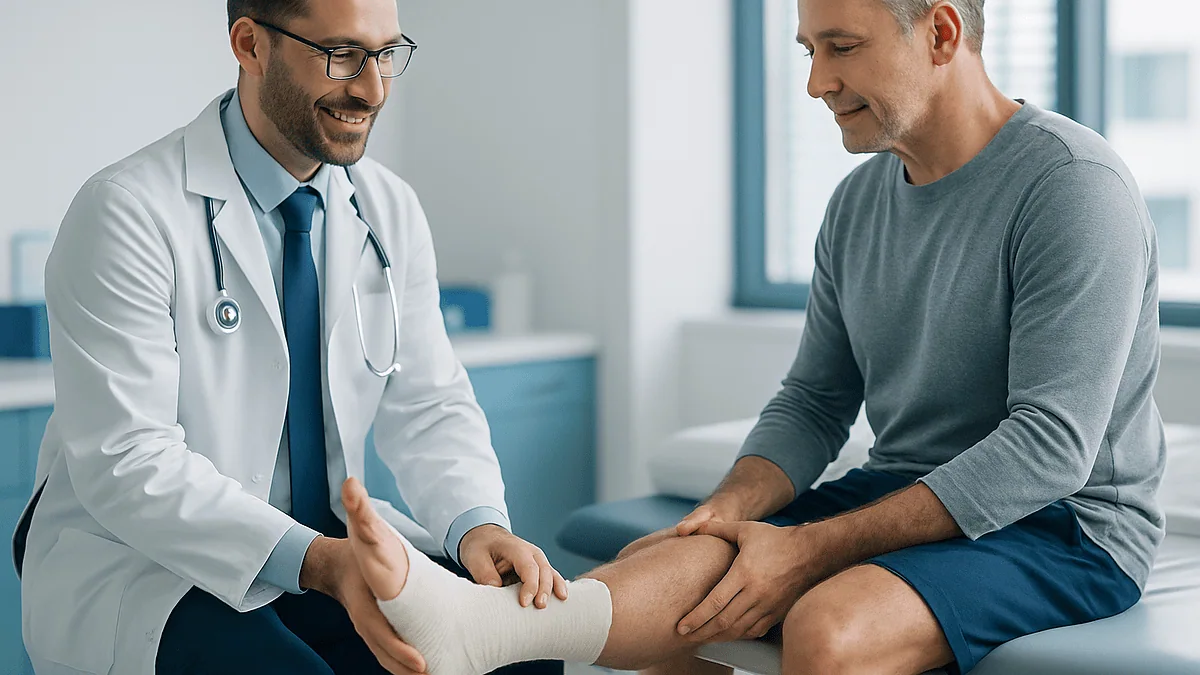
Key Takeaways
- Most Achilles ruptures occur two to six centimeters above the heel bone, in a zone where the tendon's blood supply, and repair capacity, is naturally weakest.
- In randomized trials using modern early-motion rehab, rerupture rates run roughly 4 percent without surgery versus about 2 percent with it, while surgery adds a few wound and nerve complications per hundred patients.
- The operation itself typically takes 30 to 60 minutes as a same-day procedure; the recovery, not the surgery, is the major undertaking.
- Early protected weight-bearing in a wedge boot, often started within two weeks, speeds recovery without increasing rerupture risk compared with prolonged casting.
- Around 80 percent of athletes return to sport after Achilles rupture, meaning roughly one in five never regains their prior level, and calf strength deficits of 10 to 20 percent often persist for years.
- Most reruptures happen between weeks six and twelve, usually during an unprotected stumble, precisely when people feel good enough to get careless with the boot.
Quick Answer
Achilles tendon repair is surgery that stitches the torn ends of the tendon back together, usually in under an hour as a same-day procedure. Recovery is the longer project: a splint or boot for roughly six to twelve weeks, running around five to six months, and sport at nine to twelve months. Many ruptures can also heal well without surgery through structured bracing and rehabilitation.
Ask anyone who has ruptured an Achilles and you will hear a version of the same story. A pickup basketball game, a Tuesday night tennis league, a sprint for a bus. Then a pop, loud enough that some people hear it, and the unshakable feeling that someone kicked them hard in the back of the ankle. They turn around. Nobody is there.
What follows is stranger still: many people can walk to the sideline. The Achilles is not the only structure that points the foot downward, so a fully torn tendon does not always look dramatic. That is exactly why up to a quarter of ruptures are initially missed.
What happens next, an operation, or a boot and a carefully staged rehab program, is one of the more interesting debates in orthopedics. The evidence has shifted over the past fifteen years, and it is worth understanding before you sign a consent form.
That pop in your calf: what an Achilles rupture actually is
The Achilles is the largest, strongest tendon in the body, a thick cord connecting your calf muscles to your heel bone. It earns that title honestly: walking loads it with several times your body weight, and running or jumping can push that to six to eight times. When a middle-aged recreational athlete plants a foot and pushes off explosively, all of that force funnels through a band of tissue roughly the width of a thumb.
Most ruptures happen two to six centimeters above the heel bone, in a zone where the tendon’s blood supply is naturally thinnest. Tissue with poor circulation repairs everyday microdamage slowly, so wear can accumulate silently for years, which is why many people who rupture insist the tendon never bothered them before. The classic patient is in their thirties, forties, or fifties, plays sports intermittently rather than daily, and is more often male, though anyone can rupture.
The telltale signs, per Mayo Clinic and Cleveland Clinic, are a pop or snap, the sensation of being kicked, sudden pain that may settle into a dull ache, swelling near the heel, and, the most reliable clue, an inability to push off the injured foot or rise onto tiptoes. Clinicians confirm it with a simple maneuver called the Thompson test: with you lying face down, they squeeze the calf. On a healthy leg, the foot points downward. On a ruptured one, it barely moves. Ultrasound or MRI can settle uncertain cases and measure the gap between the torn ends.
Is Achilles tendon repair a major surgery?
Honest answer: the operation is modest, the recovery is major. The procedure itself typically takes 30 to 60 minutes, and most people go home the same day, according to MedlinePlus and Johns Hopkins Medicine. You will have real anesthesia, often a nerve block that numbs the leg, sometimes combined with sedation or general anesthesiabut you will not be admitted to a hospital ward in most straightforward cases.
What makes it feel major is everything that comes after. Plan on six to twelve weeks in a splint and then a boot, several months of physical therapy, and close to a year before the tendon tolerates cutting, jumping, and competitive sport. If your job involves standing, climbing, or carrying, the surgery reshapes your working life for a season, not a weekend.
There are two broad surgical approaches:
- Open repair uses a single incision of several centimeters along the back of the ankle, giving the surgeon a direct view of the torn ends.
- Minimally invasive (percutaneous) repair uses one small incision plus tiny stab wounds, passing sutures through the skin. It tends to produce fewer wound problems but gives the surgeon less direct visibility, and the sural nerve, a sensory nerve running alongside the tendon, sits close to the instruments.
Neither approach has proven clearly superior for everyone; surgeons choose based on the tear pattern, your skin and circulation, and their training. The stitching technique matters more than the size of the scar.
Can a torn Achilles tendon heal without surgery?
Yes, and this is the single most misunderstood fact about this injury. A completely torn Achilles can heal without an operation, provided the torn ends sit close together and the ankle is held with the toes pointing downward while new tissue bridges the gap. The tendon does not need stitches to knit; it needs the ends approximated and then loaded progressively.
The evidence here is unusually good. A landmark randomized trial by Willits and colleagues, published in 2010, compared surgery with nonsurgical treatment when both groups followed the same modern rehab protocol: early protected weight-bearing and movement in a boot rather than months of rigid casting. Rerupture rates were statistically similar, and strength and function at one and two years were comparable. Larger pooled analyses since then paint a consistent picture: surgery lowers the rerupture risk by a small absolute margin, roughly two ruptures prevented per hundred patients, while adding a few extra wound and nerve complications per hundred.
The catch is the word modern. Nonsurgical treatment only performs this well when it starts promptly, uses a functional bracing protocol with early movement, and is supervised closely. Old-style treatment, a rigid cast for eight or more weeks with no weight-bearing, produced the high rerupture rates that gave nonoperative care its poor historical reputation. If you are offered the nonsurgical route, ask specifically whether the clinic follows an early functional rehabilitation protocol. That question matters more than almost any other.
How do surgeons decide between operating and bracing?
Since both paths can work, the decision comes down to particulars, yours, not the average patient’s. Factors that tend to tip the scales toward surgery:
- A visible gap. If ultrasound shows the torn ends remain separated even with the foot pointed down, bridging tissue may heal long and weak. Surgery closes the gap directly.
- Delayed diagnosis. Ruptures found weeks after the injury often have retracted, scarred ends that will not approximate on their own.
- High athletic demands. Competitive and explosive-sport athletes often choose repair for the small additional insurance against rerupture and possibly better preservation of push-off power, though the evidence on strength differences is mixed.
- Re-rupture of a previously treated tendon.
Factors that favor the nonsurgical route include diabetes, smoking, poor circulation, fragile skin, or other conditions that raise wound-healing risk: the very complications surgery adds. Age by itself is not disqualifying in either direction; a fit 60-year-old and a sedentary 35-year-old may reasonably make opposite choices.
Geography plays a surprisingly large role. Surgical rates for this injury vary widely between countries and even between hospitals, which tells you this is a genuine preference-sensitive decision, not settled science. A good consultation should feel like a conversation about your gap measurement, your health, your sport, and your tolerance for each set of risks, not a foregone conclusion. If it feels like the latter, asking for the reasoning behind the recommendation is entirely fair.
What happens during Achilles tendon repair surgery
You will typically lie face down on the operating table, the injured leg prepped and a tourniquet on the thigh to keep the field clear of blood. Anesthesia is usually a regional nerve block, which also blunts pain for the first hours afterward, with sedation, or a general anesthetic.
In an open repair, the surgeon makes an incision slightly to the inner side of the midline (to keep the scar off the back of the heel where shoes rub), opens the thin sheath around the tendon, and finds the two frayed ends, which are often described as looking like a horse’s tail. Strong, non-absorbable sutures are woven through each end using locking stitch patterns that grip the tendon fibers, then tied so the ends meet at the correct tension, snug enough to restore the tendon’s natural length, because a tendon that heals even a centimeter too long permanently weakens push-off. Badly frayed edges may be tidied, and in some cases nearby tissue is used to reinforce the repair.
Minimally invasive versions accomplish the same goal through small openings, often using a guide device that steers the needles around the tendon while protecting the skin.
Before you wake fully, the team applies a splint holding your foot in a toes-down position, which keeps the freshly stitched ends unloaded. Most people are home within hours, with crutches or a knee scooter, elevation instructions, and a follow-up visit booked for ten to fourteen days later.
How painful is Achilles tendon repair surgery?
Less than most people fear, with one caveat worth knowing in advance. During the operation you feel nothing. The tricky window is the first night or two, when the nerve block wears off, sometimes abruptly, often in the small hours. Patients who expect this transition and stay ahead of it with the pain-control plan their team prescribes tend to describe the first 72 hours as uncomfortable but manageable: a deep, throbbing ache rather than sharp agony. Those caught off guard at 2 a.m. remember it less kindly. Ask your surgical team exactly when the block is likely to fade and what to do before it does.
Two non-medication measures do a surprising amount of work. Elevation, foot genuinely above the level of your heart, not resting on a coffee table, reduces the throbbing that comes from swelling pooling in a leg hanging down. And rest matters more than toughness in week one: every hour upright on crutches is an hour your ankle spends swelling.
Pain then fades quickly. By the two-week visit, most people report soreness rather than pain, and by the boot phase many days pass with no medication at all. Later in rehab you should expect a different sensation entirely: the dull ache of a tendon being asked to work again. That ache is normal and generally acceptable if it settles within a day. Sharp pain, a new pop, or pain that escalates day over day is not normal, report it.
The first two weeks: protect the stitches, elevate the leg
Think of the first fortnight as skin-healing season. The repaired tendon is nowhere near ready to work, and the incision over it sits in one of the body’s least forgiving locations, thin skin, modest blood supply, constant motion nearby. Wound complications are the most common early problem after open repair, and your behavior in these two weeks directly influences the odds.
The daily routine is unglamorous:
- Keep the splint dry and intact. Showering means a waterproof cover or a leg propped outside the tub; no soaking, no peeking under the dressing.
- Elevate for most of the day. A stack of pillows under the calf (not the heel) with the foot above heart level keeps swelling, and pain, down.
- Move everything that is allowed to move. Wiggle toes, bend the knee, get up briefly and regularly. Total immobility invites stiffness and raises clot risk.
- Follow your weight-bearing instructions exactly. Protocols vary; some surgeons allow early touch-down weight in the splint, others none at all.
Blood clots deserve special mention. Achilles injuries carry a notable risk of deep vein thrombosispartly the immobilization, partly the injury itself, whether or not you have surgery. Your team will assess your personal risk and may recommend preventive measures. Know the warning signs cold: new calf swelling or pain in either leg, and, an emergency, chest pain or sudden shortness of breath.
Around day ten to fourteen, stitches come out, the wound gets inspected, and you graduate to the boot. The real work starts there.
Weeks two through twelve: the boot, the wedges and early walking
The walking boot is not just a cast with better marketing. It holds your foot in a toes-down position using removable heel wedges, and those wedges are the whole strategy: they keep tension off the healing repair while letting you begin to stand and walk on the leg far earlier than old protocols allowed.
This is where the evidence has genuinely changed practice. Studies over the past two decades have shown that early protected weight-bearing, often beginning within two weeks, does not increase rerupture rates and gets people back to normal life faster, with less calf wasting and less stiffness, than prolonged non-weight-bearing. Both Cleveland Clinic and NHS-style protocols now build on this principle. Gentle, controlled loading is not a threat to a healing tendon; it is the signal that tells the new tissue how to organize itself.
The typical progression looks like this, though your surgeon’s protocol governs:
- Weeks 2–4: partial weight through the boot with crutches, progressing toward full weight as comfort allows.
- Weeks 4–8: wedges removed one at a time, every week or two, gradually bringing the foot toward a flat position.
- Weeks 8–12: walking in the boot without crutches, then transitioning into a regular shoe, often with a small heel lift at first.
Two rules keep this phase safe. Never walk barefoot or in a flat shoe before you are cleared: an unprotected stumble in month two is a classic rerupture story. And do not stretch the calf, however tight it feels. A tendon coaxed into healing long stays long.
How long does it take for Achilles tendon repair to heal?
Separate two questions people usually blur together: when the tendon has knitted, and when it has remodeled into tissue that tolerates sport. The first takes about twelve weeks. The second takes close to a year, because tendon heals first as disorganized scar-like tissue and only slowly realigns its collagen fibers along the lines of force. Loading it appropriately at each stage is what drives that reorganization.
| Phase | Typical timeframe | What is happening |
|---|---|---|
| Splint | Weeks 0–2 | Incision heals; foot held toes-down; swelling control and rest |
| Boot with wedges | Weeks 2–8 | Progressive weight-bearing; wedges removed stepwise; gentle motion begins |
| Boot to shoe | Weeks 8–12 | Full walking; transition to regular footwear; gait retraining |
| Strength building | Months 3–5 | Calf raises progress from two legs to one; balance and endurance work |
| Return to running | Months 5–6 | Jogging begins once strength benchmarks are met, not before |
| Return to sport | Months 9–12+ | Cutting, jumping, competition; tendon remodeling continues past one year |
Treat every number in that table as a median, not a promise. A 25-year-old soccer player and a 55-year-old hiker will move through it at different speeds, and so will two people the same age with different tissue quality, swelling, and adherence to rehab. The trap to avoid is the opposite one, too: some people feel so normal at month four that they test the tendon early. Month four is precisely when the tendon feels better than it is.
What physical therapy really looks like, month by month
Rehab is the other half of the operation, and skimping on it wastes the surgery. A reasonable arc, always subordinate to your own team’s protocol:
- Weeks 2–8: gentle ankle motion within safe limits, toe and foot exercises, swelling management, and keeping the rest of you fit, upper body work, stationary cycling in the boot once cleared. Crucially, therapists avoid pulling the foot upward past neutral; protecting tendon length outranks chasing flexibility.
- Months 2–4: the calf-raise era. Seated raises first, then standing raises on two legs, then a gradual shift of weight toward the surgical side. Balance drills on one leg rebuild the ankle’s position sense, which quietly deteriorates during immobilization.
- Months 4–6: single-leg heel raises, the defining milestone of Achilles rehab, plus walking speed work, light resistance training, and, once strength criteria are met, a walk-jog program on level ground.
- Months 6–12: plyometrics: hopping, skipping, bounding, direction changes, sport-specific drills at rising intensity.
One honest warning the glossier guides skip: the most common long-term problem after this injury is not rerupture but a tendon that healed slightly elongated, leaving permanently reduced push-off power. Research groups measuring outcomes years later consistently find calf strength deficits of 10 to 20 percent in many patients, and a calf that stays visibly slimmer. The best defense is patient, heavy, progressive calf strengthening continued long after formal therapy ends, and resisting every urge to stretch an already-lengthened tendon in the early months.
Return to sport: pass the tests, not just the calendar
The calendar is the least interesting return-to-sport criterion. Nine months means nothing if the surgical calf cannot do what the other one can; conversely, an athlete who clears every benchmark at eight months is safer than one who limps back at twelve on schedule alone.
Benchmarks worth asking your therapist to measure formally:
- Single-leg heel raises: a common target is roughly 25 consecutive raises on the surgical side, reaching close to 90 percent of the height achieved on the healthy side. Height symmetry matters as much as repetition count: a short, shallow raise hides an elongated tendon.
- Hop tests: single hops for distance and timed repeated hops, again compared against the other leg, typically aiming for 90 percent symmetry.
- A quiet tendon: no swelling or escalating pain within 24 hours of hard training sessions.
- Confidence: psychological readiness is measurable and predicts outcomes; hesitation on the injured leg changes movement patterns and shifts injury risk elsewhere.
Set expectations honestly. Pooled studies of athletes after Achilles rupture find that around 80 percent return to sport, which means roughly one in five never gets back to their prior level. Professional athletes in explosive sports often show measurable performance dips for a season after return. None of this is a reason for despair, most recreational athletes return to the activities they love, but it is a reason to respect the injury, do the tedious strength work, and let test results, not impatience, open the gate.
Risks and complications worth knowing about
A candid inventory beats a reassuring one. In rough order of how often they come up:
- Wound problems. The most common complication of open repair: delayed healing, skin edge breakdown, and infection, together affecting a few patients per hundred in pooled analyses. Smoking, diabetes, and poor circulation raise the odds substantially, which is exactly why those factors push some patients toward nonsurgical care.
- Sural nerve irritation. This sensory nerve runs beside the tendon and can be stretched or caught by sutures, particularly in minimally invasive repairs, leaving numbness or tingling along the outer foot. Often temporary, occasionally not.
- Blood clots. Deep vein thrombosis occurs after Achilles rupture at meaningful rates regardless of treatment choice, driven by immobilization and the injury itself. Rarely, a clot travels to the lungs: a genuine emergency.
- Rerupture. Roughly two per hundred after surgery and about four per hundred after modern nonsurgical care in pooled trial data. Most reruptures happen between weeks six and twelve, often during an unprotected stumble, which is why boot discipline matters most exactly when you are starting to feel fine.
- Tendon elongation. Healing long, with permanently weakened push-off, is arguably the most underdiscussed outcome. It cannot be stretched or braced away afterward; prevention lives in surgical tensioning and disciplined early rehab.
- Anesthesia risks. Small in healthy patients, and reviewed individually beforehand.
None of these should frighten you out of good treatment. They should shape your questions, about your personal wound-healing risk, the clot-prevention plan, and the rehab protocol’s track record.
When to see a doctor
At the moment of injury, seek care the same day if you felt a pop or a kicked-from-behind sensation in the back of the ankle, cannot rise onto tiptoes on that leg, or notice a gap or dent you can feel above the heel. Do not let the ability to walk reassure you, other muscles can compensate, and a walked-on rupture is still a rupture. Prompt diagnosis genuinely changes your options: a tendon treated within days can often go either route, while one discovered a month later frequently needs a more complex operation. While awaiting assessment, stay off the leg as much as possible and avoid pointing the foot upward.
After surgery or during bracing, contact your care team promptly for:
- Fever, spreading redness, worsening pain at the incision, or any drainage or opening of the wound
- New swelling, tenderness, or warmth in the calf of either leg, possible blood clot
- Numbness or color change in the toes, or a splint or boot that suddenly feels far too tight
- A new pop, snap, or sudden loss of strength during recovery, possible rerupture
- Pain that escalates day over day instead of easing
Two symptoms skip the phone call and go straight to emergency care: chest pain and sudden shortness of breath, which can signal a clot in the lungs. It is rare. It is also the one complication of this injury that can be immediately life-threatening, so err loudly on the side of caution.
Protecting the tendon, and its twin on the other leg
Here is a statistic that changes behavior: people who rupture one Achilles carry a meaningfully elevated risk of rupturing the other one in the following years. Whatever combination of tissue quality, loading habits, and biomechanics produced the first tear is usually bilateral. Smart prevention therefore treats both legs.
The strongest lever is the least exciting one: calf strength, built gradually and maintained indefinitely. Tendons adapt to load slowly, over weeks and months, not days, so the classic rupture recipe is a sudden spike in demand on an unprepared tendon: the first basketball game in a year, a new-year sprint program, a hiking holiday after a desk-bound winter. Ramping up any explosive activity over several weeks, keeping heel raises in your routine for life, and warming up the calves before stop-start sports all lower the odds.
A few quieter factors deserve attention too. Certain prescription medicines have been associated with tendon injury; if you have had Achilles trouble, ask your clinician to review what you take rather than guessing. Long-standing Achilles pain or morning stiffness is worth evaluating before it becomes a rupture story, tendinopathy is treatable, and treating it is far easier than repairing a tear. And sudden changes in footwear, particularly dropping from cushioned heels to very flat or minimalist shoes, shift load onto the Achilles and are best made gradually.
The tendon that carried you through this whole ordeal will serve you for decades. It asks only that you never again surprise it.
Frequently asked questions
Is Achilles tendon repair a major surgery?
The operation is relatively small, usually 30 to 60 minutes, done as a same-day procedure under a nerve block or general anesthesia. What makes it feel major is the recovery: a splint and then a boot for six to twelve weeks, months of physical therapy, and close to a year before the tendon tolerates jumping and competitive sport. Plan your work and home life around the recovery, not the operation.
How painful is Achilles tendon repair surgery?
Most people describe it as very manageable after the first few days. The hardest window is the first night or two, when the nerve block from surgery wears off, sometimes abruptly. Staying ahead of pain with the plan your team prescribes, and keeping the foot elevated above heart level, makes a large difference. By the two-week visit, most patients report soreness rather than pain, and later rehab produces a dull working ache rather than sharp pain.
How long does it take for Achilles tendon repair to heal?
The tendon knits in about twelve weeks, but full remodeling into strong, organized tissue takes close to a year. Typical milestones: splint for two weeks, boot until roughly weeks eight to twelve, single-leg heel raises around months four to five, jogging around months five to six, and return to cutting and jumping sports at nine to twelve months, provided you pass strength tests, not just calendar dates.
Can a torn Achilles tendon heal without surgery?
Yes, provided the torn ends sit close together and treatment starts promptly with a functional protocol: a toes-down boot, early protected weight-bearing, and supervised rehab. Randomized trials show rerupture rates and long-term function close to surgical results under those conditions, at roughly 4 percent versus 2 percent for rerupture. Nonsurgical care performs poorly only with old-style prolonged casting, or when imaging shows a persistent gap between the tendon ends.
When can I walk normally after Achilles tendon repair?
Most people walk in the boot without crutches by around weeks six to eight, transition into a regular shoe between weeks eight and twelve, and walk with a normal-looking gait somewhere in months three to four. A slight limp during the transition is common while the calf rebuilds. Never walk barefoot or in flat shoes before your team clears it: an unprotected stumble in the early months is a classic cause of rerupture.
When can I drive after Achilles tendon surgery?
It depends on which leg and what you drive. A left-leg repair with an automatic transmission may allow driving within a few weeks once you are off strong pain medication. A right-leg repair generally means waiting until you are out of the boot and can perform an emergency stop without hesitation, often eight to twelve weeks. Confirm with your surgeon and check your insurance terms, since driving in a boot may not be covered.
How soon can I run after Achilles tendon repair?
Most protocols introduce a walk-jog program around five to six months, but the gate is strength, not the calendar. A common threshold is performing repeated single-leg heel raises on the surgical side at close to the height and count of the healthy side, with no swelling or escalating pain afterward. Starting to run before the calf can control landing forces shifts load onto a still-remodeling tendon.
Will my calf ever be the same after an Achilles rupture?
Often not completely, and it is better to know that upfront. Studies following patients for years find calf strength deficits of 10 to 20 percent are common, and the muscle frequently remains slightly smaller, whether treatment was surgical or not. Most people still return to the activities they love. The best countermeasure is heavy, progressive calf strengthening continued long after formal therapy ends, plus avoiding calf stretching in the early months so the tendon does not heal elongated.
How do I know if my Achilles is actually ruptured?
The classic pattern is a pop, the feeling of being kicked in the back of the ankle, and an inability to rise onto tiptoes on that leg, though many people can still walk, which misleads them. Clinicians confirm it with the Thompson test: squeezing the calf while you lie face down should point the foot downward; a ruptured tendon barely moves it. Ultrasound or MRI settles uncertain cases. Get any suspected rupture assessed the same day.
What is the risk of blood clots after Achilles tendon repair?
Meaningful enough to take seriously. Achilles injuries carry a notable risk of deep vein thrombosis because of leg immobilization and the injury itself, whether or not you have surgery. Your team will assess your personal risk and may recommend preventive measures. Know the warning signs: new calf swelling, pain, or warmth in either leg warrants a prompt call, while chest pain or sudden shortness of breath means emergency care immediately.
References
This article is for general information only and is not a substitute for professional medical advice. Please consult a qualified doctor about your individual situation.

More from the Blog

Living With Hip Bursitis: Sleeping, Sitting and Exercise Choices That Calm the Flare
Living with hip bursitis mostly means managing load on the outer hip: avoid lying directly on the sore side, stop crossing your legs or…
The Brostrom Procedure: Fixing Chronic Ankle Instability, Step by Step
The Brostrom procedure is an outpatient operation that tightens and reattaches the stretched outer ankle ligaments, usually the anterior talofibular and calcaneofibular ligaments, to…
When an ACL Graft Fails: Re-Rupture Causes and How Revision ACL Reconstruction Differs
ACL graft failure means a reconstructed ligament has torn, stretched or loosened enough that the knee is unstable again. Causes fall into three groups:…

How Quickly Does Tenosynovitis Settle? Healing Phases From Splint to Full Use
Tenosynovitis usually settles over weeks rather than days. With early rest and a splint, mild overuse cases often ease within a few weeks, and…

Shoulder Impingement vs Rotator Cuff Tear: How Doctors Tell the Two Apart and Why It Matters
Shoulder impingement is irritation of the rotator cuff tendons and the bursa as they pass beneath the bony roof of the shoulder blade; a…
Anesthesia for Arthroscopy: General, Regional or Spinal and Why Same-Day Discharge Is Usual
Arthroscopy is usually done under general anesthesia (fully asleep), spinal anesthesia (numb from the waist down, often with sedation), or a regional nerve block…