

Ankle Arthroscopy Recovery: Boot, Elevation and When Walking and Running Return
Key Takeaways
- Recovery after ankle arthroscopy is set by what was done inside the joint, not by the size of the incisions: soft-tissue debridement and cartilage repair share portals but follow very different timelines.
- Mainstream guidance describes light activity and desk work within a few days of arthroscopy and strenuous activity or sport after several weeks to months, with your surgeon's protocol governing the specifics.
- Keeping the ankle above heart level for most of the first week is the single recovery variable patients control most directly, and it strongly shapes how the second week feels.
- Next-morning swelling is a more reliable guide to overdoing it than pain during the activity itself, because pain lags behind tissue irritation.
- The boot protects the joint during standing and walking; unless told otherwise, gentle toe and ankle movement is encouraged to limit stiffness and reduce clot risk.
- Calf pain or one-sided leg swelling after surgery can signal a deep vein thrombosis and needs urgent assessment, while sudden breathlessness or chest pain is an emergency.
Ankle arthroscopy recovery time varies with what the surgeon did inside the joint. After simple keyhole procedures, many people manage light activity and desk-based tasks within a few days, walk in a protective boot or shoe over the first one to three weeks, and return to more strenuous activity over several weeks to months. Cartilage repair extends every stage. Your treating team sets the actual timeline.
The night before surgery, most people are not thinking about the operation. They are thinking about the stairs. How do you get to the bathroom at 3 a.m. with a bandaged foot? Who walks the dog? When can you drive to work again, and will that clunky boot fit under a desk? These are the questions that fill the pre-op waiting room far more than the surgical details do.
Ankle arthroscopy is keyhole surgery: a pencil-thin camera and tiny instruments go through two or three small cuts to clean up, smooth or repair the inside of the joint. The cuts heal quickly. The joint takes longer. That gap between how small the wound looks and how long the ankle actually needs is where most confusion about ankle arthroscopy recovery time begins.
This explainer walks through what typically happens in the first days, why the boot and the pillow matter as much as the scalpel, and how surgeons usually decide when walking and running come back.
What actually happens during ankle arthroscopy?
An arthroscope is a narrow tube, about the width of a drinking straw, with a lens and light at the tip. The surgeon makes two or three cuts of roughly a centimeter each, called portals, usually at the front of the ankle and sometimes at the back. Sterile fluid is pumped in to inflate the joint so the camera has room to see, and images appear on a screen in the operating room (Mayo Clinic).
Through the other portals go instruments no wider than a pen. Depending on the problem, the surgeon may shave away inflamed joint lining (a procedure called debridement, which simply means cleaning out damaged or irritating tissue), trim bone spurs that pinch the joint when the foot bends upward, remove loose fragments of cartilage or bone, or treat a worn patch of cartilage on the talus, the bone that sits under the shin and forms the ankle hinge.
Most ankle arthroscopies are day procedures. Anesthesia may be general, where you are asleep, or regional, where an injection numbs the leg while you rest lightly sedated. The operation itself commonly lasts under an hour, though complex repairs take longer (NHS). Afterward the portals are closed with a stitch or two, a padded bandage goes on, and a boot or splint is fitted before you leave.
One detail worth understanding early: the fluid used to inflate the joint does not vanish instantly. Some of it seeps into the surrounding soft tissue, which is one reason the ankle looks puffier the morning after than it did on the operating table. That swelling is expected and largely settles over the first days, but it drives a lot of the early advice about elevation.
Ankle arthroscopy recovery time: what the typical ranges really mean
Ask three people who have had ankle arthroscopy how long recovery took and you may hear three different answers, all of them honest. The reason is that “ankle arthroscopy” describes the access method, not the repair. A quick debridement of inflamed lining and a cartilage-restoration procedure use the same portals but demand very different healing.
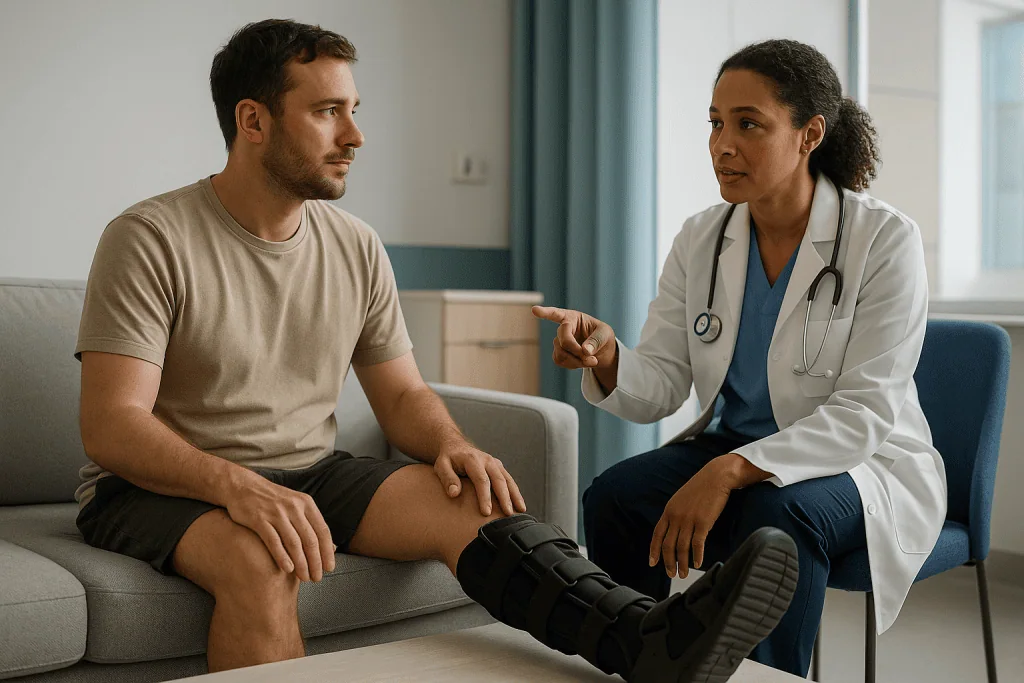
Mainstream guidance frames it this way: after arthroscopy in general, people can often resume light activity and desk work within a few days, while more strenuous activity may take several weeks or months depending on the joint and the type of surgery (Mayo Clinic). The NHS similarly notes that returning to light physical activity is often possible within weeks, but more demanding activity such as sport may take several months (NHS).
For the ankle specifically, surgeons tend to sort recovery into two broad tracks:
- Soft-tissue or bone-spur work (debridement, removing impingement, clearing loose bodies). Weight-bearing is often allowed early, and the boot phase is measured in days to a few weeks.
- Cartilage or bone repair (treating an osteochondral lesion, where cartilage and the bone beneath it are damaged, sometimes with a technique called microfracture that makes tiny holes to stimulate new tissue). Here the repaired surface must be protected, so weeks of limited weight-bearing are common before walking progresses.
Neither track comes with a guarantee. Age, smoking status, diabetes, body weight, how long the ankle was painful before surgery and how consistently rehabilitation exercises get done all shift the timeline. The most useful question to ask your surgeon is not “how long will I be off?” but “which track am I on, and what does the first milestone look like?”
Who usually has ankle arthroscopy, and who is asked to wait?
Arthroscopy is rarely the first move. Surgeons typically consider it when a specific, identifiable problem inside the joint has not settled with rest, activity modification, physical therapy, supportive footwear or bracing, and anti-inflammatory strategies over a reasonable period (Cleveland Clinic).
Common reasons include anterior ankle impingement, where bone spurs or thickened soft tissue at the front of the joint pinch every time the foot bends upward; persistent synovitis, the medical term for an inflamed joint lining that keeps swelling; loose fragments of bone or cartilage that catch and lock the joint; and osteochondral lesions of the talus, often after a bad sprain that never fully recovered. Arthroscopy is also used diagnostically when imaging is unclear and the surgeon wants to look directly at the cartilage.
People are usually asked to wait, or offered something else, when the picture is different. Widespread arthritis across the whole joint tends not to respond well to keyhole clean-outs, and surgeons may discuss other options instead. Active infection in or near the ankle, poorly controlled diabetes, significant circulation problems in the leg, or skin that has not healed from a previous injury generally postpone surgery until the risk is lower. Smokers are often counseled to stop beforehand because smoking impairs tissue healing (Johns Hopkins).
Timing matters in another way, too. Someone who has had ankle pain for six weeks after a sprain is usually still in the window where rehabilitation alone may resolve it. Someone with a year of mechanical catching and a lesion visible on MRI is in a different conversation. A good surgeon will explain which category you fall into and why, and the decision to operate, or to keep waiting, rests with you and that team together.
What happens in the first 48 hours after ankle arthroscopy?
You will almost certainly go home the same day, once the anesthesia has worn off enough for you to eat, drink, pass urine and demonstrate that you can move safely with crutches (NHS). Someone needs to drive you and, ideally, stay overnight.
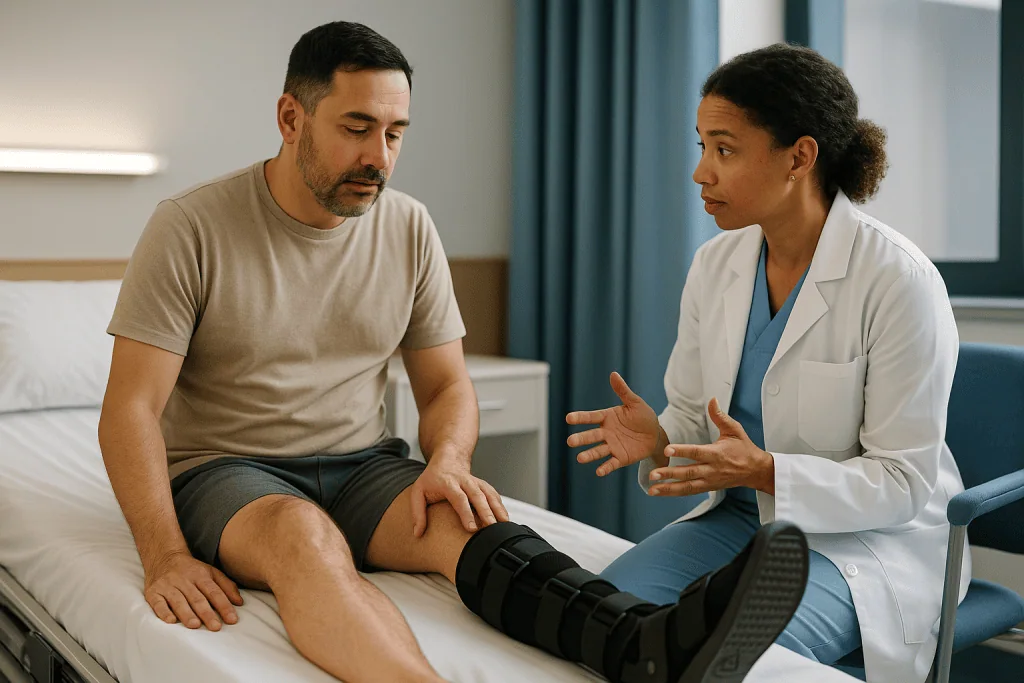
The first evening is usually the strangest. If a regional nerve block was used, the foot may feel heavy, warm and completely numb for many hours. That numbness is protective but deceptive: people sometimes feel nothing at bedtime and wake at 2 a.m. when the block wears off and the ankle announces itself. Your team will typically advise taking any prescribed pain relief before the block fades rather than waiting for pain to arrive; the exact plan comes from them.
Elevation begins immediately. Toes above the nose is the rule of thumb: lying down with the foot propped on two or three pillows so the ankle sits higher than the heart. Sitting in a recliner with the leg dangling below hip level does not count and is a common first-day mistake.
The bandage stays on and stays dry. Most instructions ask you not to remove or peek under the dressing until the first clinic check, because the small portals are still sealing. Showering usually means a waterproof cover and keeping the foot out of the spray.
Expect some bloody staining on the bandage, tightness from swelling, and a bruised, achy feeling deep in the joint. Expect, too, to feel tired and a little foggy for a day or two after anesthesia (Mayo Clinic). What you should not accept as normal is covered in the red-flag section later: pain that escalates rather than plateaus, calf pain, or numbness that persists well beyond the expected block duration.
Ankle arthroscopy boot: how long do you actually wear it?
The boot has two jobs. It holds the ankle still enough for the portals and any repair to settle, and it spreads load across the whole lower leg so the joint does not take the full force of a step. What it is not is a cast. Most modern post-arthroscopy boots are removable, and that flexibility is the point.
Duration depends on the track described earlier. After debridement or spur removal, many surgeons use a boot or a stiff-soled post-operative shoe for comfort during the first days to a couple of weeks, then let people move into supportive trainers as swelling allows. After cartilage repair, the boot often stays in service for the whole protected weight-bearing phase, which commonly runs several weeks (Mayo Clinic; Cleveland Clinic). Some protocols allow the boot to come off for gentle range-of-motion exercises and washing even when it must be worn for walking.
Practical points that surgeons repeat but patients often miss:
- The boot is for walking and standing, not necessarily for sleeping, unless you were told otherwise. Check.
- Straps should be snug, not tight. Increasing tightness during the day is a swelling signal, not a reason to loosen and ignore.
- Uneven leg length in a tall boot can strain the opposite knee and hip. A temporary lift for the other shoe is a small fix that many physical therapists suggest.
- Never drive in a boot on the operating side. Reaction time and pedal control are impaired, and most insurers and clinicians advise against it.
When the boot comes off for good is a clinical decision based on your wound, your swelling, your repair and sometimes an X-ray or clinic exam, not on the calendar alone. If the schedule you were given feels long, ask what milestone would shorten it rather than shortening it yourself.
Why elevation matters more than most people expect
If there is one part of ankle arthroscopy recovery time that patients control directly, it is elevation. The ankle sits at the bottom of the body’s plumbing. Every hour spent upright, gravity pulls fluid down into tissue that surgery has just irritated, and the veins in the calf have to push that fluid back uphill. Sitting at a desk with the foot on the floor is, from the ankle’s point of view, the worst of both worlds: not walking enough to pump the calf, not lying down enough to drain.
Swelling is not just cosmetic. A tight, fluid-filled ankle moves less, so stiffness sets in faster. It hurts more, so people move less, so it swells more. It also slows wound healing at the portals, because stretched skin has poorer blood supply. Surgeons often describe the first week as a contest between you and gravity, and the winner determines how the second week feels (Mayo Clinic; NHS).
Useful rules that clinicians commonly give:
- For the first several days, aim for the foot above heart level whenever you are not up for a purpose. Lying flat with pillows under the calf, not just the heel, keeps the knee comfortable.
- Ice or a cold pack over the dressing for short stretches helps some people with pain and swelling; keep a cloth between skin and ice, and never sleep on it (NHS).
- Wiggle the toes and gently pump the ankle, if your surgeon allows, every waking hour. This drives the calf-muscle pump that returns blood toward the heart.
- Notice the pattern. Swelling that is worse each evening and better each morning is typical. Swelling that is worse each morning, or that involves the calf, is not.
People who take elevation seriously in week one often find week two surprisingly gentle. People who go back to a desk on day three and sit with the foot down often find themselves elevating in week three instead.
How long after ankle arthroscopy can you walk?
The honest answer starts with a definition. Surgeons describe walking after surgery in graded terms, and knowing them makes your instructions much clearer:
- Non-weight-bearing: the foot does not touch the ground; crutches or a knee scooter carry you.
- Touch or toe-touch weight-bearing: the foot rests on the floor for balance only, like standing on an egg you must not crack.
- Partial weight-bearing: a set fraction of body weight goes through the leg, usually taught with a bathroom scale.
- Weight-bearing as tolerated: put down as much as comfort allows, typically in the boot.
After debridement, spur removal or loose-body removal, many people are allowed weight-bearing as tolerated in a boot or post-operative shoe from the first day, with crutches used for balance and confidence rather than to unload the joint. Walking short indoor distances is often realistic within the first few days, which matches broader guidance that light activity commonly resumes within days of arthroscopy (Mayo Clinic).
After cartilage repair, a protected phase of limited weight-bearing is common so the new tissue is not crushed before it matures. Protocols vary, but several weeks of restricted loading before progressing is typical, followed by a gradual step-up (Cleveland Clinic). The progression from crutches to boot-only to normal shoe is usually guided by your physical therapist and surgeon together.
Two practical markers help more than dates. First, can you walk without a limp? A limp means the body is still protecting the joint, and rushing through it teaches a compensation pattern that can outlast the surgery. Second, does swelling settle overnight? If a walk leaves the ankle bigger the next morning, the dose of walking was too high. Adjust with your team rather than pushing through.
Weeks one to six: what recovery usually looks like
Timelines below are typical patterns described in mainstream guidance for arthroscopic surgery and by orthopedic teams; they are not promises, and cartilage-repair protocols shift every row to the right (Mayo Clinic; NHS; Cleveland Clinic).
| Phase | What is usually happening | What people commonly do | Who decides the next step |
|---|---|---|---|
| Days 0 to 3 | Swelling peaks; nerve block wears off; portals seal | Elevate most of the day; short crutch-assisted trips; boot for standing | Surgeon’s written instructions |
| Days 4 to 14 | Dressing check; stitches out or dissolving; swelling begins to fall | Desk work if the foot can stay elevated; gentle ankle circles if allowed; boot on for walking | Clinic review, often around one to two weeks |
| Weeks 2 to 4 | Wounds healed; stiffness is the main complaint | Range-of-motion and light strength work with a therapist; boot phased out after soft-tissue procedures | Physical therapist with surgeon’s plan |
| Weeks 4 to 6 | Walking pattern normalizes; balance is retrained | Supportive trainers; stationary bike or pool if cleared; longer walks | Therapist progression criteria |
| Beyond 6 weeks | Strength, proprioception (the joint’s sense of position) and endurance rebuilt | Return-to-sport steps toward jogging when milestones met | Surgeon and therapist together |
A few realities sit behind the table. Swelling often lingers in a mild form for weeks and sometimes months after the pain has largely gone, especially by evening; this is expected after joint surgery and not by itself a sign of trouble (NHS). Stiffness on first steps in the morning is common in the middle weeks. And the first physical therapy sessions frequently feel like a step backward, because the therapist is deliberately asking the ankle to move in directions it has been guarding. That is progress wearing an uncomfortable disguise.
Running after ankle arthroscopy: when does it usually return?
Running loads the ankle with roughly two to three times body weight on every stride, far more than walking. That is why surgeons treat the return to running as a separate milestone rather than a natural extension of walking well.
General guidance is deliberately broad: after arthroscopy, strenuous activity and sport may not be advisable for several weeks to months, depending on the joint and the type of surgery (Mayo Clinic; NHS). For straightforward debridement, many rehabilitation teams begin a walk-jog program once the ankle can walk briskly without a limp or next-day swelling, has near-full range of motion, and can perform single-leg calf raises and single-leg balance comparable to the other side. After cartilage repair, running is typically held back for considerably longer so the repair matures under gradually increasing load.
The return itself is usually staged, and the stages are worth knowing because they are where impatience causes setbacks:
- Straight-line jogging on a flat, forgiving surface, often alternating with walking, comes first.
- Continuous running at easy effort follows once each session leaves no extra swelling the next morning.
- Change of direction, hills and uneven ground are added later because they demand the side-to-side stability the ankle relearns last.
- Sport-specific drills and competition come after the therapist is satisfied with hopping, cutting and landing tests.
Runners often ask whether an ankle that has been scoped will always feel different. Many describe a period of stiffness on cold mornings or after long sitting that eases with movement and fades as strength returns. Whether it fully disappears depends on what was found inside the joint, which is a conversation for your surgeon rather than a promise anyone can make in print. What is well supported is that a graded, criteria-based return produces fewer flare-ups than a date-based one.
Pain relief after ankle arthroscopy: what medicines do and how long they are used
Pain after arthroscopy tends to follow a curve: highest in the first two or three days, then a steady decline, with flares after physical therapy or a long day on the feet. Medicines are chosen to match that curve, and the plan should always come from your prescribing clinician, including any decision to start, adjust or stop.
Several classes commonly appear on discharge paperwork. Acetaminophen (paracetamol in some countries) works centrally on pain signaling and has little effect on swelling. Non-steroidal anti-inflammatory drugs, or NSAIDs, block enzymes involved in inflammation and are often used for short periods after joint surgery, though some surgeons limit them after cartilage or bone procedures because of concerns about healing, and they may be unsuitable for people with kidney, stomach or heart conditions. Short courses of opioid medicines are sometimes prescribed for the first days when other options are insufficient; they work on receptors in the brain and spinal cord, carry risks of constipation, drowsiness and dependence, and are typically tapered off quickly (Mayo Clinic).
Regional anesthesia, the nerve block placed before or during surgery, provides pain relief for many hours afterward. Teams often advise beginning oral medicines before the block wears off so there is no gap.
Non-drug measures carry real weight here. Elevation and cold reduce the pressure that drives much of the deep ache. Movement within permitted limits prevents the stiffness that becomes its own source of pain.
Timelines are individual, but many people find they need regular pain relief for the first several days, occasional relief after therapy sessions in the following weeks, and little beyond that once the boot comes off (NHS). Pain that climbs rather than falls after day three, or that does not respond to the prescribed plan, is a reason to call, not to add doses on your own.
What are the risks of ankle arthroscopy, and what are the alternatives?
Keyhole surgery lowers risk compared with opening the joint, but it does not remove it. Complications after arthroscopy are uncommon, and the usual ones described in mainstream sources include infection at the portals or inside the joint, bleeding, blood clots in the leg veins, damage to nearby nerves or blood vessels, and stiffness (Mayo Clinic; NHS).
The ankle has a specific vulnerability. Small sensory nerves run close to the skin at the front and outside of the joint, exactly where portals are placed. Bruising or irritation of these nerves can leave a patch of numbness or tingling over the top of the foot that often improves over weeks to months but occasionally persists. Surgeons mark the nerves before making cuts to reduce this, but they cannot eliminate it.
Deep vein thrombosis, a clot in the deep veins of the calf or thigh, deserves its own mention because immobility and lower-limb surgery both raise the risk. Typical signs include calf pain or tenderness, swelling of one leg more than the other, warmth and redness; a clot that travels to the lungs can cause sudden breathlessness or chest pain and is an emergency (MedlinePlus). Your team may recommend clot-prevention measures based on your individual risk; moving the toes and calf, staying hydrated and avoiding long periods of sitting with the leg down are universal basics.
Alternatives depend on the diagnosis. Continued physical therapy, bracing or orthotics, activity modification, and injections into the joint are the common non-surgical options for impingement and synovitis. Some osteochondral lesions are observed with imaging rather than operated on. For advanced arthritis across the joint, arthroscopy usually offers little, and surgeons may discuss joint fusion or replacement instead. Weighing these against each other is the treating team’s role, informed by how much the problem limits your life.
What people often get wrong about ankle arthroscopy recovery time
“Keyhole means quick.” The incisions are quick to heal. The joint is not. Inside, the surgeon has shaved, trimmed or drilled tissue, and that tissue follows biological timelines regardless of how small the scars look. The most common source of disappointment is expecting the ankle to match the wound.
“If it does not hurt, it is fine to do more.” Pain is a lagging indicator. Swelling the next morning is a better guide to whether yesterday’s activity was too much. Many setbacks in weeks three to five come from a pain-free afternoon that turned into a swollen, stiff week.
“The boot is a cast; I should not move at all.” Unless your surgeon says otherwise, most protocols want early gentle movement of the toes and, when permitted, the ankle. Immobility invites stiffness and raises clot risk. The boot protects during weight-bearing; it does not mean the ankle should be frozen.
“Physical therapy is optional after a simple scope.” The ankle loses balance sense and calf strength surprisingly fast. Even after minor procedures, a short course of guided rehabilitation is what most surgeons rely on to restore a normal walking pattern and prevent the limp from becoming a habit (Cleveland Clinic).
“Swelling at week six means something went wrong.” Mild evening swelling that resolves overnight is common for weeks after joint surgery and is not, by itself, a complication (NHS). Swelling that is worsening, warm, red, or accompanied by fever or calf pain is a different matter.
“Once I can run, I am done.” Straight-line running is a midpoint, not a finish line. The side-to-side stability that protects against re-injury is trained last and is the part most people skip.
“Recovery time is fixed by the surgeon’s skill.” Technique matters, but so do the diagnosis inside the joint, your general health, smoking, and how faithfully the elevation and exercise plan gets done. Recovery is shared work.
Questions to ask your care team before and after ankle arthroscopy
The best appointments are the ones where you leave knowing what track you are on. These questions, asked before surgery and revisited at follow-up, tend to produce the clearest answers.
- What exactly do you expect to do inside the joint, and what would change the plan once you can see it?
- Will I be allowed to put weight through the foot right away, or will there be a protected period? Roughly how long, and what would extend it?
- Which type of boot or shoe will I have, and when can it come off for washing, sleeping and exercises?
- What kind of anesthesia will be used, and how long should I expect the leg to be numb afterward?
- What is the pain-relief plan, who do I call if it is not working, and are there medicines I should avoid because of the repair or my other conditions?
- Do I need any clot-prevention measures, and what are the signs I should watch for?
- When is my first clinic check, and who removes the dressing and stitches?
- When should physical therapy start, and will you send a written protocol to the therapist?
- What milestones, rather than dates, will tell us the boot can go, that I can drive, and that I can start jogging?
- How much swelling is normal at two weeks and at six weeks, and what would you want to know about sooner?
- What did you find when you looked inside, and does it change the long-term outlook for my ankle?
- If the ankle is not progressing as expected, what is the plan and when would we reassess?
Bring a notebook or a companion. Post-anesthesia recall is unreliable, and written answers to the milestone questions are worth more than any general article, including this one. If two members of the team give different timelines, ask them to reconcile it rather than picking the one you prefer.
When to call your doctor after ankle arthroscopy
Most recoveries are uneventful, but a small number of problems need same-day attention, and a few need emergency care. Knowing which is which removes a lot of anxiety from the first weeks.
Call the surgical team the same day if you notice:
- Pain that steadily increases after the first few days, or pain that is not controlled by the prescribed plan.
- Redness spreading from a portal, thick or foul-smelling drainage, or a wound edge that has opened.
- Fever or chills, which can signal infection in the joint or the wound (NHS).
- Swelling that is worse each morning rather than each evening, or that has become tense, shiny and hot.
- Numbness, tingling or weakness in the foot that persists well beyond the expected duration of the nerve block, or that appears new.
- The boot or dressing has become so tight that toes look pale, dusky or cold.
- You have fallen on the operated leg, or the joint has started locking or giving way again.
Seek emergency care immediately if you develop:
- Calf pain, tenderness or swelling in one leg, especially with warmth or redness, which can indicate a deep vein thrombosis (MedlinePlus).
- Sudden shortness of breath, chest pain that worsens with breathing, coughing up blood, or a racing heartbeat, which can indicate a clot that has traveled to the lungs.
- A foot that is cold, white or blue and does not improve with loosening the dressing and elevating.
None of these signs means a complication is certain; each means someone should look. Surgical teams would far rather take a call about a swollen calf that turns out to be a bruise than hear about it a week later. Your discharge paperwork should include a number for after-hours concerns. If it does not, ask for one before you leave the recovery area, and keep it where the person helping you at home can find it.
Frequently asked questions
How long after ankle arthroscopy can you walk normally?
Many people walk in a boot within days after soft-tissue procedures and progress to normal shoes and a limp-free gait over the following weeks, in line with general guidance that light activity resumes within days and full activity over weeks to months (Mayo Clinic). Cartilage repair adds a protected weight-bearing phase first. Walking without a limp and without next-day swelling, not a date, marks readiness.
Ankle arthroscopy boot: how long do most people wear it?
It depends on the procedure. After debridement or bone-spur removal, a boot or stiff post-operative shoe is often used for comfort for days to a couple of weeks. After cartilage repair, the boot typically stays on for the full protected weight-bearing phase, which commonly runs several weeks. The removal decision belongs to your surgeon and is based on the wound, swelling and the repair itself.
When can I start running after ankle arthroscopy?
Running usually returns after walking is limp-free, range of motion is near full, and single-leg calf and balance tests match the other side. Mainstream guidance places strenuous activity several weeks to months after arthroscopy depending on the procedure (Mayo Clinic; NHS). Return is staged from walk-jog on flat ground to continuous running, then hills, cutting and sport-specific drills.
How long does swelling last after ankle arthroscopy?
Swelling peaks in the first few days, falls noticeably over the first two weeks, and mild evening puffiness that settles overnight can persist for weeks and sometimes a few months after joint surgery (NHS). That pattern is expected. Swelling that is worse in the mornings, increasingly tense and hot, or accompanied by calf pain or fever should be reported the same day.
Why is elevation so important after ankle arthroscopy?
Because the ankle sits at the bottom of the body, gravity pulls fluid into freshly irritated tissue whenever you are upright. Elevating the foot above heart level lets that fluid drain, which reduces pressure, pain and stiffness and helps the small portal wounds heal. Sitting with the foot below hip level, even at a desk, undoes much of the benefit.
When can I drive after ankle arthroscopy?
Not while wearing a boot on the operating side, and not while taking sedating pain medicines. Beyond that, most teams want you able to perform an emergency stop with normal force and reaction time, which usually means walking comfortably in a normal shoe. If it was the left ankle and you drive an automatic, the timeline may be shorter; ask your surgeon and check your insurer’s rules.
Do I need physical therapy after a simple ankle scope?
Most surgeons recommend at least a short course. Even after minor procedures, the ankle quickly loses calf strength and proprioception, its sense of position, and a protective limp can become habitual. Guided exercises restore range of motion, rebuild balance and set the criteria for returning to running or sport (Cleveland Clinic). Your surgeon will usually send the therapist a written protocol.
How long does the nerve block last, and what happens when it wears off?
Regional blocks commonly numb the leg for many hours after surgery, sometimes into the next day. When they fade, pain can arrive quite suddenly, often overnight. Teams typically advise taking prescribed pain relief before the block wears off to avoid a gap. Numbness or weakness persisting well beyond the expected duration should be reported to the surgical team.
What are the signs of a blood clot after ankle surgery?
Calf pain or tenderness, swelling of one leg more than the other, and warmth or redness over the calf are typical signs of deep vein thrombosis (MedlinePlus). Sudden shortness of breath, chest pain that worsens with breathing, or coughing up blood may indicate a clot has reached the lungs and requires emergency care. Moving the toes and calf regularly and avoiding long periods of sitting are basic preventive steps.
Will my ankle feel normal again after arthroscopy?
Many people describe a period of morning stiffness or a different feeling after long sitting that eases with movement and diminishes as strength returns. How completely that resolves depends on what the surgeon found inside the joint, particularly the state of the cartilage, and on how thoroughly rehabilitation is completed. That is an individual conversation with your treating team rather than something any article can promise.
References
This article is for general information only and is not a substitute for professional medical advice. Please consult a qualified doctor about your individual situation.

More from the Blog

Living With Hip Bursitis: Sleeping, Sitting and Exercise Choices That Calm the Flare
Living with hip bursitis mostly means managing load on the outer hip: avoid lying directly on the sore side, stop crossing your legs or…
The Brostrom Procedure: Fixing Chronic Ankle Instability, Step by Step
The Brostrom procedure is an outpatient operation that tightens and reattaches the stretched outer ankle ligaments, usually the anterior talofibular and calcaneofibular ligaments, to…
When an ACL Graft Fails: Re-Rupture Causes and How Revision ACL Reconstruction Differs
ACL graft failure means a reconstructed ligament has torn, stretched or loosened enough that the knee is unstable again. Causes fall into three groups:…

How Quickly Does Tenosynovitis Settle? Healing Phases From Splint to Full Use
Tenosynovitis usually settles over weeks rather than days. With early rest and a splint, mild overuse cases often ease within a few weeks, and…

Shoulder Impingement vs Rotator Cuff Tear: How Doctors Tell the Two Apart and Why It Matters
Shoulder impingement is irritation of the rotator cuff tendons and the bursa as they pass beneath the bony roof of the shoulder blade; a…

Anesthesia for Arthroscopy: General, Regional or Spinal and Why Same-Day Discharge Is Usual
Arthroscopy is usually done under general anesthesia (fully asleep), spinal anesthesia (numb from the waist down, often with sedation), or a regional nerve block…