

Booking an Eye Examination Abroad: Which Records to Carry and How Results Travel Home
Key Takeaways
- Spectacle prescriptions use diopters everywhere, but cylinder can be written in plus or minus form, and a prescription that does not state its convention can produce a lens wrong by the full astigmatism value.
- Dilating drops typically take 15 to 30 minutes to work and leave near vision blurred and eyes light-sensitive for roughly four to six hours, so driving in an unfamiliar city afterward is unwise.
- Visual acuity written as 20/20, 6/6, 1.0 and 0.0 all describe the same normal result in four different notations, and a bare figure such as 0.5 means different things in decimal and logMAR.
- A PDF report is a picture of a retinal scan; the exported DICOM or image file is the scan itself, and only the file allows a future clinician to measure change precisely.
- Eye pressure varies through the day and by instrument, so a reading travels best with the time and method recorded beside the value in millimeters of mercury.
- Several drug classes, including long-term corticosteroids, hydroxychloroquine and alpha-blockers, alter what an eye exam shows or how safely a later procedure can be done, so a generic-name medication list belongs in the folder.
For an eye exam for international patients, carry your current glasses or contact lens prescription, recent visual acuity and eye pressure readings, any retinal images or scans, a full medication and allergy list, and a note of past eye surgery. Ask for results as a printed summary plus digital image files, with measurements labeled by unit and notation, so your home clinician can compare like with like.
Priya is sitting in a departure lounge with a folder on her knees. Inside are a pair of prescriptions from two different opticians, a photograph of a retina she cannot interpret, and a printout in a language she reads only slowly. Her appointment is in another country, three time zones away, and the question nagging at her is not whether the clinician will be competent. It is whether the two halves of her eye care will ever be able to talk to each other.
That worry is well founded. An eye exam for international patients is technically the same exam anyone gets: acuity, refraction, pressure, a look at the back of the eye. What changes is the paperwork around it. Notation differs. Units differ. Image files sit on machines that do not export easily.
The good news is that most of these gaps close with about an hour of preparation before you leave, and a few pointed requests before you fly home.
What actually happens during an eye exam for international patients
Strip away the passport and the exam follows a familiar rhythm. A clinician or technician first records your history: what you see well, what you struggle with, which medicines you take, whether anyone in your family has glaucoma or macular degeneration. Then comes a series of measurements that build from the front of the eye to the back.
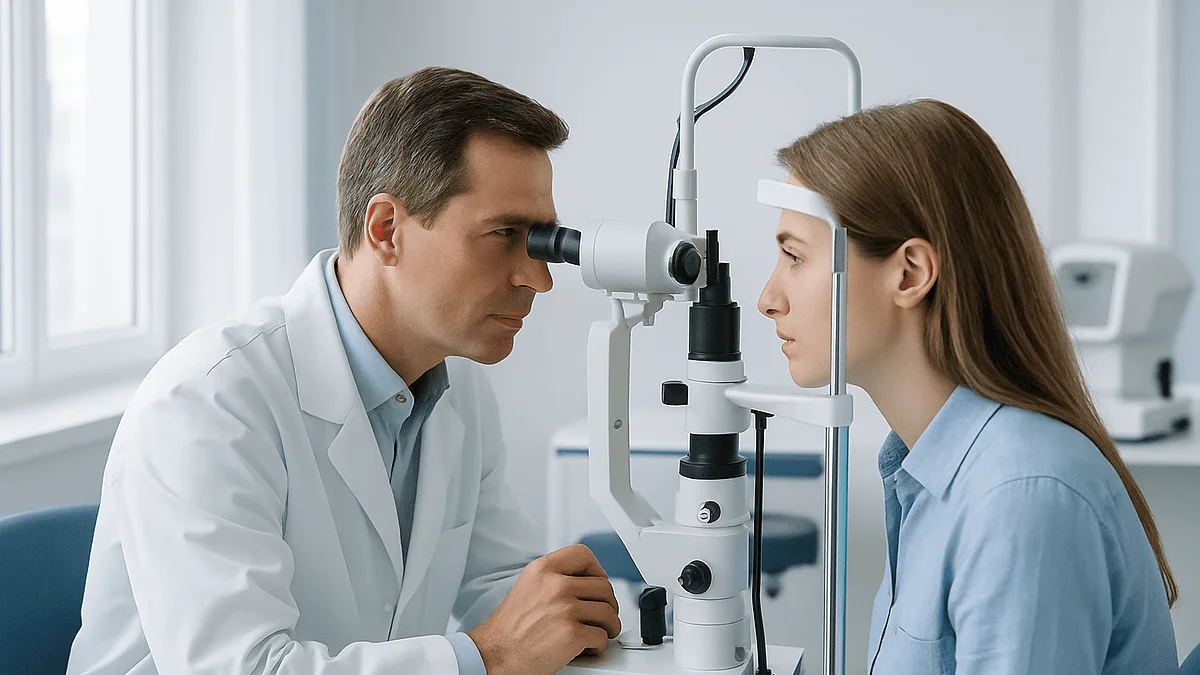
Visual acuity is measured by reading letters on a chart at a set distance. Refraction, the process of finding which lens power lets you see most sharply, is done with a phoropter (the large mask of rotating lenses) or an automated refractor, often both. Eye pressure is checked with tonometry, a gentle puff of air or a small probe that briefly touches the numbed cornea. A slit lamp, essentially a bright microscope, lets the clinician inspect the lids, cornea, iris and lens. Finally, drops may be used to widen the pupil so the retina and optic nerve can be examined and photographed.
MedlinePlus describes this sequence as a standard ophthalmic exam and notes that the full version, including dilation, usually takes somewhere between 30 minutes and an hour. Additional imaging, such as optical coherence tomography (OCT, a scan that maps the retinal layers in cross-section), adds a few minutes and produces the files you will most want to take home.
The one genuine difference abroad is the interpreter, whether that is a person or your own careful preparation. Every question about your history is only as good as your answer, and every result is only as useful as the label attached to it. That is why the records you carry in matter as much as the results you carry out.
Eye test abroad: what to bring in your folder
Start with what sits on your face. Bring your current glasses, your contact lenses in their packaging (the box lists brand-independent parameters such as base curve and diameter), and any spare pair you actually use. The lenses themselves can be read on a lensmeter if the paper prescription has gone missing.

Next, the written prescription itself, ideally the last two. A single prescription is a snapshot; two allow the clinician to see the direction of travel. The NHS points out that most adults are advised to have an eye test every two years, so two recent records usually span about four years of change.
Then the clinical numbers you may never have looked at: visual acuity for each eye, intraocular pressure with the time of day it was taken (pressure fluctuates through the day), and any visual field test results. If you have had a retinal photograph, OCT scan or corneal topography, ask your home clinic to export the images rather than just the report. A report says “normal”; an image lets the next clinician judge that for themselves.
Round out the folder with a complete medication list including over-the-counter products and supplements, an allergy list (anesthetic drops and dilating drops are common triggers of sensitivity), the dates and details of any eye surgery or laser treatment, and a brief note of relevant systemic conditions such as diabetes, high blood pressure or autoimmune disease.
Keep a digital copy on your phone and a paper copy in your bag. Batteries die, borders confiscate, and a printed page has never asked for a password.
Why your glasses prescription is more than a pair of numbers
A spectacle prescription looks like a small grid of figures, but each cell answers a different question, and a missing cell can send a new pair of glasses badly wrong.
Sphere is the main lens power, written in diopters, with a minus sign for nearsightedness and a plus sign for farsightedness. Cylinder describes astigmatism, an uneven curve of the cornea that blurs lines in one direction more than another. Axis, measured in degrees from 1 to 180, tells the lab which way to orient that cylinder. Add is the extra power for reading in a bifocal or progressive lens. Prism, when present, shifts the image to help eyes that do not align.
Two conventions trip up travelers. Cylinder can be written in minus form or plus form, and the two are mathematically interchangeable but look completely different on paper. A clinician who assumes one convention while reading the other will produce a lens that is wrong by the full cylinder amount. If your prescription does not say which form it uses, ask your home optician to note it.
The other frequent omission is pupillary distance, the gap between the centers of your pupils in millimeters. It is not part of the refraction but it is essential to positioning lenses correctly, and many prescriptions leave it off because the dispenser measures it in person. Mayo Clinic notes that the refraction is what determines the numbers; how those numbers become a physical lens is a separate step, and it is where translation errors live.
Ask for the prescription to be written with every column labeled, the cylinder convention stated, and the date recorded.
Who a comprehensive eye exam overseas is usually for, and who is asked to wait
A routine exam suits most adults who are simply due for a check, want an updated lens prescription, or have a stable long-term condition such as controlled glaucoma that needs monitoring. It also suits people with diabetes, who the NHS advises should have their eyes screened regularly because high blood sugar damages the small vessels of the retina, often before any symptoms appear.

Certain situations lead clinicians to suggest postponing or reshaping the visit rather than proceeding as booked.
- Anyone with a sudden change in vision, new flashes or floaters, eye pain or redness needs prompt assessment, not a scheduled routine test. Those symptoms belong in the emergency pathway wherever you happen to be.
- People who have had eye surgery within the previous few weeks are usually asked to complete follow-up with the operating team before starting fresh with someone new, because the early healing course is best judged by the clinician who saw the eye on the table.
- Contact lens wearers are often asked to leave lenses out beforehand, since lenses temporarily reshape the cornea and can distort refraction and topography readings. Soft lenses need a shorter break than rigid ones; the clinic will specify.
- Those whose visit depends on comparing scans with previous ones may be asked to obtain the older files first, because a single OCT without a baseline answers fewer questions.
Children can have full exams abroad, and the process is adapted with picture charts and shorter sessions. The National Eye Institute emphasizes that dilation is safe across age groups, though children may be more light-sensitive afterward, so sunglasses and a quiet afternoon help.
None of this is a bar to care. It is triage, and the deciding voice is the clinician in the room.
Medicines that change what the eye exam shows
Your medication list is not a formality. Several common drug classes leave fingerprints on the eye, and a clinician who knows about them reads the results differently.
Corticosteroids, whether tablets, inhalers or creams used over long periods, can raise intraocular pressure in susceptible people and accelerate certain cataracts. Pressure that would look alarming in one patient may be an expected side effect in another.
Hydroxychloroquine, used for autoimmune conditions, can in rare cases affect the central retina over years of use. People taking it are typically monitored with OCT and visual field testing, so bringing prior scans allows a genuine comparison rather than a fresh baseline.
Alpha-blockers prescribed for prostate or bladder symptoms relax the iris muscle and can make the pupil behave unpredictably during surgery. That matters if any procedure is contemplated later, and surgeons want to know even if the medicine was stopped years ago.
Anticoagulants and antiplatelet medicines do not usually affect a routine exam, but they are relevant to any injection or surgical planning and to how a clinician interprets small retinal hemorrhages.
Amiodarone, isotretinoin and some tuberculosis medicines have well-described eye effects ranging from corneal deposits to dry eye to optic nerve changes.
Write the generic name of each medicine, because brand names change across borders while generic names travel intact. Note roughly how long you have taken each one. Do not stop or adjust anything before the exam; a clinician who needs the eye examined free of a drug’s influence will say so and coordinate with your prescriber. The decision belongs to the team treating you, not to the itinerary.
Pupil dilation, blurred afternoons and getting back to your hotel
Dilating drops are the part of the exam that most affects the rest of your day, and they catch travelers off guard.
The drops work by temporarily paralyzing the muscle that constricts the pupil, sometimes alongside a second agent that stimulates the muscle that opens it. A wide pupil lets far more light reach the back of the eye and gives the clinician a broad view of the retina and optic nerve. The National Eye Institute notes that the drops usually take 15 to 30 minutes to work and that the effects, mainly light sensitivity and blurred near vision, typically last four to six hours, though darker irises may dilate more slowly and lighter ones may stay dilated longer.
Practically, that means you should not plan to drive, and in an unfamiliar city with unfamiliar traffic rules, it is worth arranging a companion or a pre-booked ride even if you would normally manage at home. Bring sunglasses. Reading a boarding pass or a phone screen will be frustrating for the afternoon, so download anything you need beforehand.
Some clinics offer a retinal camera that photographs the back of the eye without dilation. Mayo Clinic describes both approaches; the undilated photograph is convenient, but dilation still gives the most complete view of the peripheral retina, and the clinician will choose based on what needs to be seen.
If the exam is scheduled on a travel day, tell the clinic when booking. They may be able to sequence the visit so that dilation happens last, or advise whether it can reasonably wait for your home clinician.
International eye exam records: a checklist table
The table below is the folder Priya wishes she had assembled before she reached the airport. It is organized by what each record lets the receiving clinician do, rather than by how official it looks.
| Record | Preferred format | Why it matters |
|---|---|---|
| Current and previous spectacle prescription | Paper and photo; cylinder convention stated | Shows trend, prevents plus/minus cylinder errors |
| Contact lens parameters | Lens packaging or written base curve, diameter, power | Allows a like-for-like fit; brand names vary by country |
| Visual acuity, each eye | Chart notation named (Snellen feet, Snellen meters, decimal or logMAR) | Avoids misreading a stable eye as improved or worsened |
| Intraocular pressure | Value in mmHg, method and time of day | Pressure varies through the day and by instrument |
| Retinal photographs, OCT, visual fields | Original image files (DICOM or export), not just the PDF report | Lets the clinician measure change rather than trust a summary |
| Surgical and laser history | Operation notes if available; at minimum procedure, eye and approximate year | Explains unusual corneal shape, pressure or lens findings |
| Medication and allergy list | Generic names, duration of use | Several drug classes alter eye findings or procedure risk |
| Systemic conditions | One-line summary with treating clinician contact | Diabetes, hypertension and autoimmune disease shape the exam |
Two habits make this table work. First, ask your home clinic for the files in advance; image exports often take several days because someone has to retrieve them from an imaging server. Second, keep everything in one place, with your name and date of birth written identically to your passport on every page. Matching identities across two health systems is a surprisingly common point of failure.
How results from an eye exam for international patients travel home
The exam is over, the pupils are wide, and a receptionist hands you a single sheet. This is the moment to ask for more, politely and specifically, because once you have left the building, retrieval gets harder.
Ask for three things. The first is a written summary in a language your home clinician reads, listing acuity, refraction, pressure, and the clinician’s impression of the front and back of the eye. The second is the underlying image files. OCT machines and retinal cameras store scans in proprietary formats, but most can export to DICOM, the standard medical imaging format that hospital systems read, or to ordinary image files. A PDF report is a picture of a scan; a DICOM file is the scan. The difference matters when someone wants to measure retinal thickness against a previous visit.
The third is the prescription written in full, with every column labeled and the notation convention declared.
Delivery routes vary. Many clinics will email a report; fewer will email large image files, so a USB drive or a secure download link is worth requesting. Some countries operate patient portals that let you log in and download your own record later, and it is worth asking whether one exists before you leave.
The CDC’s guidance for anyone receiving health care abroad advises obtaining complete copies of your records before returning home and carrying them with you, precisely because follow-up depends on continuity. That advice was written with surgery in mind, but it applies just as neatly to a set of retinal scans.
When you get home, do not simply file the folder. Hand it to your usual clinician and ask that the images be imported into your record so the next comparison is possible.
Feet, meters, decimals and logMAR: reading acuity across borders
Nothing causes more confusion in a traveling eye record than visual acuity, because at least four notations describe the same thing.
Snellen notation in feet, familiar in the United States, writes normal vision as 20/20: you see at 20 feet what a standard eye sees at 20 feet. Snellen in meters, used in the United Kingdom and much of Europe, writes the same result as 6/6. Decimal notation, common in parts of continental Europe and Asia, records it as 1.0. LogMAR, the notation favored in research and increasingly in clinics, records it as 0.0, and here smaller numbers mean better vision, with negative values indicating better-than-standard sight.
A clinician skimming a record that says “0.5” needs to know whether that is decimal (roughly 20/40, meaning somewhat reduced) or logMAR (roughly 20/63, meaning more reduced). The figure is identical; the meaning is not. Always ask that the notation be named beside the number.
Refraction, mercifully, uses diopters everywhere. Intraocular pressure is universally recorded in millimeters of mercury. Corneal thickness is in micrometers. These units travel without translation, though the instrument used to measure pressure can shift readings slightly, so the method is worth noting.
Near vision is measured at a reading distance rather than across the room, and the charts and distances used vary more than distance charts do. If near vision matters to your question, ask that the test distance be written down.
MedlinePlus describes the standard exam components and the meaning of the common acuity fractions, and it is a reasonable reference to hand to anyone puzzling over a foreign record.
Sharing eye exam results safely: consent, privacy and who holds the file
Health records that cross a border enter a gap between two sets of privacy rules, and neither system automatically protects you in the other.
Most countries give patients a right to a copy of their own records, though the time allowed and the format offered differ. Ask about the clinic’s policy at booking rather than at checkout. Some will require a signed release form, particularly if they are sending records directly to another clinician rather than to you. Signing that form is usually the fastest route, because clinician-to-clinician transfer tends to include the image files that a patient copy might omit.
Email is convenient but not always secure, and some clinics decline to send anything identifiable by ordinary email. Encrypted portals, password-protected files or a physical drive are common alternatives. If you are given a password separately from the file, keep both; a locked file with no key is worth nothing to the next clinician.
Think about what you want the receiving clinic to know. The CDC’s guidance on care abroad recommends confirming in advance how your information will be shared and stored, and it is reasonable to ask whether images are retained locally, for how long, and whether they might be used for teaching. You are entitled to a plain answer.
Finally, consider identity matching. A record that lists your surname first in one country and last in another can fail to link in a hospital system. Ask that your name appear exactly as on your passport, with date of birth written unambiguously; day-month-year and month-day-year orderings produce real errors when a record such as 03/07 crosses the Atlantic.
The days and weeks after: what usually follows an exam abroad
For a routine exam, the immediate aftermath is short. Dilation wears off within the same day, according to the National Eye Institute’s typical range of four to six hours, and any stinging from anesthetic or dilating drops passes within minutes to an hour. New glasses, if ordered, usually take from a few days to a couple of weeks depending on lens complexity and whether they are made locally or shipped.
The more important timeline is the one that begins when you get home. If the exam found something unexpected, such as raised pressure, a suspicious optic nerve or a change in the retina, the clinician abroad will usually recommend a follow-up interval and may suggest specific tests to repeat. Take that recommendation to your home clinician promptly rather than waiting for your next routine appointment. Glaucoma, for instance, is typically confirmed by a pattern across repeated measurements rather than a single high reading, so a second data point matters more than a second opinion.
If the exam was normal, the value of the visit is largely stored in the files you carried home. Ask your regular clinician to import the images so that the next exam can be measured against them. The NHS two-year interval for routine adult testing is a reasonable rhythm for most people without a diagnosed condition; those with diabetes, glaucoma or a family history are often seen more frequently, on a schedule set by their treating team.
Expect some small differences when your home clinician repeats the tests. A refraction can shift by a fraction of a diopter between instruments and examiners without meaning anything has changed. Pressure varies by time of day. These are measurement realities, not signs that one clinic got it wrong.
Flying home after eye tests or minor eye procedures
A routine eye exam does not restrict flying. If your visit also included a minor procedure, such as a laser treatment for the retina or the iris, an injection into the eye, or removal of a foreign body, the picture is slightly different, and the deciding voice is the clinician who performed it.
Cabin air is dry, typically far drier than most indoor environments, and freshly treated or recently dilated eyes notice it. Lubricating drops of the kind sold without prescription are commonly suggested, though anything used after a procedure should be whatever the treating team specified. Avoid rubbing the eye. Sunglasses help with the glare of a window seat.
Pressure changes in the cabin are modest and do not affect the eye in most circumstances. The exception that clinicians care about is gas placed inside the eye during certain retinal surgeries, which expands at altitude and can dangerously raise pressure. If you have had any surgery inside the eye, ask explicitly whether flying is safe and when, and follow the answer you are given. This is not a place for a general rule.
For any longer flight, the ordinary clot-prevention basics apply to everyone regardless of eye care: move your legs regularly, walk the aisle when permitted, stay hydrated, and speak to your usual clinician beforehand if you have a personal history of clots or other risk factors. None of this is specific to the eye; it is simply sensible travel medicine.
Carry your eye records in your hand luggage, not the hold, alongside any drops prescribed. If something changes in flight, the crew and any clinician at arrival will want to see what was done and when.
What people often get wrong about eye exams abroad
The first misconception is that a prescription is universal. Diopters are, but notation conventions are not, and a prescription written in plus-cylinder form handed to a lab working in minus-cylinder form, without the convention stated, produces the wrong lens. Always ask for the convention to be written.
The second is that the report is the result. A one-page summary saying the retina is healthy is reassuring but not comparable. The scan itself, exported as a file, is what lets a future clinician detect the small thickening or thinning that precedes a diagnosis.
The third is that normal pressure means no glaucoma. Mayo Clinic notes that some people develop optic nerve damage at pressures within the usual range, and others carry higher pressures for years without damage. Pressure is one input among several; the optic nerve appearance and visual field carry at least as much weight.
The fourth is that a clear exam abroad resets the clock at home. It does not replace the relationship with a clinician who sees you over years and knows your baseline. Treat it as an additional data point, delivered to that clinician.
The fifth is that pupil dilation is optional theater. The National Eye Institute is clear that dilation gives the most complete view of the retina and optic nerve, and that undilated photographs, while useful, can miss the periphery. If a clinician recommends it, the inconvenience is buying information.
The last is that stopping a medicine before the exam will give a cleaner result. It may instead hide a side effect that needs to be documented, or destabilize the condition the medicine treats. Bring the list; let the clinician decide what to do with it.
Questions to ask your care team before and after the exam
A short list, asked out loud, saves weeks of email. Before the visit, at the point of booking, these are worth raising.
- Will my pupils be dilated, and if so, how long should I expect blurred vision and light sensitivity afterward?
- Should I stop wearing contact lenses before the appointment, and for how long?
- Which records from my home clinician would be most useful to you, and in what format?
- Can I receive the image files, not only the written report, and how will they be delivered?
- In what language will the report be written, and can visual acuity be recorded with the notation named?
After the exam, before you leave the building, a second set.
- Did you find anything that my home clinician should follow up, and within roughly what interval?
- Which cylinder convention is my prescription written in, and is my pupillary distance included?
- What method was used to measure my eye pressure, and at what time?
- Is there anything about my medicines that you would like my prescribing clinician to know?
- If I develop symptoms after I travel, what should prompt me to seek urgent care, and is there a way to contact you?
Write the answers down or ask for them in the report. Dilated eyes do not read notes well, and memory after a long day in an unfamiliar place is less reliable than it feels. If a companion is with you, let them hold the pen.
None of these questions challenges the clinician’s judgment. They simply make sure that the judgment travels intact.
When to call your doctor
Most eye exams, at home or abroad, end with nothing more troubling than an afternoon of squinting. A small number of symptoms, whether they appear after an exam, after a minor procedure, or out of nowhere on a trip, should not wait for a scheduled appointment. Seek urgent care wherever you are if you notice any of the following.
- A sudden loss of vision in one or both eyes, or a curtain or shadow spreading across part of your sight, which can signal a retinal detachment or a blockage of the eye’s blood supply.
- A sudden shower of new floaters or flashes of light, particularly with any loss of peripheral vision.
- Severe eye pain, especially with headache, nausea, a hazy cornea or haloes around lights, which together can indicate a sharp rise in eye pressure needing same-day treatment.
- A red, painful eye after any procedure or injection, particularly with increasing discharge or worsening vision, which can indicate infection inside the eye.
- Double vision that is new and persistent, or a drooping eyelid alongside it.
- An eye injury with any suspicion that something has penetrated the surface.
The NHS advises contacting emergency services or attending an emergency department for sudden vision loss or severe eye pain rather than waiting for an optician appointment, and that advice does not change with geography. If you are abroad, the report from your recent exam and your medication list will help whoever sees you.
Less urgent but still worth a prompt call to your usual clinician: gradual blurring that does not improve after dilation has worn off, persistent grittiness or light sensitivity lasting more than a day or two, or any new symptom the clinician abroad specifically told you to watch for. When in doubt, call; the decision about what to do next belongs with your treating team, and they would rather hear from you early.
Frequently asked questions
What are the most important international eye exam records to carry?
Carry your current and previous spectacle prescription with the cylinder convention stated, contact lens parameters, visual acuity and eye pressure readings with their units and notation named, any retinal photographs or OCT scans as image files, a generic-name medication and allergy list, and details of past eye surgery. Each of these lets the clinician compare rather than start from scratch, and together they fit on a few pages plus a USB drive.
For an eye test abroad, what should I bring on the day?
Bring your glasses, contact lenses in their packaging, the records folder, sunglasses for after dilation, and a companion or a planned ride if your pupils may be dilated. Have your passport-matching name and date of birth ready for the record. If you wear contact lenses, ask at booking whether to leave them out beforehand, since lenses temporarily reshape the cornea and can distort refraction readings.
How long does a comprehensive eye exam overseas usually take?
MedlinePlus describes a standard ophthalmic exam, including dilation, as typically taking around 30 minutes to an hour. Imaging such as OCT or visual field testing adds time, and waiting for the drops to work accounts for a portion of the visit. Plan for the afternoon, because blurred near vision and light sensitivity from dilation usually persist for several hours after you leave, according to the National Eye Institute.
What is the best way of sharing eye exam results with my home clinician?
Ask the clinic abroad for a written summary in a language your clinician reads, plus the original image files exported as DICOM or ordinary images, delivered by secure link, portal or drive rather than only by email. When home, hand everything to your regular clinician and ask that the images be imported into your record so future scans can be compared directly against them.
Why does my prescription look different from the one I had at home?
Often it is notation rather than a change in your eyes. Cylinder can be written in plus or minus form, which alters the sphere and axis figures while describing the same lens. Small differences of a fraction of a diopter between examiners and instruments are also normal. If the prescriptions differ substantially once converted to the same convention, ask your home clinician to review both before ordering lenses.
Is 6/6 vision the same as 20/20?
Yes. Both describe normal distance acuity, written in Snellen notation using meters in one case and feet in the other. Decimal notation records the same result as 1.0, and logMAR records it as 0.0, where lower numbers mean better vision. Because a bare number can be misread across notations, ask that the chart type be named beside your acuity result on any record that will travel.
Can I fly the same day as a dilated eye exam?
A routine dilated exam does not restrict flying, though blurred near vision and glare for several hours make navigating an airport harder, so allow extra time and bring sunglasses. If your visit also involved a procedure inside the eye, especially any surgery in which gas was placed in the eye, ask the treating clinician explicitly whether and when flying is safe, because expanding gas at altitude can raise eye pressure dangerously.
Should I stop any medicines before an eye exam abroad?
No, not on your own. Some medicines affect eye findings, but stopping them can hide a side effect that needs documenting or destabilize the condition they treat. Bring a complete list using generic names and how long you have taken each, and let the examining clinician decide whether anything needs to be discussed with your prescriber. Any change to a prescribed medicine should come from your treating team.
Do I have a right to my eye exam records from another country?
Most countries give patients a right to a copy of their own records, though the timeframe, format and any release paperwork vary. Ask about the policy at booking rather than at checkout, and request the image files as well as the report. The CDC’s guidance for anyone receiving care abroad recommends obtaining complete copies before returning home, because follow-up depends on continuity of information.
What if the exam abroad finds something my home clinician never mentioned?
Take the report and images to your usual clinician promptly rather than waiting for a routine appointment. Some findings, such as a single raised pressure reading, are confirmed only by repeated measurements over time, so a second data point matters. Measurement differences between instruments are common and do not mean either clinic erred. Your home team will decide what, if anything, needs further testing.
References
- Standard ophthalmic exam (MedlinePlus Medical Encyclopedia)
- Get a Dilated Eye Exam (National Eye Institute, NIH)
This article is for general information only and is not a substitute for professional medical advice. Please consult a qualified doctor about your individual situation.

More from the Blog

Who Is Steered Toward LASEK PRK? Thin Corneas, Contact Sports and Dry Eye Explained
LASEK and PRK are surface laser treatments that reshape the cornea without cutting a flap, so eye surgeons often suggest them for people whose…

Preparing for Vitrectomy: Fasting, Medication Review and Arranging Help for the First Days
Preparing for vitrectomy usually means attending a pre-operative assessment, following the fasting instructions your surgical team gives you, reviewing every medicine and supplement with…

Conjunctivitis in Contact Lens Wearers: Why Your Doctor Treats It More Cautiously
Doctors treat conjunctivitis in contact lens wearers more cautiously because a lens can trap germs against the eye and can mask an early corneal…

How PRK Surgery Is Done: Removing the Surface Layer, Reshaping and the Bandage Lens
PRK surgery is done in three steps. After numbing drops, the surgeon removes the cornea's thin outer skin, the epithelium, using a soft brush,…

Questions to Ask Before Strabismus Surgery: Glasses First, Injections and What Surgery Adds
Before agreeing to strabismus surgery, ask why non-surgical steps such as glasses, patching, prisms or botulinum toxin injections are or are not enough for…

What Smart Lens Surgery Can and Cannot Do for Near, Middle and Distance Vision
Smart lens surgery is a marketing name for replacing the eye's natural lens with a multifocal, trifocal or extended-depth-of-focus intraocular lens. It can restore…