

Chemical Peel Side Effects: Normal Tightness vs the Redness or Crusting You Report

Key Takeaways
- Depth determines side effects: Mayo Clinic describes typical visible healing of roughly one to seven days for superficial peels, seven to fourteen for medium, and about fourteen to twenty-one days for new skin after a deep peel.
- Uniform pinkness that fades slowly is expected healing, while redness concentrated in one warm patch or intensifying after day three is a pattern to report.
- Darkening after a peel is more common with superficial treatments and in brown or black skin, while permanent lightening is most associated with deep phenol peels, according to Mayo Clinic.
- Clusters of small painful blisters around the mouth after a peel suggest a cold-sore reactivation, which is why clinicians may discuss preventive antiviral medicine with people who have a history of herpes simplex.
- Deep phenol peels carry recognized risks to heart rhythm, kidneys and liver, which is why they are performed in stages with cardiac monitoring and usually only once.
- Picking loosening skin is one of the most common routes to scarring and pigment change; skin that is ready to release comes away with gentle washing.
After a chemical peel, tightness, mild stinging, pinkness and fine flaking for a few days are expected while the skin sheds and rebuilds. Redness that spreads or lasts far beyond the typical range for the peel depth, thick or weeping crusts, blisters, pus, fever, or new dark or pale patches are not routine and should be reported to the treating team, who decide on any next step.
The morning after a peel, most people do the same thing: lean into the bathroom mirror, tilt their chin toward the window, and try to decide whether what they see is healing or trouble. The skin feels like it has been shrink-wrapped. It is a shade too pink. Somewhere near the jaw, a patch has started to lift like old paint. None of this was in the glossy version of the story.
Chemical peel side effects sit on a spectrum, and the whole point of understanding them is knowing where the line falls between the ordinary and the reportable. Tightness and flaking are the skin doing exactly what the acid asked of it. Spreading redness, crusts that weep, or a stripe of new pigment are the skin telling you something else.
This explainer walks through what actually happens to the skin, what each day tends to look like at each depth, and which signs earn a phone call. The final judgment on any change belongs with the clinician who treated you; the goal here is to help you describe what you are seeing accurately.
What actually happens to your skin during a chemical peel
A chemical peel is a controlled chemical injury. That sounds alarming, but it is the honest mechanism. A clinician applies an acidic solution to the skin, the acid breaks the bonds holding the outermost cells together, those cells die and shed over the following days, and the skin underneath responds with a wound-healing cascade that produces new cells and, at greater depths, new collagen. Mayo Clinic describes the process plainly: the solution removes the top layers, and the skin that grows back is smoother.
Depth is the variable that governs almost every side effect. Superficial peels, often using alpha-hydroxy acids such as glycolic acid or beta-hydroxy acids such as salicylic acid, work within the epidermis, the thin outer layer you can see and touch. Medium peels, commonly trichloroacetic acid, reach the upper dermis, the thicker living layer beneath. Deep peels, historically phenol-based, reach the mid-dermis and are performed far less often because of their recovery demands and systemic risks.
The sensation during the procedure tracks depth too. Cleveland Clinic and Mayo Clinic both describe stinging and burning during application that may last several minutes; clinicians may use a fan, cool compresses or, for deep peels, sedation and local anesthesia. Deep phenol peels are done in small segments with heart monitoring because phenol absorbed through the skin can affect heart rhythm.
Why does this matter for side effects? Because the tightness you feel afterward is the dying outer layer contracting as it dries. The pinkness is increased blood flow feeding the repair. Flaking is the shed. These are not complications; they are the treatment, viewed from the outside. Complications are what happens when the injury goes deeper than intended, becomes infected, or heals with the wrong amount of pigment or collagen.
Which chemical peel side effects are normal in the first week
Think of expected side effects as the ones a clinician would nod at without reaching for a prescription pad. Mayo Clinic lists redness, scabbing and swelling as the routine responses, noting that normal healing includes redness that fades over days to weeks depending on depth. Cleveland Clinic adds tightness, dryness, mild irritation and flaking to the ordinary list.
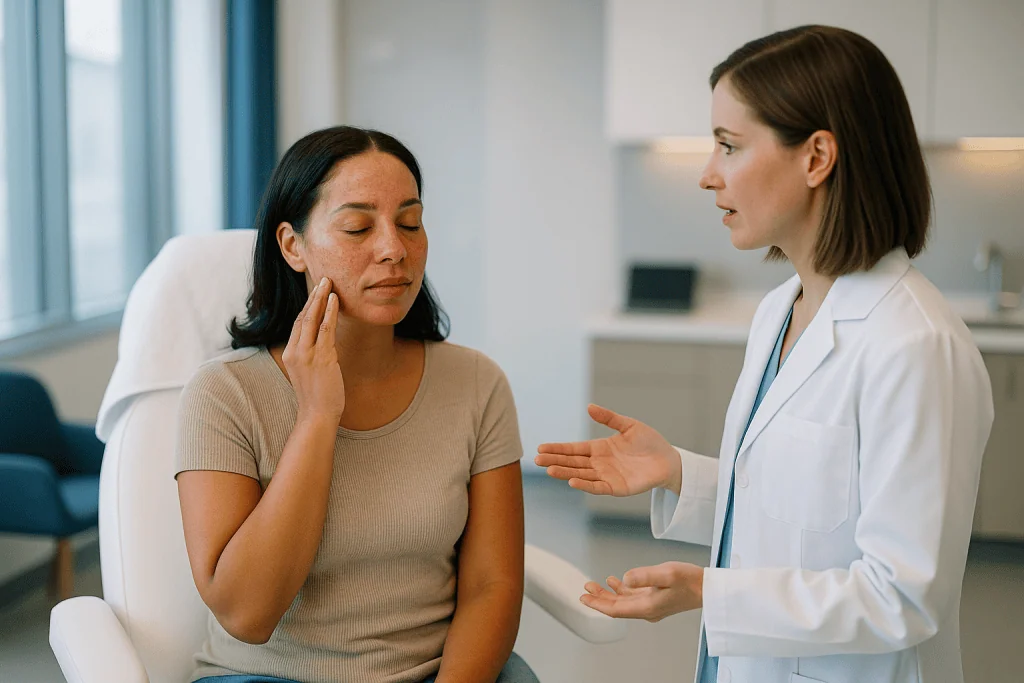
Tightness usually arrives within hours. The treated skin feels like a size too small, especially when you talk or smile. This is the frosted or coagulated surface layer losing water. Peeling itself typically begins around the mouth and nose first, where skin moves most, then spreads outward. With a superficial peel it can look like nothing more than the fine flaking of a mild sunburn. With a medium peel, sheets of darker, leathery skin may separate over several days.
A short list of what generally belongs in the expected column:
- Pink to red skin that blanches when pressed and is evenly distributed across treated areas.
- Mild stinging or itching, worse when the skin is dry, eased by the bland moisturizer your team recommended.
- Puffiness, especially around the eyes on waking, that eases through the day.
- Thin, dry flakes or larger dry sheets that lift on their own without bleeding.
- A temporary darkening of the treated skin before it sheds, which is the old layer, not new pigment.
What distinguishes expected from reportable is usually pattern and trajectory rather than any single sign. Redness that is uniform and slowly fading is normal. Redness that is concentrated in one hot patch, or that intensifies after day three when it should be easing, deserves a call. Flaking is normal. Flaking that leaves raw, weeping skin beneath is not.
Superficial, medium or deep: why depth decides the side effects
People frequently compare notes after peels without realizing they had entirely different procedures. A colleague who was back at her desk the next day and a friend who hid indoors for two weeks were not describing different tolerances; they were describing different depths. The table below summarizes typical healing windows drawn from Mayo Clinic and Cleveland Clinic descriptions. These are ranges observed in ordinary practice, not guarantees for any individual.
| Peel depth | Layer reached | Typical visible healing | Redness commonly lasts | Side effects most associated |
|---|---|---|---|---|
| Superficial | Epidermis only | About 1 to 7 days | Hours to a few days | Tightness, fine flaking, mild stinging, temporary darkening in deeper skin tones |
| Medium | Epidermis and upper dermis | About 7 to 14 days | Weeks, occasionally months | Swelling, crusting, pronounced peeling, pigment change, cold-sore reactivation |
| Deep | Mid-dermis | About 14 to 21 days for new skin | Up to several months | Severe swelling, oozing, bandaging, permanent lightening, scarring, phenol effects on heart, kidney, liver |
Two patterns in that table are worth an opinion. First, the side effects that frighten people most, weeping and crusting, are ordinary for deep peels and unusual for superficial ones. The same sign carries a different meaning depending on what was done. Second, the most serious risks cluster at depth. Mayo Clinic notes that phenol used in deep peels can damage heart muscle, cause irregular heartbeats and affect the kidneys and liver, which is why deep peels are done with monitoring and usually only once in a lifetime.
If you are not sure which depth you had, ask. It is the single most useful piece of information for interpreting what you see in the mirror.
Chemical peel recovery time: what the following days usually look like
Recovery is easier to tolerate when you know roughly what each day should bring. What follows is a composite of typical patterns described by Mayo Clinic and Cleveland Clinic; your team may give you a schedule specific to the agent they used.
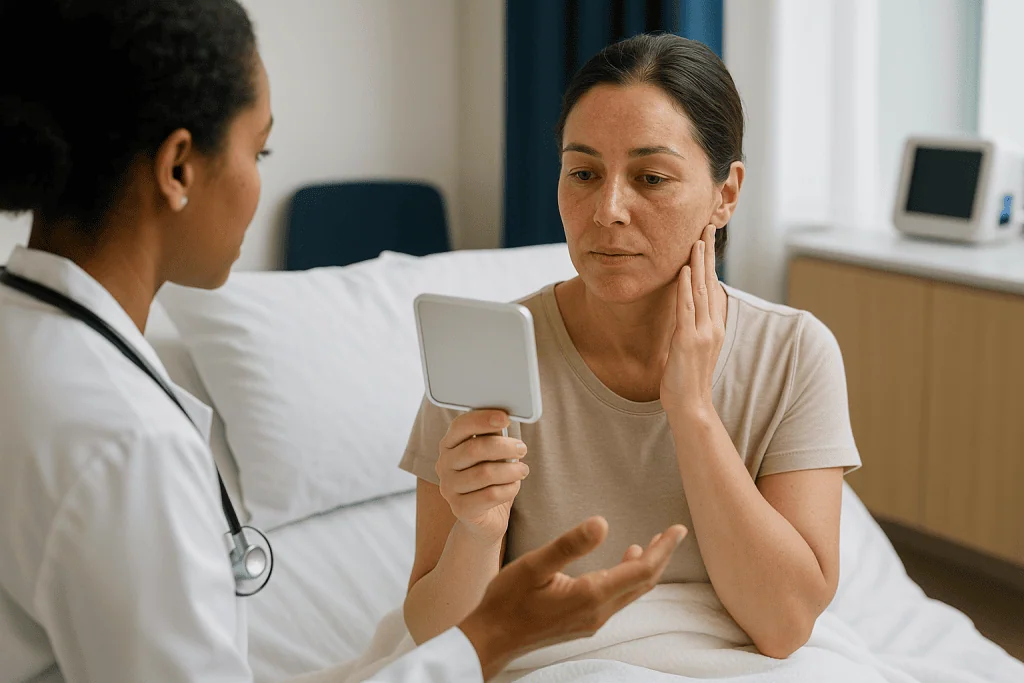
The first 24 hours belong to tightness and pinkness. After a superficial peel the skin may simply look as though you spent an afternoon outdoors. After a medium peel it can look red and slightly swollen, and a tan or brown discoloration may set in as the treated layer begins to die. Deep peel patients typically go home with the treated area covered by ointment or a dressing and with instructions for frequent soaks.
Days two to four are the shedding phase for medium peels. Skin cracks first where it moves, around the mouth and along smile lines, then separates in patches. Itching is common as the surface dries. Swelling is often worst on the second and third mornings and eases as the day goes on.
By days five to seven, superficial peels are generally finished, and medium peels are mostly shed, leaving skin that is pink, smooth and unusually sensitive to temperature and products. Mayo Clinic gives roughly one to seven days for superficial healing and seven to fourteen for medium.
Weeks two and three are when deep peel patients begin to see new skin, according to Mayo Clinic, though the area remains intensely red. For medium peels, residual pinkness gradually settles over weeks. Makeup is usually permitted once the surface is fully closed, a decision your team should confirm.
Across all depths, the trajectory matters more than any single day. Healing should move in one direction: less tight, less red, less flaky. A reversal, more swelling on day five than day three, or redness that deepens after it had begun fading, is the pattern to report.
What's the worst day after a chemical peel?
Ask enough people and a consensus emerges: the worst day is rarely the day of the peel. It is usually somewhere in the middle of the shed. The clinical timelines from Mayo Clinic point the same way. For medium peels, swelling and discomfort commonly peak around the second or third day, and that is also when the surface looks its darkest and most cracked, just before it releases.
Several forces converge on that window. Swelling has had time to build. The dead outer layer has dried and tightened, so every expression pulls. Peeling has begun in the most visible places but is nowhere near finished, leaving a patchwork of dark leathery skin and raw-looking pink beneath. Sleep may be poor because of itch and the need to keep the face still. There is also a psychological component: on day one you were braced for it; by day three the novelty has worn off and the mirror is unkind.
For superficial peels, the low point is milder and earlier, often the evening of the procedure or the next day when tightness is at its height and flaking has not yet relieved it. For deep peels the difficult stretch is longer, with the first week dominated by oozing, dressings and significant swelling, as Cleveland Clinic and Mayo Clinic describe.
The practical value of knowing this is simple. Feeling worse on day three than day one is, for most medium peels, an expected shape rather than a warning. What should not happen on that day, or any other, is fever, spreading warmth, pus, blisters filled with clear fluid in clusters, or pain that escalates sharply rather than plateaus. Those signs are not part of the ordinary low point and belong in the call to your team described later in this article.
Chemical peel redness: how long is normal and when is it too long?
Redness is the side effect people underestimate beforehand and worry about most afterward. It is also the one where depth changes the answer most dramatically. Mayo Clinic describes redness after a superficial peel fading within days, redness after a medium peel that can persist for weeks and occasionally months, and redness after a deep peel that may last several months. Those ranges are broad because individual healing varies, and they describe what commonly happens, not what you are owed.
The biology explains the timeline. Redness is blood flow. In the first days it is inflammation delivering the cells and materials of repair. After the surface closes, the new skin is thin and the vessels beneath are close to the surface and dilated, so the area stays pink long after it stops peeling. Prolonged redness, sometimes called persistent erythema, is more likely when the peel went deeper than planned, when the skin was already inflamed or irritated before treatment, or when certain acne medicines had recently been used.
How do you tell healing redness from a problem? Consider three questions.
- Is it even? Healing redness is diffuse across the treated area. Redness concentrated in one patch, or forming a raised or spreading border, suggests infection or an unexpectedly deep injury.
- Is it fading? Slow improvement week over week is expected. Redness that darkens, turns purple, or comes with new heat or swelling after the first few days is not.
- Is it alone? Redness plus pain, pus, fever, or thickening of the skin is a different category from redness by itself.
Persistent redness that outlasts the typical window for your peel depth is worth a review even without other signs, partly because it can precede scarring and partly because treatments exist that your clinician may consider. Do not treat it yourself with over-the-counter products; new skin reacts unpredictably.
Crusting, oozing and scabs: healing sign or warning sign?
Crusting is where the language of side effects gets slippery, because the same word describes two very different things. A thin, dry, honey-colored layer that forms over medium-peel skin as the surface dies and flakes is part of the shed. A thick, wet, yellow-green crust that keeps re-forming over an area that will not close is something else. Cleveland Clinic notes that deep peels in particular involve oozing and crusting during the first week as a routine phase, managed with ointments and soaks; the same appearance after a superficial peel would be unexpected.
The review of complications published in the Journal of Cutaneous and Aesthetic Surgery and indexed by PubMed Central lists infection among the recognized risks of medium and deep peels. Bacterial infection tends to announce itself with increasing pain, warmth, swelling, pus, and crusts that are moist rather than dry. Fungal infection can produce persistent redness and small pustules that do not resolve on schedule.
A separate concern is reactivation of the cold-sore virus. Anyone who carries herpes simplex can experience an outbreak on freshly peeled skin, which appears as clusters of small painful blisters that quickly crust, often around the mouth. Mayo Clinic notes that clinicians may prescribe an antiviral medicine before and after medium or deep peels for people with a history of cold sores; whether that applies to you is a decision for your prescriber, not something to arrange yourself.
The temptation with any crust is to pick it. Resist that. Picking or peeling skin before it releases naturally removes protection from tissue that has not finished healing and is one of the more common paths to scarring and pigment change. If a crust is worrying you, photograph it in daylight, note whether it is dry or weeping, and describe it to your team rather than testing it with a fingernail.
Can a chemical peel go wrong? The complications that need a report
Yes, a chemical peel can go wrong, and pretending otherwise does no one any good. The reassuring part is that serious complications cluster at greater depths, are largely recognized in advance, and are usually manageable when reported early. Mayo Clinic groups the main risks as scarring, changes in skin color, infection, and, for phenol peels, damage to the heart, kidneys or liver.
Scarring is the outcome people fear most. It happens when injury reaches deeper than intended or when healing is disrupted, most often by infection or picking. The lower face is a frequent site. Early warning signs are areas that stay red and raised, feel firm to the touch, or develop a shiny texture after the surrounding skin has healed. The complications review in the Journal of Cutaneous and Aesthetic Surgery lists both hypertrophic scars, which are raised but confined to the injured area, and keloids, which grow beyond it, as recognized risks, more likely in people who have formed keloids before.
Textural change without frank scarring is another possibility: skin that heals with enlarged pores, a lined or crepey look, or fine milia, the small white cysts that can form on new skin. Milia typically resolve or are removed easily; other textural changes may be lasting.
Systemic effects are almost exclusively a deep-peel concern. Phenol is absorbed through the skin and can provoke irregular heart rhythms, which is why Mayo Clinic describes deep peels being performed in stages with cardiac monitoring and intravenous fluids. Kidney and liver toxicity are also recognized risks. These are reasons deep peels are uncommon and reserved for specific situations under specialist care.
Eye injury from solution running toward the lids is rare but described, which is why eyes are protected during the procedure and why any eye pain, tearing or vision change after treatment is an urgent matter.
Dark or light patches after a chemical peel: pigment changes explained
Of all chemical peel side effects, pigment change is the one most tied to who you are rather than what was done. Mayo Clinic states that a peel can cause skin to darken, called hyperpigmentation, or lighten, called hypopigmentation, and that darkening is more common after superficial peels while lightening is more common after deep ones. It also notes that people with brown or black skin have a higher risk of uneven color afterward.
Hyperpigmentation after a peel is usually post-inflammatory: the pigment-producing cells respond to the injury by making more melanin, and the result is a patch darker than the surrounding skin, frequently along the jaw, cheeks or around the mouth. Sun exposure during healing amplifies it considerably. It tends to appear in the weeks after the peel rather than the first days, which is why a face that looked fine at the one-week mark can develop patches later. The complications review indexed by PubMed Central identifies this as among the more frequent complications overall, particularly in deeper skin tones.
Hypopigmentation is different. It happens when pigment cells are destroyed or suppressed by a deep injury, leaving skin paler than its surroundings. Deep phenol peels carry the highest risk, and the change can be permanent, sometimes producing a visible line where treated skin meets untreated skin along the jaw. This is one of the reasons Mayo Clinic notes that deep peels are generally recommended only for lighter skin tones and usually only once.
Two practical points follow. First, strict sun avoidance during and after healing is the most effective step within your control against darkening. Second, any new patch of color, dark or light, that emerges after the peel should be reported rather than waited out. Some post-inflammatory darkening fades on its own over months, and clinicians have treatments they may consider, but the timing of review matters.
Who a chemical peel is usually for, and who is usually asked to wait
Peels are commonly offered for fine lines, uneven tone, sun damage, some acne and acne scars, and certain kinds of pigmentation such as melasma, according to Cleveland Clinic and Mayo Clinic. Whether one is appropriate for you depends on the concern, your skin type and history, and the depth needed to address it. That assessment belongs to a qualified clinician after examining your skin.
Some situations commonly lead to a recommendation to postpone or to choose a different approach. Mayo Clinic specifically flags a higher risk of complications for people who have taken the oral acne medicine isotretinoin within the previous six months, because it alters how skin heals. A personal or family history of keloids raises the risk of raised scarring. Active skin infection, including a current cold sore, is a reason to wait, since a peel can spread or worsen it. Pregnancy and breastfeeding are usually reasons for caution, both because of limited safety data for some agents and because hormonal pigmentation changes are common during pregnancy.
People with brown or black skin are not excluded from peels, but depth is chosen more conservatively because of the pigment risks described above, and a clinician experienced with a range of skin tones is an asset. A history of frequent cold sores does not rule out treatment, but it may prompt a discussion about preventive antiviral medicine, a decision that rests with the prescriber.
Realistic goals matter as much as medical fit. Peels do not tighten sagging skin or remove deep scars, and a clinician who describes what they will not do is offering you useful honesty. Alternatives, including laser resurfacing, microneedling, prescription topical treatments or simply consistent sun protection, may suit some people better. The right choice, and whether to proceed at all, sits with you and your treating team.
How long will a chemical peel last, and does repeating it change the risks?
Two questions hide inside this one: how long the effects of a peel persist, and how often peels are repeated. The answers differ by depth and shape the side-effect picture over time.
Superficial peels produce subtle changes, mainly a brighter, smoother surface, and Mayo Clinic notes they are often repeated in a series, with sessions spaced weeks apart, to build a result. Each session carries its own short window of tightness and flaking, which most people find manageable, but cumulative irritation is possible if sessions are too close or if the skin has not fully settled between them. Signs that the skin is not recovering fully between peels include persistent pinkness, a burning response to ordinary moisturizers, or pigment patches appearing where none existed.
Medium peels produce more visible change, and Mayo Clinic describes that they may be repeated after several months to maintain the effect. Because each medium peel involves a genuine wound-healing phase with its associated risks of pigment change and prolonged redness, spacing is a clinical decision, not a schedule you set yourself.
Deep peels are described by Mayo Clinic as generally performed once, with results that may be long-lasting. The trade-off is the longest recovery, the highest risk of permanent lightening and scarring, and the systemic considerations of phenol. Sun exposure and natural aging continue afterward, so no peel of any depth stops the clock.
The candid answer to how long a peel lasts is that it depends on what was treated and how you protect the skin afterward. Daily broad-spectrum sun protection extends the benefit of every depth and reduces the chance of new pigmentation, which is the side effect most likely to erode a good result. Anyone offering a guaranteed duration is speaking beyond what the evidence supports.
What people often get wrong about chemical peel side effects
Myths around peels tend to run in two directions at once: that they are harmless spa treatments, and that they leave everyone looking like a burn victim for a month. Both are wrong, and the truth sits with depth.
The first misunderstanding is that more peeling means a better result. Visible peeling is a byproduct, not a measure of effect. Some superficial peels produce almost no flaking yet still change the surface. Judging a peel by how dramatically your skin sheds encourages people to seek deeper treatments than they need and to accept side effects they need not.
The second is that helping the skin along by peeling off loosening sheets speeds recovery. It does the opposite. Skin that is ready to release comes away with washing; skin that resists is still protecting tissue beneath. Mayo Clinic and Cleveland Clinic both advise against picking, which is a common route to scarring and pigment change.
The third is that redness means something went wrong. For medium and deep peels, weeks of pinkness are described as ordinary by Mayo Clinic. Redness becomes a concern through pattern, spread, heat or persistence beyond the typical range, not by its mere presence.
The fourth is that a home acid product and a clinical peel are the same thing at different strengths. The difference is not only concentration but control: the clinician neutralizes or times the agent, watches for the frosting that signals depth, and adjusts. Uncontrolled application, including layering home acids in the days around a professional peel, is a recognized way to deepen injury unintentionally.
The last is that darker skin cannot be peeled. It can, with appropriate agent choice and depth. What is true is that pigment risk is higher, which argues for conservative planning and experienced hands rather than avoidance.
Aftercare habits that reduce chemical peel side effects
Aftercare is not a set of rituals; it is the second half of the treatment, and it is where a good outcome is either protected or lost. The instructions your team gives you override anything general, but the principles below appear consistently in Mayo Clinic and Cleveland Clinic guidance.
Sun protection is the foundation. New skin has less pigment to defend itself and an inflammatory environment primed to overproduce melanin. Cleveland Clinic advises avoiding sun exposure and using broad-spectrum sunscreen once the skin has closed, with physical shade and hats in the meantime. This is the single habit most likely to prevent the dark patches that spoil results.
Gentle cleansing matters. Lukewarm water, a bland non-foaming cleanser and patting rather than rubbing protect fragile tissue. Bland emollient keeps the surface from cracking, which reduces itch and the temptation to scratch. Deep peel patients typically follow a specific soaking and ointment routine.
Hands off is the rule that people break most. No picking, no exfoliating, no washcloths, no retinoid or acid products until your team clears them. Mayo Clinic notes that treated skin may take weeks to tolerate ordinary products again after medium and deep peels.
Heat and sweat can worsen redness and swelling during the open phase, so vigorous exercise, saunas and hot showers are commonly paused for a period your team will specify. Sleeping with the head slightly raised for the first nights can ease morning puffiness.
Keep a simple record: a daytime photo each morning in the same light. It turns a vague sense of whether things are better or worse into evidence you and your clinician can compare, and it makes any phone call far more useful.
Questions to ask your care team before and after a peel
Most people prepare questions about results and forget to ask about the part they will actually live through. These questions steer toward the side effects and help you interpret what you see later.
- What depth of peel are you planning, and which agent? This single answer tells you which column of the depth table applies to you.
- What will my skin look like on days one, three and seven, and when do you expect redness to settle for someone with my skin type?
- Which signs would you want to hear about the same day, and how do I reach you or the on-call clinician outside office hours?
- Given my skin tone and history, what is my particular risk of darkening or lightening, and what will we do to reduce it?
- I have had cold sores before; does that change your plan?
- Have I used any acne or other skin medicines in the past year that affect healing? Bring a list rather than relying on memory.
- Which of my current skincare products should I stop before the peel and for how long afterward?
- If redness or a pigment patch persists, what treatments might you consider and when?
- How many sessions do you anticipate, how far apart, and what tells you my skin is ready for the next one?
- What would you consider instead of a peel for my concern, and why did you choose this?
After the peel, the useful questions get more specific. When you call about a change, be ready to say which day you are on, exactly where the change is, whether it is wet or dry, warm or not, spreading or stable, and whether you have fever or increasing pain. A photo in natural light, sent through whatever channel your team uses, answers half of those questions before you finish the sentence. Vague worry gets vague advice; precise description gets a precise answer, and often, a quick reassurance.
When to call your doctor after a chemical peel
Most peels heal without any of what follows. This section exists so that the small number of people who do see these signs act early, when a problem is easiest to manage. Report the following to the clinician who treated you, or to urgent care if you cannot reach them.
Signs suggesting infection: increasing rather than easing pain after the first days; spreading redness with warmth; swelling that worsens after day three; yellow or green discharge; crusts that are wet and keep re-forming; fever or feeling generally unwell.
Signs suggesting a viral outbreak: clusters of small, painful, fluid-filled blisters, especially around the mouth, appearing in the days after treatment.
Signs suggesting a deeper-than-intended injury or early scarring: areas that remain raw or open beyond the typical healing range for your peel depth; skin that becomes firm, thickened, raised or shiny while the surrounding area heals; redness that intensifies or turns purple instead of fading.
Signs involving the eyes: any eye pain, persistent tearing, light sensitivity or change in vision after the procedure, which need same-day assessment.
Signs after a deep phenol peel: palpitations, an irregular or racing heartbeat, breathlessness, dizziness, or reduced urination in the hours or days following treatment. Mayo Clinic identifies heart, kidney and liver effects as recognized phenol risks, and these symptoms warrant emergency care.
Signs of pigment change: any new dark or pale patch, even weeks later, deserves a review appointment rather than a wait-and-see approach, because early evaluation broadens the options your clinician may consider.
If you are unsure whether what you see qualifies, the answer is to call. A brief conversation that ends in reassurance costs nothing but a few minutes. The interpretation of any sign, and every decision about what to do next, sits with your treating team.
Frequently asked questions
Is chemical peeling good for your face?
A chemical peel can improve fine lines, uneven tone, sun damage and some types of acne and pigmentation when the depth and agent match the concern and skin type, according to Mayo Clinic and Cleveland Clinic. It is not suitable for everyone, does not tighten sagging skin, and carries risks that rise with depth. Whether it is a good option for your face is a judgment for a qualified clinician after examining your skin and history.
How long will a chemical peel last?
It depends on depth. Superficial peels produce subtle changes and are often repeated in a series spaced weeks apart; medium peels may be repeated after several months; deep peels are generally done once and may be long-lasting, per Mayo Clinic. Ongoing sun exposure and aging continue afterward, so daily sun protection is the main factor within your control for extending any result. No fixed duration can be promised.
What is the worst day after a chemical peel?
For medium peels, many people find the second or third day hardest, when swelling peaks and the surface is darkest and most cracked but has not yet shed. Superficial peels tend to feel worst on the first evening when tightness is highest. Deep peels involve a longer difficult first week with oozing and dressings. Feeling worse on day three than day one is a common pattern; fever, pus or blisters are not.
Can a chemical peel go wrong?
Yes. Recognized complications include infection, cold-sore reactivation, scarring, darkening or lightening of skin, and, with deep phenol peels, effects on heart rhythm, kidneys and liver, according to Mayo Clinic and a review indexed by PubMed Central. Most cluster at greater depths and in people with known risk factors such as recent isotretinoin use or a keloid history. Early reporting of unexpected signs gives the treating team the most options.
How long does chemical peel redness last?
Mayo Clinic describes redness fading within days after a superficial peel, persisting for weeks and occasionally months after a medium peel, and lasting up to several months after a deep peel. Healing redness is even and gradually improving. Redness that concentrates in one area, becomes warm, spreads, turns purple or lasts well beyond the typical range for your peel depth should be reviewed by your clinician.
Is crusting after a chemical peel normal?
Thin, dry crusting and flaking during the shed is expected after medium peels, and oozing with crusts is a routine first-week phase after deep peels, as Cleveland Clinic describes. Thick, wet, yellow or green crusts that keep re-forming, especially with increasing pain, warmth or fever, suggest infection and should be reported the same day. Crusting after a superficial peel is unusual and worth a call.
Why is my skin darker after a chemical peel?
In the first days, darkening is usually the treated outer layer dying before it sheds. Darkening that appears in the following weeks is more often post-inflammatory hyperpigmentation, where pigment cells overproduce melanin in response to injury; Mayo Clinic notes this is more common after superficial peels and in brown or black skin. Sun exposure makes it worse. New dark patches should be reviewed rather than waited out.
Can I peel off the loose skin after a chemical peel?
No. Skin that is ready to release comes away with gentle washing; skin that resists is still protecting unhealed tissue beneath. Mayo Clinic and Cleveland Clinic both advise against picking or peeling, because it is a common path to scarring and pigment change. Keep the surface moisturized to reduce itch, and if a piece is bothering you, describe or photograph it for your team instead.
Who should not have a chemical peel?
Mayo Clinic flags higher complication risk for people who have taken oral isotretinoin in the previous six months, those with a history of keloids, and those with active infection including a current cold sore. Pregnancy and breastfeeding usually prompt caution. People with brown or black skin can have peels but with more conservative depth because of pigment risk. The decision rests with the treating clinician after assessment.
When should I call a doctor after a chemical peel?
Call the same day for spreading redness with warmth, worsening swelling after day three, pus or wet re-forming crusts, fever, clusters of painful blisters, areas that stay raw beyond the typical range, skin that becomes firm or raised, or any eye pain or vision change. After a deep phenol peel, palpitations, breathlessness, dizziness or reduced urination need emergency care. When unsure, calling is the right choice.
References
- Cleveland Clinic: Chemical Peels
- NIH PubMed Central: Complications of Medium Depth and Deep Chemical Peels (Journal of Cutaneous and Aesthetic Surgery)
- NHS: Cosmetic procedures
This article is for general information only and is not a substitute for professional medical advice. Please consult a qualified doctor about your individual situation.

More from the Blog

Before Aesthetic Filling: Blood Thinners, Alcohol and Supplements Your Doctor Will Review
Before dermal fillers, clinicians typically review anything that increases bruising or bleeding: prescribed anticoagulants and antiplatelet drugs, over-the-counter anti-inflammatory painkillers, supplements such as fish…

Reconstruction After Cancer or Infection: How Grafts, Flaps and Staged Surgery Are Planned
Reconstructive surgery after cancer or infection rebuilds tissue removed by a tumor operation or destroyed by infection, using skin grafts, flaps of tissue moved…

Why Hands Show Age Early: Volume Loss, Visible Veins and Sun Spots and How Each Is Treated
Hands show age early because their skin is thin, has very little fat beneath it, and spends decades in sunlight without protection. Over time…

Hand Rejuvenation Recovery: Swelling, Bruising and Why Heavy Hand Use Waits a Few Days
After hand filler, mild swelling, tenderness and some bruising across the back of the hand are common and typically ease over several days to…
Caring for the Donor Site After a Skin Graft: Dressings, Discomfort and How It Heals
Skin graft donor site care means keeping the area where skin was taken clean, covered and moist while new skin grows back from below.…

Laser Treatment or Eye Drops for Glaucoma? How Ophthalmologists Decide the Sequence
For most people with newly diagnosed open-angle glaucoma or raised eye pressure, either pressure-lowering eye drops or a laser procedure called selective laser trabeculoplasty…