

Cloudy Vision Months After Cataract Surgery: Why It Happens and How It Is Treated

Key Takeaways
- Cloudy vision that returns months after cataract surgery is most often posterior capsule opacification, a film on the capsule behind the implant, not the cataract regrowing.
- The Mayo Clinic describes PCO as the most common late complication of cataract surgery, and it can appear months or years after an initially clear result.
- YAG laser capsulotomy opens a clear window in the cloudy capsule without any incision, and the Mayo Clinic notes the procedure takes about five minutes.
- The laser is only the right treatment when the capsule is the problem; macular swelling, dry eye and refractive error need entirely different care.
- A temporary rise in eye pressure and new floaters are the most common effects after the laser, while retinal detachment is rare but requires same-day assessment.
- The NHS lists flashes, a shower of floaters and a curtain-like shadow as red flags for retinal detachment at any point after cataract surgery.
Cloudy vision that returns months after cataract surgery is most often posterior capsule opacification, a haze that forms on the thin membrane holding the lens implant. It is not the cataract growing back. An eye specialist usually confirms it with a dilated examination and, when it affects daily sight, treats it with a brief outpatient laser procedure called YAG capsulotomy. Other causes, such as macular swelling or dry eye, need different care.
Eight months after her operation, a retired schoolteacher noticed that the crossword had gone soft again. Not the deep amber blur she remembered from before surgery, but a milky sheen, as if someone had breathed on the inside of her glasses and forgotten to wipe them. Headlights at night grew halos. She assumed the surgery had somehow failed.
It had not. Cloudy vision after cataract surgery, arriving weeks or months after a clear result, is one of the most common reasons people return to the eye clinic, and in most cases the explanation is a predictable healing process rather than a problem with the operation itself.
This explainer walks through what is actually happening behind the lens implant, the handful of other conditions that can mimic it, how specialists tell them apart, and what treatment usually involves. The aim is a calm, evidence-based picture, so the conversation with your own care team starts from understanding rather than worry.
Why is my vision cloudy again months after cataract surgery?
During cataract surgery the cloudy natural lens is removed and an artificial lens, called an intraocular lens or IOL, is placed inside the eye. The surgeon leaves behind the lens capsule, a transparent bag thinner than plastic wrap, because it is the ideal pocket to hold the new lens steady. Vision is usually noticeably clearer within days, and the NHS notes that full recovery typically takes 4 to 6 weeks.
Then, for a proportion of people, the picture slowly mists over again. The timing is the first clue. Cloudiness in the first week is usually surgical swelling settling. Cloudiness that creeps in from roughly three months onward, after a genuinely clear spell, points most often to changes in that leftover capsule.
Why does the capsule change? Cataract removal is not a sterile vacuuming. A few of the lens’s own cells inevitably remain clinging to the capsule’s inner surface. Over months they can migrate across the back wall of the capsule, directly behind the implant, multiply and lay down a fibrous or pearly film. Light passing through that film scatters instead of focusing, which the brain reads as haze, glare and fading contrast.
The Mayo Clinic describes this as the most common late complication of cataract surgery, and it can appear months or even years after the operation. It is not a sign of poor surgery, of a defective implant or of the eye rejecting anything. It is biology doing what biology does with a wound: trying to heal it.
The reassuring part is that this particular cause has a well-established, short treatment. The less obvious part, which the rest of this article covers, is that it is not the only possible cause, and the treatment differs depending on which one is found.
What is posterior capsule opacification, the so-called secondary cataract?
Posterior capsule opacification, usually shortened to PCO, is the medical name for that film. Posterior means it forms on the back surface of the capsule; opacification means it turns from clear to cloudy. Patients and clinicians often call it a secondary cataract, which is convenient shorthand but slightly misleading, because the original cataract is gone and cannot regrow.
Two patterns are recognized. In the fibrous type, remaining lens cells transform into scar-like tissue that wrinkles the capsule, producing a general blur and sometimes distortion. In the pearl type, cells swell into tiny translucent globules that pile up like frog spawn, scattering light and creating glare, particularly around bright sources at night. Many people have a mixture of both.
Symptoms tend to build gradually rather than arriving overnight. People describe reading print that seems slightly out of register, needing more light for tasks that were fine a month earlier, difficulty judging faces across a room, or a return of the yellowed, washed-out color vision they thought they had left behind. Because it develops slowly, and often in one eye first, it is easy to blame new glasses, tired eyes or simply age.
An important distinction: PCO affects only the light path. The retina, the light-sensing layer at the back of the eye, is untouched, and the implant itself is not damaged. That is exactly why treatment can restore clarity so directly: once the cloudy film is opened, there is nothing else standing between the world and a healthy retina.
The NHS lists PCO as the most common complication of cataract surgery. That word, complication, unsettles people, but in this context it means a known, expected and manageable consequence rather than an error.
What other conditions cause cloudy vision after cataract surgery?
PCO is the leading suspect, but a careful clinician never assumes. Several other conditions produce a similar complaint, and a few of them are more urgent.
Cystoid macular edema is swelling at the macula, the central patch of retina responsible for fine detail. Surgery triggers inflammation, and inflammatory chemicals can make tiny retinal blood vessels leak fluid into the macula. It typically shows up in the first few months, causing blur and sometimes a wavy or dulled center to the vision. The Cleveland Clinic and Mayo Clinic both list retinal swelling among recognized post-surgical complications. It is treatable, but the treatment is anti-inflammatory medication, not a laser.
Dry eye is far more common than most people expect after cataract surgery. The incisions temporarily interrupt corneal nerves that drive tear production, and post-operative drops can irritate the surface. A dry, uneven tear film scatters light much like frosted glass, producing fluctuating blur that often clears briefly after a blink.
Residual refractive error means the eye’s focus simply is not quite where it was intended. Even a modest amount of astigmatism, a slight oval shape to the cornea, can leave everything softly doubled. This feels like cloudiness but is fixed with glasses or, occasionally, further procedures.
Corneal swelling, particularly in people whose corneas were already fragile, blurs vision most in the morning and clears through the day.
Less commonly, a problem with the implant’s position, a new retinal condition such as an epiretinal membrane or age-related macular degeneration, or glaucoma-related damage can be the real story. Retinal detachment, which the NHS notes is a rare but serious risk, produces sudden symptoms rather than gradual haze and needs same-day assessment.
Cloudy vision after cataract surgery: a comparison of common causes
Seeing the possibilities side by side makes the specialist’s reasoning less mysterious. Timing, the character of the blur and the findings on examination usually separate them quickly. Treat this table as background for a conversation, never as a self-diagnosis tool; several of these conditions can coexist in the same eye.
| Cause | Typical timing | How it tends to feel | How it is usually confirmed | Usual treatment approach |
|---|---|---|---|---|
| Posterior capsule opacification | Months to years after surgery | Gradual haze, glare, faded contrast | Dilated slit-lamp examination | YAG laser capsulotomy when vision is affected |
| Cystoid macular edema | First few months | Central blur, wavy or dull center | Retinal imaging (OCT scan) | Anti-inflammatory drops, sometimes injections; retinal follow-up |
| Dry eye | Any time, often early | Fluctuating blur that clears with blinking, grittiness | Tear film assessment | Lubricants, lid care, review of drops |
| Residual refractive error | Once healing settles | Constant soft doubling, better with a pinhole | Refraction and corneal measurements | Updated glasses; occasionally further procedures |
| Corneal swelling | Early, sometimes persistent | Worse on waking, improves by afternoon | Corneal examination and thickness scans | Corneal specialist review |
| Retinal detachment | Any time; sudden onset | Flashes, shower of floaters, curtain over vision | Urgent dilated examination | Emergency retinal surgery |
Two patterns deserve emphasis. Gradual haze that steadily worsens over weeks, with an otherwise comfortable eye, leans toward PCO. Sudden change, pain, redness or a shadow in the field of vision leans toward something that should not wait for a routine appointment. The clinician’s job is to place your particular eye on this map; yours is to describe the timeline as precisely as you can.
How do eye specialists diagnose the cause of the cloudiness?
The good news is that the diagnostic process is short, painless and mostly involves sitting still while someone looks very carefully.
It starts with the history. When did the clarity fade? Is it both eyes or one? Does it fluctuate through the day? Are there halos, distortion, flashes or floaters? A slow, steady, painless decline months after surgery tells a different story from a sudden change last Tuesday, and a good clinician will spend real time on these questions before touching an instrument.
A vision chart establishes how much sight has actually been lost, and a refraction, the familiar routine of trying lenses, checks whether glasses alone would restore it. A pinhole test is a neat shortcut: if vision sharpens dramatically through a tiny aperture, the problem is mostly focus rather than a cloudy medium.
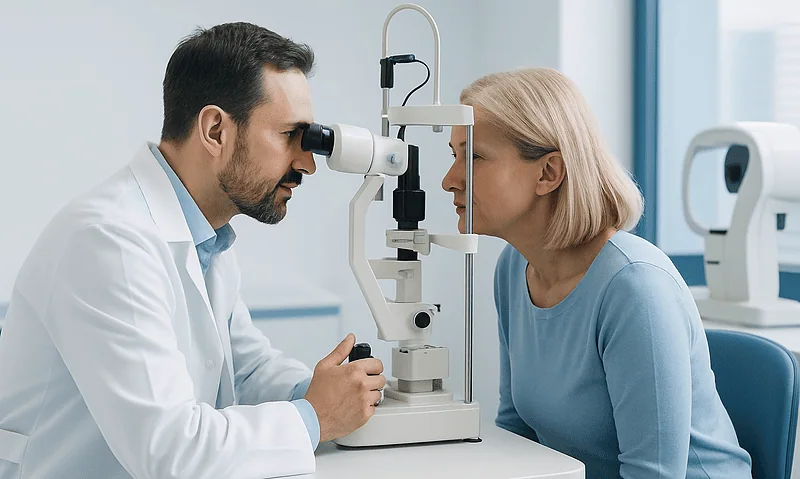
Then come dilating drops, which widen the pupil so the examiner can see the whole capsule and the retina behind it. At the slit lamp, a microscope with a bright beam, PCO is usually obvious: a wrinkled or pearly film sitting just behind the implant, often looking like fine frost on a window. The examiner also checks that the implant is centered and stable.
If the capsule looks clear, or the vision loss seems out of proportion to the haze, attention turns to the retina. Optical coherence tomography, or OCT, is a scan that uses light to map the retinal layers in cross-section, and it reveals macular swelling or a membrane that no eye chart could. The Cleveland Clinic and the National Eye Institute both describe imaging of this kind as routine when post-surgical vision problems are being investigated.
Only after this full picture does treatment get discussed, because a laser aimed at a capsule cannot help a swollen macula.
How do you fix cloudy vision after cataract surgery? YAG laser capsulotomy explained
When PCO is the confirmed cause and it is interfering with daily life, the standard treatment is a procedure called YAG laser capsulotomy. YAG refers to the type of laser crystal (yttrium aluminum garnet); capsulotomy simply means making an opening in the capsule.
The concept is elegantly simple. The cloudy film sits directly behind the implant, in the central path of light. The laser is focused precisely on that film and fired in a series of very brief pulses. Each pulse creates a microscopic shock wave that parts the tissue. Working in a circle or cross pattern, the specialist opens a clear window a few millimeters across, roughly the size of the pupil in ordinary light. The cloudy tissue does not vanish; it simply falls away from the visual axis, and the peripheral capsule remains intact to keep holding the implant.
Because the laser passes through the cornea and the implant without touching them, nothing is cut from the outside. No incision, no stitches, no operating room. The Mayo Clinic describes it as a painless outpatient procedure taking about five minutes. Anesthetic drops numb the surface, the pupil is usually dilated, and the patient rests their chin on a frame similar to the one used for a routine eye examination. Most people notice small clicks and flashes of light, and little else.
Because the retina behind was healthy all along, vision through the new opening is typically clearer within a day or so, once the dilating drops wear off. The NHS describes the laser as the treatment for PCO and notes that once treated, the condition does not usually return, because the tissue that was creating the haze has been displaced from the line of sight.
Who is usually offered YAG laser capsulotomy, and who is asked to wait?
Not every hazy capsule needs a laser. The decision rests on a single practical question: is the opacification actually limiting what this person needs to do?
People are usually offered the procedure when PCO is clearly visible on examination and they report a meaningful change: struggling to read at their usual size of print, failing or nearly failing the vision standard for driving, troublesome glare at night, or a measurable drop on the chart compared with their best post-operative result. It is also considered when haze prevents the specialist from adequately examining or treating the retina, for example in someone with diabetic eye disease who needs regular monitoring.
Others are asked to wait, and for sensible reasons. Mild PCO with vision that is still comfortable does not need intervention simply because it is there; watchful monitoring is a legitimate plan. If there is active inflammation inside the eye, most specialists prefer to settle it first, because the laser itself can stir a small inflammatory response. If macular swelling is present, treating that takes priority, since a laser will not improve central vision while the retina is waterlogged. Some clinicians also prefer to wait a few months after the original surgery so the capsule has fully contracted around the implant, reducing the chance of the implant shifting.
People with certain lens types, a previously torn capsule or very high short-sightedness, which raises the baseline risk of retinal detachment, may be counseled with extra care about risks and timing.
None of this is a fixed formula. Guideline-level advice sets the framework; the treating ophthalmologist weighs your specific eye, your other conditions and your own priorities before recommending anything.
What happens on the day of the laser, and in the weeks that follow?
Most people are surprised by how uneventful the day is. You arrive, your vision is checked, dilating and numbing drops are placed, and you wait for the pupil to open. Some specialists use a small contact lens on the eye’s surface to steady the beam; others do not. Seated at the laser, you fixate on a target light while the specialist works, and the clicks and brief flashes are over in minutes.
Straight afterward, vision is usually blurred from the dilating drops, and many people notice new floaters: small specks or threads drifting across the view. These are fragments of the opened capsule floating in the gel of the eye, and they typically settle toward the bottom of the eye and become far less noticeable over days to weeks. Because of the dilation, someone else should drive you home, and sunglasses help with the temporary glare.
Your specialist may prescribe a short course of anti-inflammatory drops, or may measure eye pressure before you leave, because a temporary pressure rise in the hours after the laser is a recognized effect. Such drops reduce inflammation on the treated surfaces; whether they are needed, and for how long, is entirely the prescribing clinician’s call.
Over the next day or two, clarity usually returns as the pupil recovers, often with the same sense of brightness people remember from just after their original surgery. Reading, screens and gentle activity are generally fine immediately; there are no incisions to protect.
A follow-up appointment, commonly within a few weeks, checks the size of the opening, eye pressure and the retina. If floaters, glare or blur persist beyond that point, the follow-up is the moment to say so.
What are the risks of YAG laser capsulotomy?
YAG capsulotomy is among the lowest-risk procedures in eye care, but low risk is not no risk, and an honest conversation covers what can go wrong.
The most frequent effect is a short-lived rise in pressure inside the eye in the first hours, which is why many clinics measure pressure afterward or use preventive drops. In people with glaucoma this needs closer attention.
Floaters are almost universal for a few days as capsule fragments drift; they are a nuisance rather than a danger, but a sudden shower of floaters accompanied by flashes is a different matter and is covered in the red-flag section.
Retinal detachment is the complication people worry about most. The laser’s shock waves can, rarely, disturb the gel inside the eye enough to tug on the retina. The absolute risk is small and is higher in eyes that were already predisposed, such as those with high short-sightedness or a prior tear. The NHS and Mayo Clinic both list retinal detachment as a rare complication following cataract surgery generally, and the same vigilance applies after the laser.
Macular swelling can occasionally be provoked or worsened, particularly if inflammation was already brewing, which is one reason specialists sometimes delay the laser.
Tiny laser marks, called pits, can occur on the implant if the beam is focused slightly too far forward. These are usually harmless and rarely noticed, but a large cluster can cause glare.
Movement or, very rarely, dislocation of the implant is possible if the capsule is weak or the opening is made very large.
Repeat treatment is uncommon. Your specialist will explain how these risks weigh against the benefit for your particular eye.
How are the other causes of cloudy vision treated?
If the examination points somewhere other than the capsule, the plan changes completely, which is exactly why the diagnosis matters more than the label.
Cystoid macular edema is treated by damping down the inflammation that drives the leak. Two classes of eye drop are commonly used: corticosteroid drops, which broadly suppress the inflammatory cascade, and nonsteroidal anti-inflammatory drops, which block a specific chemical pathway involved in retinal vessel leakage. They are often used for weeks and tapered as scans improve. When drops are not enough, a retinal specialist may discuss medication injected beside or into the eye. Which agents, in what combination and for how long are decisions for the treating team; they depend on scan findings, eye pressure and your general health.
Dry eye, often underestimated, responds to a layered approach: preservative-free lubricants, warm compresses and lid hygiene for blocked oil glands, humidifying the environment, and reviewing whether any current drops are aggravating the surface. Because the tear film sits in the direct line of sight, even modest improvements can sharpen vision noticeably.
Residual refractive error is corrected first with glasses once healing has stabilized. If the mismatch is large or the person strongly wished to be spectacle-free, options such as a laser reshaping of the cornea or, occasionally, a supplementary or exchanged implant exist, each carrying its own risks; these are specialist discussions, not defaults.
Corneal swelling that persists is reviewed by a corneal specialist, who may recommend drops that draw fluid out of the cornea or, in advanced cases, discuss a corneal graft.
Retinal conditions unrelated to the surgery, such as macular degeneration or an epiretinal membrane, are managed on their own pathways with retinal follow-up.
Can posterior capsule opacification be prevented?
People understandably ask whether something could have stopped the haze forming, and whether anything reduces the chance in the other eye. The honest answer is that PCO cannot be reliably prevented, but its likelihood has been meaningfully reduced over the years by changes in implant design and surgical technique.
Implant design matters most. Lenses with a sharp, square posterior edge create a physical barrier where the capsule folds tightly against the lens, making it harder for migrating cells to slide behind it. Modern implant materials also appear to bond to the capsule differently from older designs. Surgeons additionally polish the inside of the capsule to remove as many residual cells as practical, and place the implant fully inside the capsular bag rather than in front of it. The National Eye Institute and the Mayo Clinic both note that PCO remains possible despite these measures.
Patient factors play a role too. Younger patients have more vigorous cell regrowth and tend to develop PCO sooner. Eyes with prior inflammation, diabetes or certain other conditions may also be at higher risk. None of these are things a patient controls after the fact.
What about drops, supplements or lifestyle? There is no mainstream evidence that any eye drop, vitamin or dietary change prevents PCO once surgery is done, and none is recommended by the sources cited here. Claims that particular products keep the capsule clear are not supported.
The practical implication is reassuring rather than frustrating. PCO is not something you caused, cannot be prevented by trying harder, and has a well-understood treatment when it does occur. Attending routine post-operative reviews so it is caught when it starts to matter is the one useful step within your control.
What people often get wrong about cloudy vision after cataract surgery
Misunderstandings about this topic are common and can delay sensible care, so a few deserve direct correction.
The cataract has come back. It has not. A cataract is clouding of the natural lens, and that lens has been removed. The haze is on the capsule that held it, a different structure entirely. The term secondary cataract is a habit of speech, not an anatomical fact.
The surgery must have been done badly. PCO happens in eyes operated on by skilled surgeons using modern techniques. It reflects how living tissue heals, not a technical failure. Cleveland Clinic and Mayo Clinic both describe it as a recognized, expected complication rather than an error.
The implant is faulty and needs replacing. The implant is almost never the issue. The laser works around it, leaving it in place. Implant exchange is a separate, much larger operation reserved for genuinely different problems.
The laser is a second surgery. It involves no incision, no operating room and, for most people, no more discomfort than an eye examination. Calling it surgery overstates it; calling it a simple tweak understates the need for a proper diagnosis first.
Once lasered, the problem will keep returning. Because the cloudy tissue is displaced from the visual axis rather than merely cleared, recurrence is uncommon and the NHS notes the treatment does not usually need repeating.
Any blur after surgery is PCO. This is the most consequential myth. Macular swelling, dry eye, a refractive mismatch and, rarely, retinal detachment all masquerade as cloudiness. Assuming the benign explanation, or waiting for the haze to pass, can cost time that matters for the more serious ones.
Eye drops or supplements will clear the haze. No drop dissolves capsular tissue, and no supplement has evidence for this.
Questions to ask your care team
A good consultation is a two-way exchange. Arriving with specific questions helps you understand the plan and helps the clinician tailor it. These are questions people commonly find worth asking; you will not need all of them, and your specialist may raise some unprompted.
- What exactly is causing my cloudy vision: the capsule, the retina, the eye surface or my prescription? Could more than one thing be contributing?
- How much vision have I lost compared with my best result after surgery, and does that level of change usually warrant treatment?
- If it is posterior capsule opacification, is the laser recommended now, or is monitoring reasonable for a while? What would prompt you to act sooner?
- Do I have any features that raise my personal risk from the laser, such as high short-sightedness, glaucoma or a previous retinal problem?
- Will you check my eye pressure afterward, and will I need drops? Who do I contact if I have problems in the evening or at the weekend?
- What should I expect to see in the first day or two, and what would be abnormal?
- If the cause is macular swelling, what does my scan show, how will we know treatment is working, and when will it be repeated?
- Do my current drops or medicines affect the plan?
- Is anything about this eye relevant to my other eye if it needs surgery in future?
- When is my follow-up, and what will you be looking for?
Write down the answers, or bring someone to help. Dilated eyes and unfamiliar terminology make it hard to retain detail, and a clear record of what was said is worth more than any pamphlet.
When to call your doctor
Most cloudy vision after cataract surgery develops slowly and can be assessed at a routine appointment. A small number of situations should not wait. Contact your eye clinic the same day, or use emergency services if you cannot reach them, for any of the following, whether they occur months after your operation or in the hours after a laser procedure:
- A sudden increase in floaters, especially a shower of dark specks or a cobweb across the vision
- Flashes of light in the edge of your vision, like a camera flash or lightning
- A shadow, curtain or veil spreading across part of your field of view
- A sudden, marked drop in vision in either eye
- Significant eye pain, particularly with nausea, headache or a red eye, which can signal a sharp rise in eye pressure
- Increasing redness, discharge or sensitivity to light
- Distortion in which straight lines look bent or wavy, developing over days
The NHS specifically flags flashes, floaters and a curtain-like shadow as signs of possible retinal detachment, which needs urgent assessment because the outcome depends heavily on speed. Pain with nausea after a laser can indicate an acute pressure rise that is readily treated once recognized.
For symptoms that are gradual rather than sudden, such as slowly increasing haze, glare at night or difficulty reading that has crept in over weeks, book a review with your eye care team rather than waiting for the next scheduled visit. Describe the timeline, which eye, and whether the blur fluctuates. The distinction between slow and sudden is the single most useful thing you can tell them.
Every decision about examination, treatment and timing rests with the team looking after your eyes. This article is background for that conversation, not a substitute for it.
Frequently asked questions
How do you fix cloudy vision after cataract surgery?
It depends on the cause, which is why an eye examination comes first. If the cloudiness is posterior capsule opacification, a brief outpatient laser procedure called YAG capsulotomy opens a clear window in the hazy capsule behind the implant. If the cause is retinal swelling, dry eye or a prescription mismatch, treatment involves anti-inflammatory drops, surface care or new glasses instead. Your specialist decides based on the findings.
Can cataracts come back after surgery?
No. A cataract is clouding of the eye’s natural lens, and that lens is permanently removed during surgery and replaced with an artificial implant. What people call a secondary cataract is actually haze on the thin capsule that holds the implant. It causes similar blurring but is a different structure and is treated with a laser rather than another lens operation.
What is posterior capsule opacification?
Posterior capsule opacification, or PCO, is a cloudy film that forms on the back wall of the lens capsule, the transparent bag left in place to hold the implant. Residual lens cells migrate across it over months and lay down fibrous or pearl-like tissue that scatters light. The NHS describes it as the most common complication of cataract surgery, and it is treatable with a laser.
What is YAG laser capsulotomy and does it hurt?
YAG laser capsulotomy uses short laser pulses, focused through the cornea and implant, to open a clear central window in the cloudy capsule. Numbing drops are used and there is no incision. Most people feel nothing beyond light pressure and see brief flashes; the Mayo Clinic describes it as painless and taking about five minutes. Vision is blurred by dilating drops for several hours afterward.
How long after cataract surgery does cloudiness from PCO usually appear?
It varies widely. The Mayo Clinic notes that posterior capsule opacification can develop months or even years after surgery. Cloudiness in the first week or two is more likely to be ordinary post-operative swelling, which the NHS says usually settles within the 4 to 6 week recovery period. Haze returning after a genuinely clear spell is the pattern that most suggests PCO.
What are secondary cataract symptoms after surgery?
People typically notice gradual haze or mist, increasing glare and halos around lights at night, faded colors or contrast, and difficulty reading print that was clear a few months earlier. Symptoms build slowly and are painless. Because macular swelling, dry eye and other conditions can feel similar, these signs are a reason for an eye examination rather than a way to self-diagnose.
Is YAG laser capsulotomy safe?
It is considered one of the lowest-risk procedures in eye care, but risks exist. The most common are a temporary rise in eye pressure and new floaters for a few days. Rare complications include retinal detachment, macular swelling, small marks on the implant and, very rarely, implant movement. Your specialist will weigh these against the benefit for your specific eye before recommending it.
Can I drive after the laser procedure for cloudy vision?
Not on the day of the procedure. Dilating drops blur vision and increase glare for several hours, so someone else should drive you home. Most people find their vision clearer by the next day, but you should only drive when you comfortably meet your local vision standard and your eye care team has confirmed it is appropriate for you.
Will cloudy vision come back after YAG laser treatment?
It is uncommon. The laser displaces the cloudy tissue from the line of sight rather than simply thinning it, and the NHS notes the treatment does not usually need to be repeated. If vision becomes blurry again later, it is more likely to have a different cause, such as a retinal or surface problem, so a new examination is the right step.
Do eye drops or supplements clear a secondary cataract?
No. There is no drop, vitamin or dietary supplement with mainstream evidence for clearing or preventing posterior capsule opacification, and none is recommended by the NHS, Mayo Clinic or National Eye Institute. Anti-inflammatory drops treat retinal swelling and lubricants help dry eye, but only a laser opens a cloudy capsule. Discuss any product you are considering with your eye care team first.
References
- NHS: Cataract surgery, risks
- NHS: Cataract surgery, recovery
- National Eye Institute (NIH): Cataract surgery
- MedlinePlus: Cataract removal
This article is for general information only and is not a substitute for professional medical advice. Please consult a qualified doctor about your individual situation.

More from the Blog

Is There an Age Limit for LASIK? Prescription Stability, Presbyopia and Older Eyes
There is no fixed upper age limit for LASIK. In the United States the lasers are approved for adults 18 and older, and surgeons…

Presbyopia Treatment Options Ranked by Invasiveness: Readers, Contacts, Drops, Laser, Lenses
Presbyopia treatment options, from least to most invasive, are over-the-counter or prescription reading glasses, progressive or bifocal lenses, multifocal or monovision contact lenses, prescription…

Before Astigmatism Laser Treatment: Contact Lens Breaks and Repeat Corneal Measurements
Preparing for astigmatism laser surgery usually means stopping contact lenses for a set period before the consultation and the procedure, so the cornea returns…

Why Do Most Eye Surgeries Share the Same Rules? Drops, No Rubbing, No Swimming, No Lifting
Most eye surgeries share the same recovery rules because they protect the same three vulnerabilities: a fresh wound in or on the eye, a…
Can Amblyopia Be Treated in Teenagers and Adults? What Eye Doctors Consider
Amblyopia can often be improved in teenagers and, to a smaller and less predictable degree, in adults. The visual brain keeps some flexibility beyond…

What Multifocal Lens Implants Really Deliver: Halos, Reading Light and Adaptation
Multifocal lens implants split incoming light into two or more focal points so many people read and see distance with less need for glasses…