

Is There an Age Limit for LASIK? Prescription Stability, Presbyopia and Older Eyes
Key Takeaways
- LASIK has a lower age boundary of 18 in the United States but no defined upper age limit; candidacy above that depends on the eye, not the birth certificate.
- The NHS advises that a prescription should ideally have stayed the same for about two years before laser eye surgery, and that test applies at 21 and at 51 alike.
- Presbyopia, the age-related stiffening of the lens that the Mayo Clinic says is typically noticed in the early to mid 40s, is not corrected by LASIK, so distance-corrected eyes will still need reading glasses.
- Monovision, setting one eye for distance and one for near, suits some people and not others, which is why a contact lens trial before surgery is commonly suggested.
- By age 80 more than half of Americans have had a cataract or cataract surgery, which is why people over 60 are more often evaluated for lens-based surgery than for corneal LASIK.
- The Mayo Clinic notes healing and visual stabilization typically take about two to three months, with dryness sometimes lasting up to six months, so a residual prescription cannot be judged in the first weeks.
There is no fixed upper age limit for LASIK. In the United States the lasers are approved for adults 18 and older, and surgeons usually want a glasses prescription that has held steady for at least one to two years. After about 40, presbyopia and later cataracts change what LASIK can and cannot correct, so many older adults are evaluated for lens-based options instead. The decision always rests with the treating eye team.
She is 47, holding a restaurant menu at arm’s length, reading glasses pushed up into her hair. Her friend across the table had laser surgery a decade ago and still drives at night without lenses. “Did I miss my window?” she asks. Across town, a 19-year-old college student has the opposite worry: his contact lens prescription changed again this year, and he wants to know why nobody will book him yet.
Both are really asking the same question, and it is one of the most searched phrases in eye care: is there a LASIK age limit? The honest answer is that the number on your birth certificate matters far less than three things happening inside the eye: whether your prescription has stopped drifting, whether the natural lens has begun to stiffen, and whether it has started to cloud.
Those three milestones arrive at roughly predictable ages, which is why age becomes a shorthand. This article unpacks the biology behind the shorthand, from the teenager told to wait to the 70-year-old wondering whether it is too late.
Is there really a LASIK age limit?
Only at the bottom, and even that boundary is softer than it sounds. The Mayo Clinic lists being at least 18 years old among the usual requirements for LASIK, reflecting how the lasers were approved in the United States. There is no legal or guideline-defined cutoff at the top. Nobody becomes ineligible at 55 or 65 simply because a birthday has passed.
What actually happens is that surgeons use age as a proxy for biology. Three eye milestones tend to cluster around certain decades, and each one changes the conversation:
- Early to mid twenties: for most people the eye has finished growing and the glasses prescription stops drifting. Before that point, a laser correction is aiming at a moving target.
- Early to mid forties: presbyopia begins, the age-related loss of near focus that the Mayo Clinic describes as typically noticeable in the early to mid 40s. LASIK reshapes the cornea; it does not restore the lens’s flexibility.
- Sixties and beyond: the natural lens starts to yellow and cloud. Once a cataract is forming, correcting the cornea is fixing the wrong part of the eye.
So the practical question is never “Am I too old?” but “Which part of my eye is doing the blurring, and is that the part LASIK treats?” A healthy 58-year-old with a clear lens, a good tear film and a stable distance prescription may be a reasonable candidate. A 34-year-old with thin corneas may not be. Age narrows the odds; the examination decides.
That distinction matters because a lot of online writing on the “best age for LASIK” quietly turns a biological tendency into a rule. The rest of this article is an attempt to give you the tendency, the exceptions, and the questions that let your own eye team apply both.
How LASIK works: what actually happens to the cornea
The cornea is the clear, dome-shaped window at the very front of the eye, and it does most of the eye’s focusing. When its curve does not match the length of the eyeball, light lands in front of or behind the retina instead of on it. That mismatch is called a refractive error: nearsightedness (myopia) when distant objects blur, farsightedness (hyperopia) when near ones do, and astigmatism when the cornea is shaped more like a rugby ball than a soccer ball and everything smears slightly.
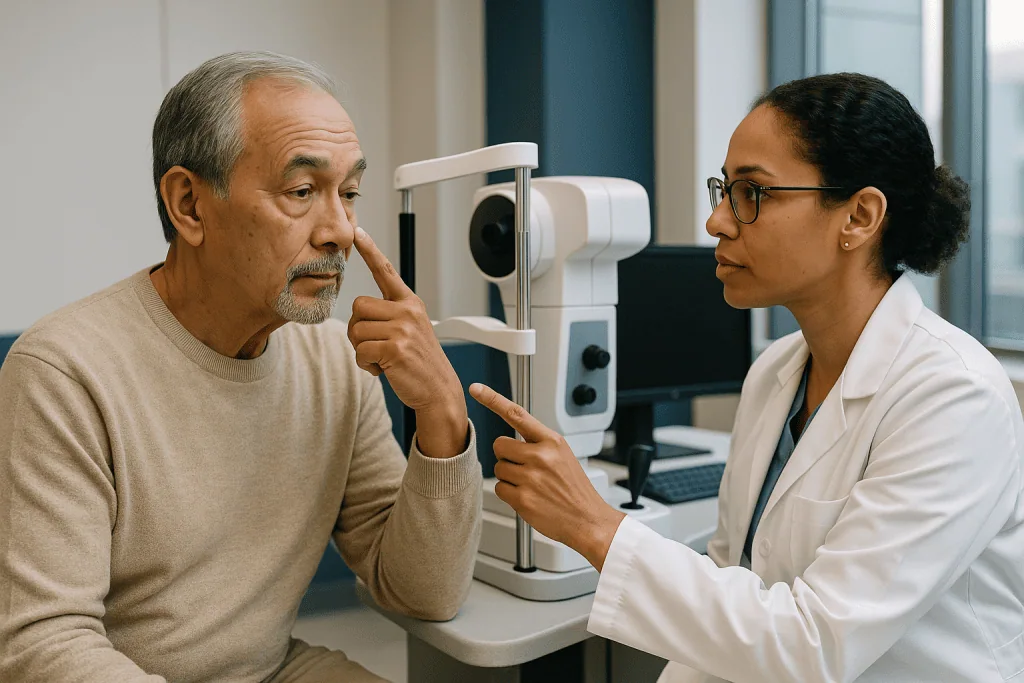
LASIK, short for laser-assisted in situ keratomileusis, changes the corneal curve to correct that mismatch. According to the Mayo Clinic, the procedure usually takes about 30 minutes or less for both eyes. Numbing drops are placed first. The surgeon then creates a thin hinged flap in the surface of the cornea, using either a fine blade or a femtosecond laser (a laser that cuts with ultra-short pulses). The flap is folded back, and a second laser, an excimer laser, removes microscopic amounts of tissue from the exposed layer beneath. For nearsightedness it flattens the center; for farsightedness it steepens it; for astigmatism it smooths the uneven curve. The flap is laid back into place and seals itself without stitches.
Why does age enter a story about corneal sculpting at all? Because the plan depends on things that change over a lifetime: how much corneal tissue there is to work with, how well the surface heals, how stable the tear film is, and, above all, whether the cornea is really the reason vision is blurry. A 25-year-old’s blur is almost always corneal in origin. A 68-year-old’s blur may come from the lens, the retina, or the tear film as often as from the cornea. The laser cannot fix what it does not touch.
Why prescription stability matters more than your birthday
Ask a refractive surgeon what disqualifies most young applicants and the answer is rarely age itself. It is a prescription that is still moving.
A refraction is the measurement, in units called diopters, of how much lens power your eye needs to focus. Through the teenage years the eyeball is still lengthening, which is why so many students need a stronger pair of glasses every year. The NHS advises that, ideally, your prescription should have stayed the same for about two years before laser eye surgery. The Cleveland Clinic frames it as at least a year of stability. Both are saying the same thing: the laser corrects a snapshot, and if the picture is still changing, the correction will be out of date before the flap has fully healed.
Stability is about more than the sphere number on your glasses. The astigmatism component and its axis should also hold steady between exams. Bring old prescriptions to your consultation; two or three years of records tell a clearer story than one measurement on the day.
Several things can nudge a refraction temporarily, and a careful team will ask about them:
- Pregnancy and breastfeeding, which the Mayo Clinic lists among reasons to postpone, because hormonal changes can shift both prescription and tear film.
- Blood glucose that swings widely in diabetes, which can alter the lens’s water content.
- Some medicines, including corticosteroids as a class, which can affect the lens and eye pressure. Never adjust a prescribed medicine for this reason; simply tell the surgeon what you take.
- Recent contact lens wear, which molds the cornea. Surgeons usually ask patients to stop lenses for a period before measurements; the Mayo Clinic notes this can be a few weeks depending on lens type.
This is why a stable 22-year-old can be a better candidate than a 29-year-old whose glasses changed last spring. The calendar is a hint. The chart is the evidence.
Who LASIK is usually for, and who is asked to wait: what disqualifies you
Candidacy is a list of yeses and a shorter list of nos, and most of the nos have nothing to do with age.

People who are generally considered include adults with a stable, moderate refractive error, corneas thick enough to leave a healthy margin after reshaping, a healthy tear film, no active eye disease and realistic expectations. The Mayo Clinic notes that LASIK tends to be most appropriate for people with a moderate degree of refractive error and no unusual vision problems, and that risks rise with very high prescriptions.
Conditions that commonly rule LASIK out, or shift the recommendation to a different procedure, include:
- Keratoconus, a disorder in which the cornea progressively thins and bulges into a cone shape. Removing tissue from an already weakening cornea is unsafe.
- Corneas that are too thin for the planned correction.
- Significant dry eye disease, since LASIK temporarily reduces tear production and can worsen it.
- A visually significant cataract, which will need lens surgery regardless.
- Uncontrolled glaucoma, or retinal disease that limits vision in ways the cornea cannot fix.
- Autoimmune conditions such as rheumatoid arthritis or lupus, and conditions or medicines that weaken the immune system, because they can impair healing.
- Poorly controlled diabetes.
People usually asked to wait rather than told no: anyone under 18, anyone whose prescription changed within the past year, anyone pregnant or breastfeeding, and anyone with an active eye infection or inflammation. Waiting is not a rejection. It is the surgeon protecting the result.
A frank note on very large pupils and high prescriptions: both can increase the chance of glare and halos at night, and the Mayo Clinic mentions these among the factors weighed. Someone who drives for a living at night may be counseled differently from someone who does not, at exactly the same age. Candidacy is personal, and the treating team, not a checklist, makes the call.
What is the best age for LASIK? The honest answer about your twenties and thirties
Marketing tends to crown the mid twenties to late thirties as the golden window, and there is real biology behind the claim. By then the eye has usually finished growing, so the prescription is stable. The cornea is at its healthiest. The tear film is robust. Presbyopia is still years away. Someone who has laser surgery at 27 may enjoy two decades of uncorrected distance vision before reading glasses enter the picture.
Those advantages are genuine. The phrase “best age” still deserves some skepticism, for three reasons.
First, stability is individual, not chronological. Some eyes settle at 20; others are still drifting at 26, particularly in people with higher myopia. The two-year stability guidance from the NHS applies whether you are 21 or 41.
Second, a young, stable eye can still be a poor candidate for structural reasons. A thin cornea at 25 is still a thin cornea. Early keratoconus often declares itself in the late teens and twenties, which is precisely why the pre-operative corneal mapping is so detailed in this age group.
Third, the twenties and thirties are also the decades of pregnancy, breastfeeding and career-driven screen time, all of which can temporarily unsettle the prescription or the tear film. Timing within the decade often matters as much as the decade itself.
The most useful reframing is this: the best age for LASIK is the age at which your particular eye has stopped changing and your particular life makes the recovery period manageable. For many people that lands in their late twenties or thirties. For others it never lands cleanly, and that is information, not failure. A candid surgeon will tell a 30-year-old that even a perfect result will not exempt them from reading glasses at 48, because presbyopia lives in the lens, not the cornea. Knowing that in advance turns a later disappointment into an expected chapter.
LASIK after 40: presbyopia changes the question
Presbyopia is the gradual loss of the eye’s ability to focus on close objects, and it happens to everyone. The natural lens, which flexes to focus, stiffens with age; the Mayo Clinic notes people typically notice it in their early to mid 40s, when menus, phone screens and price tags start creeping farther away. It is not a disease and no corneal procedure reverses it.
That single fact reshapes the LASIK conversation after 40. The laser can still correct distance vision very well. What it cannot do is give a 45-year-old lens the flexibility of a 25-year-old one. So the question becomes: which trade-off do you prefer?
- Correct both eyes for distance. Driving, sport and the television are clear without glasses; reading requires readers, just as it would for anyone your age with naturally good distance vision.
- Monovision. One eye is set for distance and the other for near, and the brain learns to use whichever image is sharper. The Mayo Clinic describes this option and notes some people adapt well while others find the loss of depth perception or the visual imbalance hard to tolerate. Most surgeons suggest trialing it first with contact lenses for a few weeks before committing.
- Wait, and revisit lens-based options when the lens itself becomes the main problem.
Is it worth getting LASIK after 40? For someone with a stable, moderate nearsighted prescription, a healthy tear film and clear expectations, many surgeons still consider it reasonable. The person who benefits most tends to be one who understands that “freedom from glasses” will mean freedom from distance glasses, and who has weighed monovision honestly.
Two age-related cautions belong here. Dry eye becomes more common through the forties and fifties, particularly around menopause, and LASIK temporarily worsens it. And mild farsightedness, which often goes unnoticed in youth, tends to unmask itself in this decade, changing the correction the surgeon plans. A thorough refraction after 40 sometimes reveals a prescription the patient never knew they had.
LASIK after 60 and beyond: can a 70 year old have LASIK?
Nothing in the guidelines says no. Plenty in the biology says “probably a different operation.”
The reason is the lens. A cataract is a clouding of the eye’s natural lens, and it is largely a function of age; MedlinePlus notes that by 80, more than half of Americans have a cataract or have had one removed. Long before a cataract is dense enough to need surgery, the aging lens changes the eye’s focusing power and scatters light. Reshaping the cornea in front of a lens that is about to change is like re-tuning a radio while someone is moving the antenna.
This is why, in most people over 60 who want to reduce their dependence on glasses, the evaluation pivots toward lens-based surgery:
- Cataract surgery removes the clouded lens and replaces it with an artificial intraocular lens, or IOL. That implant is chosen to a target power, which means the operation corrects distance vision as part of treating the cataract, and some IOL designs aim to reduce near dependence as well.
- Refractive lens exchange is the same operation performed before a cataract is visually significant, purely to change the eye’s focus. The NHS describes lens surgery as often more suitable later in life or for high prescriptions.
Can a 70-year-old have LASIK? Occasionally, yes: someone with a genuinely clear lens, a well-lubricated surface, healthy retina and a modest, stable distance error might be offered it, or offered a laser touch-up after cataract surgery to fine-tune a residual prescription. Far more often, the surgeon will explain that the lens is where the vision is heading and that treating it addresses two problems with one procedure.
Other age-related checks matter too. Dry eye is more prevalent, eyelids may not close as completely, glaucoma and macular degeneration become more common, and each affects whether any refractive surgery is sensible. The take-home for older readers is not “too late,” but “different menu.”
How age changes the LASIK conversation: a summary table
Age bands are approximations, and every row below has exceptions. Used as a map rather than a rulebook, the pattern is still useful for understanding why a surgeon’s advice sounds different at 22 than at 62.
| Age band | What is usually driving the blur | What the team checks most closely | Typical direction of advice |
|---|---|---|---|
| Under 18 | Growing eye, changing prescription | Not usually assessed for LASIK | Wait; glasses or contact lenses |
| 18 to mid 20s | Cornea, but prescription may still drift | Two years of stable refraction (NHS), corneal shape and thickness, early keratoconus screening | Proceed only once stability is documented |
| Late 20s to 30s | Cornea; prescription usually settled | Corneal thickness, tear film, pregnancy or breastfeeding status, night-vision needs | Often the most straightforward candidates |
| 40s to 50s | Cornea plus stiffening lens (presbyopia) | Dry eye, unmasked farsightedness, expectations for near vision, monovision trial | LASIK for distance with readers, monovision, or wait |
| 60 and over | Lens changes and early cataract, tear film | Lens clarity, retina, glaucoma, eyelid closure | Lens-based surgery more often than LASIK; laser sometimes used to fine-tune afterward |
Three things the table cannot show. First, corneal thickness does not follow the calendar: a thin cornea is a reason for caution in every row. Second, systemic health, particularly autoimmune disease, diabetes control and medicines that affect healing, cuts across all ages. Third, the emotional weight of the decision is different at each stage. A 25-year-old is trading decades of contact lens hassle for a one-time procedure; a 66-year-old is choosing between two surgeries, one of which they will likely need anyway.
Use the table to prepare questions, not to pre-judge the answer. The measurements taken on the day, and the surgeon interpreting them, carry more weight than any row.
How long does LASIK last? What happens 10 years after LASIK
The reshaping of the cornea is permanent. The eye around it keeps aging. Both statements are true, and the gap between them explains almost every “my LASIK wore off” story.
Ten years after a successful procedure in the late twenties, most of what changes is not the cornea at all. The Mayo Clinic notes that vision can gradually change over time as a normal part of aging, and that some people eventually need glasses again or ask about a repeat procedure. Three mechanisms account for most of that drift:
- Regression. In some eyes, part of the corrected prescription creeps back, most often in the first year or two and more commonly after larger corrections. This is the cornea itself slowly remodeling.
- Presbyopia. Arriving on schedule in the forties regardless of any earlier surgery, it brings reading glasses to people who had forgotten what glasses felt like. It is frequently mistaken for the laser “failing.”
- Lens changes. In the sixties and beyond, early cataract alters focus and adds glare. Again, the cornea is not the culprit.
An enhancement, sometimes called a retreatment, is a second, usually smaller laser correction to address regression or a residual prescription. Whether it is possible depends on how much corneal tissue remains and how healthy the surface is, which is one reason surgeons leave a safety margin the first time and why records from the original procedure are worth keeping for life.
The honest way to phrase the answer to “how long does LASIK last” is this: the correction of the shape you had on the day tends to be lasting; the eye’s needs will still evolve. Someone treated at 28 should expect clear distance vision for many years, readers by their late forties, and a conversation about the lens in later decades. None of that means the procedure stopped working. It means the rest of the eye caught up with the calendar.
What the first days and weeks after LASIK usually look like
The timeline below draws on the Mayo Clinic’s description of typical recovery. Individual experiences vary, and older eyes, in particular, may take a little longer to feel comfortable.
The first hours. Once the numbing drops fade, most people describe itching, burning, a gritty sensation and watery eyes. Vision is usable but hazy, like looking through a steamed window. Rubbing the eye is the one thing to avoid; the flap is settling and rubbing can disturb it. Someone else drives you home, and most surgeons suggest a long nap.
Day one to day two. Vision is often noticeably clearer by the next morning. The Mayo Clinic notes a follow-up visit is typically scheduled one to two days after surgery so the surgeon can check the flap and look for signs of infection. Prescribed drops, usually an antibiotic and an anti-inflammatory as classes, are used on the schedule the surgeon sets; that schedule, and any changes to it, come from the prescribing clinician, not from a magazine.
The first weeks. Dryness, fluctuating sharpness and halos around lights at night are common while the corneal nerves recover. Eye makeup, swimming, hot tubs and contact sports are typically off the table for a period the surgeon specifies. Screen work is allowed but tends to worsen dryness, so frequent breaks and artificial tears (used as directed) help.
Two to three months. The Mayo Clinic describes this as roughly how long it can take for the eye to heal and vision to stabilize, and it is the point at which a residual prescription can be measured reliably. Dryness may persist longer; the Mayo Clinic notes eyes may feel unusually dry for up to about six months.
For readers in their fifties and sixties, two practical differences stand out: the dry-eye phase tends to be more noticeable, and reading glasses will be needed almost immediately for near tasks if both eyes were set for distance. Neither is a complication. Both are worth planning for.
LASIK risks that shift with age
The core risks of LASIK are the same at 25 and 55; what changes is how likely some of them are and how much they matter to a particular life. The Mayo Clinic’s list includes dry eyes, glare and halos, undercorrection or overcorrection, regression, flap-related problems, induced astigmatism and, rarely, loss of vision that glasses cannot fully restore. Frank surgeons discuss all of them, and no honest outcome figure can be attached to an individual eye in advance.
Dry eye. Creating the flap cuts some of the corneal nerves that signal the eye to produce tears, which is why the Mayo Clinic notes a temporary drop in tear production after surgery. In a 24-year-old with a generous tear film, that dip is usually a nuisance. In a 56-year-old who already uses artificial tears, it can be the dominant part of recovery, and pre-existing dry eye disease is a common reason for a surgeon to advise against LASIK or to recommend treating the surface first.
Night vision. Glare and halos relate partly to pupil size and prescription strength, and partly to the optical quality of the aging lens. An older eye that already scatters light may notice halos more.
Healing. Conditions that become more common with age, such as diabetes and autoimmune disease, can slow healing. So can medicines that suppress the immune system. Again, the message is to disclose everything, never to alter anything on your own.
The mismatch risk. The most age-specific risk is not a complication at all: it is having a corneal procedure shortly before the lens becomes the main problem. A 63-year-old who has LASIK and then needs cataract surgery within a few years has had two operations where one might have served. Good pre-operative lens assessment exists precisely to avoid that sequence.
One reassurance for high myopes of any age: LASIK does not change the retina, but high nearsightedness itself raises retinal detachment risk over a lifetime. That is worth knowing whether or not you ever have surgery.
What people often get wrong about the LASIK age limit
Some myths are harmless. These ones lead people either to rush or to give up, so they are worth correcting one by one.
“LASIK wears off after about ten years.” The corneal reshaping is lasting. What most people notice a decade later is presbyopia, or in later decades early lens changes. Regression does exist, but it is generally an early phenomenon and is not what makes a 48-year-old reach for readers.
“Over 40 is too old.” No guideline says so. What changes after 40 is the goal-setting: distance correction is still on the table, near vision is a separate discussion involving readers or monovision.
“LASIK will fix my reading vision.” It will not restore the flexibility of the lens. Monovision can reduce reliance on readers for some people, but it is a compromise, and a contact lens trial is the honest way to find out whether your brain accepts it.
“If I am 18, I am ready.” Eighteen is the floor set by the approval, not a green light. The NHS guidance on two years of stable prescription is the more useful test, and many people in their late teens and early twenties do not meet it yet.
“LASIK protects against cataracts or glaucoma.” It does neither. It changes the cornea and nothing else. Routine eye checks remain just as necessary afterward.
“Once you have had LASIK you cannot have cataract surgery.” You can. The reshaped cornea makes the calculation of the intraocular lens power more complex, which is why keeping your pre-operative measurements and surgical records matters, and why your future cataract surgeon will want them.
“Older people heal too poorly for eye surgery.” Age alone is not the barrier; specific conditions are. Cataract surgery is one of the most commonly performed operations in older adults precisely because healthy older eyes heal well.
“There is one best age for LASIK.” There is a best age for your eye, and only the measurements can find it.
Questions to ask your care team
A consultation is a two-way examination. The surgeon is measuring your eye; you are measuring whether the plan fits your life. Take this list, or your own version of it, and do not be shy about the ones that feel basic. The clearest answers often come from the simplest questions.
- Has my prescription been stable long enough by your standard, and what records would help you judge that?
- What is causing my blur right now: the cornea, the lens, or both? Would that change in the next five years?
- How thick are my corneas, and how much margin would remain after the planned correction?
- Do I have signs of dry eye now, and would you treat the surface before considering surgery?
- Given my age, what will I still need glasses for afterward, and when do you expect that to start?
- Is monovision an option for me, and can I trial it with contact lenses first?
- Would a lens-based procedure suit my eye better than a corneal one, and why?
- What are the specific risks in my case, including night-time glare and regression, and what would an enhancement involve if one were ever needed?
- How would having LASIK now affect a future cataract operation, and what records should I keep?
- Which of my medicines or health conditions matter for healing? (Bring a full list; do not stop or change anything beforehand.)
- What does the follow-up schedule look like, and who do I call, day or night, if something feels wrong?
- If you were advising a family member with my exact measurements, what would you say?
Two habits make the answers more useful. Write them down, because post-consultation recall is unreliable when you have just had drops in your eyes. And notice whether the person answering is willing to say “not yet” or “not this procedure.” A team that is comfortable recommending against surgery is a team whose recommendation for it carries weight.
When to call your doctor
Most recovery symptoms after LASIK, such as grittiness, mild light sensitivity, watering and fluctuating sharpness, are expected in the first days and improve steadily. A short list of signs is different: they can indicate infection, inflammation, a displaced flap or, rarely, a retinal problem, and they warrant a same-day call to the surgical team or, out of hours, emergency care.
- A sudden or marked drop in vision in either eye, or vision that was improving and then clearly worsens.
- Eye pain that is increasing rather than settling, or severe pain at any point.
- Redness that is spreading or intensifying, especially with discharge.
- Marked light sensitivity that is getting worse rather than better.
- A sensation that something has shifted in the eye after rubbing, a knock or a fall, which could mean the flap has moved.
- New flashes of light, a shower of floaters or a shadow or curtain across part of your vision. These are classic warning signs of retinal detachment and apply to anyone, but especially to people with high nearsightedness.
- Any injury to the eye in the weeks after surgery, even if it seems minor.
Readers who have not had surgery should apply the same red flags to everyday eye health: the flashes, floaters and curtain combination in particular is a reason for urgent assessment regardless of age or surgical history.
Do not stop, start or change any prescribed drop or medicine on your own while you wait to be seen; tell the team what you have used and when. And keep the follow-up appointments even when everything feels fine. Several of the problems that matter most after LASIK are quieter than they sound, and the one-to-two-day and later visits that the Mayo Clinic describes exist to catch them early. Whatever your age, the treating team makes the call on what is normal and what is not.
Frequently asked questions
Is it worth getting LASIK after 40?
It can be, provided you understand what it will and will not do. LASIK after 40 can still correct distance vision in a stable, moderate prescription, but it cannot reverse presbyopia, so reading glasses or a monovision compromise remain part of the picture. Dry eye becomes more common in this decade and needs assessment first. A surgeon weighs your tear film, lens clarity and near-vision goals before advising.
What disqualifies you from getting LASIK?
The most common disqualifiers are an unstable prescription, corneas that are too thin, keratoconus or other corneal thinning disorders, significant dry eye disease, a visually significant cataract, uncontrolled glaucoma or retinal disease, autoimmune conditions that impair healing, poorly controlled diabetes, and pregnancy or breastfeeding. Very high prescriptions and large pupils raise risk rather than rule you out. Most of these depend on measurements, not age, and the treating team makes the final judgment.
Can a 70 year old have LASIK eye surgery?
There is no rule against it, but at 70 the natural lens is usually changing, so lens-based surgery is more often recommended. If a cataract is forming, cataract surgery with an intraocular lens can treat the cloudiness and correct distance focus in one operation. A 70-year-old with a genuinely clear lens, healthy surface and stable prescription might be offered LASIK, sometimes as a fine-tuning step after lens surgery.
What happens 10 years after LASIK?
The corneal reshaping is still in place, but the eye has aged around it. For someone treated in their twenties, the main change a decade later is usually the onset of presbyopia and the need for reading glasses, not a failure of the surgery. Some eyes show regression, a partial return of the prescription, and an enhancement may be discussed if corneal thickness allows. Later still, lens changes bring their own conversation.
What is the best age for LASIK?
The best age for LASIK is the age at which your own prescription has been stable for one to two years and your cornea and tear film are healthy, which for many people falls in the late twenties or thirties. That window offers a settled eye and years before presbyopia. It is a tendency, not a rule; a stable 22-year-old and a still-changing 28-year-old are judged on their measurements.
How long does LASIK last?
The change LASIK makes to the cornea is permanent. What does not stay fixed is the rest of the eye: presbyopia arrives in the forties, and lens changes follow in later decades, so most people eventually use glasses for some tasks again. Early regression of part of the correction can also occur, more often after larger corrections. Think of it as a lasting fix to the shape you had on the day of surgery.
Can you have LASIK after 60 if you have early cataracts?
Usually a surgeon will steer you toward treating the lens instead. Early cataract changes the eye’s focus and scatters light, so reshaping the cornea in front of a clouding lens risks a correction that becomes outdated quickly, followed by cataract surgery anyway. Cataract surgery replaces the lens with an implant chosen to a target power, addressing both problems. Laser touch-ups are sometimes used afterward to refine any residual prescription.
How long should my prescription be stable before LASIK?
The NHS advises that ideally your prescription should have stayed the same for about two years; other mainstream sources cite at least one year. Stability means both the main power and the astigmatism component have held steady across consecutive exams. Bring old glasses or contact lens prescriptions to your consultation, and mention pregnancy, breastfeeding, diabetes control or new medicines, since each can shift measurements temporarily.
Does LASIK fix presbyopia or reading vision?
No. Presbyopia is caused by the natural lens losing flexibility, and LASIK changes only the cornea. After surgery you will still need reading glasses at the same age you otherwise would have. Monovision, which sets one eye for distance and the other for near, can reduce reliance on readers for some people, but it trades away some depth perception and is not tolerated by everyone, so a contact lens trial first is commonly suggested.
Can I have cataract surgery later if I have already had LASIK?
Yes. Previous LASIK does not prevent cataract surgery. It does make the calculation of the artificial lens power more complex, because the cornea’s shape no longer follows standard assumptions. Keeping your pre-LASIK measurements and surgical records helps your future cataract surgeon choose the implant more accurately. Tell any new eye care provider that you have had refractive surgery, even decades later.
References
This article is for general information only and is not a substitute for professional medical advice. Please consult a qualified doctor about your individual situation.

More from the Blog

Cloudy Vision Months After Cataract Surgery: Why It Happens and How It Is Treated
Cloudy vision that returns months after cataract surgery is most often posterior capsule opacification, a haze that forms on the thin membrane holding the…

Presbyopia Treatment Options Ranked by Invasiveness: Readers, Contacts, Drops, Laser, Lenses
Presbyopia treatment options, from least to most invasive, are over-the-counter or prescription reading glasses, progressive or bifocal lenses, multifocal or monovision contact lenses, prescription…

Before Astigmatism Laser Treatment: Contact Lens Breaks and Repeat Corneal Measurements
Preparing for astigmatism laser surgery usually means stopping contact lenses for a set period before the consultation and the procedure, so the cornea returns…
Why Do Most Eye Surgeries Share the Same Rules? Drops, No Rubbing, No Swimming, No Lifting
Most eye surgeries share the same recovery rules because they protect the same three vulnerabilities: a fresh wound in or on the eye, a…
Can Amblyopia Be Treated in Teenagers and Adults? What Eye Doctors Consider
Amblyopia can often be improved in teenagers and, to a smaller and less predictable degree, in adults. The visual brain keeps some flexibility beyond…

What Multifocal Lens Implants Really Deliver: Halos, Reading Light and Adaptation
Multifocal lens implants split incoming light into two or more focal points so many people read and see distance with less need for glasses…