

Deafblindness Care Explained: How Hearing, Vision and Rehabilitation Teams Work Together
Key Takeaways
- Most deafblind people retain some usable hearing or vision, and treatment is designed around measuring and maximizing exactly those remnants rather than assuming total loss.
- Usher syndrome, the commonest genetic cause of deafblindness, accounts for roughly 3 to 6 percent of children who are deaf, and its three types differ in when hearing and vision loss begin.
- A cochlear implant is switched on only after the surgical wound has healed, typically several weeks later, and learning to interpret its signal takes months of programming and practice.
- Cataract removal, earwax clearance and treatment of active eye or ear disease can genuinely improve function, which is why a full medical examination comes before any rehabilitation plan.
- No diet, supplement or exercise is recognized by mainstream guidelines as regrowing damaged inner-ear hair cells, so claims to fix sensorineural hearing loss naturally lack evidence.
- Coordinated assessment of hearing and vision together, with a named key worker, is what separates effective deafblindness care from two separate services that never compare notes.
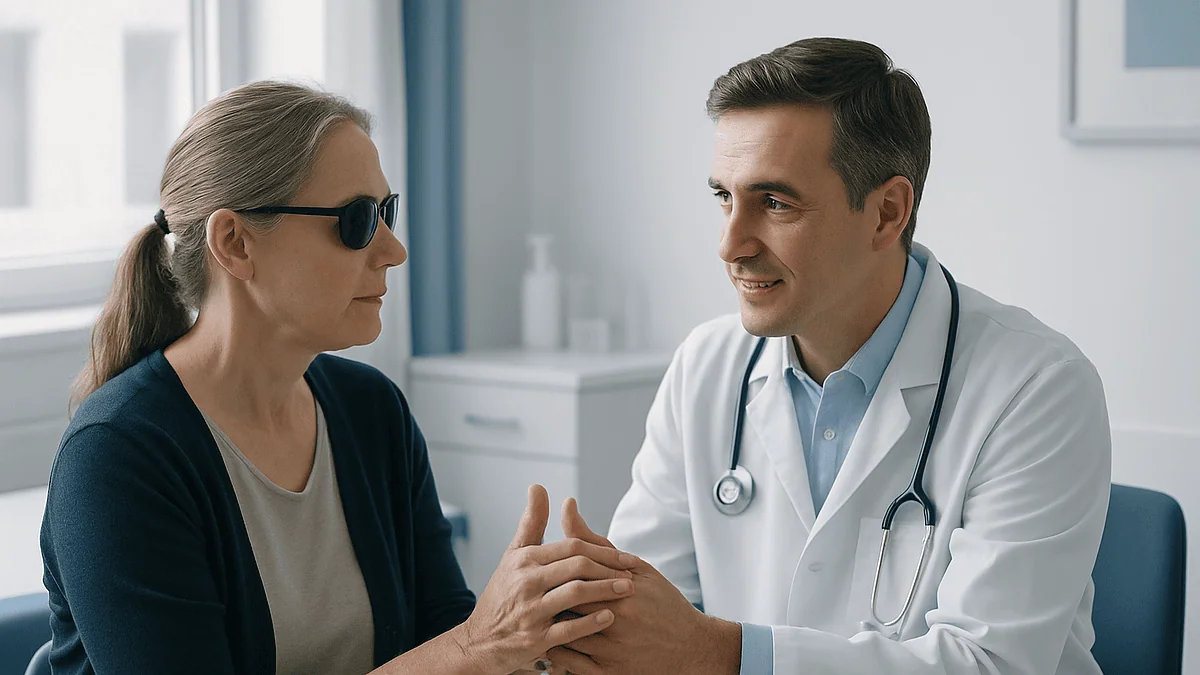
How deafblindness is treated depends on the cause and on how much hearing and vision remain. Care usually combines hearing interventions (hearing aids, cochlear implants, assistive listening), low-vision rehabilitation (magnification, lighting, orientation and mobility training) and communication support such as tactile signing or braille, coordinated by audiology, ophthalmology and rehabilitation specialists. Treatable causes are addressed; otherwise the goal is maximizing usable senses, independence and connection.
The phone lights up on the kitchen table, and she knows someone is calling because the glow flickers at the edge of what she can still see. Whether she can hear the voice on the other end depends on the room, the hour and whether her hearing aid battery lasted the morning. Her daughter, standing in the doorway, has already started signing into her mother’s open palm.
Scenes like this are why families arrive at clinic with one question that has many answers: how deafblindness is treated when neither sense can carry the whole load alone. The honest reply is that there is rarely one treatment. There is a team, a plan built around the specific cause, and a set of tools chosen for the exact mix of sight and sound a person has left.
This explainer walks through what that team does, what the evidence supports, where it is still uncertain, and what to ask along the way.
What is deafblindness, and why dual sensory loss is more than two problems
Deafblindness, also called dual sensory loss, is a combined impairment of hearing and vision serious enough that neither sense can fully compensate for the other. Very few people with the label have no hearing and no sight at all. The NHS describes someone as deafblind when the combination of sight and hearing impairment causes difficulties with communication, access to information and mobility, and it estimates that almost 400,000 people in the UK are affected by both sight and hearing loss.
The arithmetic is not additive. A person with hearing loss alone lip-reads, watches faces and follows captions. A person with vision loss alone leans on speech, audiobooks and the sound of traffic at a crossing. Take away both fallbacks and ordinary strategies collapse together. Reading a bus number, knowing a kettle has boiled, noticing that someone has entered the room: each becomes a task that needs a deliberate workaround.
Clinicians usually sort deafblindness into two broad groups because the care differs so much. Congenital deafblindness is present from birth or very early childhood, before language has formed, so the first job is building any communication system at all. Acquired deafblindness arrives later, whether through a progressive genetic condition, an illness, an injury or the slow overlap of age-related hearing and vision decline. Here the person already has language and memories of full sight and sound, and the work is about preserving what remains and translating skills into new channels.
Knowing which group someone belongs to, and exactly how much residual hearing and vision they have, is the foundation of everything that follows. A treatment plan written without that map is guesswork.
How deafblindness is treated: what actually happens after referral
Treatment begins with measurement, not gadgets. An audiologist tests hearing across pitches and speech in noise, because a chart showing residual high-frequency hearing changes which devices make sense. An ophthalmologist or optometrist maps visual acuity, visual fields and contrast sensitivity, since a person with a narrow tunnel of clear central vision needs different tools from one with blurred central sight but useful peripheral vision.
The team then asks a question that surprises many families: is any part of this reversible or slowable? Cataracts can be removed. Fluid behind the eardrum can be drained. Certain inflammatory eye conditions respond to medicine. Where an underlying cause is treatable, treating it comes first. For the larger group whose loss is permanent, the plan turns to three linked aims: amplify or replace what the senses can still do, teach new ways to communicate and move, and adapt the environment so it demands less of both senses.
In practice this produces a layered plan. Hearing aids or a cochlear implant sit on one layer. Magnifiers, high-contrast lighting and screen-reading software sit on another. Orientation and mobility training, tactile communication and, for some, a trained support worker who acts as guide and interpreter sit on a third. Each layer is adjusted as the others change, which is why coordination matters more than any single intervention.
The pace is set by the person. Someone newly diagnosed with a progressive condition may want to learn tactile signing while their vision still allows them to see the shapes of hands, a rehearsal for later. Someone whose loss is stable may prioritize a safer route to the shops. Neither approach is wrong; both are treatment.
Who is on a deafblindness care team, and who coordinates them
Nobody treats deafblindness alone, and the roster is longer than most patients expect. Audiologists assess hearing and fit devices. Ear, nose and throat surgeons evaluate and implant cochlear devices. Ophthalmologists diagnose and manage eye disease; optometrists and low-vision specialists prescribe magnification and lighting strategies. Rehabilitation officers or vision rehabilitation therapists teach orientation, mobility and daily living skills. Speech and language therapists work on communication methods, especially in children. Occupational therapists adapt homes and workplaces. Geneticists join when an inherited syndrome is suspected, and psychologists or counselors address the grief and isolation that often accompany sensory loss.
The gap between these professionals is where care most often falls apart. An audiologist may fit a hearing aid with controls too small to see; an eye clinic may recommend a talking device that a person cannot hear. Good services appoint someone to hold the whole picture, sometimes a specialist sensory social worker, sometimes a nurse or therapist acting as a key worker. In the UK, statutory guidance expects local authorities to identify deafblind people and ensure a specialist assessment of their combined needs rather than separate hearing and vision assessments that never speak to each other.
Families often become de facto coordinators. That works until it does not, and clinicians should name a point of contact so that a broken hearing aid, a change in vision or a housing move triggers a joint review rather than three separate waiting lists.
The WHO estimates that more than 1.5 billion people live with some degree of hearing loss and at least 2.2 billion have a near or distance vision impairment. The overlap is not rare, and the case for joined-up sensory services rests on that scale.
What causes deafblindness, and why the cause changes the treatment
The single most useful thing a care team can learn is why hearing and vision are failing together, because causes behave differently over time. Some are stable from birth. Some progress in a predictable order. Some are the sum of two unrelated age-related conditions that happen to arrive in the same decade.
Inherited syndromes account for much congenital and early-onset deafblindness. Usher syndrome combines hearing loss present from birth or childhood with retinitis pigmentosa, a gradual loss of the light-sensing cells in the retina that typically begins with night blindness and narrowing side vision. The NIH’s hearing institute reports that Usher syndrome accounts for roughly 3 to 6 percent of children who are deaf and a similar share of children who are hard of hearing. CHARGE syndrome, a genetic condition affecting the eyes, ears, heart and other organs, is another leading cause of congenital deafblindness.
Infections during pregnancy, including congenital cytomegalovirus and rubella, can damage both the developing ear and eye. Premature birth carries risks to both senses. Later in life, head injury, stroke, meningitis and diabetes can each affect hearing and sight. The commonest pattern of all is the quietest: age-related hearing loss meeting age-related macular degeneration, glaucoma or cataract in the same person.
Why does this matter for treatment? A child with Usher syndrome type 1 is born profoundly deaf and will lose vision over years, so early cochlear implantation and early tactile skills are both on the table. An older adult whose cataract is removable may recover enough sight that lip-reading returns. Genetic testing, imaging and a careful history are therefore not academic; they decide which door the team walks through first.
Hearing aids, cochlear implants for deafblind people and assistive listening
Hearing care for a deafblind person follows the same medical logic as for anyone else, with one added rule: every device must be usable by touch. Hearing aids amplify sound for people with residual hearing and remain the first-line option in most guidelines. For a deafblind user, the audiologist will favor models with tactile switches, rechargeable cases that are easy to seat by feel, and audible or vibrating alerts rather than tiny visual indicators.
Cochlear implants take over when hearing aids no longer deliver useful speech understanding. An implant bypasses damaged hair cells in the inner ear and stimulates the hearing nerve directly with an electrode array placed during surgery under general anesthesia. Mayo Clinic notes the device is switched on only after the incision has healed, typically several weeks later, and that hearing through an implant is not the same as natural hearing; it takes time and structured therapy to learn to interpret the signal. Recognized risks include infection, bleeding, temporary or lasting facial nerve weakness, taste disturbance, dizziness, tinnitus, device failure and a small risk of meningitis, which is why vaccination is recommended before surgery.
For someone losing vision, the calculus around implantation can shift. A person with Usher syndrome who once relied on lip-reading to fill gaps may find that support disappearing as their visual field narrows, so the value of hearing through an implant may rise over time. That is a clinical judgment for the implant team, never a rule.
Around both devices sits a layer of assistive listening: loop systems in public buildings, remote microphones worn by a companion, and vibrating or flashing alerts for doorbells, smoke alarms and alarm clocks. None of these are dramatic. Together they are often what keeps a person safely at home.
Low-vision rehabilitation: making the remaining sight work harder
Low vision means sight that cannot be corrected to normal with standard glasses, contact lenses, medicine or surgery, but that still has useful function. The NIH’s eye institute frames low-vision rehabilitation as a set of skills and tools that let people use the vision they have more effectively rather than a treatment that restores sight. For a deafblind person, this is often where day-to-day independence is won or lost.
Assessment starts with the pattern of loss. Central vision loss, common in macular degeneration, blurs faces and print but spares the edges; peripheral loss, typical of glaucoma and retinitis pigmentosa, leaves a clear but narrow central window. Each pattern calls for different tricks. Magnifiers, large-print and high-contrast materials help central loss. Training to scan systematically and the use of lighting that reduces glare help people with tunnel vision navigate a room.
Environmental changes deliver a surprising share of the benefit. Task lighting aimed at the work surface rather than the ceiling, matte finishes to cut glare, bright tape on step edges, and consistent placement of objects so that memory does the job vision cannot. Orientation and mobility specialists teach long-cane technique, route planning and how to use remaining senses, including touch and smell, to build a mental map of familiar places.
Where eye disease is active, the ophthalmologist keeps treating it alongside rehabilitation. Pressure-lowering drops for glaucoma, injections for wet macular degeneration or cataract surgery may all continue; rehabilitation is not a sign that medical care has stopped. What changes is the goal. Instead of chasing a sharper letter on the chart, the team measures success in whether a person can find their medication, cross their street and recognize a visitor at the door.
Usher syndrome treatment: what the evidence actually shows
Because Usher syndrome is the commonest genetic cause of deafblindness, families search hard for its treatment and encounter a mix of solid guidance and hopeful headlines. The NIH describes three clinical types. Type 1 involves profound deafness at birth, balance problems and retinitis pigmentosa beginning in the first decade. Type 2 involves moderate to severe hearing loss from birth, normal balance and retinal changes that usually appear in adolescence. Type 3 involves hearing loss that worsens over time, variable balance and vision loss that starts later.
There is currently no established treatment that halts the retinal degeneration in Usher syndrome. The hearing component is managed in the standard way: hearing aids for types 2 and 3 while they help, and cochlear implants where hearing loss is profound, often in early childhood for type 1. Early diagnosis matters because a child implanted before spoken language would normally develop has the chance to build it, while families can also begin learning sign and tactile methods as insurance against later vision loss.
On the vision side, the honest position is that management is supportive. Regular retinal monitoring, ultraviolet-protective eyewear, low-vision rehabilitation and genetic counseling form the backbone. Some studies have examined whether vitamin A palmitate slows retinitis pigmentosa; the NIH’s eye institute notes the evidence is mixed and that high intake carries its own harms, so any supplement decision belongs with the treating specialist and should never be self-started.
Gene-based approaches are in development for several Usher genes and are being tested in clinical trials. A gene therapy has been approved for one unrelated form of inherited retinal disease linked to a single gene, which shows the concept is possible, but it does not apply to Usher syndrome today. Ask the retina team about trial eligibility; treat anything sold outside a trial as unproven.
Communication methods: tactile signing, manual alphabets, braille and interveners
Communication is the treatment that no device can replace. A hearing aid and a magnifier help a person receive information; a shared language lets them hold a conversation, argue, joke and refuse. The method chosen depends on when deafblindness began, what language the person already has, and how much hearing and vision remain.
Someone who grew up using sign language and later loses vision often moves to hands-on or tactile signing, where the receiver rests their hands lightly on the signer’s hands to feel the shapes and movement. Someone who grew up speaking and later loses both senses may prefer the deafblind manual alphabet, in which words are spelled letter by letter onto the palm using set positions, or the block alphabet, where capital letters are simply traced on the hand. Both are quick for family members to learn.
Braille opens written information, and refreshable braille displays connect to phones and computers so that email, messages and web pages can be read by fingertip. Speech-to-text apps paired with high-contrast or braille output give some people access to spoken conversation they can no longer hear. For those with residual vision, signing within a smaller visual frame or at close range, sometimes called visual frame signing, can work.
Children born deafblind need something different again. An intervener, a specially trained person who works one-to-one to bring the world to the child through touch and consistent routines, helps build the very idea of communication: that a touch on the shoulder means a person is present, that a particular object cue means bathtime is coming. Language grows from those anchors.
The best method is the one a person can use with the people around them. Teams therefore teach the family as much as the patient.
Which approach fits which type of deafblindness: a comparison table
No two plans are identical, but patterns emerge once you know the cause, the age of onset and the residual senses. The table below summarizes the typical starting points a coordinated team considers. It is a map of options, not a prescription; the treating team weighs each person’s hearing thresholds, visual fields, general health and preferences before recommending anything.
| Situation | Hearing focus | Vision focus | Communication and rehabilitation focus |
|---|---|---|---|
| Congenital deafblindness (for example CHARGE syndrome, congenital infection) | Early hearing assessment; aids or cochlear implant evaluation where appropriate | Treat any correctable eye problems; maximize residual vision with light and contrast | Intervener support, object and touch cues, building first language |
| Usher syndrome (childhood hearing loss, progressive retinal disease) | Aids for types 2 and 3; implant evaluation for profound loss | Retinal monitoring, UV protection, low-vision rehab as fields narrow | Learn tactile signing early while vision still helps; mobility training |
| Acquired loss after illness or injury (stroke, meningitis, head trauma) | Reassess hearing once medically stable; devices as indicated | Treat active disease; rehabilitation for new visual pattern | Manual alphabets, speech-to-text with braille or large-print output |
| Age-related dual sensory loss | Hearing aids with tactile controls; loop and alerting systems | Cataract surgery, glaucoma or macular treatment where indicated; lighting and magnification | Falls prevention, home adaptation, watch for isolation and low mood |
Two things stand out across every row. First, medical treatment of active disease and rehabilitation run in parallel rather than in sequence. Second, the communication column is never empty, whatever the cause. A team that fits devices and then discharges has done half the job.
Who is usually offered each intervention, and who is asked to wait
Not everyone with deafblindness is a candidate for every option, and understanding why can spare frustration. Hearing aids are offered to almost anyone with measurable residual hearing who wants them. Cochlear implants are considered when hearing aids no longer provide adequate speech understanding after a proper trial, when the hearing nerve is intact on imaging, and when the person or family understands the rehabilitation that follows. Mayo Clinic lists candidacy criteria that include severe to profound hearing loss and limited benefit from aids; it also notes that people with certain medical conditions may face higher surgical risk and be advised against surgery or asked to defer.
Waiting is sometimes the right recommendation. A child with fluctuating hearing may be monitored rather than implanted straight away. An adult with an active ear infection will be treated first. Someone whose eye disease is still changing rapidly may be asked to delay a definitive low-vision prescription until the picture stabilizes, because a magnifier chosen for this month’s acuity may be wrong by next season.
Elective eye surgery has its own gatekeeping. Cataract removal is offered when the lens opacity is limiting function and the benefit outweighs the surgical risk; in a person with severe retinal disease, the surgeon will be candid about how much vision a clear lens can realistically restore. Retinal injections continue only while they are producing measurable benefit.
Rehabilitation, by contrast, has almost no exclusion criteria. Orientation and mobility training, communication teaching and environmental adaptation are appropriate at every age and stage, including for people who decline surgery. If a team says no to a device, the right next question is which non-surgical supports start now.
What the following weeks and months usually look like
Deafblindness care does not follow a single timeline, but the sequence has a recognizable shape. The first phase is assessment, and it takes longer than people expect because two specialties must each do their work and then compare notes. Expect separate audiology and eye appointments, possibly imaging, and in suspected genetic conditions a genetics referral with a wait for results.
The second phase is fitting and adjustment. New hearing aids are typically reviewed and fine-tuned over follow-up visits as the brain adapts to amplified sound. If a cochlear implant is chosen, the surgical day is usually short and many people go home the same day or after one night, but the device stays switched off until the wound has healed; Mayo Clinic describes activation taking place several weeks after surgery, followed by a series of programming appointments and auditory training that continues for months. Sound through an implant often starts as beeps or mechanical tones and becomes more speech-like with practice.
Low-vision rehabilitation runs on its own cadence: an initial assessment, a trial of magnifiers and lighting at home, and a handful of training sessions for cane use and route learning. Communication teaching is open-ended. Learning a manual alphabet can take a family a few evenings; becoming fluent in tactile signing takes far longer and depends on daily use.
Somewhere in the first months, most services schedule a joint review to check that the hearing plan and the vision plan still fit each other and the person’s daily life. After that, reviews continue on a schedule set by how quickly the underlying condition changes. Progressive conditions warrant closer follow-up; stable ones may need only annual checks and a clear route back if anything shifts.
Living with deafblindness: how people actually manage day to day
Ask deafblind adults how they live and the answer is rarely about devices. It is about routines, trusted people and a fierce defense of independence. A kitchen organized so every item sits in the same place by touch. A phone set to vibrate in patterns that distinguish a message from a call. A neighbor who has learned to spell into a palm. A route to the pharmacy walked so many times that the change in pavement texture at the corner is as clear as a street sign.
Technology has widened the options. Smartphones with screen readers, braille displays and haptic feedback let people bank, shop and message. Navigation apps that vibrate at turns help on unfamiliar routes. Video relay services and remote interpreting connect signers to hearing callers. None of it replaces a human guide in a busy station, and many people describe a mix of independent travel on known routes and support for the unknown.
Isolation is the risk that clinicians should name out loud. When phone calls and reading both become hard, contact shrinks unless someone actively builds alternatives. Peer groups of deafblind people, in person or online with accessible formats, consistently rank high in what patients say helps, and mental health support belongs in the care plan rather than being added after a crisis.
Work and study are possible with adjustments, and legal frameworks in many countries recognize deafblindness as a disability that entitles a person to reasonable accommodations and, in some places, to specialist assessment and support. Deafblindness is a disability in that sense. It is also, for many who live with it, an identity and a community, and clinicians do well to treat it as both.
What people often get wrong about deafblindness and its treatment
The first misconception is that deafblind means total darkness and silence. Most deafblind people have some usable hearing, some usable vision, or both, and treatment is built on exactly those remnants. Assuming nothing is left leads families to skip hearing aids or lighting changes that could matter enormously.
The second is that hearing loss can be fixed naturally. Search engines are full of supplements, ear drops and exercises promising to restore hearing. For the sensorineural loss that underlies most deafblindness, where inner-ear hair cells or the hearing nerve are damaged, no mainstream guideline recognizes any diet, herb or maneuver that regrows them. Earwax removal and treating middle-ear fluid can genuinely improve hearing, which is why a proper examination matters, but that is medicine, not a natural fix.
The third is that one good surgery ends the story. A cochlear implant is the beginning of a rehabilitation process measured in months; cataract removal in a person with retinal disease may improve light and contrast without restoring reading vision. Clinicians who set realistic expectations before surgery spare their patients a second grief afterward.
The fourth is that communication support is a luxury for after the medical work is done. In congenital deafblindness the reverse is true: building language early is the medical work, and delaying it can cost developmental ground that is hard to recover.
The fifth is that isolation is inevitable. It is common, and it is not inevitable. People who receive coordinated rehabilitation, learn a communication method their family shares and connect with peers describe lives that are busy and self-directed. The evidence base for these services is stronger than the evidence for most of the products advertised alongside them.
Questions to ask your care team about deafblindness treatment
Appointments are short and there are two specialties to cover, so it helps to arrive with a list. These are the questions that tend to shape the plan.
- What is the likely cause of my hearing and vision loss, and is any part of it treatable or expected to change?
- Do you recommend genetic testing, and what would a result change about my care or my family’s?
- How much hearing and how much vision do I have now, in terms I can use at home, and how will you track changes?
- Who coordinates my hearing, vision and rehabilitation care, and how do I reach them between appointments?
- Which hearing devices can I operate by touch, and what alerting systems do you suggest for smoke alarms, doorbells and the phone?
- If a cochlear implant is being considered, what are the specific risks in my case, what does the rehabilitation involve and how long does it usually take before speech becomes recognizable?
- What low-vision aids and lighting changes should I try, and can someone assess my home?
- Which communication method do you suggest I and my family start learning now, and who can teach us?
- Am I eligible for orientation and mobility training, a communicator guide or, for a child, an intervener?
- Are there clinical trials relevant to my condition, and how would I find out about them safely?
- What signs of change should prompt me to call you rather than wait for the next review?
- Where can I meet other people living with deafblindness, in a format I can access?
Bring a companion who can take notes in a format you can read later, and ask for written or accessible summaries. A plan you cannot review is a plan you cannot follow.
When to call your doctor: red-flag signs in deafblindness care
Most changes in a long-term condition can wait for a scheduled review. Some cannot, and a person who relies on limited hearing and vision has less margin than most when something goes suddenly wrong. Seek urgent medical care, the same day, for any of the following.
- A sudden drop in hearing in one or both ears, with or without ringing or dizziness. Sudden sensorineural hearing loss is treated as an emergency because outcomes depend on early assessment.
- A sudden change in vision: a curtain or shadow across part of the visual field, a shower of new floaters, flashes of light, or a rapid blur. These can signal retinal detachment or a blocked vessel.
- Severe eye pain, a red painful eye, nausea with blurred vision or halos around lights, which can indicate a sharp rise in eye pressure.
- After cochlear implant or other ear surgery: fever, increasing pain, discharge or swelling at the wound, new facial weakness, severe vertigo, a stiff neck or a severe headache.
- After any eye surgery or injection: worsening pain, increasing redness, sudden vision loss or discharge.
- New confusion, a fall with head injury, or a sudden change in balance, particularly in older adults with dual sensory loss.
Contact the care team promptly, though not necessarily the same day, if a hearing aid or implant processor stops working and no spare is available, if vision has worsened enough that usual routes or reading tasks are no longer safe, or if low mood, withdrawal from contact or thoughts of not wanting to go on are creeping in. Depression is treatable, and sensory teams expect to be told.
Every threshold in this list is a reason to be assessed, not a diagnosis. The treating team decides what is happening and what to do; the person’s job, and their family’s, is simply to make the call early.
Frequently asked questions
Can deafblindness be reversed or fully treated?
Usually not fully, but parts of it sometimes can be. Where a treatable cause is present, such as cataract, middle-ear fluid or earwax, addressing it can restore meaningful function. For permanent sensorineural hearing loss and degenerative retinal disease, current care manages rather than reverses the condition, using hearing aids or cochlear implants, low-vision rehabilitation and communication training. Research into gene-based therapies continues, but these remain experimental for most causes of deafblindness.
Can you fix hearing loss naturally?
Not the kind that underlies most deafblindness. Sensorineural hearing loss involves damaged inner-ear hair cells or nerve fibers, and no diet, supplement, herb or exercise is recognized by mainstream medical guidelines as regenerating them. Conductive causes such as earwax blockage or middle-ear fluid can improve with medical treatment, which is why examination matters. Protecting remaining hearing from loud noise is the one preventive step with solid evidence behind it.
How do people live with deafblindness day to day?
Through routines, technology and people. Deafblind adults typically organize their homes by touch, use smartphones with screen readers or braille displays, rely on vibrating alerts for doorbells and alarms, and travel familiar routes independently while using a guide for unfamiliar ones. Communication may be tactile signing, a manual alphabet or speech-to-text with accessible output. Peer networks and support workers help counter the isolation that otherwise tends to build.
Is deafblindness a disability?
Yes. Deafblindness is recognized as a distinct disability in many legal frameworks because the combination of hearing and vision loss creates barriers greater than either alone. The NHS defines a person as deafblind when combined sight and hearing impairment causes difficulty with communication, access to information and mobility. Recognition typically entitles people to specialist assessment, reasonable accommodations at work or school, and in some countries to dedicated support services.
What is deafblindness, and does it mean total loss of both senses?
Deafblindness, or dual sensory loss, is a combined hearing and vision impairment severe enough that neither sense can compensate for the other. It rarely means complete deafness and complete blindness. Most people have some residual hearing, some residual vision or both, and clinicians distinguish congenital deafblindness, present from birth or early childhood, from acquired deafblindness that develops later through genetic, infectious, traumatic or age-related causes.
What does Usher syndrome treatment involve?
Hearing loss in Usher syndrome is managed with hearing aids or, for profound loss, cochlear implants, often early in childhood for type 1. The retinal component, retinitis pigmentosa, has no established treatment that halts it, so care is supportive: regular retinal monitoring, ultraviolet-protective eyewear, low-vision rehabilitation and early learning of tactile communication. Gene-based approaches are in clinical trials. Supplement decisions, including vitamin A, belong with the treating specialist because evidence is mixed and high intake carries risks.
Are cochlear implants suitable for deafblind people?
They can be, subject to the same medical criteria as for anyone: severe to profound hearing loss, limited benefit from hearing aids and an intact hearing nerve. For someone losing vision, the value of improved hearing may rise as lip-reading becomes harder, which implant teams take into account. Risks include infection, facial nerve injury, dizziness, tinnitus, device failure and a small meningitis risk. Activation happens several weeks after surgery, followed by months of rehabilitation.
How is dual sensory loss in older adults different?
It is usually the meeting of two common age-related conditions, such as hearing loss with macular degeneration, glaucoma or cataract, rather than a single syndrome. Treatment often includes correctable steps like cataract surgery and properly fitted hearing aids with tactile controls, alongside home lighting changes, falls prevention and alerting devices. Older adults with dual sensory loss face higher risks of isolation, falls and low mood, so care teams watch for these actively.
How long does deafblindness rehabilitation take?
There is no fixed duration because rehabilitation is matched to the person and the pace of their condition. Initial assessment by audiology and eye services can take several appointments. Hearing aid adjustment continues over follow-up visits, cochlear implant rehabilitation runs for months after activation, and low-vision training typically involves a short series of sessions. Communication learning is ongoing; a manual alphabet can be picked up quickly, while tactile signing fluency takes much longer.
Who coordinates care when several specialists are involved?
Ideally a named key worker, such as a specialist sensory social worker, rehabilitation officer or nurse, holds the combined hearing and vision plan and arranges joint reviews. In the UK, statutory guidance expects local authorities to identify deafblind people and provide a specialist assessment of combined needs. If no coordinator has been named, ask the care team directly who fills that role and how to reach them between appointments.
References
- NHS: Deafblindness
- NIH National Institute on Deafness and Other Communication Disorders: Usher Syndrome
- NIH National Eye Institute: Retinitis Pigmentosa
- WHO: Deafness and Hearing Loss Fact Sheet
This article is for general information only and is not a substitute for professional medical advice. Please consult a qualified doctor about your individual situation.

More from the Blog

How Is a Child Followed Up After Congenital Hydrocephalus Surgery? Growth, Milestones and Scans
After surgery for congenital hydrocephalus, a child is followed for years, usually into adulthood. Visits typically combine head measurement, growth and developmental checks, an…

Life After a Craniotomy: Hair Regrowth, Scars, Driving and Long-Term Neurosurgery Follow-Up
Life after craniotomy usually means a hospital stay of several days, a scar hidden under regrowing hair within a few months, fatigue that eases…

How Brain Aneurysm Imaging Works: CT Angiography, MRA and the Catheter Angiogram
CT angiography (CTA) is usually the first test for a suspected brain aneurysm because it is fast, widely available and detects most aneurysms larger…

How Congenital Hydrocephalus Is Treated and Why Relieving Pressure Early Protects Development
Congenital hydrocephalus is treated with surgery that redirects or reroutes the excess cerebrospinal fluid pressing on a baby's brain, most often a ventriculoperitoneal shunt…
ALS vs Other Motor Neuron Diseases: Why the Diagnosis Changes the Care Plan
ALS is the most common motor neuron disease, but the two terms are not the same thing. Motor neuron disease is an umbrella for…

How Does Recovery Differ After Brain Aneurysm Coiling and Clipping? Timelines Side by Side
After an unruptured brain aneurysm is treated, coiling recovery is usually shorter: most people go home within one to two days and ease back…