Quick answer
Retinitis pigmentosa is an inherited retinal disease that gradually damages the light-sensitive cells of the eye, leading to progressive vision loss, often beginning with night blindness and narrowing peripheral vision. Management focuses on detailed eye evaluation, genetic assessment, regular monitoring, and supportive treatments to preserve visual function and address complications, with care tailored by ophthalmology specialists at Acibadem in Turkey.
What is retinitis pigmentosa?
Retinitis pigmentosa is the name for a group of inherited eye conditions that gradually damage the retina, the thin layer of light-sensing tissue at the back of the eye. The retina contains two main types of light-detecting cells, called photoreceptors: rods, which allow us to see in dim light and detect movement at the edges of our vision, and cones, which allow us to see fine detail and color in bright light. In retinitis pigmentosa, these photoreceptor cells slowly stop working and break down over time, usually starting with the rods. This is why the first problems most people notice involve night vision and side (peripheral) vision.
When people ask “what is retinitis pigmentosa,” the simplest answer is that it is a progressive, genetic condition of the retina rather than an infection or an injury. The word “retinitis” suggests inflammation, but that name is historical; the condition is not primarily an inflammatory disease. “Pigmentosa” refers to the characteristic clumps of dark pigment that an eye doctor can often see in the retina during an examination.
Retinitis pigmentosa is considered a rare disease, but it is one of the most common inherited causes of retinal degeneration worldwide. It affects people of all backgrounds and both sexes, although some inheritance patterns make it more common or more severe in males. Symptoms often begin in childhood, the teenage years, or early adulthood, but the age of onset and speed of progression vary widely from person to person, even within the same family. Some people keep useful central vision for many decades, while others lose sight more quickly.
Symptoms of retinitis pigmentosa
Retinitis pigmentosa symptoms usually develop slowly, over years or decades, which is why many people do not realize anything is wrong at first. Because rods are typically affected before cones, difficulties in dim light generally come before problems with detailed central vision.
Common retinitis pigmentosa symptoms include:
- Night blindness (nyctalopia): difficulty seeing in dim light or darkness, such as trouble adjusting when walking from a bright room into a dark one. This is often the earliest symptom.
- Loss of peripheral vision: a gradual narrowing of the field of vision, sometimes described as “tunnel vision.” People may begin bumping into furniture, doorframes, or people at their sides.
- Difficulty adapting to changing light: slow adjustment when moving between bright and dark environments.
- Sensitivity to glare and bright light (photophobia): discomfort in strong sunlight or from headlights.
- Problems with color vision: colors may appear faded or harder to tell apart, usually in later stages when cone cells are affected.
- Flashes of light (photopsia): some people notice shimmering or flickering lights in their vision.
- Loss of central vision: in advanced stages, reading, recognizing faces, and other detailed tasks become difficult.
How symptoms unfold depends on the stage and the specific type of the condition. In the typical, rod-first form, night blindness in childhood or adolescence is followed by slowly shrinking side vision, while central vision is preserved for a long time. In less common cone–rod forms, the order is reversed: central vision, reading vision, and color perception decline first, and night vision problems come later. Retinitis pigmentosa can also occur as part of broader genetic syndromes; for example, Usher syndrome combines retinitis pigmentosa with hearing loss. Because both eyes are usually affected in a fairly symmetrical way, a sudden change in only one eye should always be checked promptly, as it may signal a separate problem.
Causes and risk factors
Retinitis pigmentosa causes are genetic. The condition results from changes (mutations) in genes that the retina needs to keep its photoreceptor cells healthy and working. Many different genes have been linked to retinitis pigmentosa, which is one reason the disease looks so different from one family to another. When one of these genes is faulty, the rod cells, and eventually often the cone cells, deteriorate and die over time.
The condition can be passed through families in several inheritance patterns:
- Autosomal dominant: only one altered copy of a gene, inherited from one parent, is enough to cause the condition. An affected parent has a 50 percent chance of passing it to each child. This pattern often, though not always, causes milder or later-onset disease.
- Autosomal recessive: a person must inherit an altered gene copy from both parents, who are usually unaffected “carriers.” This is a common pattern and may be more likely when parents are blood relatives.
- X-linked: the altered gene sits on the X chromosome. Males, who have only one X chromosome, are usually affected earlier and more severely; females who carry the gene may have mild symptoms or none at all.
In a significant number of people, no other family member is known to be affected. This can happen with recessive inheritance, with a new mutation, or simply because the family history is incomplete. A negative family history therefore does not rule out retinitis pigmentosa.
The main risk factor is having a family member with the condition or carrying one of the associated gene changes. Retinitis pigmentosa is not caused by reading in poor light, screen use, diet, or eye strain, and it is not contagious. People with retinitis pigmentosa can also develop additional, potentially treatable eye problems more often than average, such as cataract (clouding of the eye’s natural lens) and macular edema (swelling in the central retina), which can worsen vision on top of the underlying disease.
Diagnosis
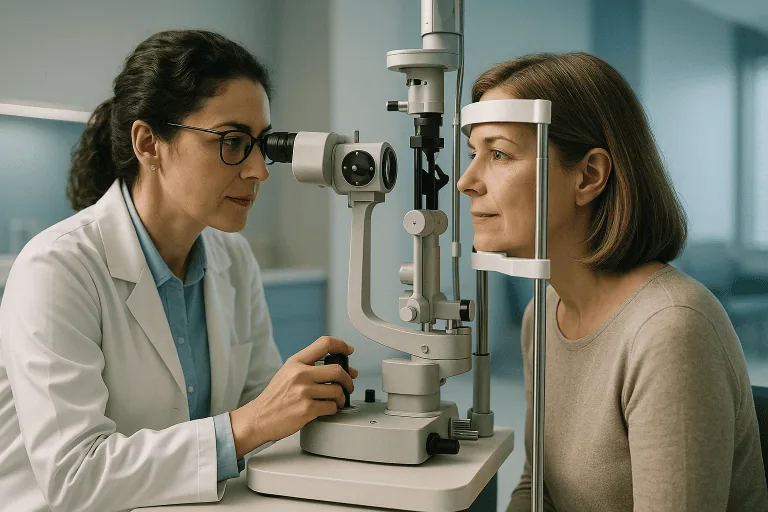
Retinitis pigmentosa diagnosis begins with a detailed conversation about symptoms, especially night vision and side vision, and a careful family history, followed by a full eye examination. Because the condition is inherited and progressive, doctors usually combine several tests to confirm the diagnosis, judge how advanced the disease is, and rule out other causes of similar symptoms.
Tests your doctor may use include:
- Dilated eye examination (ophthalmoscopy): drops widen the pupil so the doctor can inspect the retina. Classic findings include clumps of dark pigment in the peripheral retina (often described as “bone spicule” pigmentation), narrowed retinal blood vessels, and a pale appearance of the optic nerve.
- Visual field testing (perimetry): a test that maps how far your vision extends to the sides, above, and below. It documents the typical ring-shaped or tunnel-like loss of peripheral vision and helps track progression over time.
- Electroretinography (ERG): a key test for this condition. Small sensors measure the retina’s electrical responses to flashes of light. In retinitis pigmentosa, the responses from rod cells, and later cone cells, are reduced or absent, often before major changes are visible on examination.
- Optical coherence tomography (OCT): a painless scan that produces detailed cross-sectional images of the retina, showing thinning of the photoreceptor layers and detecting complications such as macular edema.
- Fundus photography and autofluorescence imaging: specialized photographs of the retina that highlight areas of stressed or lost retinal cells and help monitor change over time.
- Genetic testing: a blood or saliva sample can be analyzed to look for mutations in the genes known to cause retinitis pigmentosa. Identifying the exact gene can clarify the inheritance pattern, inform family counseling, and determine whether a person may be a candidate for gene-specific therapies or clinical trials.
Doctors may also perform additional tests to exclude conditions that can mimic retinitis pigmentosa, including certain vitamin deficiencies, medication side effects, infections, and other inherited retinal diseases. Because hearing loss can accompany some forms, a hearing assessment is sometimes recommended, particularly in children.
Treatment options
There is currently no cure that reverses retinitis pigmentosa for most people, and it is important to be honest about that. However, retinitis pigmentosa treatment has real goals: slowing progression where possible, treating complications that add to vision loss, making the most of remaining sight, and, for a small subset of patients with specific gene changes, offering newer targeted therapies. Care is typically coordinated by a retina specialist within an ophthalmology department; at hospital groups such as Acibadem, this condition is managed by ophthalmologists with experience in retinal disease, often alongside genetic counselors and low-vision services.
Monitoring and supportive care. Because the disease usually progresses slowly, regular follow-up examinations are a core part of management. Monitoring allows doctors to track the visual field, detect treatable complications early, and update advice about driving, work, and daily safety. This “watchful” approach is not doing nothing: it is structured, ongoing care.
Treating complications. Cataracts are common in people with retinitis pigmentosa and can often be removed surgically, which may meaningfully improve the remaining vision even though it does not affect the underlying retinal disease. Macular edema, when present, may respond to certain eye drops or oral medications; your doctor will weigh the benefits and side effects in your individual case.
Nutritional measures. Some studies have explored whether vitamin A supplements or certain nutrients might slow progression in selected patients, but the evidence is debated and high-dose vitamin A can be harmful, especially in pregnancy, in people with liver disease, and in certain genetic subtypes. Supplements should only be taken under medical supervision after discussion with your specialist. Doctors also generally advise ultraviolet (UV) protection with appropriate sunglasses outdoors, as sensible eye protection.
Gene therapy. For a small group of patients whose disease is caused by mutations in a specific gene (RPE65), an approved gene therapy exists that is delivered by an operation under the retina. It does not restore normal vision, but in suitable patients it may improve the retina’s ability to respond to light. Eligibility depends entirely on genetic testing results, remaining retinal cells, and specialist assessment; it is not an option for most people with retinitis pigmentosa.
Retinal implants and emerging approaches. Electronic retinal implants (“bionic eye” devices) have been developed for people with very advanced vision loss; availability is limited and the visual benefit is partial. Research into stem-cell approaches, additional gene therapies, and drugs designed to protect photoreceptors is active, and clinical trials are ongoing. Your doctor can advise whether any trial is appropriate for your specific genetic diagnosis.
Low-vision rehabilitation. For many people, this is the most practically helpful part of treatment. Low-vision specialists can recommend magnifiers, screen readers, high-contrast and lighting adjustments, orientation and mobility training, and other tools that help preserve independence at each stage of the condition.
Living with retinitis pigmentosa and outlook
Retinitis pigmentosa is a lifelong, usually progressive condition, but the outlook varies enormously. Many people retain useful central vision into middle age or beyond, particularly with dominant forms of the disease, while others, often those with X-linked or certain recessive forms, lose vision earlier. Complete blindness, meaning no light perception at all, occurs in some people but is not the outcome for everyone; many retain at least some light perception even in advanced disease. Because progression is generally gradual, most people have time to adapt, plan, and learn new skills.
Practical steps that often help include:
- Attending regular eye examinations so complications like cataract or macular edema are caught early.
- Working with low-vision rehabilitation services early, rather than waiting until vision loss is severe.
- Improving lighting at home, reducing trip hazards, and using high-contrast markings on stairs and steps.
- Discussing driving honestly with your doctor; night driving usually becomes unsafe early, and legal visual field requirements may eventually rule out daytime driving as well.
- Considering genetic counseling, which can clarify the inheritance pattern, what it means for children and siblings, and whether gene-specific therapy or trials could apply.
- Seeking support for the emotional side of progressive vision loss; anxiety and low mood are common and understandable, and counseling or patient support groups can help.
No doctor can promise how any individual’s vision will change, but a confirmed genetic diagnosis, regular monitoring, and early rehabilitation give people the best chance of staying independent and informed as the condition evolves.
Frequently asked questions
What is retinitis pigmentosa in simple terms?
Retinitis pigmentosa is an inherited condition in which the light-sensing cells of the retina, at the back of the eye, gradually stop working. Because the cells responsible for night and side vision are usually affected first, most people notice difficulty seeing in dim light and a slow narrowing of their field of vision before any change in their central, detailed vision.
Can retinitis pigmentosa be cured or heal on its own?
At present there is no cure that restores lost photoreceptor cells, and the condition does not heal on its own. However, a gene therapy is approved for one specific genetic form, complications such as cataract can often be treated, and research into new therapies is active. Management focuses on preserving remaining vision, treating what is treatable, and supporting daily life with low-vision aids.
Does everyone with retinitis pigmentosa go blind?
Not necessarily. The condition is progressive, and most people lose substantial peripheral and night vision over time, but the speed and extent of loss vary widely. Many people keep useful central vision for decades, and complete loss of all light perception is not universal. Your specialist can give a more individualized picture based on your genetic type, examination findings, and how your vision has changed over time.
What are the first symptoms of retinitis pigmentosa?
The earliest retinitis pigmentosa symptoms are usually trouble seeing in dim light or darkness, for example, difficulty adjusting when entering a dark room or seeing at dusk, often beginning in childhood or the teenage years. Gradual loss of side vision typically follows, which people may first notice as bumping into objects or missing things approaching from the side. In less common types, blurred central vision or color problems can come first.
How is retinitis pigmentosa diagnosed?
Diagnosis is based on a dilated retinal examination, visual field testing to map peripheral vision loss, and electroretinography, which measures the retina’s electrical response to light and is often reduced early in the disease. Retinal imaging such as OCT supports the diagnosis and detects complications. Genetic testing can identify the responsible gene, which helps with family counseling and determines eligibility for gene-specific treatment or trials.
Is retinitis pigmentosa always inherited from a parent?
The condition is genetic, but an affected person does not always have an affected parent. In recessive forms, both parents can be healthy carriers, and sometimes a new gene change arises for the first time in an individual. This is why many people with retinitis pigmentosa have no known family history. Genetic counseling can help clarify how the condition may affect other family members and future children.
Can anything slow down retinitis pigmentosa?
Some measures may modestly help in selected patients, such as certain supplements under strict medical supervision and protection from bright ultraviolet light, but the evidence is limited and some supplements can be harmful in the wrong situation. The most reliable benefits currently come from treating complications like cataract and macular edema, keeping up with regular monitoring, and, for eligible genetic subtypes, approved gene therapy or clinical trials. Always discuss any supplement or new treatment with your eye specialist first.
When to see a doctor
If you have gradually worsening night vision, shrinking side vision, or a family history of retinitis pigmentosa, arrange an eye examination, early diagnosis allows monitoring, genetic counseling, and timely treatment of complications. If you have already been diagnosed, keep to the follow-up schedule your specialist recommends even when your vision feels stable.
Seek urgent medical attention if you notice any of the following, because they may signal a separate, treatable emergency such as a retinal detachment rather than the slow course of retinitis pigmentosa itself:
- Sudden loss or dimming of vision in one or both eyes.
- A sudden shower of new floaters (dark specks or strands drifting in your vision) or a burst of new light flashes.
- A dark curtain or shadow spreading across part of your visual field.
- Sudden eye pain, redness, or a rapid increase in light sensitivity.
- A rapid change in central vision, such as sudden blurring or distortion of straight lines, which may indicate swelling in the central retina.
- Any sudden difference between the two eyes, since retinitis pigmentosa usually affects both eyes symmetrically.
Sudden changes are not typical of retinitis pigmentosa, which usually progresses slowly. Any abrupt shift in your vision deserves prompt assessment by an eye doctor, ideally within hours rather than days.
Medically reviewed by the Acıbadem International Medical Board September 2, 2026
See our medical review board →
Update history
- PublishedJune 14, 2026
- Medical review approvedSeptember 2, 2026
- Last content updateSeptember 2, 2026