

Dental Crown Problems Explained: High Bite, Dark Gum Line, Decay at the Margin and Loosening
Key Takeaways
- A crown that sits too high does not wear in, because porcelain and zirconia are harder than enamel; the overloaded tooth and its ligament absorb the extra force until the crown is adjusted.
- Decay cannot form in the crown itself, but it can form in the natural tooth at the margin and spread underneath, which is why routine bitewing X-rays matter even when a crowned tooth feels fine.
- The dark line at the gum edge of an older crown is usually the metal shell of a porcelain-fused-to-metal crown revealed by gum recession, a cosmetic issue that should still prompt a check of gum health.
- Cleveland Clinic gives a typical crown lifespan of five to fifteen years, with grinding, poor plaque control at the margin, dry mouth and biting hard objects among the factors that shorten it.
- Mild hot-and-cold sensitivity for a few days after a crown is common, whereas pain that lingers after the trigger, throbs at night or worsens over time points toward the pulp and needs assessment.
- Facial swelling, fever with dental pain, or difficulty swallowing or breathing are signs that infection may be spreading from a tooth and warrant urgent medical care, not a routine dental appointment.
Dental crown problems usually fall into four groups: a crown that sits too high and takes the first hit when you bite, a dark line where the gum has receded from a metal-based crown, decay creeping under the edge where crown meets tooth, and a crown that loosens as cement or the tooth beneath it fails. Each has a distinct cause and a different fix, and a dentist needs to examine and often X-ray the tooth to tell them apart.
It happens at dinner, three days after the appointment. You bite into something ordinary, a piece of bread, and one tooth arrives before all the others. You run your tongue over the new crown for the twentieth time that day. It feels enormous. Everyone told you it would settle. You are starting to wonder.
Or it happens years later: a thin gray shadow at the gum edge of a front tooth that was once invisible. Or a sudden looseness, a wobble under the tongue, and a small ceramic cap in your palm that you did not expect to see again.
Dental crown problems are common enough that most people who wear a crown for a decade or two will meet at least one of them. The good news is that they are not mysterious. High bite, dark gum line, decay at the margin and loosening each have a mechanical explanation, a typical timeline and a recognized way of being sorted out. This article walks through all four, honestly, including what the evidence does and does not say.
How a dental crown actually works
A crown is a custom-made cap that covers the whole visible part of a tooth above the gum. A dentist first reshapes the natural tooth, removing damaged enamel and enough healthy structure to make room, so that the finished crown ends up the same size as the original tooth rather than bulkier. That prepared stump is called the abutment: the part of your own tooth that the crown grips.
The crown itself is made from porcelain, zirconia (a very hard white ceramic), metal alloys, or porcelain bonded to a metal shell. It is fixed in place with dental cement, an adhesive that fills the microscopic gap between the inside of the crown and the surface of the abutment. Cleveland Clinic describes the usual sequence: preparation and an impression or digital scan, a temporary crown while the permanent one is made, then cementing the final crown at a second visit.
Three features decide whether a crown behaves well over the years. The first is the margin, the thin edge where the crown ends and natural tooth begins, usually at or just below the gum. A margin that fits tightly leaves bacteria little room to work. The second is occlusion, the way your upper and lower teeth meet when you close and chew. A crown shaped even fractionally too tall changes that pattern. The third is the health of the tooth underneath: how much natural structure remains, and whether the pulp, the living nerve and blood supply in the center of the tooth, is still healthy.
Every one of the four problems in this article is really a failure at one of those three points. Keep that map in mind and the rest becomes much easier to follow.
Signs of a bad crown: dental crown problems at a glance
People searching for the signs of a bad crown often expect a single symptom. In practice each problem announces itself differently, and the timing is often the biggest clue. Trouble in the first week points one way; trouble after eight quiet years points somewhere else entirely.
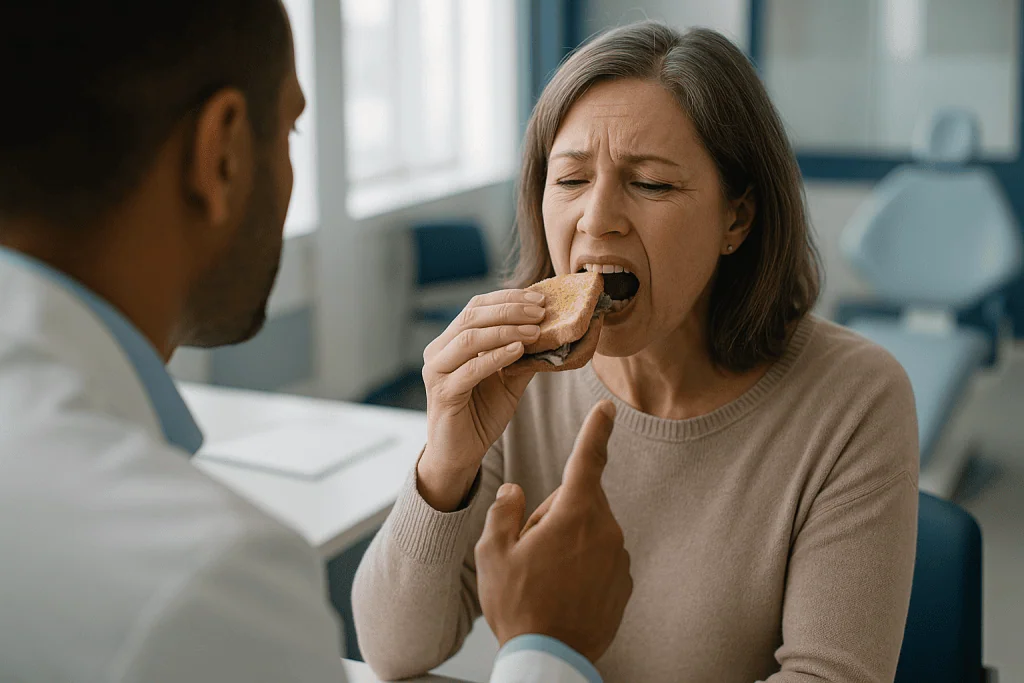
A crown that is too high tends to declare itself immediately, usually as a tooth that feels tender when you chew or that you notice touching first when you close your mouth. A dark gum line is slow and silent, a cosmetic change with no pain at all. Decay at the margin is the sneakiest of the four, frequently painless until it is well advanced, and often first spotted on a routine X-ray rather than by the person wearing the crown. Loosening usually gives a warning wobble, a sensation of movement, or a sudden sensitivity to cold as the seal opens.
| Problem | Typical timing | What people usually notice | Usual first step |
|---|---|---|---|
| High bite | Days after fitting | Tooth hits first; sore to chew on | Bite check and adjustment of the crown surface |
| Dark gum line | Years later | Gray or blue shadow at the gum edge; no pain | Assessment of gum health; discussion of crown material |
| Decay at the margin | Years later | Often nothing; sometimes sensitivity or a bad taste | X-ray, then removal and replacement of the crown if needed |
| Loosening | Any time, usually years | Wobble, cold sensitivity, crown comes off | Examination of crown and tooth; re-cementing or remaking |
None of these signs is a diagnosis on its own. Several overlap, and a loose crown can hide decay, just as a high bite can mimic nerve pain. That is why the table ends every row with an examination rather than a self-directed fix.
Why does my new crown feel too high?
Your teeth are extraordinarily good at measuring. The ligament that suspends each tooth in its socket contains pressure sensors that can register a difference in height thinner than a sheet of paper. So when a crown sits even slightly taller than the tooth it replaced, your jaw notices at once. Dentists call this a high bite or a high occlusion, meaning the crown meets the opposing tooth before any of its neighbors do.
The mechanism of the soreness is simple physics. Chewing force that should spread across a dozen teeth lands first on one. The ligament around that tooth becomes inflamed and tender, and the tooth may feel bruised or start to ache when you bite. Some people describe the crown as feeling loose when it is not; the movement they sense is the ligament being pressed harder than usual.
Why does it happen? Fitting a crown involves checking the bite while the patient is numb and often lying back, which is not quite how anyone chews dinner. Small discrepancies are common and are the reason a dentist asks you to bite on marking paper and to come back if something feels off.
The fix is usually straightforward: the dentist identifies the high spot with marking paper and polishes a small amount off the crown surface. Relief from the bruised feeling typically follows over the next few days as the ligament calms down, though a tooth that has been overloaded for weeks may take longer to settle. Cleveland Clinic lists a bite that feels off as one of the ordinary reasons to return after a crown is fitted rather than wait for it to adapt on its own.
What you should not do is try to grind the crown down yourself or chew hard on the other side for weeks hoping it evens out. A high crown does not wear in; the tooth beneath simply keeps absorbing the extra load.
Is it normal for a new crown to hurt? Crown pain when biting and the nerve underneath
Some discomfort in the first days after a crown is expected. The tooth has been reshaped, the gum around it has been handled, and the pulp inside has had a busy week. Cleveland Clinic notes that sensitivity to hot and cold or mild soreness commonly lasts a few days after the crown is placed. A tooth that twinges at ice water but settles within seconds, and improves day by day, is behaving as most do.

Crown pain when biting is a different signal, and it is worth separating two versions. The first is the high-bite soreness described above: an ache when the tooth is loaded, better when it is left alone, and usually fixed by adjusting the bite. The second is sharper and more alarming: a lingering pain after cold, a throb that arrives at night, or a tooth that hurts when you release the bite rather than when you press down. Those patterns point toward the pulp rather than the ligament.
Why would the nerve be involved? Preparing a tooth for a crown removes a layer of tooth structure and brings the drill closer to the pulp. In a tooth that already had a large filling or a deep crack, the pulp may have been struggling before the crown was ever planned. Sometimes it recovers. Sometimes the crown is the last straw and the pulp becomes irreversibly inflamed or dies, in which case a root canal, a procedure that removes the pulp and seals the empty canal, may be recommended. The NHS explains that root canal treatment is used when the pulp is infected or damaged, and that it can often be carried out through an existing crown.
The honest answer to the question, then, is: mild, improving sensitivity is normal; pain that is getting worse, waking you at night or lingering long after the trigger is not, and needs a dentist to assess the pulp with testing and an X-ray.
Why is there a dark gum line around my crown?
A gray or bluish line at the gum edge of a crowned tooth is one of the most searched dental crown problems and one of the least dangerous. It is almost always cosmetic. Understanding where the color comes from explains both why it appears and why it is so difficult to hide.
Most older crowns, and many current ones on back teeth, are porcelain fused to metal: a thin metal shell for strength with tooth-colored porcelain baked onto the outside. At the margin the porcelain thins out and the metal is closest to the surface. When the crown is first fitted the gum sits snugly over that edge and hides it. Over years, gums naturally recede a little, and the metal collar becomes visible as a dark rim. Light passing through the gum tissue can also pick up the gray of the metal beneath and cast a shadow even before the edge itself shows.
Gum recession has its own causes, and they matter more than the color they reveal. Gum disease, an infection of the tissues supporting the teeth, is a major one. The NHS describes early gum disease as gums that bleed when brushing, progressing to bone loss if untreated. Aggressive brushing, thin gum tissue, and a crown margin that was placed too deep and irritates the gum can all contribute.
So the dark line is a prompt for two separate conversations. The first is about gum health: is the recession stable, or is there active disease that needs treating regardless of appearance? The second is about the crown: if the line bothers you, all-ceramic materials such as zirconia or lithium disilicate have no metal to show and are commonly discussed as replacements on visible teeth. Whether replacing a functionally sound crown is worthwhile is a judgment call to make with your dentist, weighing the removal of more tooth structure against the cosmetic gain.
Decay at the margin: can a tooth with a crown still get a cavity?
Yes, and this surprises people more than any other item on the list. The crown itself cannot decay; porcelain and metal are immune to the acids that dissolve enamel. The natural tooth underneath is not. Wherever the crown ends and tooth begins, at the margin, there is a seam. Bacteria live in that seam as happily as anywhere else in the mouth, and if they are fed sugar and left undisturbed they produce acid that eats into the exposed tooth at the edge and then travels underneath the crown, where no toothbrush can reach.
Dentists call this recurrent or secondary decay. Cleveland Clinic lists it among the reasons crowns eventually need replacing. Three factors raise the risk. A margin that does not fit closely, leaving a ledge or gap, gives plaque a permanent foothold. A margin sitting right at the gum in someone whose gums bleed and recede exposes fresh root surface, which is softer than enamel and decays faster. And a dry mouth, from medication, medical conditions or age, removes the saliva that normally rinses and buffers acid.
The frustrating feature of margin decay is its silence. There is often no pain until the decay has reached deep into the tooth or the pulp, because the crown insulates the tooth from the temperature changes that would otherwise give an early warning. Many cases are found on routine bitewing X-rays, the small films taken at check-ups that show the sides of the back teeth and the bone between them. This is the single strongest argument for keeping check-up appointments even when a crowned tooth feels fine.
Treatment depends on extent. A small area at the edge may occasionally be repaired around the crown. More often the crown must be removed, the decay cleared, the tooth rebuilt and a new crown made. If decay has reached the pulp, root canal treatment enters the conversation, and if too little tooth remains to hold a crown, extraction and replacement options, including an implant, are discussed.
Loose dental crown: why crowns loosen and what happens if one comes off
A loose dental crown is a symptom, not a diagnosis. The crown has separated, wholly or partly, from the abutment beneath it, and the interesting question is why. There are three common answers, and they lead to very different treatments.
The first is cement failure. Dental cements are strong but not eternal. Years of chewing, thermal cycling between hot coffee and ice cream, and the slow seep of saliva along the margin can dissolve or fatigue the bond. If the tooth underneath is sound, the dentist may simply clean both surfaces and re-cement the same crown.
The second is decay of the abutment. When bacteria have hollowed out the tooth under the crown, the cement has nothing solid to hold, and the crown lifts off with soft, discolored tooth inside it. This is the scenario dentists check for first when a crown arrives in a patient’s hand, and it usually means a new crown after the decay is removed.
The third is fracture. A tooth weakened by a large filling or a root canal can crack under the crown, or the crown may have been placed on a very short stump with little to grip. Sticky foods, night-time clenching and biting on hard objects add load that a compromised tooth cannot take. A fractured abutment sometimes cannot be saved.
If a crown comes off, keep it. Do not throw it away, and do not try to glue it back with household adhesive, which can damage both the crown and the tooth and make professional re-cementing impossible. Rinse it, store it somewhere safe, avoid chewing on that side, and contact a dentist promptly. The exposed abutment is vulnerable to decay and sensitivity, and neighboring teeth can begin to drift into the space within weeks. The MedlinePlus guidance on dental emergencies covers lost crowns and fillings and makes the same point: see a dentist as soon as possible.
Can a dental crown cause TMJ symptoms?
The temporomandibular joints, or TMJ, are the hinges just in front of each ear where the lower jaw meets the skull. They are among the most used joints in the body and are sensitive to how the teeth meet. So the question people ask after a crown, whether jaw clicking, aching or tightness could be linked, is a reasonable one.
The connection runs through the bite. When one crown sits high, the jaw muscles instinctively shift the lower jaw to avoid the premature contact. That compensatory movement can strain the chewing muscles and load one joint unevenly. Symptoms that people report in this situation include aching in the cheek or temple, tenderness in front of the ear, clicking when opening, a jaw that feels tired in the morning, and headaches around the temples. Mayo Clinic lists jaw pain, aching around the ear, difficulty chewing and joint locking among the features of TMJ disorders in general, and notes that the causes are often multifactorial.
Two honest caveats. First, TMJ symptoms have many causes, including clenching, grinding, arthritis, stress and injury, and a crown fitted last month may be coincidence rather than culprit. Second, the evidence that bite discrepancies cause chronic TMJ disorders is mixed; occlusion is one contributor among several, not the whole story. Mayo Clinic points out that many TMJ symptoms are temporary and improve with conservative care.
What this means in practice: if jaw symptoms start soon after a crown, the crown’s height should be checked, because that is easily done and easily corrected. If adjusting the bite resolves the muscle ache, the answer was probably simple. If symptoms continue despite a balanced bite, the assessment should widen to the joint itself, clenching habits and other causes, and a dentist or physician can guide that next step.
How long do crowns last, and how many years is realistic?
Every patient asks, and every honest dentist gives a range rather than a number. Cleveland Clinic states that dental crowns generally last between five and fifteen years, with many lasting longer when well cared for. That spread is wide because the crown is only half of the equation; the tooth beneath it, the gums around it and the habits of the person wearing it decide the rest.
Consider what a crown survives. It is loaded thousands of times a day, bathed in acid after every meal, cycled through temperature extremes and, in people who clench or grind, subjected to forces at night that far exceed ordinary chewing. Material matters at the edges: gold alloys wear gently and rarely chip; porcelain can fracture under heavy load; zirconia is extremely strong but very hard on the opposing tooth if it is not polished well. No material, however, protects the margin from plaque or the root from recession.
Things known to shorten crown life include grinding without a night guard, biting ice or hard candy, poor plaque control at the gum line, untreated gum disease, dry mouth and frequent sugar exposure. Things associated with longer life are unglamorous: daily flossing along the margin, a soft brush, routine check-ups with periodic X-rays, and prompt attention to a bite that feels off.
Two myths are worth retiring. A crown is not permanent in the sense of lasting a lifetime; it is a repair with a lifespan. And a crown does not mean the tooth is finished with needing care. It needs slightly more, because the one place it can still decay is the one place you cannot see.
When a crown is replaced after a long and useful life, that is not a failure. It is the expected end of one repair and the start of another, ideally planned before decay or fracture makes the choice for you.
Who is usually offered a repair or replacement, and who is asked to wait
Not every imperfection needs intervention, and the decision to touch a crown is weighed against the cost of touching it: every removal risks damaging the tooth beneath, and every new preparation removes a little more natural structure.
A dentist is usually quick to act when there is a high bite, because adjustment is minor and leaving it risks pulp inflammation and joint strain. Recurrent decay at the margin that is visible on X-ray is another prompt to act, since it will not stop on its own. A crown that has come off is generally re-cemented or remade promptly to protect the abutment. A fractured crown with sharp edges, or one where the porcelain has chipped down to metal on a tooth that matters cosmetically, is also commonly addressed.
Waiting, or watching, is usually proposed in other situations. A dark gum line on a crown that fits well, with healthy gums and no decay, is a cosmetic choice rather than a clinical need, and many people reasonably decide to live with it. Mild sensitivity in the first days after cementing is watched rather than treated, because most of it resolves. A small chip on a back crown that is not sharp and not near the margin may be smoothed and monitored. A crown with slightly visible margins but no plaque trap or decay may be left alone and checked at each visit.
Some people are asked to pause for medical reasons rather than dental ones. Active gum infection is generally treated before a new crown is made, because a stable gum position is needed for a lasting margin. Uncontrolled clenching or grinding may be addressed with a night guard first so that the new crown does not meet the same fate as the old. People undergoing certain cancer treatments or with acute illness are sometimes asked to defer elective dental work until their medical team agrees the timing is right.
In every case the choice sits with the patient and the treating dentist together, informed by the examination and X-rays rather than by symptoms alone.
What the following days and weeks usually look like
Whether a crown is adjusted, re-cemented or remade, the recovery follows a recognizable pattern, and knowing it helps you tell settling from trouble.
After a bite adjustment, the tooth often feels immediately different, sometimes oddly low for a day as your jaw relearns where to close. The bruised, tender feeling in the ligament typically fades over the following days. If it has not improved in a week or two, or if the tooth begins to ache without being touched, the dentist should look again, because the bite may need a second refinement or the pulp may be involved.
After re-cementing a crown, most people are asked to avoid chewing on that side for a short period while the cement fully sets, and to avoid sticky foods that could pull it loose. The gum around the margin may be slightly tender where excess cement was cleaned away. Cold sensitivity from the exposed abutment usually eases once the crown seals the tooth again.
After a new crown is made, there is generally a period with a temporary crown while the permanent one is fabricated. Cleveland Clinic advises treating the temporary gently, avoiding sticky and hard foods and flossing carefully by sliding the floss out sideways rather than lifting it. Once the permanent crown is cemented, some sensitivity to temperature for a few days is common. Speech and tongue position adapt quickly on back teeth; front crowns can take a little longer to feel natural.
Throughout, the trend matters more than any single day. Sensitivity that is a little better each morning is reassuring. Pain that is a little worse each morning is not. Cleveland Clinic recommends contacting the dentist if pain persists or the bite feels off after a crown is placed, and that guidance applies at any point in the timeline.
What people often get wrong about dental crown problems
Some of the most common beliefs about crowns are half true, and the half that is wrong causes real harm.
"A crowned tooth can’t get a cavity." The crown cannot; the tooth under it can, and the margin is the entry point. Decay beneath a crown is one of the leading reasons crowns are replaced, and it is often painless until it is deep.
"A high crown will wear in." Porcelain and zirconia are harder than enamel. What wears is the opposing natural tooth, and what suffers is the ligament and pulp of the overloaded tooth. A high spot is adjusted, not waited out.
"If it doesn’t hurt, it’s fine." Two of the four problems in this article, dark gum line and margin decay, are typically painless. Regular check-ups with periodic X-rays exist precisely because pain is an unreliable alarm for crowned teeth.
"A crown means the nerve is dead." Most crowns are placed on teeth with a living pulp. That is why a crowned tooth can still feel cold and can still develop nerve pain. A root canal is a separate procedure, sometimes done before a crown, sometimes needed years later.
"A loose crown just needs glue." Household adhesives damage the crown, irritate the gum and often cannot be removed, turning a simple re-cement into a remake. A loose crown also needs the tooth underneath examined for the reason it loosened.
"Jaw pain after a crown means TMJ disorder." Sometimes it means a bite that is fractionally high and a jaw that is compensating. That is the first thing to rule out, because it is the easiest to correct. Chronic joint disorders have many contributors, and a crown is rarely the only one.
The thread running through these is the same: a crown is a repair on a living tooth, not a replacement for it. Treat it as such and most of the surprises disappear.
Questions to ask your care team
Good questions turn a rushed appointment into a shared decision. If you are sitting in the chair with a crown that hurts, has darkened or has come loose, these are the ones worth asking.
- What exactly is causing the problem: the bite, the gum, the margin, the cement or the tooth underneath? Which of those did the X-ray show?
- Is the pulp still healthy? How did you test it, and what would change if it were not?
- Can this crown be adjusted or re-cemented, or does it need to be remade? What would you gain and lose with each option?
- If a new crown is needed, what material do you suggest for this tooth, and why? What are the trade-offs for appearance, strength and wear on the opposing tooth?
- How much natural tooth is left under the crown? Is there a point at which a crown is no longer the right repair?
- If there is decay at the margin, how deep is it, and how close to the nerve?
- Is my gum recession stable, or is there active gum disease that should be treated first?
- Do I show signs of clenching or grinding, and would a night guard help protect the new work?
- What should the tooth feel like over the next week, and what would make you want to see me sooner?
- How often should this crown be checked and X-rayed from here on?
Write the answers down, or ask for them in a treatment summary. People remember a fraction of what is said in a dental chair, and the reasoning behind a plan is as useful to keep as the plan itself. If two dentists give different advice, that usually reflects genuine clinical judgment about a borderline case, and asking each to explain their reasoning is entirely appropriate.
When to call your doctor
Most dental crown problems are inconvenient rather than dangerous, and a call to your dentist’s office in ordinary hours is the right response for a high bite, a dark gum line, a wobble or a crown that has come off intact. A few situations are different, and they should not wait for the next available check-up.
Contact a dentist promptly, the same day where possible, if you have severe or worsening toothache that is not eased by the measures your dentist has suggested, pain that wakes you at night, a tooth that has become very tender to touch, a bad taste or discharge from around the crown, or a crown that has come off and left a sharp or very sensitive stump. These features suggest that the pulp may be inflamed or infected, or that decay under the crown has progressed, and earlier treatment generally preserves more options.
Seek urgent medical care, at an emergency department if necessary, if you develop swelling of the face, jaw or neck, fever alongside dental pain, difficulty opening your mouth, or any difficulty swallowing or breathing. Mayo Clinic identifies these as warning signs that a dental abscess, a pocket of infection at the root of a tooth, may be spreading beyond the tooth into the surrounding tissues, and notes that this can become serious quickly. Anyone with a weakened immune system, diabetes that is hard to control, or a heart valve condition should have a lower threshold for calling, and should mention those conditions when they do.
Jaw symptoms deserve a call too, though rarely an urgent one: persistent clicking with pain, a jaw that locks open or closed, or facial pain that has not improved after a bite adjustment warrants assessment rather than continued waiting.
Whatever the situation, the decision about what to do next, whether adjustment, re-cementing, root canal treatment, replacement or referral, belongs with the dentist or physician who has examined you. This article can tell you what the possibilities are; only an examination can tell you which one applies.
Frequently asked questions
What are the symptoms of a bad crown?
The most common signs are a tooth that hits first when you bite, sensitivity or pain when chewing, a gray line at the gum edge, a wobble or sensation of movement, a bad taste around the tooth, or a crown that comes off. Two of the most serious problems, decay under the margin and a dying nerve, can be nearly painless at first, so a symptom-free crown still needs regular check-ups and periodic X-rays.
Is it normal for a new crown to hurt?
Some sensitivity to hot and cold, and mild soreness of the gum, is expected for a few days after a crown is fitted and should improve steadily. Pain that gets worse, lingers long after cold, throbs at night, or is triggered by biting down usually means either the bite is high or the pulp is inflamed. Both should be assessed by a dentist rather than waited out.
How many years should a dental crown last?
Cleveland Clinic gives a typical range of five to fifteen years, and many crowns last longer with good care. Lifespan depends less on the crown material than on what happens at the margin and to the tooth underneath: plaque control, gum health, grinding habits, dry mouth and diet all matter. A crown that needs replacing after a long working life is the expected end of a repair, not a failure.
What are common TMJ symptoms that can occur after getting a dental crown?
People report jaw muscle aching in the cheek or temple, tenderness in front of the ear, clicking when opening, a tired jaw on waking and temple headaches. These often trace back to a crown sitting fractionally high, which makes the jaw shift to avoid it. Adjusting the bite frequently resolves them. Persistent symptoms after a balanced bite need broader assessment, since TMJ disorders have many causes beyond the teeth.
What does crown pain when biting usually mean?
Pain on biting down most often means the crown is high and the ligament around the tooth is bruised from taking too much load. Pain on releasing the bite, or a sharp jolt with cold that lingers, points more toward the pulp or a crack. A dentist distinguishes them with marking paper, pulp testing and an X-ray. Neither pattern improves reliably on its own.
Why is there a dark line at the gum around my crown?
The line is usually the metal shell of a porcelain-fused-to-metal crown becoming visible as the gum recedes, or its gray shadow showing through thin gum tissue. It is cosmetic rather than harmful, but the recession that revealed it may reflect gum disease or aggressive brushing, which should be checked. Replacement with an all-ceramic crown is an option worth discussing, not a necessity.
Can a tooth under a crown get a cavity?
Yes. The crown material cannot decay, but the natural tooth at the margin can, and decay can travel underneath where brushing cannot reach. It is often painless until deep and is commonly found on routine bitewing X-rays. Treatment usually means removing the crown, clearing the decay, rebuilding the tooth and making a new crown, sometimes with root canal treatment if the decay has reached the pulp.
What should I do about a loose dental crown or one that has fallen off?
Keep the crown, rinse it, and store it safely. Do not use household glue, which damages the crown and gum and can make professional re-cementing impossible. Avoid chewing on that side and contact a dentist promptly, because the exposed tooth is vulnerable to decay and sensitivity. The dentist will check why it loosened: cement failure can often be re-cemented, while decay or fracture underneath usually means a new crown.
How long do crowns last compared with the tooth underneath?
The crown often outlives its own usefulness because the tooth beneath changes: gums recede, exposing root surface that decays more easily than enamel, and a heavily filled tooth may crack under years of load. That is why dentists judge a crown by its margin fit and the health of the abutment on X-ray rather than by its age alone, and why a functioning crown of any age still needs regular review.
Do I need a root canal if my crowned tooth hurts?
Not necessarily. Many crowned teeth hurt because the bite is high, and adjusting it resolves the pain. Root canal treatment is considered when testing and X-rays show the pulp is irreversibly inflamed or infected, which can happen years after a crown is placed. The NHS notes it can often be performed through the existing crown. The decision rests on examination findings, not on pain alone.
References
- Cleveland Clinic: Dental Crowns
- NHS: Root canal treatment
- NHS: Gum disease
- MedlinePlus: Dental care – adult
This article is for general information only and is not a substitute for professional medical advice. Please consult a qualified doctor about your individual situation.

More from the Blog
Imaging in Implantology: How Panoramic X-Rays and 3D Scans Guide Implant Position and Depth
Implantology imaging combines two-dimensional dental X-rays, most often a panoramic film, with a three-dimensional cone beam CT (CBCT) scan when the clinician needs to…

Why Jaw Growth Decides When Implantology Can Place an Implant in a Younger Patient
Dental implants for teenagers are usually postponed until the jaw has stopped growing, because an implant fuses to bone and cannot move with the…

How Mini Implants Are Placed: Flapless Insertion, Same-Day Denture Fitting and What to Expect
A mini implant procedure places one or more narrow titanium posts into the jawbone, usually through a small pierce in the gum rather than…

All On 4 Healing Timeline: Soft Diet Weeks, Bone Integration and the Final Bridge Switch
All-on-4 healing usually unfolds in stages. Swelling and soreness peak in the first two to three days and settle over one to two weeks,…

Mini Implant Problems Explained: Loosening, Wear of Denture Attachments and When to Call
Mini implant problems most often fall into three groups: the implant itself loosening because bone has not bonded to it or has later receded,…

All On 6 Problems Explained Honestly: Screw Loosening, Bridge Fractures and Gum Inflammation
All on 6 problems usually fall into three groups: mechanical issues such as a loosened prosthetic screw or a chipped or fractured bridge, biological…