

Does Scaling and Root Planing Hurt? Local Anesthesia and Sensitivity Afterwards

Key Takeaways
- Scaling and root planing is done with local anesthesia, so people typically feel pressure and vibration during the appointment rather than sharp pain.
- Healthy gum pockets measure about 1 to 3 millimeters; pockets over 4 millimeters signal periodontitis and are the reason a deep cleaning is offered instead of a routine one.
- Cold sensitivity afterward comes from exposed root dentin and usually eases over days to a few weeks as gums heal and saliva reseals the tiny tubules.
- General anesthesia is not standard for deep cleaning; anxious patients may be offered nitrous oxide or oral sedation, but the teeth still need to be numbed.
- Teeth may look longer and small gaps may appear after treatment because healing gum shrinks back to reveal bone loss the disease already caused, not because the cleaning damaged anything.
- Nearly half of adults 30 and older in the United States have some periodontal disease, making deep cleaning one of the most common procedures in dental care.
Scaling and root planing is usually not painful during the appointment, because dentists typically numb the treated area with a local anesthetic and can apply a numbing gel first. Most people feel pressure, scraping and vibration rather than pain. Afterward, mild gum soreness and temporary tooth sensitivity to cold are common for days to a few weeks. Pain that worsens or persists is not expected and should be reported to your dental team.
The appointment card says “SRP, upper right,” and the person holding it has already read the phrase “deep cleaning” three times on the drive over. They remember a routine cleaning that stung a little along one back molar. Now a hygienist is talking about going below the gumline, and the mind does what minds do: it imagines something worse than what is likely to happen.
That gap between imagination and reality is the whole story of the question does scaling and root planing hurt. The procedure sounds aggressive. In practice it is a slow, methodical clean of tooth roots that have been hiding under inflamed gum, done with the area numbed. The parts that surprise people are usually not the appointment itself but the odd, tingly hours afterward and the new zing from cold water a week later.
This explainer walks through what is really happening under the gum, what local anesthesia does and does not do, why sensitivity shows up afterward, and where the honest evidence sits on comparisons like root canal versus deep cleaning.
Does scaling and root planing hurt during the appointment?
For most people, the truthful answer is: not much, and not in the way they feared. Scaling and root planing is treatment for periodontitis, the stage of gum disease in which infection has moved below the gumline and started to damage the bone and fibers that hold teeth in place. Because the work happens on root surfaces beneath inflamed gum, dentists and hygienists usually numb the area first with a local anesthetic, a medicine injected near the teeth that temporarily blocks nerve signals from that region. Mayo Clinic describes scaling and root planing as a nonsurgical treatment that can be done with hand instruments, an ultrasonic device or a laser.
With numbing in place, what people report is sensation rather than pain. There is pressure when an instrument is pushed under the gum. There is a distinct scraping feel and sound as hardened deposits come off. Ultrasonic scalers add a buzzing vibration and a spray of water. None of that is comfortable in the way a nap is comfortable, but it is a different category from the sharp pain many people brace for.
The exceptions are worth naming plainly. A tooth that already aches, a very deep pocket, or an area where the anesthetic has not fully taken hold can produce a jolt. That is a signal, not a failure. Clinicians expect to be told, and adding more anesthetic to a stubborn spot is routine. The anticipation, in other words, is usually harder than the appointment, and a raised hand mid-procedure is part of how the appointment is meant to go.
What actually happens during a deep cleaning, step by step
The word “cleaning” undersells what is going on, so it helps to picture the mouth from the inside. Plaque is the soft film of bacteria that forms on teeth every day. When it sits undisturbed, minerals in saliva harden it into calculus, also called tartar, which cannot be brushed away. Above the gumline, tartar is a cosmetic and gingivitis problem. Below the gumline, tartar on the root surface keeps the gum inflamed and the pocket between tooth and gum deepening.
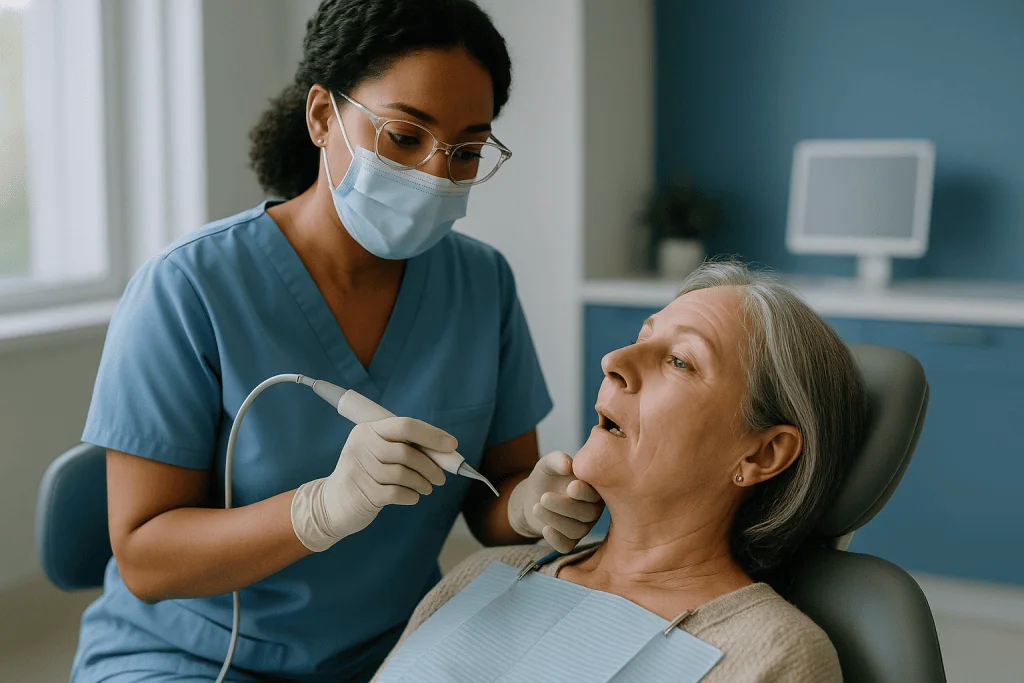
Scaling is the removal of those deposits from the crown and root. The clinician works an ultrasonic tip or a slim hand instrument called a curette down into the pocket, feeling for the rough ledge of tartar and dislodging it, section by section. Root planing follows: the root surface is smoothed so that bacteria have fewer crevices to recolonize and so the gum can reattach more snugly. Mayo Clinic notes that this also removes bacterial byproducts that keep the inflammation going.
Because thorough work takes time, the mouth is often treated in quadrants, meaning one quarter of the mouth per visit, or in halves. Splitting it up limits how much of the face is numb at once and lets the clinician be meticulous. Some practices treat the whole mouth in a single longer appointment; the scheduling decision is made by the treating team, weighing pocket depth, how much tartar is present and the patient’s tolerance for sitting still.
Some pockets are irrigated with an antiseptic rinse, and in selected cases a dentist may place an antibiotic directly into a pocket or prescribe one by mouth; Mayo Clinic lists both as adjuncts, not routine steps. Whether any medicine is used is a clinical judgment for the prescribing dentist.
Why gum pockets change how a cleaning feels
The single number that best predicts how a deep cleaning feels is pocket depth. A periodontal probe is a thin, blunt ruler slipped between tooth and gum; healthy gums measure about 1 to 3 millimeters, and Mayo Clinic describes pockets deeper than 4 millimeters as a sign of periodontitis, with pockets over 5 millimeters difficult to clean well. Every extra millimeter means the instrument has to reach further into tissue that is already tender.
Inflamed gum is also simply more reactive. The tissue is swollen with immune cells and extra blood flow, which is why it bleeds when probed and why even a gentle touch registers more strongly than it would on healthy gum. This is also why a person who has skipped dental visits for years may have felt nothing until the day someone probes those pockets and asks about pain.
The scale of the problem is bigger than most people assume. The Centers for Disease Control and Prevention reports that 47.2 percent of adults aged 30 and older in the United States have some form of periodontal disease, and the figure rises to 70.1 percent among adults 65 and older. Deep cleaning is therefore not a rare, dramatic intervention; it is one of the most common treatments in a dental office, and clinicians have refined comfort measures around it accordingly.
Two practical consequences follow. First, someone with shallow 4-millimeter pockets and light deposits may need only a topical numbing gel, while someone with 6-millimeter pockets and heavy tartar will almost always be offered injected anesthetic. Second, a follow-up cleaning months later, after the gum has calmed and shrunk back toward the tooth, typically feels easier than the first. The disease, not the instrument, is doing most of the hurting.
Local anesthesia for scaling and root planing: what it does and how long it lasts
The local anesthetics used in dentistry belong to a class of medicines that block sodium channels in nerve fibers. When those channels are blocked, the nerve cannot transmit the electrical signal that the brain would interpret as pain. Touch and pressure are carried partly by different fibers, which is why a numbed jaw still registers pushing and vibration while pain drops away. The medicine is injected near the nerve branches supplying the teeth being treated, either right beside the tooth or, for lower back teeth, further back where a larger nerve enters the jaw.

Before the injection, many clinicians paint or spray a topical anesthetic gel on the gum so the needle prick itself is dulled. The injection is then given slowly; speed is a major factor in how much an injection stings. A brief pinch and a spreading heaviness in the lip, cheek or tongue are what most people describe.
Numbness begins within minutes and then lasts for hours, fading gradually rather than switching off. During that window the lip and cheek feel fat and clumsy. The classic hazards are biting the inside of the cheek without noticing and sipping something hot that would ordinarily prompt a flinch. Chewing on the numb side is best deferred until sensation returns.
Local anesthesia does not alter consciousness. People drive themselves home, return to work and hold conversations, albeit with a slightly lopsided smile. Anyone who has had a poor reaction to a dental injection in the past, who has a heart rhythm condition, or who takes medicines that could interact should mention it beforehand; the choice of anesthetic and whether it contains a vessel-constricting additive is a decision the treating dentist makes for each patient.
Are you put to sleep for scaling and root planing?
Not usually, and for good reason: the procedure is designed to be done with the patient awake and the area numbed. General anesthesia, in which a person is fully unconscious and monitored by an anesthesia professional, carries risks and demands resources that are out of proportion to a nonsurgical gum treatment for most adults. Local anesthesia is the standard.
That said, “awake” sits on a spectrum, and dental teams have options for people whose anxiety is the real barrier. Nitrous oxide, sometimes called laughing gas, is a mild sedative gas breathed through a small mask; it reduces anxiety while leaving a person able to respond, and its effects wear off within minutes of the mask coming off. Oral sedative medicines, taken before the appointment as prescribed by the dentist, produce a deeper drowsiness and require someone else to drive. Intravenous sedation is available in some settings for people with severe dental phobia or extensive treatment needs.
Which, if any, of these is appropriate depends on health history, other medicines, the extent of treatment and local regulations governing who may administer sedation. None of them replaces local anesthesia; the tooth still needs to be numbed, because sedation calms the mind without blocking the nerve.
A frank conversation is the most useful step here. Telling the hygienist “I had a bad experience as a child and I tense up” changes how the appointment is paced, how often breaks are offered and whether a sedation referral is worth discussing. Dental anxiety is common enough that clinicians have scripts for it, and the person who asks for help with it is not being difficult. They are helping the team do a better job.
Who is usually offered scaling and root planing, and who is asked to wait
Deep cleaning is treatment for periodontitis, not a premium version of a routine polish. The typical candidate has pockets of 4 millimeters or more, bleeding on probing, and X-ray evidence that the bone supporting the teeth has begun to recede; Mayo Clinic and Cleveland Clinic both describe these findings as the basis for diagnosis. Someone with gum inflammation confined to the surface, the stage called gingivitis, generally needs a standard cleaning and better home care rather than root planing, because there is nothing below the gumline to plane.
A few situations prompt the team to pause or coordinate first:
- An acute abscess or facial swelling is usually treated as an urgent problem in its own right before a scheduled deep cleaning proceeds.
- People taking blood-thinning medicines, or living with a bleeding disorder, are not excluded, but the dentist may consult the prescribing physician about timing. The NHS advises against stopping such medicines without medical advice, and dental teams share that position.
- Recent heart surgery, certain heart valve conditions or a recent joint replacement may lead the dentist to contact the physician about whether any precaution is needed before treatment that causes gum bleeding.
- Uncontrolled diabetes worsens gum healing and gum disease worsens glucose control, so the two conditions are often managed side by side rather than one waiting for the other.
Pregnancy deserves a specific word, because myths abound. Gum inflammation often flares during pregnancy, and treating it is generally considered appropriate; the treating dentist and obstetric team decide on timing and anesthetic choices together. Nobody should assume they are automatically ineligible. The right move is to bring a full medicine list and health history to the assessment visit and let the team weigh it.
Sensitivity after deep cleaning: what the first days and weeks usually look like
The appointment is one afternoon; the recovery is a short arc with a recognizable shape. Understanding it in advance is the best antidote to the second-guessing that starts around day three.
| Stage | What is common | What is not expected |
|---|---|---|
| Leaving the office | Numb lip, cheek or tongue; slight bleeding from the gums; mild ache as numbness fades | Heavy bleeding that does not slow |
| First few days | Gums tender and slightly swollen; discomfort when brushing the treated area; teeth zing with cold drinks | Throbbing pain that builds, fever, or swelling spreading into the face |
| First few weeks | Gums look pinker and tighter; small gaps near the gumline may appear; cold sensitivity gradually eases | New or worsening pain in one tooth; pus or a bad taste |
| Re-evaluation visit | Pockets re-measured; maintenance interval set | Persistent sensitivity without improvement |
Mayo Clinic notes that teeth may feel sensitive after periodontal treatment and that this usually settles as the gums heal; in its expert guidance on sensitive teeth, it describes post-procedure sensitivity as typically temporary. Cleveland Clinic similarly describes soreness and sensitivity lasting from days to a few weeks rather than months. Because the mouth is often treated in sections, this cycle can repeat on each side, which sometimes gives the impression of a longer recovery than any single area actually experiences.
Gentle care in this window matters more than any product. Soft-bristled brushing, warm saltwater rinses if the team suggests them, and avoiding very hot, very cold or very crunchy food for a day or two are the standard advice. A re-evaluation appointment some weeks later measures whether the pockets have shrunk, which is the real test of whether the treatment did its job.
Why teeth feel sensitive after deep cleaning, and what usually helps
The sharp, brief zing from cold water that shows up after a deep cleaning has a straightforward anatomy. Tooth roots are not covered by enamel. They are covered by cementum, a thin, softer layer, and beneath that lies dentin, a porous material laced with microscopic tubules that lead toward the nerve. Cold, sweet or air moving across exposed dentin shifts fluid inside those tubules, and the nerve reads that movement as a sting.
Two things happen during and after root planing to expose more dentin. The instruments remove tartar that had been acting, ironically, as an insulating crust over the root, and some cementum inevitably comes away with it. Then, as inflammation resolves, swollen gum shrinks back toward the bone. That healing is desirable, but it uncovers root surface that was previously buried under puffy tissue. The result is teeth that look a little longer and feel a lot more awake.
Most of this fades on its own. Saliva gradually deposits minerals that partially seal the tubules, and the nerve inside the tooth becomes less reactive to repeated mild stimulation. Mayo Clinic’s guidance on sensitive teeth describes several approaches a dentist may suggest: toothpastes formulated for sensitivity, which work by calming the nerve or blocking tubules; fluoride applied in the office to strengthen exposed root; and, for stubborn spots, a bonding material or sealant painted over the root. Which, if any, is appropriate is a decision for the treating dentist based on how the sensitivity behaves over the following weeks.
Habits count too. Brushing hard with a stiff brush scrapes cementum and keeps tubules open, so a soft brush and a light grip protect the very surface the cleaning just exposed. Acidic drinks sipped through the day do the same chemically. Sensitivity that is improving week over week is healing in progress; sensitivity that is getting worse deserves a phone call.
Which is more painful, a root canal or a deep cleaning?
People ask this expecting a ranking, and the honest answer is that mainstream evidence does not rank dental procedures on a fixed pain scale, because pain is shaped as much by the state of the tooth and the person’s anxiety as by the procedure itself. Still, the two treatments can be compared usefully on what they involve.
A root canal treats infection inside a single tooth by removing the inflamed or dead nerve tissue, cleaning the internal canals and sealing them. It is done under local anesthesia, and the tooth that needs it often hurts badly beforehand, which is why the procedure carries such a fearsome reputation; the pain people remember is frequently the toothache that preceded it. Once the nerve is removed, that tooth cannot feel cold or heat at all, so post-procedure sensitivity is more about biting pressure on tender ligaments than about temperature.
Scaling and root planing treats the tissues around many teeth rather than the inside of one. The soreness afterward is spread across a whole quadrant of gum, and the sensitivity is temperature-driven because the teeth still have living nerves. The discomfort is milder per site but wider in distribution.
Put plainly: during either procedure, effective local anesthesia is meant to keep pain controlled, and clinicians add more if it is not. Afterward, root canal patients tend to describe a focused ache in one tooth for a few days, while deep cleaning patients describe diffuse gum tenderness and cold zings for days to weeks. Neither is the horror of popular imagination, and the person who has had both often reports that expectation was the worst part of each.
What is considered the most painful dental procedure?
There is no guideline or systematic review that crowns a single “most painful” dental procedure, and any article that claims one is offering opinion dressed as data. What the evidence does support is a set of factors that make any dental experience more painful, and those factors are more useful than a league table.
The first is pre-existing infection. Inflamed tissue is harder to numb, because the acidic chemical environment around an abscess reduces how well local anesthetics work, and because inflamed nerves fire more readily. This is why an emergency extraction of a badly infected tooth is more often remembered as painful than a planned extraction of a healthy one, and why a deep cleaning on severely inflamed gums can feel worse than the same procedure a few months later on calmer tissue.
The second is the size and location of the surgical field. Procedures that involve cutting bone, such as removing impacted wisdom teeth or placing implants, produce more post-operative swelling and ache than procedures confined to soft tissue or tooth surface. Scaling and root planing involves no incision and no bone removal, which places it firmly in the lower-intensity group for recovery.
The third is the individual. Dental anxiety amplifies pain perception, and previous bad experiences prime the nervous system to expect the worst. People with generalized chronic pain conditions also often report heightened sensitivity in dental settings.
None of this means discomfort should be dismissed. It means the sensible question is not “where does my procedure rank” but “what can be done about the specific factors that apply to me.” For deep cleaning, that usually means good anesthesia, honest communication during the appointment, and a plan for the cold-sensitive weeks afterward.
What are the downsides of scaling and root planing?
Every effective treatment has trade-offs, and patients deserve to hear them before the first injection rather than discovering them in the bathroom mirror.
The cosmetic change is the one that catches people off guard. As inflamed gum heals and tightens, it recedes toward the bone, and teeth that looked normal-length may appear longer. Small dark triangles can open between teeth where swollen gum used to fill the space. This is not damage caused by the cleaning; it is the true shape of the gum once disease-related swelling is gone, and it reflects bone that was already lost. Still, it is a visible change, and it is fair to ask the team what to expect for the front teeth in particular.
Sensitivity to cold, covered above, is the most common physical downside and is usually temporary. Tenderness and some bleeding for a few days are expected. Teeth can feel slightly loose for a short while as swollen tissue settles, which is unnerving but generally resolves as the gum reattaches.
The larger downside is conceptual: deep cleaning is not a one-time fix. Mayo Clinic and Cleveland Clinic both frame it as the start of ongoing periodontal maintenance, with cleanings scheduled more often than the routine interval and pockets re-measured at each visit. People who expect a single appointment to close the chapter are often disappointed when they hear the word “maintenance.”
Alternatives exist along a spectrum. For milder disease, a standard cleaning with improved home care may be enough. For deep pockets that do not respond, surgical options such as flap surgery, in which the gum is lifted to clean and reshape the bone, or grafting may be discussed. Choosing among these is the treating periodontist’s or dentist’s call, made with the patient’s priorities in view.
What people often get wrong about scaling and root planing pain
Myths around deep cleaning cluster into a handful of confident but mistaken beliefs, and clearing them up changes how people feel walking in.
“If I do not feel pain now, my gums must be fine.” Periodontitis is frequently painless until it is advanced. Bleeding when brushing, bad breath that returns quickly and gums that look puffy or dusky are more reliable clues than pain, according to the NHS and MedlinePlus. Absence of pain says little about pocket depth.
“Deep cleaning damages the teeth and makes them loose.” Any looseness felt afterward comes from tissue settling as swelling subsides, and the recession people notice reveals bone loss that the disease already caused. The alternative, leaving tartar under the gum, is what keeps eroding support.
“Scraping the roots weakens them permanently.” Root planing removes a thin layer of cementum along with the deposits embedded in it. This exposes dentin and drives temporary sensitivity, but the root remains structurally sound.
“The anesthetic shot is the worst part, so I will skip it.” With topical gel and a slow injection, the shot is a brief pinch, and declining it turns a manageable appointment into a genuinely uncomfortable one for anyone with pockets beyond the shallow range.
“Once it is done, I am done.” Bacteria recolonize pockets within weeks. Without maintenance visits and daily cleaning between teeth, deposits rebuild and the cycle restarts.
“Sensitivity afterward means something went wrong.” Cold sensitivity that eases over a few weeks is expected physiology. What warrants a call is pain that intensifies, localizes to one tooth or comes with swelling, and the next section spells that out.
Questions to ask your care team before scaling and root planing
The assessment visit, when pockets are measured and X-rays reviewed, is the moment to ask questions, because answers then shape both comfort and expectations. Bringing a short list is not fussy; clinicians generally welcome an engaged patient.
- How deep are my pockets, and which areas are most affected? Knowing whether the problem is a few back teeth or the whole mouth frames everything else.
- Will the whole mouth be treated in one visit or in sections, and roughly how long will each appointment take?
- What anesthesia do you plan to use, and what options are there if I am anxious? This opens the door to topical gel, injected anesthetic and, where appropriate, sedation.
- Do you expect any changes in how my gums or teeth look afterward, especially at the front?
- What should I do about brushing and flossing the treated area in the first days?
- How long is sensitivity likely to last for someone with my pocket depths, and what would you suggest if it lingers?
- Are there any medicines you plan to prescribe or place in the pockets, and how do they fit with the medicines I already take?
- Given my medical history, is there anyone you want to coordinate with before we start?
- When is the re-evaluation, and what result would tell us the treatment worked?
- How often will I need maintenance cleanings afterward, and what happens if pockets do not improve?
A practical addition: ask how to signal discomfort during the procedure. Agreeing on a raised hand before instruments go in makes it far easier to speak up in the moment. The person who knows what is coming, what it should feel like and how to pause it tends to describe the whole experience as far less of an ordeal than they had rehearsed.
When to call your doctor
Expected recovery from scaling and root planing follows a downhill slope: tender gums that ease day by day, and cold sensitivity that gradually fades over weeks. Anything heading uphill deserves a call to the dental office, and a few signs warrant urgent contact the same day.
Call promptly if you notice any of the following:
- Pain that increases after the first couple of days instead of settling, or pain that concentrates in a single tooth and throbs.
- Swelling of the gum, face or jaw that appears or grows after the appointment, particularly with fever or feeling generally unwell.
- Bleeding that does not slow with gentle pressure, or that starts again hours after the visit.
- Pus, a persistent bad taste, or a pimple-like bump on the gum, which can indicate an abscess.
- Numbness that has not worn off many hours after the appointment, or tingling that persists into the following day.
- Any rash, itching, wheezing or lip and throat swelling after the anesthetic or any prescribed medicine, which needs emergency care.
- Difficulty opening the mouth, swallowing or breathing, which is an emergency.
Sensitivity that has not improved at all by the re-evaluation visit, or that interferes with eating, should also be raised even though it is not dangerous; the team may offer in-office fluoride or other measures. People with diabetes, heart valve conditions, immune suppression or those on blood thinners should have a lower threshold for calling, because complications can escalate faster.
Every judgment about whether a symptom is routine healing or a problem sits with the treating dental team, who know what was found in the pockets and what was done. A brief phone call that turns out to be nothing costs very little. A delayed call about a spreading infection can cost a great deal more.
Frequently asked questions
Does scaling and root planing hurt without anesthesia?
It can, particularly where pockets are deep or gums are very inflamed, which is why anesthetic is usually offered. Shallow pockets with light deposits are sometimes treated with only a numbing gel. Declining anesthesia does not make the procedure safer or faster; it mainly makes it harder to tolerate. The treating clinician can tailor the approach to pocket depth and personal preference.
How long does sensitivity last after deep cleaning?
Cold sensitivity commonly lasts from a few days to a few weeks and fades gradually as gum tissue heals and the exposed root surface becomes less reactive. Mayo Clinic describes sensitivity after dental procedures as typically temporary. Sensitivity that worsens over time, or that has not improved by the re-evaluation visit, should be reported so the dentist can assess it.
Are you put to sleep for scaling and root planing?
No, general anesthesia is not standard for this nonsurgical procedure. Local anesthetic numbs the treated area while the person stays awake. For significant dental anxiety, some practices offer nitrous oxide or oral sedative medicines, which relax rather than induce sleep, and intravenous sedation exists in selected settings. Whether any sedation is appropriate is decided by the treating team based on health history.
Which is more painful, root canal or deep cleaning?
Neither is expected to be painful during the procedure, since both are done under local anesthesia. Afterward, a root canal tends to produce a focused ache in one tooth for a few days, while deep cleaning produces diffuse gum tenderness and cold sensitivity across the treated area for days to weeks. Much of the root canal’s reputation comes from the toothache that precedes it.
What are the downsides of scaling and root planing?
Temporary gum soreness, bleeding for a day or two and cold sensitivity are the common physical downsides. Gums may recede as swelling resolves, so teeth can look longer and small gaps may appear between them. Deep cleaning also commits a person to ongoing maintenance visits rather than a one-time fix, and deep pockets that do not respond may need surgical treatment.
Can I eat after scaling and root planing?
Yes, once the numbness has worn off, to avoid biting a numb cheek or burning a numb tongue. Soft, lukewarm foods are easier on tender gums for the first day or two, and very hot, cold, crunchy or spicy items tend to provoke the treated area. The dental team may give specific instructions if an antibiotic was placed in the pockets.
Why do my teeth feel loose after a deep cleaning?
Slight looseness shortly after treatment usually reflects swollen tissue settling as inflammation resolves, and it generally improves as the gum reattaches to the cleaned root. The cleaning does not remove bone. Looseness that persists or worsens, however, can reflect bone loss that the disease caused before treatment, and it should be mentioned at the re-evaluation so the dentist can assess it.
Does scaling and root planing hurt more than a regular cleaning?
It involves more sensation, because instruments work below the gumline in inflamed pockets rather than on the visible tooth surface. That is exactly why anesthetic is used for deep cleaning and rarely for a routine polish. With numbing in place, most people report pressure and scraping rather than pain, and the recovery tenderness is greater than after a standard cleaning but still short-lived.
Can I drive home after scaling and root planing?
With local anesthesia alone, yes; it numbs the mouth without affecting alertness or coordination. If nitrous oxide was used, most people can drive once its brief effects clear, but the team should confirm. Oral or intravenous sedation requires someone else to drive and stay with the person afterward. Always follow the specific instructions given by the treating dental office.
What if the numbing does not work during my deep cleaning?
Tell the clinician immediately; incomplete numbing is common in very inflamed areas and is routinely fixed by adding more anesthetic or using a different injection site. Inflamed tissue is more acidic, which blunts how well local anesthetics work. Pushing through pain is not expected. Agreeing on a hand signal before the procedure makes it easier to pause and ask for more.
References
- Cleveland Clinic: Periodontitis
- CDC: About Periodontal (Gum) Disease
- NHS: Gum disease
- MedlinePlus: Periodontitis
This article is for general information only and is not a substitute for professional medical advice. Please consult a qualified doctor about your individual situation.

More from the Blog
Impacted Canine vs Impacted Wisdom Tooth: Why One Is Often Saved and the Other Removed
An impacted canine is usually saved because it is a cornerstone tooth with the longest root in the mouth, guides the bite and anchors…
Do Root Canals Make You Sick? Old Myths About Treated Teeth, Corrected
No. Current evidence does not show that a properly treated root canal tooth causes cancer, heart disease, arthritis or other illnesses. The idea traces…
Do Teeth Need Straightening Before Porcelain Veneers? When Orthodontics Comes First
Not everyone needs braces before veneers, but many people benefit from straightening first. Porcelain veneers can mask mild rotations, small gaps, and uneven edges,…
Sinus Lift: Why Upper-Jaw Implants Sometimes Need It, and How It Heals
A sinus lift is a surgical procedure that adds bone between the upper jaw and the maxillary sinus so a dental implant has enough…

How 3D Imaging Changes Oral and Maxillofacial Surgery Planning Around Nerves and Sinuses
3D imaging in oral surgery planning, most often a cone beam CT scan, gives surgeons a layered view of the jaw so they can…

Oil Pulling: The Ancient Practice vs the Actual Evidence
Oil pulling, swishing edible oil in the mouth for 10 to 20 minutes, may modestly reduce plaque and mouth bacteria, according to a handful…