

How a Hair Transplant Without Shaving Is Done: Hidden Donor Windows and Graft Placement

Key Takeaways
- A no-shave transplant trims narrow donor strips beneath longer hair rather than leaving the scalp unclipped; the hidden windows are covered when the hair above falls back.
- The follicles, anesthetic, healing and shedding cycle are identical to a shaved FUE procedure; only visibility, session length and harvest size change.
- Longer hair in the field slows harvesting and can raise the chance of accidentally cutting neighboring follicles, which is why experienced staffing matters more with this technique.
- Transplanted hairs shed within the first few weeks and regrow over months, with the final appearance usually judged at around a year, according to MedlinePlus and Cleveland Clinic.
- Relocated follicles keep their resistance to pattern loss, but untreated hair around them can keep thinning over a decade, so long-term planning matters as much as the surgery.
- No high-quality trial compares no-shave with shaved FUE on graft survival; the technique is biologically sound but should not be sold with percentage promises.
A no shave hair transplant procedure harvests follicles from narrow, concealed strips of the back and sides of the scalp, trimmed short beneath longer hair that is combed over them, and places the grafts between existing hairs in the thinning zone without clipping it. It uses the same follicular unit extraction technique as a shaved transplant, but takes longer per graft, usually moves fewer grafts per session, and depends on having enough surrounding hair to hide the work.
He had rehearsed the sentence in the car: a hair transplant, yes, but not if it means turning up to Monday’s client meeting with a buzz cut and a red hairline. Sitting in the consultation room, he asked it anyway, half expecting a polite no.
It is one of the most common questions surgeons hear, and the answer is more interesting than yes or no. A no shave hair transplant procedure does exist, and it works on a simple idea: rather than clipping the whole back of the head, the surgeon trims a series of thin, hidden windows inside the hair, harvests follicles from those windows, and lets the longer hair above fall back over them like a curtain. In front, the grafts go in between the hairs already there.
What follows is how that is actually done, what it costs you in time and graft numbers rather than money, and what the evidence honestly supports.
What is a no shave hair transplant procedure, in plain language?
Start with the standard operation, because the no-shave version is a variation on it, not a different surgery. Modern hair transplantation moves follicular units, the natural clusters of one to four hairs that grow together from a single opening in the skin, from the back and sides of the scalp to a thinning area. Hair in that back-and-sides band is generally resistant to the hormonal process behind pattern hair loss, and it keeps that resistance after it is moved. MedlinePlus describes the operation as a same-day procedure done under local anesthetic, typically lasting several hours (MedlinePlus).
There are two ways to collect those units. Follicular unit transplantation, often called the strip method, removes a thin strip of scalp and dissects it under magnification. Follicular unit extraction, or FUE, removes each unit individually with a tiny circular punch less than a millimeter wide. FUE is the method used for no-shave work, because it does not require a long incision, only access to individual follicles.
To see and reach those follicles, a surgeon normally clips the donor hair to a stubble length so each unit’s angle and direction are obvious. The no-shave approach keeps the surrounding hair long and instead trims only what is strictly needed, in places the longer hair will cover afterwards. On the recipient side, the surgeon makes tiny slits between existing hairs and slides grafts into them without clipping the area first.
So the honest one-line definition is this: the same FUE operation, delivered with far more attention to concealment, at the price of extra time and a smaller harvest per sitting. Everything else in this article follows from that trade.
How the hidden donor windows are planned and harvested
The phrase hidden windows describes a layering technique. Imagine the back of the head divided into horizontal bands. The surgeon lifts a section of longer hair upward and clips it out of the way, then shaves or trims a strip perhaps a finger’s width beneath it. Follicles are harvested from that strip. The lifted hair is released, drops back, and covers the trimmed band. The process is repeated with another band lower or higher on the head, sometimes several times, until enough follicles have been collected.
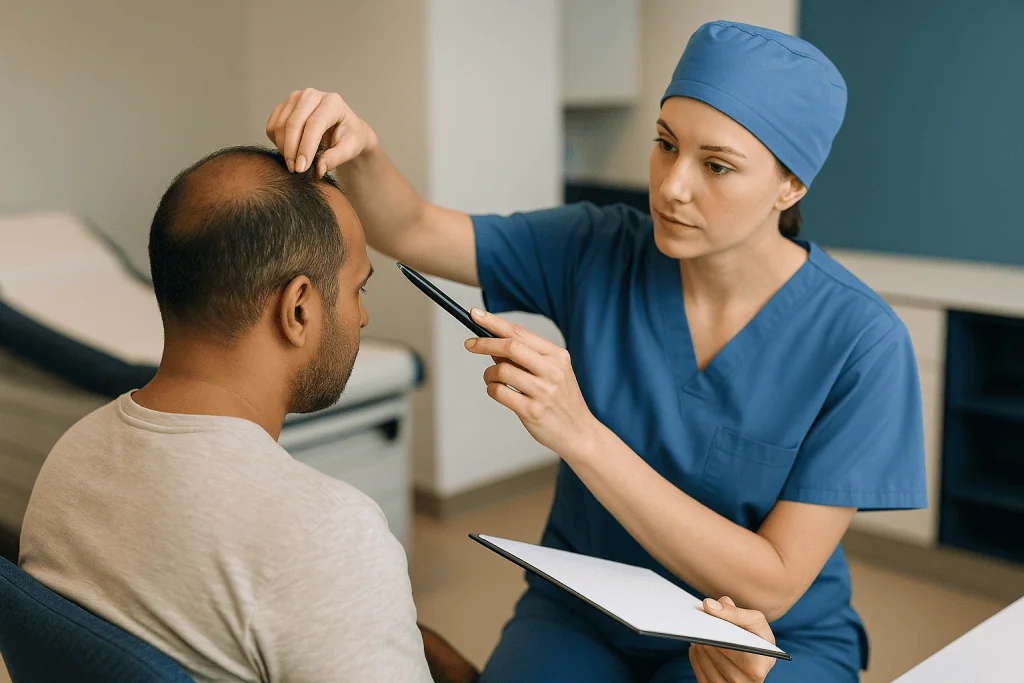
Planning matters more here than in a fully shaved case. Before any trimming, the team assesses three things. First, donor density: how many follicular units sit in each square centimeter of the safe zone. Second, hair length and behavior: straight hair that lies flat covers a window differently from tightly coiled hair that stands away from the scalp. Third, how much needs to be moved. A harvest that would be routine on a shaved head may require many windows on an unshaved one, and each window removed from a limited area increases the visible thinning within it.
Harvesting itself is unchanged. A motorized or manual punch scores the skin around each unit, following the angle at which the hair exits, and the unit is lifted out with fine forceps. The tiny openings left behind heal as pinpoint marks. What changes is visibility. Long hair falls into the field, has to be held back, and hides the exit angle of neighboring follicles, which is why surgeons describe no-shave harvesting as slower and more tiring for the operator.
An alternative some teams use is trimming individual follicular units rather than strips, selecting them one at a time and leaving every neighbor long. It is more concealed still, and slower still.
What actually happens on the day of a no shave FUE hair transplant
The morning usually begins with photographs and design. The surgeon draws the proposed hairline and the zones to be filled, then agrees the plan with the patient while both can still change their minds. Hair is washed, and the donor windows are mapped and sectioned with clips.
Local anesthetic is injected into the donor area. Patients commonly describe this as the least pleasant part; after it, the scalp is numb and the sensation is pressure rather than pain. Harvesting follows, often with the patient lying face down or seated. Extracted grafts are counted, sorted by hair number under magnification, and kept in a chilled holding solution so the follicles stay viable out of the body.
After a break, the recipient area is numbed. The surgeon creates recipient sites, tiny slits or holes made with a blade or needle, angled to match the direction of the surrounding hair. Grafts are placed into those sites one by one, either with forceps or with an implanter device that both opens the site and deposits the graft. Because the recipient hair is long, an assistant often holds sections aside or wets the hair to keep it flat.
MedlinePlus notes that a session commonly runs for several hours, and that larger plans may be split across more than one session (MedlinePlus). A no-shave session tends toward the longer end of that range for the same number of grafts, simply because every step involves working around hair rather than through stubble. Before leaving, the patient receives written aftercare, and the donor area is either left open or lightly dressed depending on the team’s protocol.
How graft placement works between existing hairs
Placing grafts into an unshaved recipient area is where the phrase hair transplant without shaving head earns its meaning for many patients, because the front of the scalp is what they see in the mirror. The technique rests on three principles: angle, density and protection of what is already there.
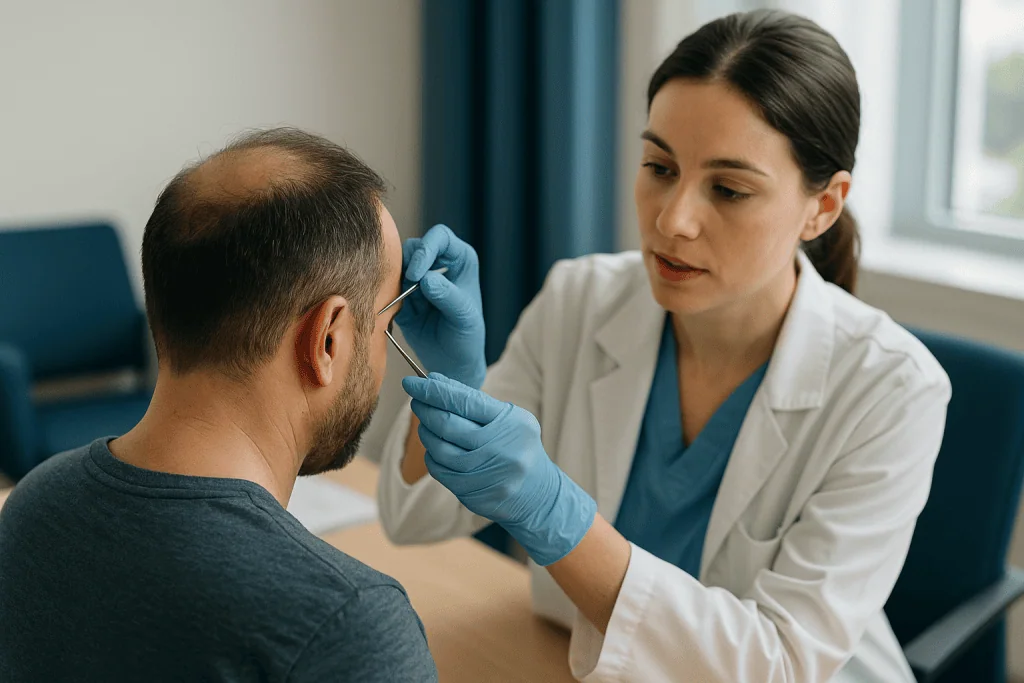
Angle first. Native hair on the hairline exits the skin at a shallow, forward-leaning angle; over the crown it fans out in a whorl. Each recipient site is cut to copy the exit angle of the nearest existing hairs, so the transplanted hair grows in the same direction and does not stand out. Long surrounding hair actually helps here, because it shows the direction clearly, though it also gets in the way of the blade.
Density second. The surgeon spaces sites so that the final result blends, placing single-hair units along the leading edge of the hairline and multi-hair units behind them for fullness. In a thinning zone that still has miniaturized hairs, sites are placed in the gaps between them.
Protection third, and this is the part most worth understanding. Existing hairs are vulnerable during surgery in two ways. The blade can cut a follicle sitting just below the surface, and the swelling and trauma of the procedure can push nearby hairs into a resting phase so they shed temporarily. Surgeons call that second effect shock loss. Mayo Clinic notes that hair loss around the treated area after surgery is usually temporary and the hair generally regrows (Mayo Clinic). Working between long hairs demands care to avoid the first problem and honesty with patients about the second, since they will see any shed strands against a full head of hair rather than stubble.
Who a no shave approach is usually for, and who is usually asked to wait
The best candidates tend to share a profile. They have enough length on the back and sides, usually a few centimeters or more, for hair to drape over trimmed windows. They need a moderate rather than very large number of grafts, so the harvest can be spread across a few windows without hollowing out any one of them. Their donor density is good. And they have a specific reason, often professional or personal, why a visibly clipped scalp for a couple of weeks is not workable.
People with advanced thinning who need a large harvest are frequently steered toward a shaved or partially shaved approach instead. Spreading thousands of grafts across hidden windows either takes several sessions or thins each window enough that the concealment stops working. Very short donor hair, or hair that will not lie flat, undermines the technique for the same reason.
Some patients are asked to wait regardless of technique. Hair transplantation moves hair; it does not stop the underlying process. NHS guidance notes that pattern hair loss is progressive and that surgery is typically considered once the pattern has become reasonably predictable, which is why very young patients are often advised to hold off (NHS). Anyone with active, patchy or inflammatory hair loss such as alopecia areata or scarring alopecias, an unexplained pattern in a woman, or an untreated scalp condition is usually asked to see a dermatologist first, because transplanting into an unstable scalp risks losing the grafts (Mayo Clinic).
Medical fitness matters too: bleeding disorders, medicines that affect clotting, poorly controlled diabetes and smoking all influence healing, and the treating team weighs them before offering any date. The decision, and any waiting period, sits with them.
Shaved FUE, partial shave, no shave and strip: how the approaches compare
Patients often arrive believing they are choosing between two options. In practice there are at least four, and the differences are about visibility, time and harvest size rather than about the quality of the follicles moved. The table below summarizes what is generally accepted among practitioners; the figures describing individual outcomes vary by patient and are for the surgeon to estimate in person.
| Approach | Donor visibility | Recipient area | Typical harvest per session | Time per graft | Main trade-off |
|---|---|---|---|---|---|
| Fully shaved FUE | Whole donor zone clipped short | Usually shaved | Largest | Shortest | Two weeks or more of visibly short hair |
| Partial shave FUE | One or two wide bands clipped, longer hair above | Often left long | Moderate to large | Moderate | Cover depends on hair length and style |
| No shave FUE (hidden windows) | Several narrow trimmed strips concealed under long hair | Left long | Smallest | Longest | Slower, more sessions for big plans |
| Strip (FUT) | Linear scar under long hair; donor hair not clipped | May be shaved or not | Large | Moderate | Permanent line scar; short haircuts may show it |
Two observations follow. The strip method is, in its own way, a no-shave technique, since the donor hair above and below the incision is left long; it is simply less often marketed that way. And partial-shave FUE frequently gives most of the concealment of a full no-shave procedure while allowing a larger harvest, which is why many surgeons propose it as a middle path.
MedlinePlus and Mayo Clinic both describe the choice of technique as one made between patient and surgeon based on the extent of loss, hair characteristics and personal priorities, rather than one method being universally superior (MedlinePlus; Mayo Clinic).
Do no shave hair transplants work?
The short answer is that the follicles do not know whether the hair around them was shaved. Graft survival depends on how gently each unit is removed, how long it spends outside the body, how it is stored and how carefully it is placed. Those variables are the same for shaved and unshaved cases. Mayo Clinic notes that transplanted hair generally grows in over the months following surgery, without distinguishing between shaving approaches (Mayo Clinic).
What the evidence does not offer is a large, high-quality trial comparing no-shave FUE directly with shaved FUE on graft survival or patient-reported outcomes. Most published descriptions are case series and technique papers from individual surgical teams, which describe results as comparable when the operator is experienced but cannot rule out bias. The honest position, then, is this: the technique is plausible and widely practiced, and there is no biological reason for it to produce inferior growth, but the comparative data are limited and no percentage should be quoted as if it were established.
Where no-shave work can genuinely underperform is indirect. If the operator struggles to see follicle angles under long hair, the rate of transected, or accidentally cut, follicles can rise. If a very long session leads to grafts sitting longer in holding solution, viability can fall. If concealment pressures the surgeon into overharvesting a small window, the donor area can thin visibly. None of these is inherent to the method; all are consequences of doing a harder job under time pressure.
So the useful question is not whether no-shave transplants work, but whether a particular team has the experience and the staffing to do them well for a plan of your size. That is a conversation to have at consultation.
The trade-offs nobody should gloss over
Concealment is bought with time, and time is not free in surgery. A no-shave session for a given graft count is longer than a shaved one, which means longer under local anesthetic, longer lying still and a longer day for the team whose concentration you are relying on. Some surgeons address this by capping the graft number per session and scheduling a second day; others by using partial rather than full concealment.
The second trade-off is harvest size. A patient hoping to address a receding hairline and a thinning crown together may find that a fully no-shave approach cannot deliver both in one sitting. Cleveland Clinic describes hair transplantation as commonly requiring more than one session for larger areas, and the no-shave method pushes further in that direction (Cleveland Clinic).
Third, the donor area still changes. Every follicle removed leaves a small dot-shaped mark that fades but does not vanish, and the density within each trimmed window drops. Long hair hides this well while the hair is long. Anyone who later prefers a very short haircut, or whose donor hair thins with age, may find that the harvested windows become visible in a way they did not anticipate.
Fourth, aftercare is fiddlier. Washing around grafts embedded among long hairs, keeping long strands from matting into healing crusts, and avoiding traction on the recipient area all require more patience than caring for a shaved scalp.
Finally, the visibility problem does not disappear so much as move. On day two, a no-shave patient can often walk into a room without comment. But redness, tiny crusts and any shock loss in the recipient zone sit among longer hair, where they can be noticed at close range for a couple of weeks. It is a smaller visibility cost than a shaved head, not zero.
What no shave hair transplant recovery usually looks like in the first two weeks
The first night is mostly about position. Teams generally ask patients to sleep with the head elevated to limit swelling, which tends to peak around the second to fourth day and can drift down toward the forehead and eyes before settling. The donor windows feel tight or tender rather than painful for most people, and the tiny openings seal within a day or two.
Washing begins early, often from the day after surgery, following the team’s written instructions exactly. The aim is to soften and eventually lift the small crusts that form around each graft without dislodging the graft itself. With long hair in the way, this means pouring rather than rubbing, patting rather than towelling, and combing only the hair well away from the recipient zone. Cleveland Clinic advises avoiding vigorous activity, direct sun on the scalp and anything that raises pressure or sweat on the head during the early healing period (Cleveland Clinic).
By around a week to ten days the crusts have usually gone, the redness is fading and the grafts are considered anchored. This is the point at which many no-shave patients say the procedure becomes essentially undetectable to others, though the individual timeline varies with skin tone, hair color and how much shock loss occurs.
Toward the end of the second week, and continuing over the following weeks, the transplanted hairs themselves begin to fall out. MedlinePlus describes this shedding as expected: the follicle survives beneath the skin while the hair shaft it carried is released, and new growth follows over the coming months (MedlinePlus). Knowing this in advance saves a great deal of alarm. Return to desk work is often possible within a few days; return to heavy exercise, swimming and hair products is something the team times individually.
From shedding to regrowth: what months one to twelve typically bring
Hair transplantation asks for patience, and the no-shave version asks for the same amount. After the early shedding, there is a quiet stretch during which little appears to happen. Follicles moved to a new site enter a resting phase before restarting growth, so the recipient area can look, for a while, much as it did before surgery. This is normal, and it is also the period when patients most often wonder whether the operation failed.
MedlinePlus notes that new hair typically begins to grow within a few months of the procedure (MedlinePlus). The first hairs tend to be fine and sometimes lighter in color; they thicken and darken with successive growth cycles. Mayo Clinic describes noticeable improvement developing over the months following transplantation, and Cleveland Clinic places the point at which most people can judge the final appearance at roughly a year, sometimes longer for crown work, which is generally slower (Mayo Clinic; Cleveland Clinic).
Any shock loss of existing hairs in the recipient area usually recovers along a similar timeline, so the mid-point of the year can look better than the early months for two reasons at once.
Follow-up visits are typically scheduled at a few points across the year, partly to check healing and partly to photograph progress under consistent lighting, because day-to-day mirror checks are unreliable. It is also the window in which the treating team may discuss whether any medical treatment for the underlying hair loss is appropriate alongside the surgery. That is a decision for the prescribing clinician; the surgery itself changes where hair grows, not whether the untreated hair around it continues to thin.
A second session, if planned, is usually considered only once the first has fully declared itself, so the surgeon can see exactly what needs adding.
What happens 10 years after a hair transplant?
People searching this question are really asking two things: will the transplanted hair still be there, and what will the rest of my hair have done in the meantime.
On the first, the reasoning is well established. Follicles from the back and sides of the scalp carry a resistance to the hormone-driven miniaturization that causes pattern hair loss, and they retain that resistance after relocation, a principle known as donor dominance. Mayo Clinic describes hair transplantation as a lasting way to restore hair in treated areas for that reason (Mayo Clinic). Transplanted hair does still age with the rest of the scalp, so it may become finer or grayer over a decade, as any hair would.
On the second, the answer is less comforting and more important. Pattern hair loss is progressive. Hair that was thinning but present at the time of surgery, and hair that was still full behind the transplanted zone, can continue to recede. Ten years on, this can leave a well-grown transplanted hairline sitting in front of an area that has since thinned, or a filled crown ringed by newer loss. This is the main reason surgeons plan conservatively in younger patients and why many discuss long-term medical management alongside surgery (NHS).
Two classes of medicine are the mainstream options for slowing ongoing loss: a topical treatment that prolongs the growth phase of the hair cycle, and an oral hormone-pathway blocker that reduces the hormone driving miniaturization in men. Mayo Clinic notes that both take months to show an effect and that stopping them allows loss to resume (Mayo Clinic). Whether either is suitable, and for how long, is a decision for the prescribing clinician.
Donor windows harvested for a no-shave procedure also age. If donor hair thins over a decade, previously hidden harvest sites can become more noticeable, particularly with shorter haircuts. That is worth factoring into the very first planning conversation.
What people often get wrong about a no shave hair transplant procedure
The first misunderstanding is that nothing is shaved. In the standard hidden-window technique, hair is trimmed; it is simply trimmed where longer hair will cover it. A fully unshaved harvest, selecting each follicle without clipping neighbors, exists but is slower still and rarely used for anything but small plans.
The second is that no-shave means invisible from day one. It means far less visible. Redness, small crusts, swelling and later shedding all still occur; they are just framed by longer hair rather than stubble.
The third is that a no-shave procedure is a different, gentler operation. It is the same FUE surgery with the same follicles, the same local anesthetic, the same recovery biology and the same limits on how much donor hair a person has for life.
The fourth concerns celebrities. Searches asking which product a particular famous person used to regrow hair have no reliable answer, because private medical histories are not published and photographs cannot distinguish surgery, medication, styling or lighting. Mayo Clinic’s account of what is actually supported for pattern hair loss lists a small number of medicines, surgery, and, with weaker evidence, low-level laser devices; nothing on that list depends on who has used it (Mayo Clinic).
The fifth is that supplements, special shampoos or scalp massage can substitute for surgery or its follow-up. Unless a deficiency has been diagnosed, mainstream guidance does not support them as treatments for pattern hair loss, and the National Institutes of Health cautions that biotin supplements, in particular, lack evidence in people who are not deficient (NIH Office of Dietary Supplements).
The last is that the number of grafts is the measure of a good result. Design, angle, density distribution and preservation of the donor area matter at least as much as the count.
Risks, alternatives and non-surgical options in neutral terms
Hair transplantation is minor surgery, and it carries the risks of minor surgery. MedlinePlus lists bleeding, infection, scarring, swelling, bruising around the eyes, numbness or altered sensation over the scalp, and hair that grows in an unnatural direction if sites are poorly angled (MedlinePlus). Mayo Clinic adds temporary shedding of existing hair around the treated area and the possibility of small bumps or cysts where grafts have been placed (Mayo Clinic). Allergic reaction to local anesthetic is rare but possible.
Risks specific to the no-shave approach are mostly the indirect ones described earlier: a higher chance of transected follicles if visibility is poor, over-harvesting within a small concealed window, and difficulty cleaning around grafts under long hair, which can raise the chance of local infection if aftercare is rushed. Longer sessions also mean more time under anesthetic.
Alternatives fall into three groups. Within surgery, the partial-shave and strip methods offer concealment with a larger harvest, each with its own donor-scar profile. Outside surgery, the two established medicine classes described above slow ongoing loss and can produce some regrowth over months, though they require indefinite use and are prescribed only after individual assessment (Mayo Clinic; NHS). Non-medical options include hair fibers, scalp micropigmentation, which is a cosmetic tattoo of dots to mimic shaved hair or reduce contrast, and hairpieces; NHS guidance lists these as legitimate ways to manage the appearance of hair loss without treating it (NHS).
Platelet-rich plasma injections and low-level laser devices are offered in many places. The evidence for both is limited and mixed, with small studies and inconsistent protocols, and neither is presented in mainstream guidance as a proven treatment. Anyone considering them alongside surgery should ask the team what the evidence actually shows rather than what is offered.
Questions to ask your care team before a hair transplant without shaving your head
Consultations go better with a list. The questions below are the ones that separate a well-planned no-shave procedure from an optimistic one.
- Given my donor density and hair length, how many grafts can be harvested through hidden windows in one session without visibly thinning any window?
- Would a partial-shave approach let you move more in a single day, and what would that look like for me in the first two weeks?
- Where exactly will the trimmed windows be, and how will they sit if I later wear my hair shorter or if my donor hair thins with age?
- Who performs each stage, harvesting, site creation and placement, and how long will the grafts spend outside the body?
- How do you protect the existing hairs in the recipient zone, and how much shock loss do you usually see with this technique?
- What is your plan if the harvest is smaller than expected on the day?
- What does aftercare involve with long hair in place, and when can I wash, exercise, swim and use styling products?
- Is my hair loss stable enough to plan a hairline now, and how will you design it so it still fits my face if loss continues behind it?
- Do you recommend medical treatment for the surrounding hair, and what would that involve over the long term?
- How will progress be photographed and reviewed, and at what points over the year?
- What would make you advise me to wait, or to choose a different technique?
Write the answers down. A team that welcomes these questions, and is willing to say that a fully no-shave plan does not suit your goals, is giving you the most useful information a consultation can provide. The decision on technique, timing and any medication remains with them and you together, not with a marketing description.
When to call your doctor
Most recovery from hair transplantation is uneventful, and most concerns can wait for a scheduled follow-up. A short list of signs, drawn from MedlinePlus and Cleveland Clinic guidance on post-procedure care, should prompt a same-day call to the treating team rather than a wait (MedlinePlus; Cleveland Clinic).
- Bleeding from the donor or recipient area that does not stop with several minutes of gentle, steady pressure with clean gauze.
- Increasing pain after the first two or three days, rather than pain that is easing.
- Spreading redness, warmth or swelling around the scalp, or yellow or foul-smelling discharge from any harvest site or graft.
- A fever, chills or feeling generally unwell in the days after surgery.
- Swelling that closes the eyes, or facial swelling on one side that is markedly worse than the other.
- Numbness that spreads or worsens beyond the first weeks, or new weakness in the face.
- A firm, painful lump under the skin that enlarges over days.
- Any reaction such as hives, wheezing or throat tightness, which needs emergency care rather than a phone call.
Some things that alarm patients are expected and not red flags: crusting in the first week, shedding of transplanted hairs from around the second week onward, small pimple-like spots as new hairs emerge months later, and itching as the scalp heals. If in doubt, the team would rather hear from you than not.
Separately from surgery, anyone who notices sudden, patchy or rapidly accelerating hair loss, hair loss with scalp pain, scaling or sores, or loss accompanied by fatigue, weight change or other symptoms should see a doctor before considering any transplant. Mayo Clinic notes that these patterns can point to conditions that need diagnosis and treatment in their own right, and that surgery is not appropriate until the scalp is stable (Mayo Clinic).
Frequently asked questions
Do no shave hair transplants work as well as shaved ones?
There is no biological reason for transplanted follicles to grow differently because surrounding hair was left long. Survival depends on gentle extraction, short time outside the body and careful placement, all of which apply equally to both approaches. Direct comparative trials are lacking, however, so claims of equal or better results rest on surgeon experience rather than robust data.
Is anything shaved at all in a no shave FUE hair transplant?
Usually yes. The standard technique trims several narrow strips in the donor area and lets longer hair above cover them. A fully unshaved harvest, selecting follicles one by one without trimming neighbors, is possible but very slow and generally reserved for small plans. The recipient area is typically left uncut in both versions.
How long does a no shave hair transplant procedure take?
MedlinePlus describes hair transplant sessions as generally lasting several hours under local anesthetic. A no-shave session for the same graft count usually runs longer than a shaved one, because harvesting and placement around long hair are slower. Larger plans are often divided across more than one day rather than compressed into a single very long session.
What does no shave hair transplant recovery look like in the first week?
Expect mild tenderness at the donor windows, swelling that peaks in the first few days, and small crusts around each graft that are softened by gentle washing. Long hair is kept away from the recipient zone and combed only where safe. By about a week to ten days the crusts have usually cleared and the grafts are considered anchored.
Will the transplanted hair fall out?
Yes, temporarily. From roughly the second week the hair shafts of transplanted grafts shed while the follicles remain in place beneath the skin. MedlinePlus notes that new growth typically begins within a few months, first as fine hairs that thicken over successive cycles. This shedding is expected and does not mean the procedure has failed.
What happens 10 years after a hair transplant?
Transplanted follicles keep the resistance to pattern hair loss they had in the donor area, so they generally persist, though they age like any hair. The surrounding native hair can continue to thin, which may leave the transplanted zone looking isolated unless further treatment or surgery is planned. Donor windows may also become more visible if donor hair thins.
Can I have a hair transplant without shaving my head if my hair is short?
Concealment depends on having enough length above each trimmed window to cover it, usually a few centimeters. Very short donor hair leaves little to drape, so a surgeon may suggest growing it out first, accepting a partial shave, or considering the strip method, which does not clip donor hair but leaves a linear scar.
Who is usually asked to wait before a no shave hair transplant?
People whose hair loss is still evolving, particularly younger patients, are often advised to wait until the pattern is more predictable. Anyone with patchy, inflammatory or unexplained loss, an active scalp condition, or health factors that impair healing is generally assessed and treated first. Those needing very large harvests may be steered toward a shaved or partial-shave approach.
What did a celebrity use to regrow their hair?
Reliable answers do not exist, because private medical histories are not published and photographs cannot separate surgery, medication, styling and lighting. Mayo Clinic lists a small number of evidence-supported options for pattern hair loss: two established medicine classes, surgical transplantation and, with weaker evidence, low-level laser devices. None depends on who has used them.
How much does a no shave hair transplant cost?
Pricing varies widely by region, graft number, team and whether more than one session is needed, and this article does not quote figures. NHS guidance notes that hair transplantation for pattern hair loss is generally considered cosmetic and not routinely funded. A consultation with a qualified team is the only reliable way to obtain a written estimate for an individual plan.
References
This article is for general information only and is not a substitute for professional medical advice. Please consult a qualified doctor about your individual situation.

More from the Blog
What Happens During PRP for Hair Loss: From the Blood Draw to the Scalp Injections
During PRP for hair loss, a clinician draws a small tube of your own blood, spins it in a centrifuge to separate a platelet-rich…
How Surgeons Assess Keloid Risk and Scar Tendency Before an Afro Hair Transplant
Before an afro hair transplant, surgeons assess keloid risk by asking about personal and family scar history, examining existing scars anywhere on the body,…
Beard Transplant Recovery: Healing Without Ruining the Grafts
Most people are socially presentable within 7 to 10 days of a beard transplant, but biological recovery takes months. Grafts anchor securely by about…
How Technique Choice Changes Shaving and Placement: FUE or DHI for a Female Hair Transplant?
For a female hair transplant, FUE and DHI use the same method of harvesting follicles one by one from the back of the scalp;…
Hair Transplant Without Shaving Results: Does Working Around Existing Hair Limit Density?
A hair transplant can be done without shaving the whole head, usually as an unshaven or partially shaved follicular unit extraction. Working around existing…
Who Suits Scalp Micropigmentation for Scars and Thinning, and Who Needs Another Approach?
Scalp micropigmentation for scars usually suits adults whose scar is fully healed and flat, whose skin does not tend to form raised keloids, and…