

How Immunotherapy for Melanoma Skin Cancer Is Given, Cycle by Cycle

Key Takeaways
- Checkpoint inhibitors for melanoma do not attack the cancer directly; they block brake proteins such as PD-1 and CTLA-4 on T cells so the immune system can act, which is why side effects are inflammatory rather than the hair loss and low blood counts of chemotherapy.
- Treatment is given by intravenous infusion in cycles roughly every few weeks, with blood tests and a structured symptom screen before each one, and a delayed cycle usually means the monitoring is working, not that treatment has failed.
- Adjuvant immunotherapy after surgery for stage III melanoma has generally been studied and given for around a year, while treatment for advanced disease often continues longer or until progression or side effects, according to the trials the NCI summarizes.
- Immune-related side effects can involve the skin, gut, liver, lungs and hormone glands, tend to appear at different times over the course of treatment, and can emerge months after the last infusion, so follow-up blood tests continue after treatment ends.
- A tumor that looks larger on an early scan may be showing pseudoprogression, swelling from infiltrating immune cells, so teams often confirm apparent growth with a repeat scan before changing course.
- No single life-expectancy figure applies to someone receiving immunotherapy for melanoma, because published statistics describe past groups treated before or during a period of rapid change; only your own team, with your stage and scans, can give a realistic range.
Immunotherapy for melanoma is usually given as an intravenous infusion in repeating cycles, typically every few weeks, with blood tests and a symptom review before each one. After surgery it is commonly planned for around a year; for advanced melanoma it often continues longer, depending on response and side effects. Because the side effects come from the immune system itself, they can appear at any point, so early reporting matters.
The envelope from the pathology lab is thinner than you expect for something that rearranges a year. Sentinel node positive. A week later you are sitting in an infusion-suite orientation, holding a laminated calendar with small colored squares on it, and the nurse is saying “cycle” the way other people say “Tuesday.”
If you are searching for immunotherapy for melanoma and what to expect, that calendar is probably what you want decoded. Not the biology in the abstract, but the practical shape of it: what happens on infusion day, how many weeks pass between visits, what the first few days afterward tend to feel like, and how anyone knows whether it is working.
This explainer walks through the treatment in the order you will actually live it, from the pre-treatment blood draw to the last follow-up scan. It sticks to what mainstream evidence supports, says plainly where the evidence is thin, and leaves every decision where it belongs: with you and the team treating you.
How immunotherapy for melanoma works, in plain language
Immunotherapy is treatment that helps your own immune system recognize and attack cancer cells, rather than a drug that attacks the cancer directly. The type used most often for melanoma is a class called immune checkpoint inhibitors.
Here is the mechanism without the jargon. Your T cells (the immune system’s patrol officers) carry brake proteins on their surface so they do not attack healthy tissue. Two of the best studied are PD-1 and CTLA-4. Melanoma cells learn to press those brakes, effectively showing a false ID badge that says “nothing to see here.” A checkpoint inhibitor is a laboratory-made antibody that blocks the brake, so the T cell can look again and, often, act. The National Cancer Institute describes PD-1, PD-L1 and CTLA-4 blockers as the main checkpoint inhibitors in use, with a newer target called LAG-3 also approved in combination for melanoma.
Why melanoma in particular? Years of ultraviolet damage leave melanoma cells carrying an unusually high number of genetic changes, which makes them look more foreign to T cells than many other cancers do. That is part of why melanoma was among the first cancers for which checkpoint inhibitors were approved.
The same mechanism explains the side-effect profile. Release the brakes and the immune system can also turn on normal skin, gut lining, liver or hormone glands. Unlike chemotherapy, which damages any rapidly dividing cell, checkpoint inhibitors do not typically cause hair loss or mouth sores; their risks come from friendly fire. Understanding that single idea will make almost everything else in this article, from the pre-treatment thyroid test to the red-flag list, make sense.
Which stage of melanoma requires immunotherapy, and who is usually asked to wait
Melanoma is staged from 0 to IV. Stages 0 to II mean the tumor is confined to the skin; stage III means it has reached nearby lymph nodes or skin channels; stage IV means it has spread to distant organs. Surgery remains the main treatment for melanoma confined to the skin, and the NHS notes that many early melanomas need no treatment beyond removal and follow-up.

Immunotherapy typically enters the conversation in three situations. The first is adjuvant treatment, meaning treatment given after surgery to lower the chance of the cancer returning. According to the NCI’s melanoma treatment summary, this is an established option for stage III disease, and it is also considered for some higher-risk stage II melanomas, judged by tumor thickness and ulceration. The second is neoadjuvant treatment, given before surgery, an approach that is increasingly used in stage III disease under specialist guidance. The third is melanoma that cannot be fully removed, or has spread, where checkpoint inhibitors are a standard systemic treatment, sometimes alongside or instead of targeted therapy for people whose tumor carries a BRAF mutation (a specific gene change found in roughly half of melanomas, per the NCI).
Who is usually asked to wait, or offered something else? People with thin, early melanomas, because the added risk is not justified by the expected benefit. People with active autoimmune disease, a transplanted organ, or significant liver or lung problems need a careful, individual weighing of risk, since releasing immune brakes can worsen those conditions. Pregnancy is another situation that requires a specific discussion. None of these is an automatic no; each is a reason for a longer conversation with the treating team, who hold the full picture.
Before the first cycle: what the pre-treatment checks are for
The week before cycle one is mostly measurement. It can feel like stalling. It is not.
Expect blood tests that establish a baseline: blood counts, kidney and liver function, blood glucose, and thyroid hormones. Some centers also check morning cortisol, the adrenal stress hormone, and a heart tracing (ECG). The point is comparison. When a liver enzyme drifts upward in cycle four, the team needs to know what it was before any drug was given, because immune-related inflammation of the liver or thyroid often shows up in the blood before you feel anything.
You will also have staging scans, commonly a CT or PET-CT, and sometimes an MRI of the brain, since melanoma can spread there. The Mayo Clinic lists these imaging tests as part of standard workup for advanced disease. These scans become the reference images against which every later scan is judged.
A medication and health review follows. Be candid about autoimmune conditions, even mild ones such as psoriasis or a thyroid problem, and about every supplement you take. Herbal products are not automatically harmless in this setting, and the team can only weigh what it knows about.
Consent is a conversation, not a signature. You should hear the intended goal (reducing recurrence risk versus controlling existing disease), the planned length, the main risks and the alternatives, including surveillance alone or targeted therapy where relevant. Many centers hand you a card to carry stating that you are on a checkpoint inhibitor, so that an emergency department treats a new symptom with that in mind.
Last practical detail: most people receive the drug through a small cannula in the arm. A central line or port is rarely needed for this class of treatment.
How is immunotherapy given for melanoma? Infusion day, hour by hour
Checkpoint inhibitors for melanoma are given intravenously, into a vein, as the NHS and NCI both describe. There is no tablet version of this class. Here is a typical day, though your center’s own information sheet is the final word.
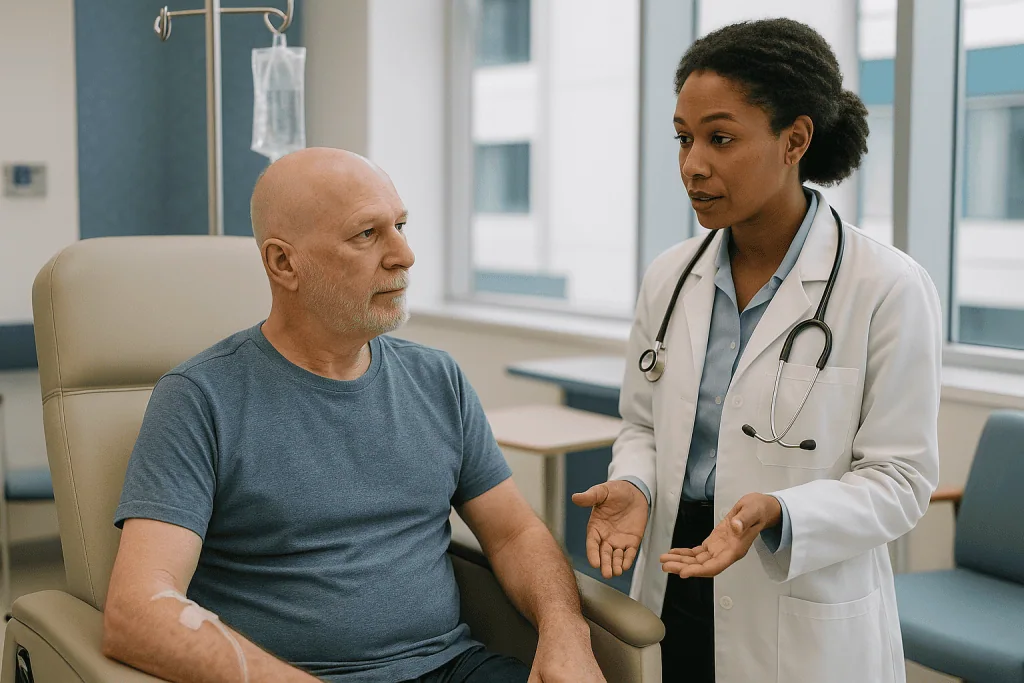
You arrive and are weighed, because the drug is prepared in the pharmacy for you specifically. A nurse checks blood pressure, pulse, temperature and oxygen level, then asks a structured set of questions: any diarrhea, new rash, cough, headaches, unusual tiredness, changes in vision? This is not small talk. It is the screening step that catches immune-related problems early, and honest answers protect you.
Your blood results are reviewed, often drawn a day or two beforehand so the team can decide before you travel in. If a liver test or thyroid level is out of range, the cycle may be delayed. A delay is not a failure; it is the system working as designed.
Once the clinician clears you, the pharmacy compounds the infusion, which is why there is often a wait. The drip itself commonly runs for around half an hour to an hour, depending on the drug and the regimen. Pre-medications such as antihistamines are not routinely needed for this class, unlike some chemotherapy. You sit in a recliner, can read, eat, and use your phone. Afterward there is usually a short observation period, then you go home.
Plan for a half day, and for the first cycle bring someone with you. Most people can drive themselves to later visits unless told otherwise. Serious reactions during the infusion are uncommon, but the nurse will describe what to flag: flushing, chills, breathlessness, chest tightness or dizziness during the drip.
Cycle by cycle: how the treatment schedule unfolds
A cycle means one treatment plus the rest interval that follows before the next. The NCI explains that immunotherapy is often given in cycles precisely so the body has time to respond and recover between doses. The interval depends on which drug or combination you receive and on the dosing regimen your oncologist selects; for checkpoint inhibitors in melanoma, visits fall roughly every few weeks, and the interval can be lengthened later in treatment without changing the intent. When a PD-1 blocker is combined with a CTLA-4 blocker, there is commonly an initial combination phase followed by a longer maintenance phase on the single agent.
| Phase | What usually happens | Typical timing |
|---|---|---|
| Baseline | Blood tests, scans, medication review, consent | The week or two before cycle 1 |
| Cycle 1 | First infusion, closest monitoring | Day 1 |
| Early cycles | Repeat infusions; symptom screen and bloods each visit | Every few weeks, per regimen (NCI) |
| First response scan | Imaging compared with baseline | Commonly after the first several cycles, set by your center |
| Ongoing treatment | Continued cycles; scans at intervals; watch for immune effects | Months |
| Planned end | Around a year in the adjuvant setting; often longer in advanced disease (NCI) | Varies with goal and response |
| Follow-up | Skin checks, bloods, scans; side effects can still emerge | Years |
Two habits make cycles easier. Keep a simple diary of symptoms and bowel movements, so the pre-infusion questions have real answers. And ask at each visit what has changed in your blood results, even when everything is normal. Knowing your own trend line turns a bewildering schedule into something you can follow.
Immunotherapy for melanoma: what to expect in the first days after an infusion
People who have watched a friend go through chemotherapy often brace for a crash on day three. Immunotherapy does not usually behave that way, and the question “how many days after immunotherapy do you feel bad?” has a more variable answer than most expect.
Many people feel much as they did before the infusion. When something does happen in the first one to three days, it is most often tiredness, mild aches, a low-grade flu-like feeling, or itchy skin. The NCI lists fatigue, flu-like symptoms and skin reactions among the more common effects of checkpoint inhibitors. These early effects tend to be mild and settle on their own; a quiet evening and normal meals are usually enough.
What does not happen with this class, as a rule, is the predictable pattern of chemotherapy: no hair loss, no drop in white blood cells on a set day, no metallic taste or mouth ulcers. Appetite is usually preserved. Because of that, the fatigue can be surprising in a different way. It is often cumulative rather than acute, building gently across cycles rather than hitting hard after each one.
Infusion reactions, the body’s immediate response to a foreign protein in the vein, are uncommon with checkpoint inhibitors and, when they occur, happen during the drip or within the following hours. This is why the observation period exists.
The more meaningful “feeling bad” with immunotherapy usually arrives later and looks different: diarrhea that persists, a rash that spreads, a cough that lingers, a headache that will not shift. Those belong in the next section, and they are the reason the daily diary matters more than the calendar.
Immunotherapy for melanoma side effects: why the timing is different from chemotherapy
Doctors call these immune-related adverse events: side effects caused by the newly unbraked immune system attacking healthy tissue. Almost any organ can be involved, but a handful account for most cases, according to the NCI’s summary of immunotherapy side effects.
- Skin: rash, itching, patches of lost pigment (vitiligo).
- Gut: diarrhea and colitis, which is inflammation of the bowel lining.
- Liver: hepatitis, usually silent at first and found on blood tests.
- Lungs: pneumonitis, an inflammation that causes cough and breathlessness.
- Hormone glands: thyroid over- or underactivity, inflammation of the pituitary gland, adrenal insufficiency, and occasionally new-onset diabetes.
- Less often: joints, nerves, kidneys, eyes, and rarely the heart muscle.
Timing is the key difference from chemotherapy. Skin effects tend to appear earliest, in the first weeks; gut and liver inflammation more often in the following weeks to months; hormone effects can be later still. The NCI is explicit that immune-related effects can occur at any time during treatment and even after it has stopped, sometimes months later. That is why follow-up bloods continue after your last infusion.
Most effects are mild to moderate and manageable. Some, particularly hormone gland damage, can be permanent, leaving a person on lifelong hormone replacement for the thyroid or adrenal glands. Combining a CTLA-4 blocker with a PD-1 blocker increases both how often and how severely these events occur compared with a PD-1 blocker alone, which is a central part of the benefit-and-risk conversation for advanced disease.
Management follows a graded approach: mild effects are watched or treated symptomatically; moderate ones may mean pausing treatment and starting corticosteroids, medicines that dampen the immune response; severe ones require hospital care. Two rules protect you: never treat persistent diarrhea with over-the-counter remedies without calling the team first, and never adjust any medicine the team has prescribed without speaking to them.
What the following weeks and months usually look like
Once the first cycles are behind you, life settles into a rhythm: an infusion, a stretch of ordinary weeks, a blood draw, another infusion. The milestones that punctuate it are scans.
Response is judged by comparing imaging with your baseline. The Mayo Clinic describes periodic scans as the way teams monitor advanced melanoma during treatment; the exact interval is set by your center, often a matter of a few months. In the adjuvant setting, where there is no visible tumor to measure, scans are looking for anything new, and a clear scan is the good news it sounds like.
Reading scans on immunotherapy requires patience. Tumors can appear larger on an early scan because they are swollen with infiltrating immune cells, not because they are growing. This is called pseudoprogression, and the NCI notes it as a recognized phenomenon with checkpoint inhibitors. Responses can also be slow to appear, or mixed, with some spots shrinking while others hold steady. Experienced teams often confirm apparent growth with a repeat scan before changing course, provided you are well. If your first scan is ambiguous, ask directly whether pseudoprogression is on the list of explanations.
Between scans, the work is surveillance of you rather than the tumor. Bloods before each cycle track liver and thyroid function. You will be asked about energy, bowels, breath and mood. Fatigue tends to accumulate rather than spike; gentle regular exercise is generally encouraged, and the American Heart Association’s physical activity guidance for adults is a reasonable frame unless your team advises otherwise.
Sun protection continues to matter. Immunotherapy does not make skin sun-resistant, and you remain at risk of new melanomas, so the same hat, shade and broad-spectrum sunscreen habits apply, along with regular skin checks.
Combination immunotherapy and the other kinds you might hear about
Most people receiving immunotherapy for melanoma get a PD-1 blocker, either alone or in combination. But you may hear other names in clinic or online, and knowing what they are keeps the conversation grounded.
PD-1 plus CTLA-4 blockade releases two different brakes at once. Trials summarized by the NCI show higher response rates than single-agent treatment in advanced melanoma, at the cost of more frequent and more serious immune-related effects. PD-1 plus LAG-3 blockade is a newer combination that targets a third checkpoint and appears to add benefit with a side-effect profile closer to single-agent treatment; it is approved for advanced melanoma.
Tumor-infiltrating lymphocyte therapy, usually shortened to TIL therapy, is different in kind. T cells are harvested from a piece of your own tumor, expanded to enormous numbers in a laboratory, and returned to you after a short course of chemotherapy to make room for them. It is a one-time hospital treatment rather than a series of outpatient cycles, and it is an option for some people whose advanced melanoma has progressed after checkpoint inhibitors.
Oncolytic virus therapy uses a modified virus injected directly into skin or lymph node deposits to trigger a local immune reaction; it is used for melanoma that can be reached with a needle. Interleukin-2, one of the earliest immunotherapies, is a high-intensity inpatient treatment now used far less often. Personalized cancer vaccines, including mRNA approaches, are in clinical trials and are not yet a standard option.
The decision among these rests on your stage, tumor genetics, general health, prior treatment and your own priorities. Where a clinical trial is available, it is a legitimate option to ask about, not a last resort.
How long does melanoma immunotherapy last?
Length depends on why you are having it.
After surgery, adjuvant checkpoint inhibitor treatment has generally been studied and given for around a year, which is the duration the NCI’s melanoma summary reflects from the trials that established it. The logic is that a year gives the immune system a sustained window to find and eliminate microscopic cells, after which continuing adds risk without clear added benefit. Stopping at the planned end point is the intended outcome, not a downgrade.
For melanoma that has spread or cannot be removed, treatment often continues longer. In the trials described by the NCI, checkpoint inhibitors were typically continued for up to about two years, or until the cancer progressed, or until side effects made stopping the safer choice. Some people who achieve a complete response, meaning no detectable disease on scans, stop earlier after discussion with their team; whether and when to do so is an individualized judgment, and the evidence on the ideal stopping point is still developing.
Treatment also stops for reasons other than the calendar. A serious immune-related event may mean a permanent halt even when the melanoma is responding, because the immune activation that caused the damage can persist. Conversely, some people who stop early for toxicity keep responding for a long time afterward, a feature of this class that distinguishes it from chemotherapy, where the effect fades when the drug does.
Neoadjuvant treatment, given before surgery, is the shortest course by design, typically a small number of cycles followed by the operation and then a decision about further treatment based on what the pathologist finds.
Whatever the plan, ask for it in writing, including what would prompt the team to change it.
Does melanoma respond well to immunotherapy? What the evidence actually shows
Compared with most solid cancers, yes, and that statement can be made carefully. Melanoma was among the first cancers for which checkpoint inhibitors were approved, and the NCI’s treatment summary describes randomized trials in which PD-1 blockers, alone or in combination, improved survival in advanced melanoma compared with the chemotherapy and earlier immunotherapy that preceded them. In the adjuvant setting, trials showed a lower rate of recurrence after surgery for stage III disease. Those are the reasons this treatment became standard.
The honest qualifications matter just as much. Not everyone responds. Some melanomas show no shrinkage from the start, a pattern called primary resistance, and some respond for a time and then begin to grow again. Researchers have not found a single reliable blood or tissue test that predicts who will benefit; the PD-L1 marker used in some other cancers is not a dependable gate for melanoma treatment decisions. Factors associated with a better chance of response include a smaller volume of disease and normal levels of a blood enzyme called LDH, but these are group-level tendencies, not individual guarantees.
Melanoma type also matters. Uveal melanoma, which begins in the eye, responds less often to checkpoint inhibitors than skin melanoma, and mucosal melanomas sit somewhere in between.
One more point worth holding onto: responses to this class, when they occur, are often durable, continuing after treatment ends. That durability is what changed the outlook for advanced melanoma over the past decade. But “often” is not “always,” and the only response that matters to you is your own, read scan by scan with your team.
Average life expectancy with melanoma on immunotherapy: why there is no single honest number
This is one of the most searched questions about melanoma treatment, and any single figure offered in answer should be treated with suspicion. Here is why.
Published survival statistics describe groups of people diagnosed years earlier, followed for years more. The people in those groups were treated with whatever was standard at the time, and for melanoma the standard shifted dramatically with checkpoint inhibitors. A statistic gathered from people who never had access to these drugs says little about someone starting them now, and even recent trial data describe an average across people whose disease, age and health varied widely.
Stage changes everything. Someone receiving adjuvant treatment after surgery for stage III melanoma has no measurable disease and a very different outlook from someone with melanoma in the liver and brain. Within stage IV, the number of sites involved, LDH level, BRAF status, tumor type and general fitness all move the picture. Averages flatten those differences into a number that fits nobody.
The pattern that has emerged across trials, without pinning it to a percentage, is that a meaningful share of people with advanced melanoma treated with checkpoint inhibitors remain alive many years later, something that was uncommon before this class existed. That is real and worth knowing. It is also not a promise.
The useful version of this question is personal: “Given my stage, my scans, my mutation status and my health, what range of outcomes do you think is realistic, and what would change it?” Your oncologist can answer that with your own data. A search engine cannot, and it should not try.
What people often get wrong about immunotherapy for melanoma
“It’s a gentler kind of chemo.” It is not chemotherapy at all. The drugs do not attack dividing cells; they change what your immune system is permitted to attack. That is why the side effects are inflammatory and can involve hormone glands, not hair or blood counts.
“Because it uses my own immune system, it’s natural and low-risk.” An unbraked immune system can inflame the bowel, liver or lungs. The Cleveland Clinic and NCI both describe serious, occasionally life-threatening immune-related effects. Respect the treatment.
“The tumor looked bigger on the scan, so it has failed.” Early apparent growth can be immune cells flooding the tumor. Ask about pseudoprogression before drawing conclusions.
“Side effects mean it’s working; no side effects mean it isn’t.” Some studies have found a loose association between immune-related events and response, but plenty of people respond with no side effects at all. Do not read your rash as a scan.
“I feel fine, so I can stop.” Or the reverse: “I should push through anything.” Both are decisions for the team, based on scans, bloods and a graded assessment of any side effect.
“Supplements will boost my immune system and help.” Herbal and high-strength products can interact with treatment or muddy the liver tests the team relies on. Disclose everything; add nothing without asking.
“I can’t have any vaccines.” Inactivated vaccines, including the standard flu shot, are generally considered appropriate during checkpoint inhibitor treatment; live vaccines need discussion. Confirm timing with your team.
“Once the infusions end, I’m done.” Immune effects can emerge after stopping, and new melanomas can arise. Follow-up is part of the treatment.
Questions to ask your care team
The first oncology visit moves fast, and the questions you meant to ask tend to surface in the parking lot. Bring this list, or a version of it, and do not be shy about asking for answers in writing.
- What is the goal of my immunotherapy: lowering the chance of recurrence, or controlling melanoma that is already present?
- Which drug or combination are you recommending, and why that one for my stage and tumor type?
- Has my tumor been tested for a BRAF mutation, and how does the result affect my options?
- How often will I come in, how long will each visit take, and how long is the overall plan?
- Which blood tests will you follow, and what would a concerning result look like?
- What are the side effects you most want me to call about, and who exactly do I call, day and night?
- If I develop a serious immune-related effect, what happens to my treatment?
- When is my first scan, and how will you interpret a result that is unclear?
- Are there clinical trials I would be eligible for, now or if this stops working?
- What are the alternatives, including surveillance alone or targeted therapy, and what are their trade-offs?
- Can I keep working, exercising and traveling, and is there anything I should avoid?
- Which vaccines can I have during treatment, and when?
- Are any of my current medicines or supplements a concern?
- Who coordinates my care if I see other specialists, such as an endocrinologist or dermatologist?
- What will follow-up look like after treatment ends, and for how long?
A good team welcomes these questions. If an answer is “we don’t know yet,” that is often the most honest reply, and it is worth hearing.
When to call your doctor
Immune-related side effects are most manageable when caught early, and the single most protective habit during immunotherapy is a low threshold for picking up the phone. Your center will give you a 24-hour contact number. Use it. Nobody on that line will think you are wasting their time.
Call the same day, without waiting for your next appointment, if you notice any of the following, which the NCI and Cleveland Clinic list among the warning signs of immune-related effects:
- Diarrhea that is new or increasing, especially several loose stools a day, or any blood or mucus in the stool, or abdominal pain and cramping.
- New or worsening cough, shortness of breath, or chest pain or tightness.
- Yellowing of the skin or eyes, dark urine, pale stools, or pain under the right ribs.
- A rash that is spreading, blistering, peeling, or involves the mouth, eyes or genitals.
- Severe or persistent headache, vision changes, unusual dizziness, or fainting.
- Extreme tiredness, confusion, marked weight change, feeling very cold or very hot, or a racing or very slow heartbeat, any of which can signal a hormone gland problem.
- Excessive thirst, frequent urination, or fruity-smelling breath, which can indicate new diabetes.
- Fever, particularly if you also feel unwell or shivery.
- Muscle weakness, numbness or tingling, or new joint pain and swelling.
Seek emergency care immediately for severe breathing difficulty, chest pain, signs of a stroke, a severe allergic reaction, fainting, or diarrhea so heavy you cannot keep fluids down. Tell the emergency staff you are receiving a checkpoint inhibitor and show your treatment card; the standard treatment for these effects differs from that for infections, and the distinction matters.
Between cycles, keep the symptom diary and report changes at every visit. The team’s job is to decide what a symptom means. Your job is only to make sure they hear about it.
Frequently asked questions
What stage of melanoma requires immunotherapy?
Immunotherapy is usually considered for stage III melanoma after surgery, for some higher-risk stage II melanomas, and for stage IV or unresectable melanoma, according to the National Cancer Institute’s treatment summary. Thin, early melanomas are generally treated with surgery and follow-up alone, because the added risk of immunotherapy is not justified by the expected benefit at that stage. The decision depends on tumor thickness, ulceration, lymph node findings and your overall health, and rests with your treating team.
How many days after immunotherapy do you feel bad?
There is no predictable bad day with checkpoint inhibitors, unlike the day-three slump many people associate with chemotherapy. Some people feel entirely normal; others notice tiredness, mild aches, a flu-like feeling or itchy skin during the first one to three days, which usually settles on its own. The more significant effects, such as persistent diarrhea, a spreading rash or a lingering cough, tend to appear weeks or months in and should be reported promptly rather than waited out.
Does melanoma respond well to immunotherapy?
Melanoma is among the cancers that respond best to checkpoint inhibitors, and randomized trials summarized by the NCI showed improved survival in advanced disease and lower recurrence after surgery for stage III melanoma. Not everyone responds, however; some melanomas resist treatment from the start and others respond then progress. Uveal melanoma, which starts in the eye, responds less often. No single test reliably predicts who will benefit, so response is judged by scans over time with your team.
What is the average life expectancy for someone with melanoma who receives immunotherapy?
No single figure is honest, because published survival statistics describe groups diagnosed years ago, often before checkpoint inhibitors were standard, and they average across very different stages and health situations. Someone receiving adjuvant treatment after surgery has a very different outlook from someone with melanoma in several organs. Trials have shown that a meaningful share of people with advanced melanoma remain alive many years after checkpoint inhibitor treatment, but your own oncologist, using your stage, scans and mutation status, is the only reliable source for a realistic range.
How is immunotherapy given for melanoma: a pill or an infusion?
Checkpoint inhibitors for melanoma are given as an intravenous infusion through a small cannula in the arm, as the NHS and NCI describe; there is no tablet version of this class. The infusion itself commonly takes under an hour, though the appointment is longer because of the symptom check, blood-result review and pharmacy preparation beforehand. A central line or port is rarely needed. Other immunotherapies, such as oncolytic virus injections or TIL therapy, are delivered differently and are used in specific situations.
How long does melanoma immunotherapy last after surgery?
Adjuvant checkpoint inhibitor treatment after surgery has generally been studied and given for around a year, which is the duration reflected in the trials the National Cancer Institute summarizes for stage III melanoma. Reaching that planned end point is the intended outcome. Treatment may stop earlier if a serious immune-related side effect develops or if the melanoma returns despite treatment. Follow-up blood tests and skin checks continue afterward, because immune effects and new melanomas can still appear.
Is immunotherapy for stage 3 melanoma given before or after surgery?
Most commonly after surgery, as adjuvant treatment intended to lower the chance of recurrence, which is the established approach in the NCI’s melanoma treatment summary. Giving immunotherapy before surgery, called neoadjuvant treatment, is increasingly used for stage III disease under specialist guidance, typically for a short number of cycles followed by the operation, with the pathology result then guiding further treatment. Which sequence suits you depends on your lymph node findings, tumor characteristics and your team’s assessment.
What are the most common immunotherapy for melanoma side effects?
The most common are fatigue, skin rash and itching, and diarrhea, according to the NCI’s summary of immunotherapy side effects. Less common but important are inflammation of the liver, lungs or bowel, and hormone gland problems affecting the thyroid, pituitary or adrenal glands, some of which can be permanent. Combining a CTLA-4 blocker with a PD-1 blocker raises both the frequency and severity of these effects. Because they can appear at any time, including after treatment ends, early reporting to your team is essential.
Can I work, exercise and travel during immunotherapy for melanoma?
Many people continue working and exercising through treatment, since checkpoint inhibitors do not usually cause the blood-count drops or nausea that limit activity during chemotherapy; fatigue tends to build gradually rather than spike. Regular moderate exercise is generally encouraged unless your team advises otherwise. Travel is often possible between cycles, but discuss it first, carry your treatment card and the center’s contact number, and know where you would seek care if a new symptom such as diarrhea or breathlessness developed away from home.
Can I have vaccines during immunotherapy for melanoma?
Inactivated vaccines, such as the standard flu shot, are generally considered appropriate during checkpoint inhibitor treatment and are often recommended because infections are harder to sort from immune-related effects. Live vaccines require individual discussion, and some teams prefer to time any vaccine away from an infusion day. Always confirm with your oncology team before receiving any vaccine, and tell the person giving it that you are on immunotherapy so any reaction can be interpreted correctly.
This article is for general information only and is not a substitute for professional medical advice. Please consult a qualified doctor about your individual situation.

More from the Blog
Surgery or Chemoradiation for Cervical Cancer? What Makes Each Path the Better Fit
Surgery and chemoradiation treat cervical cancer about equally well when each is matched to the right stage. Surgery is usually chosen for small tumors…

How Long After Radioiodine Treatment Does the Thyroid Respond? A Realistic Timeline
Radioactive iodine does not work immediately. For an overactive thyroid, hormone levels usually begin falling within a few weeks, and most people notice the…

Questions to Ask Your Dermatologist or Oncologist Before Skin Cancer Treatment
Before skin cancer treatment, ask your dermatologist or oncologist what type and stage of skin cancer you have, what the pathology report says, which…
Esophagectomy for Esophageal Cancer: What Happens in the Operating Room and After
An esophagectomy removes part or most of the esophagus, usually along with nearby lymph nodes, and rebuilds the swallowing tube by pulling the stomach…
Surveillance or Chemotherapy After Testicular Cancer Surgery: How the Choice Is Made
After an orchiectomy for stage I testicular cancer, teams choose between active surveillance and adjuvant chemotherapy by weighing the tumor type (seminoma or nonseminoma),…
Who Is Eligible for CAR-T Cell Therapy? Prior Treatments, Cancer Type and Fitness Checks
Eligibility for CAR T-cell therapy rests on three things: a cancer type and target protein the approved treatments are designed for (currently certain B-cell…