

How Long Does a TMS Course Last? From the First Mapping Session to the Final Visit

Key Takeaways
- A standard TMS course for depression runs about four to six weeks of weekday sessions, roughly 20 to 36 treatments, with the exact count set by the treating clinician.
- The first visit is a mapping session that finds your motor threshold and coil position, and it typically runs longer than every session that follows.
- Standard rTMS stimulation lasts about 20 to 40 minutes per session, while intermittent theta burst compresses it to roughly three to ten minutes without shortening the number of weeks.
- Early improvement, when it comes, most often appears in the second to fourth week, so an uneventful first week is expected rather than a sign of failure.
- Scalp discomfort and headache are the most common side effects and usually ease within the first week or two; seizure is the rare serious risk that screening is designed to reduce.
- There is no fixed lifetime limit on TMS courses, but repeat or maintenance courses are individual clinical decisions, and the evidence for maintenance schedules is thinner than for the initial course.
A standard TMS course for depression usually runs about four to six weeks of weekday sessions, roughly 20 to 36 treatments, after an initial mapping visit that sets the coil position and stimulation level. Standard sessions take about 20 to 40 minutes; newer theta burst protocols are shorter. Some clinics add a brief taper. Your treating team sets the exact length and may adjust it as you go.
The hardest part, one patient told her psychiatrist, was not the treatment itself. It was the conversation with her manager: could she slip out every weekday at ten for the next six weeks, and would anyone notice? She had already tried three antidepressants. What she wanted now was a calendar, not a brochure.
That is the honest starting point for most people weighing transcranial magnetic stimulation. The questions are practical. How many mornings? How long in the chair? What happens at the first visit that makes it different from the rest? And when the last session ends, is that it?
This guide walks through the tms treatment course length the way a clinician would explain it across a desk: the mapping visit, the daily rhythm, the shorter protocols that have changed the arithmetic, the taper, and the follow-up. Where the evidence is solid, we say so. Where it is still thin, we say that too.
What is TMS, and what actually happens during a session?
Transcranial magnetic stimulation (TMS) is a non-invasive treatment that uses brief magnetic pulses, delivered through a coil resting on the scalp, to nudge activity in a small region of the brain. Nothing is implanted and no anesthesia is needed. The magnetic field passes through skin and bone and induces a tiny electrical current in the cortex beneath the coil, which is why the full name is repetitive TMS, or rTMS, when pulses are delivered in trains.
For depression, the usual target is the left dorsolateral prefrontal cortex, a patch of the frontal lobe involved in mood regulation and decision-making that tends to be underactive in people with persistent depression. The working theory, supported by imaging studies summarized by the National Institute of Mental Health, is that repeated stimulation gradually restores activity in that circuit and the networks connected to it.
The experience is less dramatic than the physics. You sit in a reclining chair, awake and able to talk. A technician positions the coil against your head. When the machine runs, you hear loud clicking and feel a tapping sensation on the scalp, sometimes with a twitch of the jaw or eyelid muscles. Earplugs are standard. Between trains of pulses there are quiet pauses. When the session finishes, you stand up, collect your things, and leave; most people drive themselves and return to work or home. Nothing about the day needs to change afterward.
The Mayo Clinic describes rTMS as an option generally considered when depression has not responded adequately to other treatments. That framing matters for understanding the course: it is designed as a concentrated block of treatment, not an open-ended habit, and its length is one of the few things about it that is fairly predictable.
What happens at the first TMS mapping session, and how long does it take?
The first visit is different from every one that follows, and it is usually the longest. Its job is to locate the right spot on your head and to find the stimulation level that is right for your brain. Clinicians call this determining the motor threshold.
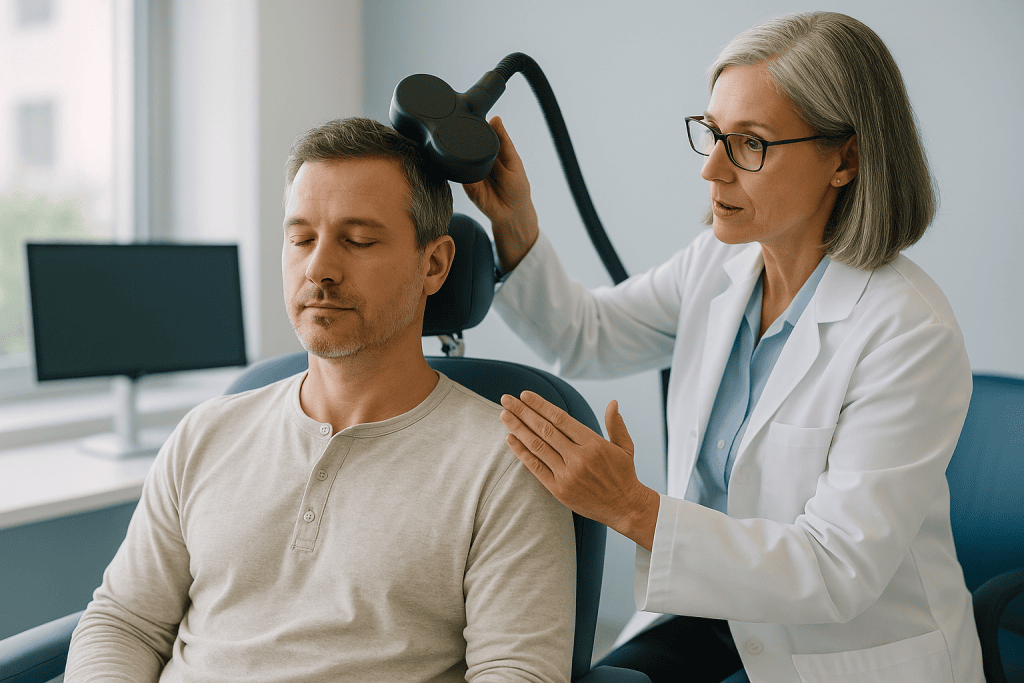
The motor threshold is the lowest pulse intensity that makes a muscle in your hand twitch when the coil sits over the part of the motor cortex that controls that hand. The technician moves the coil in small steps, fires single pulses, and watches your thumb or fingers. Once the twitch appears reliably, that intensity becomes the reference point. The treatment intensity is then set relative to it, and the coil is moved forward by a measured distance (or guided by scalp landmarks or imaging) to the prefrontal target. Because scalp thickness and anatomy vary, this step is what makes the course individual rather than generic.
Expect the mapping visit to take roughly an hour, sometimes longer, including consent, a safety screen, and a first short run of treatment pulses. Cleveland Clinic notes that the initial appointment runs longer than routine sessions for exactly this reason. The twitch-finding part can feel odd, a bit like a reflex hammer tapping from the inside, but it is not painful for most people.
Some clinics repeat the mapping partway through the course, or whenever the coil position seems off, because small drifts in placement can change what the brain receives. If your clinic re-maps, that session will also run longer than usual. The mapping visit is typically counted as session one of the tms treatment course length, so it is worth asking your team whether their stated total includes it.
How long is a TMS session once treatment is underway?
After mapping, the daily rhythm settles quickly. For a standard high-frequency rTMS protocol, the stimulation itself lasts about 20 to 40 minutes. The Mayo Clinic puts a typical session at around 30 to 60 minutes of total appointment time, which allows for check-in, coil positioning, the treatment, and a brief check-out. The National Institute of Mental Health gives a similar window.
What happens inside those minutes is repetitive by design. The machine delivers a train of pulses lasting a few seconds, then pauses, then repeats, dozens of times. The pattern does not change from day to day unless your clinician adjusts it. People read, listen to music, or chat with the technician; a few close their eyes, though sleeping is discouraged because head position matters.
Theta burst stimulation, a newer pattern that packs pulses into short bursts mimicking the brain’s own rhythms, compresses the stimulation to roughly three to ten minutes. The large head-to-head trial that established intermittent theta burst for depression compared a session of about three minutes against a standard session of about 37 minutes and found similar outcomes. For anyone juggling work or childcare, that difference is the single biggest change in the practical calendar of TMS over the past decade.
Whatever the protocol, plan for the whole appointment, not just the pulses. Parking, a waiting room, a mood questionnaire, and the walk back to your car add up. Most people find a 45-minute block covers a standard session comfortably, and a 20-minute block covers theta burst, but your clinic’s own scheduling is the number to trust.
TMS treatment course length: how many sessions and how many weeks?
The classic acute course for depression is five sessions a week, Monday through Friday, for four to six weeks. That works out to about 20 to 30 treatments, and many programs extend to around 36 when a taper is included. The Mayo Clinic, Cleveland Clinic, and the National Institute of Mental Health all describe this four-to-six-week, weekday pattern as the standard.

Why five days a week? The evidence base was built on daily stimulation, and the working model is cumulative: each session adds a small push, and the brain’s circuits need repeated, closely spaced input to settle into a new pattern. Spreading the same number of sessions over months has not been studied as rigorously, so most clinicians keep to the dense schedule that the trials used.
Here is a realistic shape for a six-week course:
- Week 1: the mapping visit, then four routine sessions; scalp discomfort and headache, if they occur, are most common now.
- Weeks 2 to 4: steady daily sessions, with brief mood check-ins; this is when early changes, if any, often begin.
- Weeks 5 to 6: the final block of daily sessions; some programs begin stepping down to three, then two, then one session a week.
Some newer protocols, including accelerated schedules that deliver multiple theta burst sessions per day over about a week, are under active study and used in some specialist settings. They change the calendar dramatically but are not yet the standard described by the sources above, and your team will tell you whether they are appropriate for you.
The honest answer to the tms treatment course length question, then, is a range rather than a number: most people should plan for roughly five to seven weeks from the mapping visit to the last session, with the exact count set by their clinician.
Standard rTMS vs theta burst: a side-by-side timeline
Two protocols dominate everyday practice, and the choice between them affects your calendar more than almost any other decision. Both are delivered with the same kind of equipment and the same safety screening; the difference is the pattern and length of the pulses.
| Feature | Standard high-frequency rTMS | Intermittent theta burst (iTBS) |
|---|---|---|
| Stimulation time per session | About 20 to 40 minutes | About 3 to 10 minutes |
| Sessions per week | Typically 5 | Typically 5 |
| Course length | Usually 4 to 6 weeks | Usually 4 to 6 weeks |
| Mapping visit | Required | Required |
| Typical appointment slot | 30 to 60 minutes | Often under 30 minutes |
| Evidence for depression | Multiple controlled trials over two decades | Large trial showing similar outcomes to standard rTMS |
Notice what does not change: the number of weeks. Theta burst shortens the chair time, not the course. People sometimes assume a three-minute session must mean a three-week course, but the trial that validated iTBS used the same six-week, weekday schedule as the standard arm. The time saving is daily, which still matters enormously when you are asking for 30 days off in a row.
The other thing the table cannot show is tolerability. Theta burst is delivered at a lower overall intensity but in denser bursts, and some people find it slightly more uncomfortable in the first days; others find it easier because it is over quickly. Reports of headache and scalp discomfort were similar in the head-to-head trial. Your clinic’s choice may also be shaped by equipment, the condition being treated, and your own preference; it is a reasonable topic to raise before the mapping visit rather than after.
How long does TMS take to work, and what should you notice first?
This is the question beneath all the others, and the evidence supports a measured answer rather than a confident one. Most people who respond to TMS begin to notice change somewhere in the second to fourth week, and improvement tends to build through the end of the course rather than arriving all at once. Harvard Health describes the benefit as typically emerging over several weeks of daily sessions, not after a handful.
What the early signs look like is surprisingly ordinary. People often describe sleeping a little better, finding it easier to start a task, or noticing that a morning passed without the familiar weight. Family members sometimes spot it before the patient does. Mood rating scales, which most clinics use weekly, pick up these shifts in numbers that can feel more objective than memory.
What the evidence shows about who improves is worth stating plainly. In the trial literature summarized by Harvard Health, roughly half to 60 percent of people with treatment-resistant depression experience a clinically meaningful response, and about a third reach remission, meaning few or no remaining symptoms. Those figures come from research populations and are not a promise for any individual; some people improve late in the course, some not at all, and clinicians cannot yet reliably predict who will fall where.
Two practical implications follow. First, a quiet first week is normal and is not a reason to stop. Second, because change is gradual, your team may extend the course by a week or two if you are clearly improving but not yet where you need to be. That decision belongs to the treating clinician, and the right time to discuss it is around the end of week four, when the pattern usually becomes clearer.
Who is TMS usually for, and who is usually asked to wait?
TMS earned its place as a treatment for major depressive disorder in adults who have not improved enough with at least one antidepressant trial. That remains its best-supported use, and the Mayo Clinic frames it exactly that way. Regulators have since cleared protocols for obsessive-compulsive disorder, for smoking cessation, and for depression with prominent anxiety, and research continues in other conditions. Course lengths for those indications differ, so the four-to-six-week figure above applies most clearly to depression.
Before the mapping visit, every candidate goes through a safety screen. The main concern is metal in or near the head. Magnetic pulses can heat or move certain implants, so anyone with a cochlear implant, aneurysm clips or coils, implanted stimulators, metal plates near the scalp, or bullet fragments is usually excluded, and Cleveland Clinic lists these as reasons TMS may not be suitable. Dental fillings and braces are generally fine.
People who are often asked to wait, rather than being ruled out, include:
- Those with a history of seizures or a condition that lowers the seizure threshold, until a neurologist weighs in.
- Those who are pregnant, where data are limited and the decision is individualized.
- Those in an acute crisis with active suicidal intent, for whom faster-acting options may be prioritized.
- Those with bipolar disorder not currently stabilized, because stimulation can occasionally trigger a shift toward mania.
Age is less of a barrier than people expect. Adults across the lifespan receive TMS, and some programs treat adolescents under research or specialist supervision. What matters more than age is a clear diagnosis, a documented history of what has already been tried, and a realistic conversation about what a six-week commitment involves. If your team suggests waiting, it is usually because one of these pieces is not yet in place.
What the first days and weeks of a TMS course usually look like
The first week has a texture of its own. Day one is the long mapping visit. Days two through five are shorter, and this is when the body does most of its adjusting. The scalp under the coil can feel tender, a bit like a sunburn the size of a coin, and tension-type headaches are common. Cleveland Clinic and the Mayo Clinic both list scalp discomfort and headache as the most frequent side effects, and both note that these usually ease over the first week or two. A technician can shift the coil slightly or slow the ramp-up if the first sessions are rough.
By the second week, most people have stopped thinking about the sensation and started thinking about the logistics. A fixed daily slot helps; many clinics offer early morning or late afternoon times to protect the workday. Driving is fine immediately after a session, because nothing is given that impairs alertness, which is a real distinction from treatments requiring sedation.
Weeks three and four are the stretch where early improvement most often appears, and also where motivation can dip if nothing has changed yet. Weekly mood questionnaires serve a quiet purpose here: they catch small shifts that memory smooths over.
Through the final two weeks the pattern continues, and some programs begin the taper described later. Energy at the end of a course is often described as unremarkable, which is the point; TMS does not leave people drained the way some treatments do. Keeping other parts of the plan steady, including any prescribed medicine and therapy, gives the course the best chance to show what it can do. Any change to medicine during the course should come from the prescribing clinician, not from a sense that TMS has made it unnecessary.
TMS therapy side effects and how they shape your schedule
Side effects are part of the course calendar because they cluster at the beginning and because a few of them can pause treatment. The common ones are local and short-lived: scalp discomfort at the coil site, headache, facial muscle twitching during pulses, and lightheadedness right after standing up. The National Institute of Mental Health describes these as generally mild to moderate and improving shortly after a session or over the first weeks.
Hearing deserves its own line. The coil clicks loudly enough that earplugs are standard, and a temporary change in hearing has been reported when protection was skipped. Wear them every time, including the mapping visit.
The rare serious risk is a seizure. It is uncommon with modern protocols and careful screening, which is why clinics ask about seizure history, alcohol use, sleep deprivation, and certain medicines before each session. A seizure during treatment ends that session and triggers a review before the course resumes.
A less visible risk is a shift toward unusually elevated or irritable mood, particularly in people with a bipolar history. Your team will ask about sleep and energy for that reason.
What TMS does not do is as important as what it does. It does not cause memory loss, does not require anesthesia, and does not leave people unable to work the same day. Compared with electroconvulsive therapy, which Harvard Health describes as more potent but more burdensome, TMS trades some strength for a far gentler daily footprint.
If side effects are making sessions hard, say so early. Minor adjustments in coil angle, intensity ramping, or the protocol itself can often make the difference between finishing the course and dropping out at week two.
What can shorten or extend a TMS treatment course length?
Plans and reality diverge, and TMS courses are no exception. Several ordinary things change the number on the calendar.
Missed sessions are the most common. A cold, a work trip, or a snow day will happen over six weeks. One missed day is generally made up at the end rather than skipped; a gap of several days is usually tolerated without restarting, though clinics vary on how long a break they allow before the cumulative effect is considered lost. Ask your team for their threshold before the course begins so you are not guessing when something comes up.
Early response can shorten the course, though many clinicians prefer to complete the planned block even when someone feels well by week four, because the trials that established the treatment did not stop early. Slow but real improvement can lengthen it; extending to seven or eight weeks is a recognized option when the trajectory is positive but incomplete.
The protocol itself matters. Theta burst shortens the daily session but not the course. Accelerated protocols compress the course into days by delivering several sessions a day, an approach still being evaluated and not part of the standard schedule described by the Mayo Clinic or Cleveland Clinic.
Side effects occasionally pause treatment. A severe headache pattern, a new medical issue, or a seizure will stop sessions until a review. Re-mapping after a pause adds a longer visit.
Finally, the indication sets the baseline. The course for obsessive-compulsive disorder, for example, runs on a different protocol and session count than depression. None of these variables is something a patient should manage alone; they are exactly the decisions a treating team is there to make, and the most useful thing you can do is report missed days and changes honestly.
The taper and the final visit: what happens when the daily sessions end
Many programs do not stop abruptly. After the daily block, they step down: three sessions one week, two the next, then one. This taper, usually lasting two to three weeks, is a common part of practice, though the evidence that it prevents relapse is less robust than the evidence for the daily course itself. Cleveland Clinic describes a gradual reduction in frequency as part of some treatment plans.
The final visit tends to be unceremonious. A last session, a last questionnaire, a conversation about what comes next. That conversation is the real content of the day. It usually covers three things: how your symptoms compare with the baseline measured at mapping, what the plan is for any prescribed medicine and therapy, and what signs would prompt an earlier return.
Follow-up after the final visit varies. Some teams see people at four to six weeks, then quarterly; others hand care back to the referring psychiatrist or primary care clinician with a written summary. Either way, continuing other elements of treatment is the norm. TMS is generally added to an existing plan rather than replacing it, and the National Institute of Mental Health notes it is often used alongside medicine and psychotherapy.
How long improvement lasts is a fair question with an honest answer: it varies. Studies following people after a successful course show that benefit persists for many for months, and that a proportion experience a return of symptoms within the first year. That is why the follow-up plan is written down before you leave, and why the next section matters.
How many times can you do TMS therapy? Maintenance and repeat courses
There is no fixed lifetime limit on TMS. The pulses leave nothing behind in the body, and long-term follow-up studies have not identified cumulative harm from repeated courses. What limits repetition in practice is evidence, logistics, and whether a prior course helped.
Two patterns are common. The first is a repeat acute course. If symptoms return months after a successful course, clinicians frequently offer the full daily block again, because people who responded once often respond again. The second is maintenance TMS: scheduled sessions at a lower frequency, perhaps weekly or every few weeks, intended to hold the gains. Maintenance is widely practiced, but the research behind it is thinner than for the initial course, consisting mostly of observational series rather than large controlled trials. Harvard Health acknowledges that the best approach to maintaining benefit is still being worked out.
So the honest framing is this: you can do TMS more than once, and many people do, but each repeat is a clinical decision rather than a renewal. Your team will weigh how well the first course worked, how long the benefit lasted, what else has changed, and whether the schedule is sustainable for you.
A few points help set expectations:
- A second course usually requires a new mapping visit, because the motor threshold can shift over time.
- Maintenance schedules are individualized; there is no standard interval.
- If a first full course produced no response at all, a repeat course with the same protocol is less likely to help, and the conversation may turn to other options.
The question people are really asking is whether they are signing up for something endless. For most, the answer is a defined course with the option to return, not a permanent appointment.
What people often get wrong about the TMS timeline
A few persistent misunderstandings shape the way people plan for TMS, and correcting them early saves frustration.
Myth: a shorter session means a shorter course. Theta burst takes minutes rather than half an hour, but the validated schedule still runs for weeks. Chair time and calendar time are different things.
Myth: if nothing changes in week one, it is not working. The typical window for early improvement is the second to fourth week. The first week is for the body to adjust and for the course to accumulate. Stopping early because the first few sessions felt uneventful discards the part of the course most likely to matter.
Myth: TMS is an experimental treatment. The technique was first described in the mid-1980s and has been cleared for depression in the United States for well over a decade, with controlled trials spanning two decades. Some protocols are newer than others, which is why it is fair to ask how established the specific one offered to you is.
Myth: TMS replaces medicine. It is usually added to an existing plan. Any change to a prescription is a decision for the prescribing clinician, not a side effect of feeling better in week five.
Myth: it works for everyone who finishes. It does not. Roughly half of people in trials experience a meaningful response, by Harvard Health’s summary of the research, and clinicians cannot yet predict reliably who will. Finishing the course is necessary for benefit, not sufficient.
Myth: the benefit is permanent. For many it lasts months; for some it fades. A follow-up plan is part of the treatment, not an afterthought.
The thread running through all of these is the same: TMS is a defined, dense block of treatment with a measured, gradual effect. Planning around that shape, rather than around hopes for something faster or simpler, tends to make the six weeks easier to live through.
Questions to ask your care team before the mapping visit
The best time to settle the calendar is before the first session, when the technician and clinician have time to talk and you are not yet sitting under a coil. A short written list helps; these are the questions that most often change how a course goes.
- Which protocol are you proposing, standard rTMS or theta burst, and why that one for me?
- How many sessions do you plan, and does that total include the mapping visit and any taper?
- How long should I block out for each appointment, including check-in and check-out?
- What is your policy on missed sessions? How many days can I miss before we need to re-map or restart?
- How will you measure whether it is working, and at what point would you consider extending or stopping the course?
- What should I do about my current medicines and therapy during the course?
- What are the most common side effects you see in the first week, and what adjustments can you make if they are a problem?
- Do I have any implants, devices, or history that affect my safety screen?
- What will follow-up look like after the final session, and who should I contact if symptoms return?
- Have you treated people with my particular diagnosis or history before, and what did their courses typically look like?
Two further questions are worth asking even if they feel awkward. First, what happens if the course does not help: what is the next step in the plan? Second, if things go well, how would a repeat or maintenance course be decided? Teams that have thought these through will have ready answers, and the answers tell you a great deal about how the course will be managed.
Write the answers down. Six weeks is long enough to forget what was said at the start, and the mapping visit itself is busy enough that details slip.
When to call your doctor during or after a TMS course
Most of what people feel during TMS is mild and local, and a quick word with the technician at the next session is enough. A small number of signs call for a same-day call to your treating team or, in a few cases, emergency care.
Contact your care team promptly if you notice:
- A headache that is severe, different from your usual pattern, or not easing with your normal approach.
- Scalp pain that persists between sessions or skin changes at the coil site.
- New ringing in the ears or a change in hearing after a session.
- Sleeping far less than usual while feeling unusually energetic, talkative, or irritable, which can signal a shift toward mania.
- Feeling persistently worse in mood, or a sense that the course is harming rather than helping.
Seek emergency care, or ask someone to call for you, if any of the following occur:
- A seizure, loss of consciousness, or a period of confusion you cannot account for, during or after a session.
- New or worsening thoughts of harming yourself or ending your life, or feeling unable to keep yourself safe.
- Chest pain, difficulty breathing, or fainting.
Depression itself can deepen during any treatment course, and TMS does not remove that risk. In the United States, the 988 Suicide and Crisis Lifeline is available by call or text at any hour; clinics will also give you their own after-hours contact. Keep both somewhere easy to find.
After the final visit, the same list applies, with one addition: a return of the symptoms that led you to TMS in the first place is a reason to call, not to wait for the scheduled follow-up. Earlier contact gives your team more options. Every decision about pausing, adjusting, repeating, or stopping treatment belongs to that team, and a call is never an overreaction.
Frequently asked questions
What is TMS, in plain language?
TMS, or transcranial magnetic stimulation, is a non-invasive treatment that uses magnetic pulses from a coil on the scalp to change activity in a targeted brain region, most often the left prefrontal cortex in depression. You stay awake, nothing is implanted, and no anesthesia is involved. It is usually offered when depression has not responded adequately to other treatments and is given as a course of daily sessions over several weeks.
How long is a TMS session from arrival to leaving?
Plan for about 30 to 60 minutes for a standard rTMS appointment, which covers check-in, coil positioning, roughly 20 to 40 minutes of stimulation, and a brief check-out. Theta burst appointments are shorter because the stimulation itself takes only a few minutes. The mapping visit on day one runs longer than either. Your clinic’s own scheduling slot is the figure to trust.
How many TMS sessions are in a full course?
Most courses for depression involve about 20 to 36 sessions delivered five days a week over four to six weeks, sometimes followed by a short taper. The mapping visit is usually counted as the first session. Courses for other conditions, such as obsessive-compulsive disorder, follow different protocols and counts. Your treating team may extend or shorten the plan based on how you respond.
How long does TMS take to work?
People who respond typically notice change somewhere in the second to fourth week, with improvement building through the end of the course rather than arriving suddenly. Some improve late, and some do not respond. Research summarized by Harvard Health suggests roughly half to 60 percent of people with treatment-resistant depression experience a meaningful response, with about a third reaching remission; those are group figures, not individual predictions.
How many times can you do TMS therapy?
There is no fixed lifetime limit, and the pulses leave nothing behind in the body. People whose symptoms return after a successful course are often offered a repeat course, and some clinics provide lower-frequency maintenance sessions. Each repeat is a clinical decision based on how well the previous course worked and how long the benefit lasted; it is not an automatic renewal. The evidence for maintenance schedules is weaker than for the initial course.
How new is TMS therapy?
The technique was first described in the mid-1980s, and repetitive TMS for depression has been cleared by United States regulators for well over a decade, supported by controlled trials spanning about twenty years. Newer patterns such as theta burst and accelerated protocols are more recent, and some remain under study. It is reasonable to ask your team how established the specific protocol they are offering is.
How much does TMS therapy cost for anxiety disorders?
We do not publish price figures, and no single number would be accurate: the amount a person pays depends on the diagnosis, the protocol, the number of sessions, and insurance coverage, which differs widely. TMS is best established for depression; a protocol for depression with prominent anxiety has been cleared, while anxiety disorders alone are still largely a research area. Ask the clinic and your insurer for a written estimate before the mapping visit.
What are the most common TMS therapy side effects?
Scalp discomfort at the coil site and headache are the most frequent, along with facial muscle twitching during pulses and brief lightheadedness afterward. These are usually mild and tend to ease within the first week or two. Earplugs are used to protect hearing from the loud clicking. Seizure is the rare serious risk, which is why clinics screen carefully before and during the course.
What happens if I miss a TMS session?
A single missed day is usually made up at the end of the course rather than skipped. A gap of several days is often tolerated without restarting, though clinics differ on how long a break they allow before the cumulative effect is considered lost and a re-mapping or restart is needed. Tell your team about any missed or planned absences so they can adjust the schedule.
Is TMS the same as electroconvulsive therapy?
No. Electroconvulsive therapy uses an electrical current under general anesthesia to induce a controlled seizure and is generally considered more potent but more burdensome. TMS uses magnetic pulses while you are awake, involves no anesthesia, and does not cause memory loss; most people drive themselves home afterward. They sit at different points on the treatment ladder, and your psychiatrist can explain which fits your situation.
References
- Cleveland Clinic: Transcranial Magnetic Stimulation (TMS)
- National Institute of Mental Health: Brain Stimulation Therapies
This article is for general information only and is not a substitute for professional medical advice. Please consult a qualified doctor about your individual situation.

More from the Blog

When Is the Right Time to Start Aphasia Therapy After a Stroke? Early vs Later Rehabilitation
Most stroke teams begin assessing language within the first days, once a person is medically stable, and start speech and language therapy as early…

Reading a Dementia Care Plan: Questions Families Ask About Medicines and Follow-Up
A dementia care plan is a written summary of diagnosis, medicines, goals, safety steps, and follow-up dates. Families most often ask what each medicine…

Traumatic Brain Injury Rehabilitation: The Stages From Intensive Care to Returning Home
Traumatic brain injury rehabilitation usually moves through several stages: emergency and intensive care to stabilize the brain, an acute hospital ward where therapy begins…

Temporal Lobectomy or Laser Ablation: How Does Each Epilepsy Surgery Reach the Seizure Focus?
A temporal lobectomy reaches the seizure focus from the outside: the surgeon opens a section of skull and removes the front of the temporal…

Is Insomnia Treated Differently in Older Adults? What Sleep Specialists Adjust and Why
Yes. Insomnia treatment in older adults still begins with cognitive behavioral therapy for insomnia, but clinicians adjust how they apply it and become far…

Migraine Myths a Neurologist Would Correct: It Is Not Just a Bad Headache
Migraine is a neurological disorder, not simply a severe headache. Attacks often unfold in phases, can occur without head pain or aura, affect men…