

How Long Is Parotidectomy Recovery? Drain Removal, Incision Care and Resuming Activity

Key Takeaways
- Most people go home the same day or after one night, and the drain typically comes out within about one to three days once its output falls and clears.
- The incision usually seals within one to two weeks, but the scar is at its most visible around one to three months and keeps fading for a year or more.
- Numbness of the earlobe from the great auricular nerve is very common after parotidectomy and often partly permanent, though the affected area usually shrinks over months.
- Temporary facial weakness after surgery for benign disease usually reflects a stretched, intact nerve and improves over weeks to months; an eye that does not close fully needs protection right away.
- A soft swelling that enlarges at mealtimes in the early weeks is often collected saliva rather than infection, and sour or strongly flavored foods make it worse.
- Frey syndrome, sweating on the cheek while eating, can appear several months after surgery and is a treatable late effect, not a sign the operation failed.
Parotidectomy recovery time is usually measured in weeks rather than days. Most people go home the same day or after one night, the surgical drain typically comes out within about one to three days, and light daily activity returns within a week or two. Strenuous exercise and full work duties commonly resume over two to four weeks, while scar fading and any temporary facial nerve weakness can take months.
The night before surgery, a lot of people do the same small thing: they stand in front of the bathroom mirror, turn their head, and try to picture where the scar will sit in front of the ear. Then they think about the drain the surgeon mentioned, and the word “facial nerve,” and the very practical question underneath all of it: how long until I feel like myself again?
Parotidectomy recovery time is one of the most searched questions about this operation, and the honest answer has several layers. There is the hospital part, which is short. There is the drain and incision part, which lasts a week or two. And there is the slower part, involving nerve function, numbness and scar maturation, which unfolds over months.
This explainer walks through each layer using mainstream clinical sources, so you know what is typical, what is variable, and which questions belong to your surgical team.
Parotidectomy recovery time: the realistic overall picture
A parotidectomy is an operation to remove part or all of the parotid gland, the largest saliva-producing gland, which sits in front of and just below each ear. Most parotidectomies are done for a lump in the gland, and the majority of parotid lumps turn out to be non-cancerous, though only pathology after removal can say for certain (Mayo Clinic, MedlinePlus).
Recovery is best pictured as three overlapping stages. The first is the hospital stage. Patient guides from Mayo Clinic and Cleveland Clinic describe most people going home the same day or after a single overnight stay. The second stage covers the first one to two weeks, when the drain comes out, the incision seals, swelling peaks and then subsides, and people gradually return to routine tasks. The third stage stretches across months: numbness of the earlobe slowly changes, any temporary weakness of the facial muscles gradually improves in most cases, and the scar fades from pink to pale.
Two things shape where an individual falls within those ranges. One is the extent of surgery. A superficial parotidectomy, which removes only the part of the gland lying outside the facial nerve, is generally a smaller undertaking than a total parotidectomy, which removes tissue on both sides of the nerve. The other is the reason for surgery. When the operation is for a confirmed or suspected cancer, the team may also remove lymph nodes in the neck, and further treatment such as radiation may be planned, which changes the timeline entirely.
Everything that follows describes typical ranges from published patient information, not promises. Your surgeon, who knows the size and location of your tumor and what was found during the operation, is the only person who can translate these ranges into a plan for you.
What actually happens during a parotidectomy
The parotid gland has a design quirk that explains almost everything about how this surgery is done and how recovery feels. The facial nerve, which controls the muscles of expression on that side of the face, enters the gland from behind and fans out through it in five main branches. Surgeons describe the gland as having a superficial lobe and a deep lobe, but the dividing line is really the nerve itself (Cleveland Clinic).
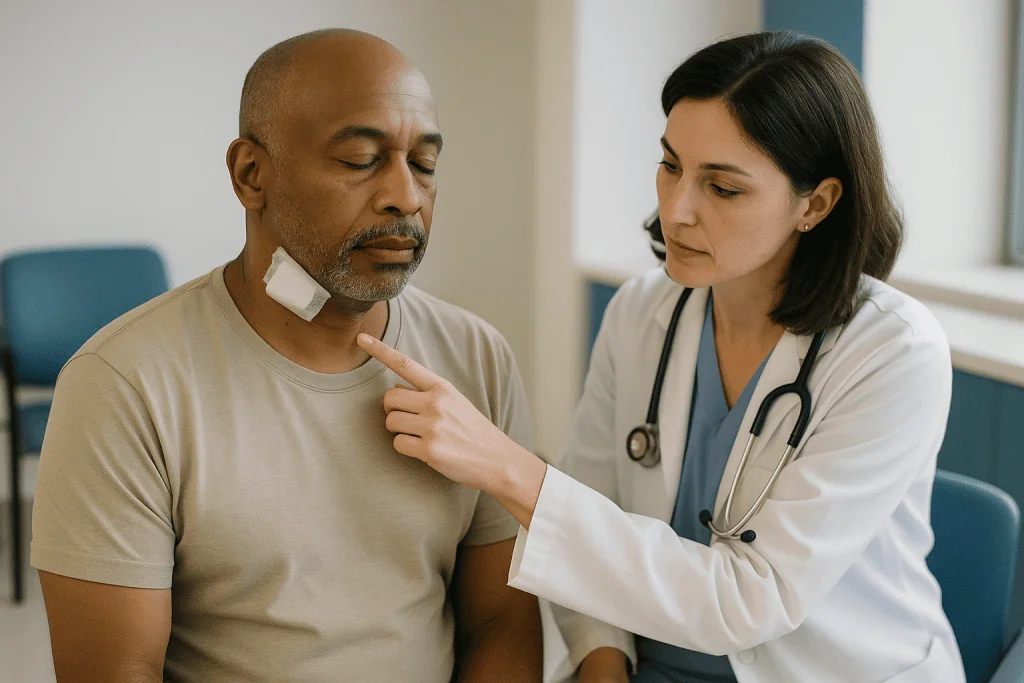
You are asleep under general anesthesia. The incision usually begins in a skin crease in front of the ear, curves around or behind the earlobe, and then runs down into a natural fold of the upper neck. That path gives the surgeon a view of the whole gland while placing most of the scar where skin creases and hair shadow hide it.
The surgeon then lifts the skin forward, finds the main trunk of the facial nerve where it emerges from the skull, and follows each branch through the gland, freeing the tumor and the surrounding gland tissue from around them. Many teams use a nerve monitor, a device with fine sensors in the facial muscles that alerts the surgeon when a branch is touched or stretched (Johns Hopkins Medicine).
Once the tissue is out, it goes to pathology. A thin drain tube is placed in the wound to carry away blood and saliva that would otherwise pool under the skin, the incision is closed in layers, and a dressing is applied. Some surgeons also lay a piece of nearby tissue over the raw surface of the remaining gland to reduce later problems with sweating while eating.
Knowing this sequence makes recovery less mysterious: the drain exists because the gland keeps making saliva, the earlobe numbness exists because a sensory nerve runs directly across the surgical field, and any facial weakness reflects how closely the nerve was handled.
How many hours does a parotidectomy take, and when do you go home?
People are often surprised by how long they are in the operating room for what looks, from the outside, like a modest incision. Cleveland Clinic’s patient information describes parotidectomy as typically taking several hours, and surgeons commonly quote a range of roughly two to four hours, longer when the deep lobe is involved or lymph nodes are being removed. Most of that time is spent carefully identifying and protecting the facial nerve branches, not removing the lump itself.
Families waiting outside should build in extra time for anesthesia induction beforehand and for the recovery room afterward, where staff monitor breathing, blood pressure, pain and the wound before you are moved to a room or prepared for discharge.
Whether you stay overnight depends on the extent of surgery, how you recover from anesthesia, whether a drain is in place, and your other health conditions. Mayo Clinic and Cleveland Clinic both describe same-day discharge or a single night as usual. A drain does not automatically mean a hospital stay; many teams send people home with the drain and teach them, or a family member, how to empty and record it.
Before you leave, expect the nursing team to check several things: that you can swallow liquids comfortably, that pain is manageable with what has been prescribed, that you have walked, that the dressing is dry, and that you understand how to care for the drain if you have one. You will also be asked to smile, raise your eyebrows and close your eyes tightly so the team can document facial nerve function on the day of surgery, a baseline they will compare against at follow-up.
You will not be able to drive yourself home after a general anesthetic, and it is sensible to have someone stay with you the first night.
Who is usually offered parotidectomy, and who is asked to wait
The most common reason for parotidectomy is a slow-growing lump in the gland. Even when imaging and a needle biopsy suggest a benign tumor, surgeons frequently recommend removal, because the most common benign parotid tumor, a pleomorphic adenoma, can enlarge over years and carries a small long-term risk of becoming malignant if left in place (Mayo Clinic). Removal also gives a definitive diagnosis, which a needle sample cannot always provide.
Surgery is also the usual first treatment for salivary gland cancers that are confined to the gland or nearby nodes, sometimes followed by radiation therapy depending on the pathology results (NHS). Less often, parotidectomy is considered for chronic infections or stones that keep recurring despite other management, or for a gland damaged by longstanding inflammation.
Some people are asked to wait, or to consider alternatives. Warthin tumor, a benign growth more common in older adults and in people who smoke, grows slowly and rarely changes character, so observation with periodic imaging is a reasonable option for some, particularly when surgery carries higher anesthetic risk. People with poorly controlled diabetes, unstable heart or lung disease, or who are taking blood thinners may be asked to optimize those conditions first, in coordination with their other physicians, because bleeding into the surgical field is one of the main early complications.
Pregnancy, an active infection in the gland, or a recent illness can also shift timing. And when a lump is very large, fixed to surrounding tissue, or already causing facial weakness, the discussion changes rather than stops: those features raise concern for cancer and often lead to more extensive planning rather than a delay.
None of this is a checklist you can apply to yourself. It describes the kinds of factors a surgical team weighs, and the decision to operate, wait or watch belongs to that team together with you.
Is parotidectomy a serious surgery?
The fair answer is that parotidectomy is a common, well-standardized operation with a generally good safety record, and it is also a delicate one because of the facial nerve. Both statements are true at once, and the second is why recovery gets so much attention.
The complications described in mainstream patient information fall into a few groups (Cleveland Clinic, Johns Hopkins Medicine):
- Facial nerve weakness, most often temporary and affecting one branch, such as a slightly asymmetric smile or a lower lip that lags; permanent weakness is uncommon in surgery for benign disease.
- Numbness of the earlobe and skin in front of the ear from division or stretching of the great auricular nerve, a sensory nerve that crosses the surgical field; this is very common and often partly permanent.
- Bleeding or a hematoma, a collection of blood under the skin, usually within the first day.
- A salivary fistula or sialocele, meaning saliva leaking through the wound or pooling under the skin from the remaining gland.
- Frey syndrome, which is sweating or flushing of the cheek while eating, appearing months later.
- Infection, poor scar healing and a contour dip in front of the ear.
What makes an operation “serious” for you personally depends on the reason for it and your overall health. A superficial parotidectomy for a small benign tumor in a healthy adult sits at one end. A total parotidectomy with neck dissection for cancer, followed by radiation, sits at the other, with a recovery that is longer and involves a wider team.
Ask your surgeon where your operation falls on that spectrum, how often they see each of these problems in their own practice, and what they would do if one occurred. Those are reasonable questions, and good teams expect them.
The first 48 hours: drains, dressings and the first night
The first two days are mostly about swelling, the drain and finding a comfortable position. Expect the side of your face and upper neck to feel tight and puffy, with a firm, bruised sensation rather than sharp pain. Keeping your head raised on two pillows, or sleeping in a recliner, reduces swelling, and many people find this the single most useful comfort measure (Cleveland Clinic).
The drain is a soft tube exiting through a small opening near the incision, attached to a small bulb or bottle that holds gentle suction. Its job is to remove blood and saliva that would otherwise collect under the skin flap. You or a family member will usually be shown how to empty it, squeeze the bulb to restore suction, and write down the amount collected. Output is typically highest in the first day and falls steadily. The fluid starts dark red and lightens to pink and then a straw color as it settles.
The dressing may be a light pad over the incision or, in some practices, a snug wrap around the head for the first day to apply gentle pressure. Do not remove or adjust it unless your team told you to.
Eating and drinking usually resume the same day. Soft, cool foods are easier because chewing moves the surgical area and because the mouth may feel slightly dry on that side. Sour or strongly flavored foods, which trigger a surge of saliva, are worth avoiding early on, since that saliva has to go somewhere.
Walk around the house several times a day. Movement lowers the risk of blood clots in the legs after any operation under general anesthesia, and it helps the lightheadedness that follows anesthesia clear faster. Rest is important, but so is not staying in bed all day.
How painful is parotid surgery? And when does parotidectomy drain removal happen?
Most people are relieved to find that parotid surgery is less painful than they feared. The typical description is pressure, tightness and an ache that is worst on days one and two, then eases noticeably by the end of the first week. Chewing, yawning and turning the head pull on the area and are the usual triggers for sharper twinges (Mayo Clinic). Numbness around the ear can make the incision feel oddly distant rather than sore.
Pain management typically starts with over-the-counter analgesic classes, and some people are sent home with a short course of a stronger prescription medicine for the first few days. Which medicines are appropriate, in what amount and for how long, is a decision for your prescribing clinician, especially if you take blood thinners or have kidney, liver or stomach conditions. Cold packs wrapped in a cloth, applied for short intervals over the dressing rather than on bare skin, are a common non-drug comfort measure. Do not use heat on an area with reduced sensation, because you cannot feel a burn developing.
Parotidectomy drain removal is usually the first milestone. Cleveland Clinic’s patient information describes drains commonly staying in for about one to three days, and the timing is decided by output: once the volume collected over a day falls below the threshold your surgeon uses and the fluid is no longer bloody, the drain can come out. Removal is done in clinic or, if you stayed overnight, before discharge. It takes seconds. Most people describe a brief pulling or sliding sensation, sometimes a sting, rather than pain; no anesthetic is usually needed. A small dressing covers the exit site, which seals within a day or two.
If the drain stays in longer than expected, that usually means it is still doing useful work, not that something has gone wrong.
Incision care: what to do and what to leave alone
Incision care after parotidectomy is mostly about restraint. The skin in front of the ear and along the upper neck is thin, and the wound heals best when it is kept clean, dry at first, and free of friction.
Your surgical team will give specific instructions, and those override anything general. The principles below reflect standard surgical wound guidance from MedlinePlus and Cleveland Clinic:
- Keep the dressing dry and in place for as long as instructed, often 24 to 48 hours. After that, many teams allow showering with the back to the water stream so the incision is rinsed gently rather than blasted.
- Pat the area dry with a clean towel; do not rub.
- Leave surgical glue, tape strips or dissolvable stitches alone. They lift or dissolve on their own over one to three weeks. Non-dissolving stitches or staples are removed at a clinic visit, commonly around one week after surgery.
- Do not apply creams, ointments, vitamin oils or antiseptic solutions unless your team specifically recommended one. Several can irritate a fresh wound or dissolve skin glue early.
- Avoid soaking the incision in a bath, pool, hot tub or the sea until it is fully sealed and your team has said it is safe.
Small amounts of clear or slightly pink fluid on the dressing in the first days are normal. A firm ridge along the incision line is also expected and softens over weeks. What is not normal is spreading redness, increasing warmth, thick or foul-smelling discharge, a wound edge that opens, or a rapidly enlarging swelling under the skin; those belong in the “call your doctor” section below.
Men are often advised to avoid shaving over the numb skin in front of the ear for a week or two, since it is easy to nick skin you cannot feel. Use an electric razor when you resume, and go slowly.
How long does it take for a parotidectomy scar to heal?
A parotidectomy scar goes through the same stages as any surgical scar, but its location makes people watch it closely. The incision itself typically seals within about one to two weeks; that is when stitches are out, glue has lifted and showering is unrestricted. “Healed” in the cosmetic sense takes far longer.
Over the first four to eight weeks the scar is at its most visible: pink or red, slightly raised, and firm to the touch as collagen is laid down. Between roughly two and six months it usually begins to flatten and fade. General wound guidance from MedlinePlus and Cleveland Clinic describes scars continuing to soften and lighten for up to a year or more, and many surgeons ask people to withhold judgment about the final appearance until at least twelve months have passed.
Parotidectomy scar healing is helped by a few evidence-based habits:
- Sun protection. Fresh scars pigment easily. Once the wound is sealed, a broad-spectrum sunscreen on the scar, or a collar and hat, for the first year reduces permanent darkening.
- Gentle massage. Once your team confirms the wound is fully closed, firm circular massage along the scar for a few minutes daily can help soften the ridge. Ask first, because timing varies.
- Not smoking. Nicotine narrows small blood vessels and is associated with slower wound healing and poorer scars.
- Silicone gel or sheeting, which is used in scar care by many teams; whether and when it suits you is your surgeon’s call.
Two other cosmetic points deserve mention. First, a shallow hollow in front of the ear is common after removing gland tissue, and it is often more noticeable to you than to others. Second, people with a personal or family history of keloids, which are thick scars that grow beyond the original wound, should tell their surgeon beforehand so the plan can account for it.
Facial weakness, numb earlobe and other nerve effects during parotid surgery recovery
Two nerves run through the surgical field, and each leaves its signature on parotid surgery recovery.
The great auricular nerve supplies sensation to the earlobe and the skin in front of and below the ear. It lies directly on top of the gland, so it is stretched, and sometimes deliberately divided, during almost every parotidectomy. The result is numbness of the earlobe that most people notice on the first day. Johns Hopkins Medicine and Cleveland Clinic describe this as very common, and some degree of it is often permanent, though the area of numbness usually shrinks over six to twelve months and stops being bothersome. Practical consequences: be careful with earrings, hair tools and razors on that side, and expect odd tingling as sensation partly returns.
The facial nerve is the one everyone worries about. Because the surgeon works directly on its branches, some degree of temporary weakness is a recognized outcome of parotidectomy. It most often affects a single branch, producing a lower lip that does not pull down fully when you show your teeth, an eyebrow that lifts less, or an eye that closes slightly less tightly. In benign disease, patient information sources describe temporary weakness as fairly common and permanent weakness as uncommon; when a tumor is cancerous and has grown into the nerve, the surgeon may need to remove a branch, which is discussed beforehand (Cleveland Clinic).
Temporary weakness reflects bruising or stretching of the nerve, and recovery follows the nerve’s own slow timetable, typically weeks to several months. If your eye does not close fully, protecting it matters: lubricating drops during the day, ointment and sometimes taping at night, because an unprotected cornea can dry and scratch. Your team will show you how. Facial exercises are sometimes suggested; evidence for them is limited, so ask rather than improvise.
Fluid collections, first bite and sweating while you eat
The remaining gland tissue keeps doing its job after surgery, which produces a set of recovery quirks that are rarely dangerous but are alarming if nobody warned you.
A sialocele is a pocket of saliva that collects under the skin, usually appearing in the first one to two weeks as a soft, sometimes fluctuating swelling near the incision that may enlarge around mealtimes. A salivary fistula is the same saliva escaping through the wound as clear, watery drainage. Both happen because the cut surface of the gland is still secreting. Cleveland Clinic describes these as generally self-limiting; management may involve drawing the fluid off with a needle in clinic, a pressure dressing, and sometimes medicines from the anticholinergic class, which reduce saliva production. Those decisions belong to your surgeon. Avoiding sour and very flavorful foods in the early weeks reduces the saliva surge that feeds the collection.
First bite syndrome is a sharp, cramping pain in the parotid area with the first bite or two of a meal, easing as you continue to eat. It is thought to arise from disturbed sympathetic nerve fibers, the tiny nerves that normally moderate the gland’s response to food, and it is more common after surgery involving the deep lobe. For many people it fades over months; for some it lingers and is managed with the surgical team.
Frey syndrome, also called gustatory sweating, appears later, often several months after surgery. Nerve fibers that once told the gland to make saliva regrow into the skin and instead tell sweat glands to work, so the cheek sweats or flushes when you eat. Johns Hopkins Medicine describes it as a recognized late effect; a simple starch-iodine test can confirm it, and treatments ranging from antiperspirants to injections that block the sweat glands exist. Many people find it mild enough to ignore; if not, it is treatable, and your team can explain the options.
Resuming activity after parotidectomy: driving, work, exercise and lifting
The pattern for returning to normal life is gradual and driven by two things: how you feel, and not disturbing the healing wound while blood vessels and skin edges are still fragile. The ranges below summarize typical guidance in Cleveland Clinic and Mayo Clinic patient information. They are starting points for a conversation with your team, not a schedule to follow on your own.
| Activity | Typical timing | Why the wait |
|---|---|---|
| Walking, light housework | From day one | Reduces clot risk; no strain on the wound |
| Showering over the incision | Often after 24 to 48 hours, per your team | Dressing and glue need time to seal |
| Driving | Once off sedating pain medicine and able to turn the head comfortably, often around one week | Neck movement and alertness |
| Desk work | Commonly one to two weeks | Fatigue and swelling; drain must be out |
| Physical or public-facing work | Commonly two to four weeks | Strain, sweating, exposure of the wound |
| Heavy lifting, straining, vigorous exercise | Commonly two to three weeks or as advised | Raised blood pressure can cause bleeding under the skin flap |
| Swimming, bathing the wound | After the incision is fully sealed and cleared by your team | Infection risk from soaking |
| Air travel | Often after the first follow-up visit | Access to care if early problems arise |
Two nuances matter. First, fatigue is real and often underestimated; a general anesthetic plus healing tissue leaves many people tired for two to three weeks even when the wound looks fine. Second, if lymph nodes were removed or radiation therapy is planned, your timeline is different and should come from the oncology and surgical teams together.
If you plan to travel any distance soon after surgery, the practical medical points are the same as for any operation: keep moving on long journeys to lower clot risk, know where you would seek care if a problem arose, and arrange your follow-up appointment before you go.
What people often get wrong about parotidectomy recovery time
Several beliefs circulate in waiting rooms and online forums that deserve a correction grounded in what the evidence actually shows.
“A small incision means a quick recovery.” The skin wound is only part of the story. Beneath it, a skin flap has been lifted, gland tissue removed and nerves handled. Swelling, numbness and fatigue follow that deeper work, which is why two to four weeks is a more honest frame than a few days (Cleveland Clinic).
“Any facial weakness means the nerve was cut.” In most cases weakness after surgery for benign disease reflects stretching or bruising of an intact nerve, and function returns over weeks to months. Your surgeon will know whether the nerve was preserved; ask directly rather than assuming.
“The drain coming out late is a bad sign.” Drain timing tracks fluid output, which varies with gland size, the extent of surgery and individual biology. A drain kept a day or two longer is usually a precaution, not a complication.
“The scar I see at two months is the scar I will have.” Scars are at their most visible between about one and three months and continue to fade for a year or more. Judging early leads to needless distress.
“I should exercise the face to speed nerve recovery.” Evidence for facial exercises after parotidectomy is limited, and aggressive attempts can be frustrating. Protecting the eye if it does not close fully has far stronger justification. Ask your team before starting any routine.
“Benign means no follow-up.” Some benign tumors, particularly pleomorphic adenoma, are followed for years because of a small recurrence risk (Mayo Clinic). A benign result is good news, and it still comes with a follow-up plan.
“Dry mouth is inevitable.” The other parotid and the remaining salivary glands compensate well; noticeable dry mouth after a one-sided parotidectomy is uncommon unless radiation follows.
Questions to ask your care team
The most useful questions are specific to your operation, because ranges in patient guides cannot account for your tumor’s size, its position relative to the facial nerve or your health. Consider bringing a written list, and ask someone to take notes.
- Are you planning a superficial or total parotidectomy, and might that change during surgery?
- How do you protect and monitor the facial nerve, and how often do you see temporary and permanent weakness in your own practice?
- Will I have a drain, will I likely go home with it, and what output level do you use to decide on removal?
- What exactly should I do and not do with the incision, and when may I shower, shave and swim?
- Which stitches or glue are you using, and when and where are they removed?
- What pain medicine plan do you recommend for me, given my other medicines and conditions, and when should I expect to stop needing it?
- When can I drive, return to my specific job and resume my usual exercise?
- If my eye does not close fully after surgery, what should I do that first evening?
- What signs should make me call the clinic, and what number do I call after hours?
- When will pathology results be ready, and how will they be communicated to me?
- If the result shows cancer, what are the possible next steps, and who coordinates them?
- What follow-up schedule do you recommend, and for how many years?
- Is there anything about my scar, such as a history of keloids, that you would manage differently?
Notice that several of these ask the surgeon about their own practice rather than general statistics. That is appropriate. Published ranges describe populations; your surgeon’s answers describe the team that will care for you. Neither replaces the other, and together they give you a realistic picture of what parotid surgery recovery is likely to look like for you.
When to call your doctor
Most recoveries follow the arc described above without incident, but a handful of signs warrant a same-day call to your surgical team, and a few warrant emergency care. Your discharge paperwork should include an after-hours number; keep it where you can find it.
Call your surgical team promptly if you notice:
- A rapidly enlarging, tense or painful swelling under the skin near the incision, especially within the first day or two, which can indicate bleeding beneath the skin flap.
- Spreading redness, increasing warmth, thick or foul-smelling discharge from the wound or drain site, or a wound edge that opens.
- Fever, or chills that come on after the first day.
- Clear, watery drainage that increases around meals, or a soft swelling that fills up when you eat, which may be saliva collecting.
- A drain that stops collecting fluid abruptly, falls out, or produces fresh, bright red blood in increasing amounts.
- New or worsening facial weakness that was not present when you left the hospital, or an eye that will not close and is becoming red, gritty or painful.
- Pain that is escalating rather than easing after the first two to three days, or pain not controlled by the plan you were given.
- Calf pain or swelling in one leg, which can signal a blood clot after any operation.
Seek emergency care immediately, without waiting to reach the clinic, if you develop difficulty breathing or swallowing, swelling that is pushing the airway or making your voice muffled, heavy bleeding that soaks dressings, chest pain, or sudden shortness of breath.
None of these signs means a poor outcome is certain; most are manageable when addressed early, which is precisely why teams want to hear from you sooner rather than later. If you are unsure whether something counts, that uncertainty is itself a reason to call. Recovery decisions, from drain removal to when you return to the gym, rest with the team who operated on you and knows what they found.
Frequently asked questions
How long is parotidectomy recovery time overall?
Typically two to four weeks for most daily activities, with slower recovery of nerve function and scar appearance over months. Patient guides describe same-day or overnight discharge, drain removal within about one to three days, return to desk work around one to two weeks and strenuous activity after two to three weeks. Surgery for cancer, especially with lymph node removal or planned radiation, extends this considerably.
Is parotidectomy a serious surgery?
It is a common, standardized operation with a generally good safety record, but it is delicate because the facial nerve runs through the gland. Main risks are temporary facial weakness, permanent earlobe numbness, bleeding, saliva collections and later sweating while eating. How serious it is for you depends on the extent of surgery, the reason for it and your overall health, which your surgeon can put in context.
How painful is parotid surgery?
Most people describe tightness, pressure and an ache rather than severe pain, worst on the first two days and easing noticeably within a week. Chewing, yawning and turning the head cause the sharpest twinges. Pain is usually managed with common analgesic classes chosen by your prescribing clinician, plus head elevation and wrapped cold packs. Numbness near the ear often makes the incision feel oddly distant.
How many hours does a parotidectomy take?
Usually several hours, commonly quoted in the range of about two to four, and longer when the deep lobe or neck lymph nodes are involved. Most of that time is spent identifying and protecting the branches of the facial nerve rather than removing the lump. Add time for anesthesia beforehand and recovery-room monitoring afterward when planning for family members waiting.
When does parotidectomy drain removal usually happen?
Commonly within about one to three days, decided by how much fluid the drain collects and whether it has cleared from bloody to pale. Removal takes seconds in clinic or before discharge and feels like a brief pull or sting rather than real pain. A drain that stays longer is usually still doing useful work, not a sign of a complication.
How long does it take for a parotidectomy scar to heal?
The incision typically seals within one to two weeks, but the scar looks most red and raised around one to three months and keeps flattening and fading for a year or more. Sun protection over the first year, not smoking, and gentle massage once your team confirms the wound is closed all support parotidectomy scar healing. Judge the final result at twelve months, not before.
Will my face be paralyzed after parotid surgery?
Complete paralysis is unusual in surgery for benign tumors. Some temporary weakness of one branch, such as a slightly uneven smile, is a recognized outcome and usually improves over weeks to months as a stretched nerve recovers. Permanent weakness is uncommon unless a cancer has grown into the nerve, which the surgeon would discuss beforehand. Ask your surgeon directly whether the nerve was preserved.
Why is my earlobe numb after parotidectomy?
The great auricular nerve, which supplies sensation to the earlobe and skin in front of the ear, lies directly on the gland and is stretched or divided during almost every parotidectomy. Numbness is therefore very common and often partly permanent, though the area typically shrinks over six to twelve months. Take care with earrings, razors and hair tools on that side while sensation is reduced.
What is the swelling near my incision that gets bigger when I eat?
It is often a sialocele, a pocket of saliva from the remaining gland collecting under the skin, and it typically appears in the first one to two weeks. Cleveland Clinic describes it as generally self-limiting; your surgeon may drain it with a needle, apply a pressure dressing or consider saliva-reducing medicine. Avoiding sour and strongly flavored foods helps. Report it, since infection can look similar.
When can I go back to work and exercise during parotid surgery recovery?
Desk work is commonly possible around one to two weeks, once the drain is out and fatigue eases, while physical jobs and vigorous exercise are usually delayed two to four weeks because straining raises blood pressure and can cause bleeding under the skin flap. Driving waits until you are off sedating medicines and can turn your head comfortably. Your team’s advice for your specific operation takes precedence.
References
This article is for general information only and is not a substitute for professional medical advice. Please consult a qualified doctor about your individual situation.

More from the Blog
Questions to Ask Before HIPEC: Second Opinions, Expected Benefits and the Recovery Plan
Before HIPEC, ask your care team how complete they expect tumor removal to be, what evidence supports HIPEC for your specific cancer type, which…

Life After Wilms Tumor Treatment: Living With One Kidney, Sports and Long-Term Follow-Up
Life after Wilms tumor usually means living well with one kidney, returning to school and most sports, and attending long-term follow-up for years. The…
Voice and Swallowing After Neck Cancer Treatment: What Rehabilitation Can Restore
Voice changes after neck cancer treatment, such as hoarseness, breathiness, a lower or weaker pitch and difficulty swallowing, are common after surgery, radiation or…
How Ovarian Cancer Treatment Is Planned: Surgery, Chemotherapy and the Order They Come In
Ovarian cancer treatment by stage usually combines surgery to remove as much visible cancer as possible with platinum-based chemotherapy. Early-stage disease confined to the…

Simple, Skin-Sparing or Nipple-Sparing Mastectomy: How the Types Differ and Who Gets Which
The main types of mastectomy differ in how much skin and nipple are kept, not in how much breast tissue is removed. A total…
Sarcoma in Teenagers and Young Adults: How Treatment Planning Considers Growth and School
Sarcoma treatment in teenagers usually combines chemotherapy with surgery, and sometimes radiation, sequenced over many months by a specialist sarcoma team. Because young bodies…