

How Narrowband UVB Phototherapy Works for Vitiligo: Sessions, Timing and Care Between Visits
Key Takeaways
- Narrowband UVB uses a slim band of ultraviolet B light near 311 nanometers to calm the immune attack on pigment cells and stimulate reserve melanocytes hiding in hair follicles to spread back across a patch.
- Typical courses run two to three sessions a week for several months, with a first review of photographs commonly around three months.
- Early repigmentation usually shows as freckle-like dots around hairs inside the patch within one to three months, with fuller response often taking six months or longer.
- Face and neck respond best; hands, feet, lips, and any patch containing white hairs respond poorly because those areas have few or no follicular melanocytes to rebuild from.
- Sun exposure on treated skin the same day is the most common cause of burns during a course, and burns can themselves provoke new vitiligo through the Koebner response.
- Long-term skin cancer risk with narrowband UVB is described as uncertain rather than proven, which is why teams track cumulative sessions, shield untreated areas, and recommend ongoing skin checks.
Narrowband UVB phototherapy for vitiligo exposes depigmented patches to a narrow band of ultraviolet B light, usually two to three times a week in a clinic, to quiet the immune attack on pigment cells and prompt remaining melanocytes to spread back into the patch. Early specks of color often appear after one to three months, a full response can take six months or longer, and results differ by body area.
The booth looks like a tall phone box lined with fluorescent tubes. You stand inside in a pair of dark goggles, the door closes, the tubes hum to life, and after a count of seconds shorter than a traffic light, it is over. For many people with vitiligo, that anticlimax is what the first appointment feels like. The bigger questions come afterward, in the car home: How many of these will I need? When will I see anything? What am I supposed to do with my skin in between?
Phototherapy for vitiligo has been used for decades, and the narrowband ultraviolet B version is now the form most dermatology teams reach for first when patches are too widespread for creams alone. Its logic is simple, its schedule is demanding, and its results are real but uneven.
This explainer walks through what actually happens to skin under that light, who tends to be offered it, what the weeks between visits look like, and where the honest limits of the evidence sit.
What is narrowband UVB phototherapy for vitiligo?
Phototherapy means treating skin with controlled light. Narrowband UVB, often shortened to NB-UVB, is a form of phototherapy that uses a very slim slice of the ultraviolet B spectrum, centered around 311 nanometers, rather than the broad range of wavelengths in ordinary sunlight. That narrowness is the point: the wavelengths that help repigmentation are kept, and much of the range that mainly causes burning is left out.
Vitiligo itself is an autoimmune condition in which the body’s immune system targets melanocytes, the cells in the skin that make the pigment melanin. When melanocytes in a patch are destroyed or switched off, the skin there turns milky white. The condition affects roughly 0.5 to 2 percent of people worldwide across every skin tone, according to the NIH’s StatPearls review, and it is not contagious, not caused by poor hygiene, and not a sign of internal illness on its own.
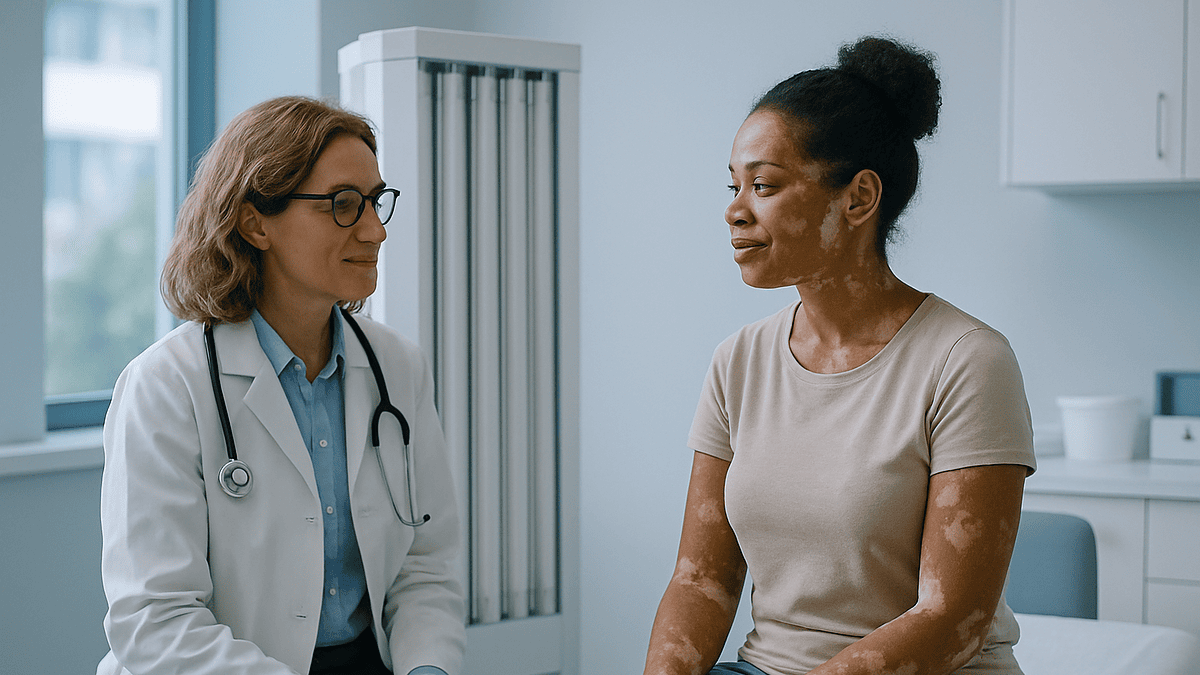
In a typical service, phototherapy for vitiligo is delivered in a walk-in cabinet for widespread patches, or with a smaller hand-held or panel device for a few localized areas. The medical team calculates a starting exposure based on skin type and response, then adjusts it session by session. Treatment is measured in seconds and minutes, not hours.
Mayo Clinic and the NHS both describe NB-UVB as the mainstay light treatment for vitiligo that covers more than a small area of the body, usually alongside or after topical medicines. It is not offered as a single course with a fixed finish line. Instead, the team reviews response at intervals and decides with the patient whether to continue, pause, or combine it with something else.
How does narrowband UVB actually work on vitiligo skin?
Two things need to happen for a white patch to recover color, and NB-UVB nudges both.
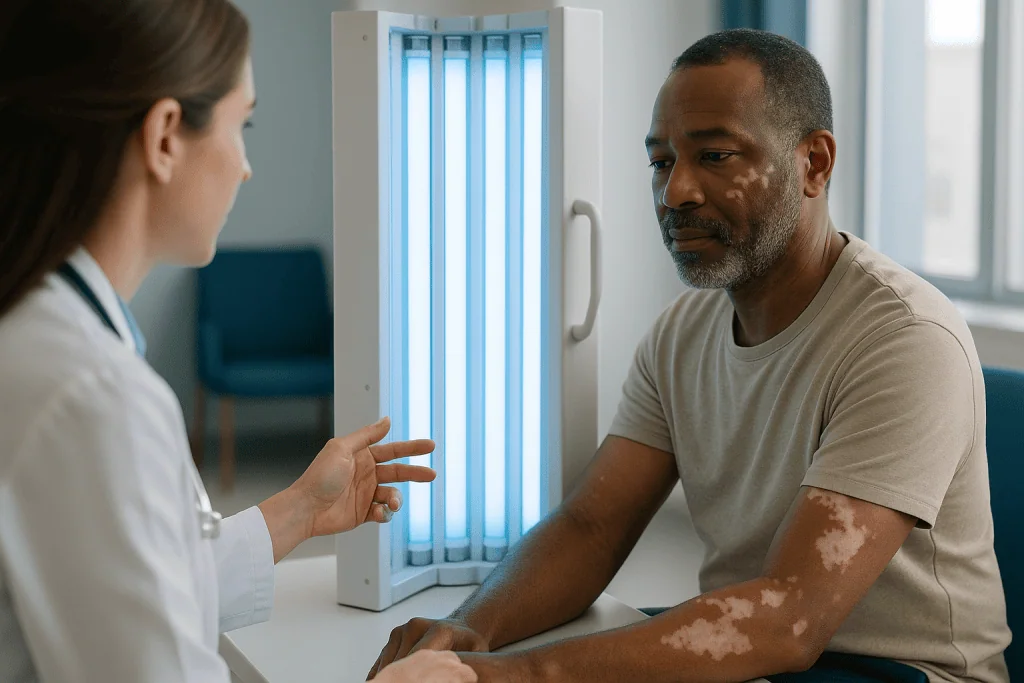
The first is to calm the attack. Ultraviolet B light reaching the upper skin dampens the activity of the T cells, a type of immune cell, that are targeting melanocytes in the patch. Think of it as lowering the volume on a local alarm that has been ringing for months. This immune-quieting effect is the same reason phototherapy is used for psoriasis and eczema.
The second is to rebuild. Melanocytes are not entirely gone from most patches. A reserve population sits in the outer root sheath of hair follicles, tucked below the surface and partly shielded from immune attack. UVB light stimulates these dormant cells to divide, migrate up the follicle, and spread outward across the skin surface. That is why early repigmentation so often appears as tiny dots of color around each hair, the pattern dermatologists call perifollicular repigmentation. Color can also creep in from the edges of a patch, where healthy melanocytes at the border extend inward.
This mechanism explains a great deal about who responds. Skin dense with hair follicles, such as the face, has a deep reserve to draw on. Skin with few or no follicles, such as the palms, soles, fingertips, and lips, has almost nothing to rebuild from, which is why the evidence consistently shows those areas respond poorly to light, as Mayo Clinic notes in its treatment overview.
The process is slow because cell migration is slow. Melanocytes move millimeters, not centimeters, over weeks. That biological pace, rather than any shortcoming of the machine, sets the timetable for everything that follows.
What happens during a phototherapy session?
The appointment itself is brief, and the routine becomes second nature quickly.
On arrival, a nurse or technician checks how the skin reacted to the last session. Faint pinkness that faded overnight means the exposure is about right and can be increased slightly. Deeper redness that lingered, stung, or blistered means the exposure was too high and will be held or reduced. This check is the most important minute of the visit, and it is why honesty about what happened at home matters more than pushing through.
You then undress to expose the patches being treated. Areas not being treated, and areas that always need shielding, are covered. Everyone wears UV-blocking goggles inside the cabinet, because the cornea and lens of the eye are damaged by UVB. People being treated on the face may have the eyelids protected separately. Men are usually advised to cover the genitals, since that skin burns easily and has a higher theoretical cancer risk with long-term UV exposure.
The cabinet door closes, the tubes light up, and the machine times the exposure automatically. Early sessions can last well under a minute. Later sessions, once the skin has adapted, may run several minutes. You stand still, turn if asked, and the lights switch off on their own.
A few practical points shape a good session. Fragrances, some moisturizers, and self-tanning products can make skin more light-sensitive or block light unevenly, so teams usually ask that treated skin be clean and bare on the day. Any new medicine, supplement, or herbal product should be mentioned, because some increase light sensitivity. The team also asks about recent sun exposure, since a weekend of gardening on top of a clinic session can tip mild pinkness into a burn.
How many phototherapy sessions does vitiligo need, and how often?
The frequency is the part most people underestimate before they start.
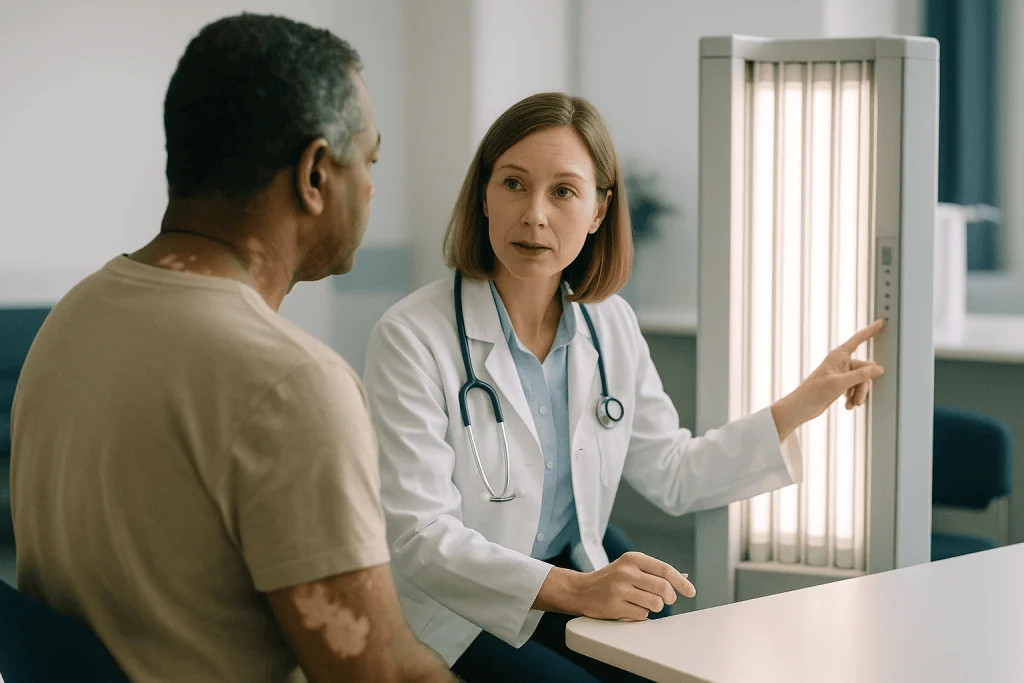
Both Mayo Clinic and the NHS describe narrowband UVB for vitiligo as typically given two or three times a week, with at least a day between sessions so the skin can recover. Fewer visits than that tends to slow progress because each exposure builds on the mild adaptation left by the last; more frequent visits do not speed repigmentation and raise the risk of burning.
Courses are long. The NHS notes that phototherapy may need to continue for several months before its effect can be judged, and Mayo Clinic describes a typical review point after a few months, with treatment sometimes extended toward a year or more when color is still returning. Some services set a checkpoint around three months: if no repigmentation at all has appeared by then, the team may discuss whether continuing makes sense. Others continue as long as visible gains are still being made and the skin tolerates it.
Multiply those numbers and the commitment becomes clear. Two visits a week for six months is roughly 50 appointments. Three a week over a year approaches 150. This is why access to a phototherapy unit near home or work, flexible working hours, and childcare frequently decide whether a course succeeds in practice, regardless of how the skin would have responded.
Missed sessions matter but are not catastrophic. A single missed week usually means the next exposure is held at the same level rather than increased. A gap of several weeks often means restarting at a lower exposure, because the skin loses its adaptation. The team keeps a record and will set the new starting point; there is no need to guess or to try to make up for lost time.
How long does phototherapy take for vitiligo to show results?
Most people search this question within a week of their first session, and the honest answer is: longer than anyone would like, but with a recognizable pattern.
Mayo Clinic’s treatment guidance describes early change appearing within one to three months of regular sessions, with a fuller response often taking six months or longer. The very first sign is rarely a patch shrinking from its edges. It is usually a scatter of freckle-sized dots inside the patch, each sitting over a hair follicle, sometimes darker than the surrounding normal skin at first. Over subsequent months those dots widen and merge into islands, and the islands join.
Timelines run at different speeds across the body. Face and neck patches frequently show dots within the first couple of months. Trunk, upper arms, and thighs follow. Hands, feet, and bony prominences such as elbows and knees may show little or nothing even after many months, which reflects their sparse follicles rather than a failing on the patient’s part.
Newer patches, and patches that have been stable rather than spreading, tend to respond more readily than long-standing ones, according to the NIH StatPearls review. The same source notes that the presence of white hair within a patch signals loss of the follicular melanocyte reserve there, so repigmentation in that spot is less likely.
Photographs are the most useful measuring tool. Progress in the mirror is nearly invisible day to day and becomes obvious only when a current photo sits next to one from twelve weeks earlier. Many phototherapy units take standardized images at baseline and at review; taking your own in the same light and pose each month, without filters, gives you the same reassurance between visits.
Who is phototherapy for vitiligo usually for, and who is asked to wait?
Dermatology teams tend to reach for narrowband UVB in a fairly consistent set of circumstances.
Widespread or rapidly spreading vitiligo is the most common reason. When patches cover more than a small area, applying a cream to each one twice daily becomes impractical, and the NHS describes phototherapy as an option in exactly that situation. Patches that have not responded to topical treatment over a reasonable trial are another common trigger. People whose vitiligo is actively spreading may be offered light therapy alongside medicine to help stabilize the process. Facial and neck vitiligo, which responds best and carries the heaviest psychological weight for many, is also frequently treated.
Certain people are usually steered away, or asked to wait, and the reasons are protective rather than dismissive:
- A personal history of skin cancer, or conditions that greatly increase skin cancer risk, since cumulative ultraviolet exposure adds to that risk.
- Photosensitive conditions such as lupus, or a history of light-triggered rashes, where UVB can provoke a flare.
- Taking medicines that heighten light sensitivity; the team may wait until a course finishes or coordinate with the prescriber, and any change to a prescribed medicine rests with that prescriber.
- Young children who cannot stand still in a cabinet or reliably keep goggles on, where safe treatment is simply not feasible until they are older.
- Very limited vitiligo, where topical medicine or a targeted device is a better fit than whole-body light.
Pregnancy is not an automatic barrier to narrowband UVB, but the decision belongs to the treating team, who weigh the individual situation. Photosensitizing regimens such as PUVA are generally avoided in pregnancy.
Skin tone is not a barrier. Vitiligo occurs in every skin tone, and narrowband UVB is used across the range, with exposure adjusted to how each person’s skin reacts rather than to a color category.
Narrowband UVB vs excimer laser vs PUVA: how do vitiligo light treatments compare?
Several forms of light are used for vitiligo, and they are not interchangeable. The table summarizes how they differ in practice, drawing on descriptions from Mayo Clinic, the NHS, and the NIH StatPearls review.
| Treatment | What it is | Typically used for | Main trade-offs |
|---|---|---|---|
| Narrowband UVB (cabinet) | Whole-body or large-panel exposure to UVB near 311 nm | Widespread vitiligo; spreading disease | Requires 2-3 clinic visits a week for months; short-term redness and dryness; long-term skin cancer risk not fully defined |
| Targeted UVB or excimer laser | A focused beam of UVB at 308 nm aimed only at patches | A few small, localized patches, especially on the face | Spares unaffected skin; impractical for large areas; also needs repeated visits |
| PUVA | UVA light combined with a psoralen medicine that sensitizes the skin | Now used less often; some resistant cases | Nausea, need for all-day eye protection after treatment, and a documented increase in skin cancer risk with cumulative use |
| Home narrowband UVB unit | A small prescribed device used at home under clinic supervision | People who cannot attend a unit frequently | Convenience; risk of burning if used without a supervised schedule; requires regular review |
The pattern across the table is that narrowband UVB has largely replaced PUVA because it avoids the sensitizing medicine and appears to carry a lower long-term risk, while targeted devices exist to spare healthy skin when only a little is affected. Which one, if any, is right for a given person depends on how much skin is involved, where, how fast it is changing, and what the person can realistically attend. That is a conversation for the treating team, not a menu to choose from alone.
What do the first weeks of narrowband UVB for vitiligo usually look like?
The opening month has its own rhythm, and knowing it in advance takes some anxiety out of it.
Week one to two: exposures are short, and most people feel nothing at all during or after. A faint warmth or pinkness a few hours later is common and, according to Mayo Clinic, typically fades within hours. Skin may feel a little tighter or drier. Nothing changes in the patches yet, and that is expected.
Week three to six: exposures have been increased in small steps. Mild pinkness after sessions is more likely now, and this is the window where a burn can occur if a step is too large or if clinic light lands on top of weekend sun. The normally pigmented skin around patches begins to tan slightly, which can temporarily make the white areas look more obvious. This contrast effect distresses some people; it is not the vitiligo worsening, and it evens out as repigmentation starts.
Week six to twelve: for face, neck, and trunk patches, the first perifollicular dots often appear. They can look odd, darker than the surrounding skin, almost like new freckles inside the patch. That is a good sign. Hands and feet usually show nothing yet.
Around three months: most services hold a formal review with photographs. Three broad outcomes emerge. Clear repigmentation, in which case treatment usually continues. Stabilization without new color, where spreading has stopped but the patches are unchanged, which the team may still regard as worthwhile. Or no change at all, which prompts a discussion about whether to continue, adjust, combine with a topical medicine, or stop.
Throughout, the ordinary business of life continues. Work, exercise, and swimming are all fine; the only real adjustment is protecting treated skin from extra sun on top of clinic exposure.
Which body areas respond best to phototherapy for vitiligo?
Vitiligo does not spread evenly, and neither does repigmentation. Being clear-eyed about this before starting spares real disappointment later.
The face and neck respond best. They are rich in hair follicles, the skin is thin, and light penetrates easily. Mayo Clinic and the NIH StatPearls review both identify these as the areas most likely to regain color with light-based treatment, and they are also the areas where other treatments tend to work best.
The trunk, upper arms, and thighs respond moderately well. Follicle density is reasonable and the skin is not heavily keratinized.
The hands, feet, wrists, ankles, elbows, and knees respond poorly. Fingertips, knuckles, palms, and soles are the most stubborn of all. The reasons are structural: few or no hair follicles, thicker skin, frequent friction, and in the case of hands, near-constant environmental exposure. Lips, nipples, and genital skin share the same follicle scarcity. No amount of extra light overcomes an absent reserve of melanocytes, and increasing exposure to chase these areas mainly increases burning.
Segmental vitiligo, a form confined to one side or one strip of the body, behaves differently from the more common generalized form. It tends to stabilize early but often responds less to phototherapy, and surgical approaches that transplant pigment cells are sometimes considered for stable segmental patches instead.
Patches containing white or gray hairs are a warning sign that the follicular reserve there is depleted. Repigmentation in those spots is uncommon with light alone.
A practical consequence follows: many teams, when the aim is cosmetic rather than halting spread, treat the face and exposed trunk and accept that hands may not change. Camouflage products and, occasionally, depigmentation of remaining color are discussed for extensive hand involvement. Those are separate decisions with their own trade-offs, made with the treating team.
What are the phototherapy side effects for vitiligo patients?
Narrowband UVB is generally well tolerated, but it is still ultraviolet light, and its side effects sit in two categories: the short-term ones you will probably notice, and the long-term ones the evidence is still describing.
Short-term effects, per Mayo Clinic, include redness, itching, burning, and dryness of treated skin. Redness usually appears within hours of a session and settles within a day. A sunburn-like reaction with soreness or blistering means the exposure was too high, and the team will adjust it. Tanning of surrounding normal skin is almost universal and is cosmetic rather than harmful, though it can temporarily heighten contrast with white patches. Some people notice reactivation of cold sores on the lips, since UV light can trigger the virus that causes them; a lip-covering sunblock during sessions is a common precaution.
Eye protection prevents the one short-term effect that would be serious: UV damage to the cornea and lens. Goggles are worn in every session, without exception.
The long-term question is skin cancer. Ultraviolet light is a known carcinogen, and the older PUVA regimen has a documented increase in squamous cell skin cancer with cumulative use. For narrowband UVB, the picture is more reassuring but not settled. Long-term follow-up studies have not shown a clear rise in skin cancer, yet they are limited in duration and size, so Mayo Clinic and the NIH review describe the long-term risk as uncertain rather than absent. That is why teams track cumulative sessions, shield the genitals and face where not being treated, and encourage lifelong skin checks.
Photoaging, meaning fine wrinkling, dryness, and mottled pigmentation over years, is plausible with any repeated UV exposure and is another reason exposure is kept to the minimum that works.
How should you care for your skin between phototherapy visits?
What happens in the 48 hours between sessions shapes how well the next one goes. None of it is complicated.
Moisturize, but time it. Dry skin is more prone to itch and to uneven light absorption. A plain, fragrance-free emollient applied in the evening after a session, and on non-treatment days, keeps the barrier intact. On the morning of a session, most units ask that treated skin be clean and free of creams, because some products scatter or absorb UV and can make the exposure unpredictable. Your unit will tell you its exact preference; follow that over anything read online.
Treat sun as part of the dose. A phototherapy session is a measured amount of UV. Uncontrolled sun exposure on the same skin the same day is an unmeasured extra, and it is the most common cause of burns during a course. Broad-spectrum sunscreen on treated areas when outdoors, plus shade and clothing, is standard advice from the NHS for anyone with vitiligo, and it matters more, not less, during treatment. White patches lack melanin and burn faster than surrounding skin.
Keep the routine steady. Avoid starting new skincare actives, fragrances, or self-tanners on treated areas without mentioning them at the next visit. Tell the team about any new medicine or supplement, since some increase photosensitivity. Do not change any prescribed medicine on your own account because of phototherapy; that is a conversation between you and the prescriber.
Report reactions promptly. Pinkness that fades overnight is useful information. Redness that persists, stings, or blisters is important information. Either way, describe it accurately at the next session so the exposure can be adjusted correctly.
Photograph monthly. Same light, same pose, no filters. It is the single most reassuring habit during a slow treatment.
Can you do vitiligo light therapy at home?
Home narrowband UVB units exist, and some dermatology services prescribe and supervise their use for people who cannot attend a clinic two or three times a week because of distance, work, disability, or caregiving. The NHS and Mayo Clinic both mention home phototherapy as an option in selected circumstances, and the key word is supervised.
A supervised home program looks much like a clinic course transplanted into a bathroom. The team assesses suitability, provides a written schedule of exposures that increase in defined steps, teaches goggle use and shielding, and reviews progress and skin reactions at regular appointments. The device itself is prescribed and its use is documented. Decisions about starting, adjusting, or stopping remain with the clinician.
Where home light therapy goes wrong is when it becomes unsupervised. Ultraviolet exposure without a measured schedule is a straightforward route to burns, and burns on vitiligo skin can themselves trigger new patches through a phenomenon called the Koebner response, in which skin injury provokes vitiligo at the injured site. Devices marketed online for general use, sunbeds, and tanning lamps are not equivalent to medical NB-UVB: sunbeds emit mostly UVA, which does not drive repigmentation the same way, and their output is not standardized. Health agencies including the CDC and WHO warn against tanning beds for any purpose because of skin cancer risk.
Sunlight is sometimes suggested as a free alternative. Sun does contain UVB, and some people do repigment with careful, brief exposure, but the dose is uncontrolled, varies by season and latitude, and burns vitiligo skin easily. Most dermatology teams do not recommend deliberate sun exposure as a treatment strategy.
If clinic attendance is the obstacle, the useful question to ask is whether a supervised home program is available in your service and whether you are a suitable candidate for it.
Does phototherapy work alongside creams and other vitiligo treatments?
Light is rarely used entirely alone, and the combinations are where much current treatment sits.
Topical medicines applied to patches are the most common partner. Two classes are long established: topical corticosteroids, which reduce local inflammation, and topical calcineurin inhibitors, which dampen the immune signaling that targets melanocytes and are often favored on the face where steroid thinning of the skin is a concern. Mayo Clinic notes that combining these with light therapy may improve repigmentation compared with either alone, particularly on the face. A newer class, topical JAK inhibitors, blocks a signaling pathway central to the immune attack in vitiligo; a cream in this class has regulatory approval in some countries for nonsegmental vitiligo, and its combination with phototherapy is an active area of study rather than settled practice. Which medicine, whether any is used, and how it is applied around sessions are decisions for the prescribing clinician; nothing here should prompt starting, stopping, or changing a prescription.
Systemic medicines, taken by mouth, are sometimes used for rapidly spreading vitiligo to halt progression while light therapy rebuilds color. These carry their own side effects and are reserved for specific situations under specialist care.
Surgical options, including transplanting small grafts or suspensions of melanocytes from normally pigmented skin into stable patches, are considered when vitiligo has been unchanged for a year or more and has not responded to other treatments. Phototherapy is often used after grafting to encourage the transplanted cells to spread.
Camouflage is a legitimate treatment, not a consolation. Medical-grade cover creams and self-tanning products can even out appearance while slower treatments work, and the NHS describes them as a standard part of vitiligo care.
Vitamin D deserves a note: phototherapy raises skin vitamin D production, and some studies observe low vitamin D in people with vitiligo, but supplementation has not been shown to treat vitiligo itself. Any testing or supplementation is a matter for the care team.
What people often get wrong about phototherapy for vitiligo
Vitiligo attracts more folklore than most skin conditions, and phototherapy has collected its share. A few corrections, each grounded in mainstream evidence.
“If it works, it works fast.” It does not. Melanocytes migrate slowly, and Mayo Clinic’s one-to-three-month window for first change is typical, not pessimistic. Stopping at week five because nothing has happened is the most common way a course that would have worked is abandoned.
“More light means faster results.” Exposure is increased in small steps for a reason. Pushing it faster produces burns, and burns can trigger new patches through the Koebner response. Skipping ahead is counterproductive.
“A tanning bed does the same thing.” Sunbeds emit mostly UVA at unstandardized intensities. They do not replicate medical narrowband UVB, they raise skin cancer risk, and health agencies advise against them for any purpose.
“Phototherapy causes skin cancer.” The honest position is subtler. PUVA has a documented increased risk. For narrowband UVB, long-term studies have not shown a clear rise, but they are limited, so the risk is described as uncertain and monitored, not as established.
“Once color returns, it stays.” Not necessarily. Vitiligo is a chronic condition, and Mayo Clinic notes that repigmentation can fade over time, with the durability of results not well defined. Some people need maintenance or repeat courses.
“Diet, detoxes, or supplements can replace treatment.” No dietary approach has been shown to repigment vitiligo in controlled studies. Eating well is good for you; it is not a treatment for this condition.
“It doesn’t work on darker skin.” Narrowband UVB is used across all skin tones, with exposure adjusted to individual response. Repigmentation on deeper skin tones is often more visually complete because the color match is closer.
“Vitiligo is just cosmetic, so treatment is vanity.” The psychological burden of visible vitiligo is well documented, and treating it is legitimate medical care.
Questions to ask your care team before starting phototherapy
A phototherapy course is a months-long partnership, and the first appointment is the right moment to set expectations on both sides. These questions tend to produce the most useful answers.
- Which of my patches are you aiming to treat, and which do you expect to respond least? Knowing in advance that hands may not change prevents later disappointment.
- How many sessions a week do you recommend for me, and how will we handle missed weeks or holidays?
- When is our first formal review, and what would make you suggest continuing, changing, or stopping?
- Will I use any cream alongside the light, and if so, how should it be timed around sessions?
- Which of my current medicines or supplements could increase light sensitivity, and should any prescriber be told I am starting phototherapy?
- How do you want me to prepare my skin on treatment days, and what should I avoid putting on it?
- What reaction after a session is normal, what should I report at the next visit, and what should make me call before then?
- Do you record my cumulative number of sessions, and how will my skin be monitored for long-term effects over the years?
- Is a supervised home unit an option in this service if attendance becomes difficult, and would I be suitable?
- If my vitiligo is spreading quickly, is there anything you would add to stabilize it while the light works?
- What are the alternatives if phototherapy does not suit me or does not work, including camouflage and surgical options?
- Are there support organizations or counseling services you recommend for the emotional side of living with vitiligo?
Bring photographs of your patches from before any treatment if you have them; they become the baseline for every later comparison. Writing down the answers, or bringing someone to listen, helps, because a great deal of information arrives in a short first visit. Every one of these decisions sits with you and the treating team together, and the answers will be specific to your skin, not to a general rule.
When to call your doctor during phototherapy for vitiligo
Most of a phototherapy course is uneventful. A few situations should prompt a call to the phototherapy unit or your dermatology team before your next scheduled session rather than waiting.
Call promptly if treated skin develops blistering, weeping, or a painful burn, or if redness after a session lasts more than a day and is worsening rather than fading. These signal that the exposure needs adjusting, and continuing at the same level risks further injury and, through the Koebner response, potentially new patches.
Call if you develop a new rash that is different from your vitiligo, particularly a raised, itchy, or light-distributed rash on sun-exposed areas, or a flare of a condition such as lupus or a cold-sore outbreak that is severe or spreading.
Call if your eyes are sore, red, gritty, or unusually sensitive to light after a session, which could indicate UV exposure to the eye and needs assessment.
Call if you notice a new or changing mole, a sore that does not heal, or a scaly patch that persists on any skin, treated or not. Anyone receiving cumulative UV needs any suspicious lesion checked, and this remains true for years after treatment ends.
Call before your next session if you have started any new medicine, supplement, or herbal product, or if you may be pregnant, so the team can decide whether to adjust or pause.
Seek urgent care the same day if a burn is extensive and accompanied by fever, chills, dizziness, or feeling generally unwell, or if you develop facial swelling or difficulty breathing after using any product on treated skin, which could indicate a severe allergic reaction.
Between those moments, keep to the schedule, report reactions honestly, and let the review appointments do their work. Your treating team holds the full picture of your skin, your history, and your response, and every decision about continuing, adjusting, or stopping rests with them, made together with you.
Frequently asked questions
Is narrowband UVB for vitiligo painful?
No, the sessions themselves are painless; most people feel nothing beyond mild warmth. Afterward, treated skin may turn faintly pink and feel dry or slightly itchy for a few hours, similar to a very light sunburn. A reaction that stings, blisters, or lasts more than a day means the exposure was too high and should be reported at the next visit so the team can adjust it.
How long does phototherapy take for vitiligo to work?
First signs typically appear after one to three months of regular sessions, and a fuller response often takes six months or longer, according to Mayo Clinic. The earliest change is usually small dots of color around hair follicles inside a patch rather than the patch shrinking from its edges. Face and neck tend to respond first; hands and feet may show little change even after many months.
What are the most common phototherapy side effects for vitiligo?
Short-term effects are redness, itching, burning, and dryness of treated skin, which usually settle within hours. Surrounding normal skin tans, which can temporarily make patches look more obvious. Cold sores can reactivate on the lips. Long-term, cumulative ultraviolet exposure carries a theoretical skin cancer and photoaging risk that current studies of narrowband UVB have not clearly confirmed but have not ruled out, so ongoing skin checks are advised.
Can I do vitiligo light therapy at home instead of at a clinic?
Sometimes, under supervision. Some dermatology services prescribe home narrowband UVB units for people who cannot attend two or three times a week, with a written exposure schedule, taught goggle use, and regular reviews. Unsupervised devices, sunbeds, and tanning lamps are not equivalent: they risk burns, can trigger new patches, and raise skin cancer risk. Ask your care team whether a supervised home program is available and suitable for you.
Does narrowband UVB work on darker skin tones?
Yes. Vitiligo occurs in every skin tone and narrowband UVB is used across the whole range, with exposure adjusted to how each person’s skin reacts rather than to a color category. On deeper skin tones, returning pigment often blends more seamlessly with surrounding skin because the color match is closer, though the same limits apply: follicle-poor areas such as hands and feet respond least regardless of skin tone.
Will the color come back permanently after phototherapy?
Not always. Vitiligo is a chronic condition, and Mayo Clinic notes that repigmentation gained through light therapy can fade over time, with the durability of results not well defined in the evidence. Some people keep their color for years; others notice patches returning and need maintenance or a repeat course. Your team will discuss what to watch for and when to return if color starts to fade.
Can children have phototherapy for vitiligo?
Older children and teenagers can, in many services, provided they can stand still in the cabinet and keep goggles on reliably. Younger children are usually asked to wait, and topical medicines or targeted devices are used instead. The decision rests with the treating team, who weigh the child’s age, how much skin is affected, and the practicalities of frequent visits, and who set exposure individually.
Should I stop my other medicines before starting phototherapy?
No, never stop or change a prescribed medicine on your own because of phototherapy. Some medicines increase sensitivity to light, so the phototherapy team needs a full list of everything you take, including supplements and herbal products. If anything needs adjusting, that decision is made by the prescribing clinician in coordination with the dermatology team, not by the patient.
Why do my white patches look worse after the first few weeks of narrowband UVB?
Because the normally pigmented skin around them has tanned slightly in response to the light, increasing the contrast. This is expected in the first weeks and is not the vitiligo spreading. As repigmentation begins inside the patches, usually as dots around hairs, the contrast evens out. If patches are genuinely enlarging or new ones are appearing, tell your team, since spreading disease may need an added treatment.
What is the difference between narrowband UVB and the excimer laser for vitiligo?
Both use ultraviolet B light at similar wavelengths, but a narrowband UVB cabinet treats large areas or the whole body, while an excimer laser or targeted lamp aims a focused beam only at individual patches. The targeted approach spares unaffected skin and suits a few small patches, especially on the face; the cabinet suits widespread vitiligo. Both require repeated visits over months, and the choice depends on how much skin is involved.
References
This article is for general information only and is not a substitute for professional medical advice. Please consult a qualified doctor about your individual situation.

More from the Blog

Living With Chronic Hives: Heat, Cold, Pressure and the Everyday Triggers Worth Tracking
Living with chronic hives means managing welts that recur for six weeks or longer, often without a single clear cause. Heat, cold, pressure, friction,…

Questions to Ask at Your Eczema Consultation: Treatment Steps, Maintenance and When to Return
At an eczema consultation, the most useful questions cover four areas: what type of eczema you have and what may be driving it, which…
Double Cleansing and Oil Cleansing: Who Benefits and Who Is Over-Washing
Double cleansing means washing the face twice in a row: first with an oil or balm that dissolves sunscreen, makeup and sebum, then with…
Puffy Eyes and Eye Bags: Fluid, Fat or Skin? How the Cause Decides the Fix
Puffy eyes come from one of three things: fluid pooling in the thin eyelid tissue, orbital fat pushing forward as the tissue holding it…
How to Exfoliate: The Right Way for Your Skin Type
To exfoliate safely, match the method to your skin type: a soft washcloth or gentle chemical exfoliant for dry or sensitive skin, and an…

Acute vs Chronic Urticaria: How the Six-Week Line Changes the Way Hives Are Investigated
Acute urticaria is hives that settle within six weeks; chronic urticaria is hives that keep appearing, on most days, for longer than six weeks.…