

Is Your Vitiligo Active or Stable? How the Answer Shapes the Treatment Plan

Key Takeaways
- Vitiligo is an autoimmune process in which T cells target pigment cells, so "active" describes an ongoing attack and "stable" describes a pause, not a permanent state.
- Dermatologists judge activity from specific clues such as confetti-like dots, blurred or trichrome borders, and new patches at sites of injury, confirmed under a Wood's lamp and with standardized photographs.
- Active disease is managed first by calming the immune response, and the measure of success at that stage is no new patches, not the return of color.
- Surgical repigmentation is generally reserved for people whose vitiligo has stayed unchanged for an extended period, because grafts placed into active skin are attacked like the original cells.
- Mayo Clinic describes phototherapy two to three times a week, with change sometimes visible after one to three months and full effect taking six months or longer.
- Segmental vitiligo often progresses for around a year and then settles durably, while non-segmental vitiligo can flare after years of quiet, which is why stability is reassessed at every visit.
Active vitiligo means patches are still appearing, spreading, or changing, which tells the dermatologist the immune process is ongoing; stable vitiligo means the pattern has held steady for months. Active disease is usually managed first by calming that immune response, while stable disease opens the door to repigmentation approaches, including surgical grafting, that only work when the skin is no longer under attack. Your treating team makes that call.
Maya scrolls back through her phone to a photo taken on a beach a few months ago. Her hands look the same as they do now, mostly. But there is a new pale fleck near her wrist, and the patch by her elbow seems to have softened at its edge. She cannot decide whether she is seeing change or just looking harder.
That uncertainty is the heart of the first question a dermatologist will ask about vitiligo, and it is the question that quietly steers everything that follows. The distinction between active vs stable vitiligo is not a footnote in the notes. It decides whether the first goal is to stop the loss of pigment or to try to bring color back, which treatments are even on the table, and how long the plan will run before anyone judges whether it is working.
Here is how clinicians tell the two apart, why it matters so much, and what the following months tend to look like on each path.
What does active vs stable vitiligo actually mean, and why does it matter?
Vitiligo is a long-term condition in which the skin loses melanocytes, the cells that make pigment, leaving patches that are paler than the surrounding skin. The NIH’s National Institute of Arthritis and Musculoskeletal and Skin Diseases describes it as an autoimmune condition: the body’s own immune system targets those pigment cells. It affects roughly 1% of people worldwide, and Mayo Clinic notes it usually begins before age 30, although it can start at any age.
Activity describes what the immune system is doing right now. When vitiligo is active, new patches are forming, existing ones are enlarging, or their borders are blurring. When it is stable, the map of the skin looks the same month after month; no new patches, no growth, no shrinking that then reverses.
Why should that shape treatment? Think of a lawn that keeps getting scorched in the same spot. Reseeding it while the heat source is still on wastes the seed. Repigmentation, whether from creams, light, or grafting, depends on surviving pigment cells migrating back into pale skin and staying alive there. If the immune attack is ongoing, newly recruited cells are simply targeted again. So the sequence in most treatment plans is: quiet the process first, then rebuild.
The distinction also changes expectations. Someone with active disease is often told the first success is nothing new appearing, which can feel anticlimactic until you understand that it is the foundation for everything else. Someone with stable disease is told, more directly, that the aim is now color, and the conversation turns to which repigmentation approach fits their pattern, body site, and preferences. Neither status is permanent, and the treating team reassesses it at each visit.
What is actually happening in the skin when vitiligo is active?
Under the surface, active vitiligo is an immune conflict. Melanocytes sit in the bottom layer of the epidermis, handing packets of melanin to neighboring skin cells. In vitiligo, cytotoxic T cells, a type of white blood cell built to destroy targets it recognizes as foreign, mistakenly recognize melanocyte proteins. They move into the skin, release inflammatory signals, and the pigment cells either die or stop functioning.

Two features make this process distinctive. First, it is patchy rather than uniform, which is why vitiligo appears as islands of pale skin rather than an all-over fade. Second, it often flares in response to physical stress on the skin. NHS guidance lists triggers such as skin damage, including severe sunburn or cuts, and stressful life events, though it stresses that the exact cause is not fully understood. The tendency for a new patch to appear precisely where the skin was scraped, burned, or rubbed is called the Koebner phenomenon, and its presence is one of the clearest clues that disease is active.
Genes load the dice. Vitiligo tends to run in families and clusters with other autoimmune conditions, particularly autoimmune thyroid disease, which is why Mayo Clinic notes that a dermatologist may order blood tests to check thyroid function at diagnosis. Having the genetic tendency does not guarantee the disease, and having the disease does not mean it will always be active.
When the attack quiets, the skin is left in a holding state. Some melanocytes survive in hair follicles, which act like protected bunkers, and in the pale patch’s border. Those survivors are the raw material repigmentation relies on, which is why regrowth so often begins as tiny dots around hairs or as a slow creep inward from the edge. Understanding this mechanism explains the whole logic of the treatment sequence.
How to know if vitiligo is spreading: the signs a dermatologist looks for
Patients often ask how to know if vitiligo is spreading, and the honest answer is that the eye alone is unreliable. Pale skin against a tan looks more obvious in summer without having grown at all. That is why clinicians combine your history with specific visual clues, and why the assessment belongs in the clinic rather than the bathroom mirror.
The features dermatologists weigh include:
- New patches reported by the patient in recent weeks or months, especially at sites of friction or injury.
- Confetti-like depigmentation: clusters of tiny pale dots scattered near a larger patch, suggesting fresh cell loss.
- Blurred or hypochromic borders: edges that fade gradually rather than ending in a crisp line, which points to an ongoing process at the margin.
- Trichrome patches: three shades visible at once, normal skin, an intermediate tan zone, and fully white skin, another marker of transition.
- Koebner phenomenon: a new patch tracking the exact shape of a scratch, waistband line, or healed wound.
- Inflammatory borders: a slightly raised or pink rim, which is uncommon but strongly suggests activity.
None of these is a self-diagnosis checklist; several can be mimicked by other conditions, and the absence of all of them does not prove stability. What they do is give the clinician a way to read the recent past off the skin itself, even when the patient is unsure what has changed.
Stability, by contrast, looks quieter: sharp borders, uniform white color, sometimes a little regrowth around hair follicles, and a patient history of no change over an extended period. That is the picture the team wants to see before discussing anything that involves moving pigment cells from one place to another.
How is vitiligo activity measured in the clinic?
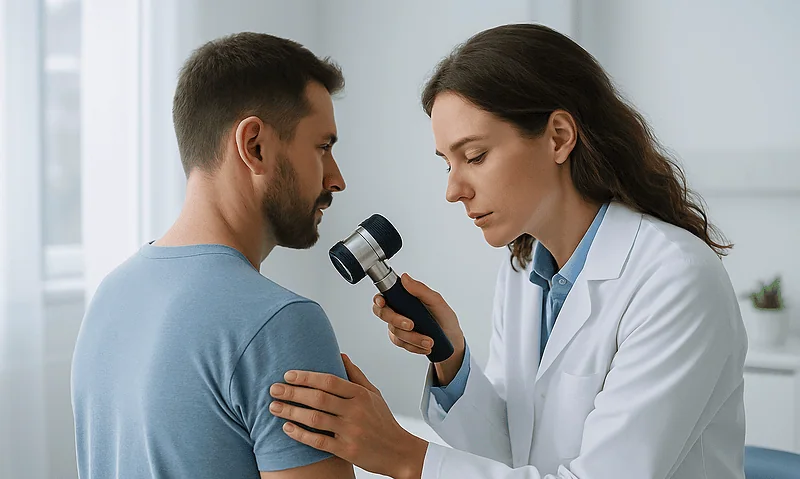
The first tool is a lamp. Mayo Clinic describes the use of a Wood’s lamp, a handheld ultraviolet light, in a darkened room. Under it, skin with no pigment at all glows a bright chalk white, while skin with partial pigment appears duller. This sharpens borders that look fuzzy in daylight, reveals patches invisible on very fair skin, and helps distinguish vitiligo from conditions that only lighten skin rather than removing pigment entirely.

The second tool is a camera. Standardized clinical photographs, taken with the same lighting and positioning at each visit, turn a vague sense that something has changed into an objective comparison. Many dermatology clinics ask patients to keep their own dated photo series between appointments, because the person who sees the skin daily is least able to notice slow drift.
Third comes history, sometimes formalized. Clinicians may use the Vitiligo Disease Activity score, or VIDA, a simple scale that grades how recently new patches or spreading were noticed, from within the past six weeks to no change for more than a year. Body surface area may be estimated, and specialists sometimes score extent and change using research indices, although those are more common in trials than routine clinics.
Fourth are blood tests, not for the skin but for what travels with it. Mayo Clinic notes that thyroid function testing is commonly considered, and other autoimmune checks may follow depending on symptoms.
Finally, a skin biopsy, in which a small sample is removed under local anesthetic, is rarely needed. It is reserved for cases where the diagnosis itself is in doubt.
The point of all this measurement is a single word in the plan, active or stable, and the team’s confidence in that word is what allows them to choose the next step.
How is active vitiligo treated? Calming the immune response comes first
When patches are still appearing, the plan starts by lowering the immune activity in the skin. The choice among the available options belongs to the prescribing clinician, and the notes below describe mechanism and typical timelines only.
Topical corticosteroids damp inflammation broadly and have long been a first step for limited areas. NHS guidance describes a review after roughly a month to check response and skin thinning, because prolonged use carries that risk, particularly on the face and skin folds.
Topical calcineurin inhibitors, a class that blocks a signaling step T cells need to activate, are often chosen for delicate sites such as the face because they do not thin skin. Mayo Clinic lists them among standard options.
Topical Janus kinase inhibitors interrupt the chemical messengers that recruit T cells into the skin and are a newer class approved for nonsegmental vitiligo; response, when it occurs, builds over months rather than weeks.
Narrowband ultraviolet B phototherapy works on two fronts: it suppresses local immune activity and stimulates melanocytes in hair follicles. Mayo Clinic describes treatment two to three times a week, with change sometimes visible after one to three months and full effect taking six months or longer. Some clinicians combine phototherapy with a topical medicine.
Where spreading is rapid, a short course of a systemic medicine that suppresses the immune system may be considered to halt progression quickly; this is a specialist decision weighed against side effects.
The measure of success at this stage is stability. If no new patches appear over a run of visits and borders sharpen under the lamp, the plan usually shifts toward repigmentation. Stopping a treatment early because “nothing is happening” can miss the fact that the important thing, spread, is exactly what stopped. Any change to a prescribed regimen should go through the treating clinician.
Stable vitiligo treatment: bringing color back once the attack has quieted
Once the skin has been steady for months, the goals widen. Stable vitiligo treatment is about recruiting the surviving pigment cells and, where they are absent, moving new ones in.
Phototherapy remains central, because ultraviolet light is the strongest signal for follicular melanocytes to divide and migrate outward. Regrowth typically appears first as freckle-sized dots around hairs, which slowly merge. Sites rich in hair follicles, such as the face and trunk, tend to respond better than hairless skin like fingertips, knuckles, and the ankles, a pattern Mayo Clinic and NHS both describe. Targeted light devices, including the excimer laser, deliver the same wavelength to small areas.
Topical medicines continue on stable skin too, often alongside light, to keep the environment calm and to support regrowth.
Surgical repigmentation becomes an option only at this stage. In these procedures a dermatologist harvests pigment-containing skin or cells from an unaffected donor site and transfers them to the pale area, using punch grafts, suction blister grafts, or a suspension of separated cells spread onto prepared skin. Mayo Clinic notes these are considered when light therapy and medicines have not worked and the disease is stable, because grafts placed into active skin are attacked like everything else.
For widespread disease where most skin has lost pigment, some people choose the opposite direction: depigmentation of the remaining color to create an even tone. It is permanent and increases sun sensitivity, so it follows extensive counseling.
Camouflage products, self-tanning agents, and daily broad-spectrum sunscreen sit alongside every option, since pale skin burns easily and, as the NHS points out, sunburn can itself trigger new patches. Which combination fits is a shared decision between patient and treating team, shaped by extent, body site, skin tone, and what the person actually wants.
Active vs stable vitiligo at a glance
Many people find the two pathways easier to hold in mind side by side. The table below summarizes how clinicians typically frame each status. It is a general guide, not a protocol; the treating team adapts it to the individual.
| Feature | Active vitiligo | Stable vitiligo |
|---|---|---|
| What the skin is doing | New patches, enlargement, blurred or trichrome borders, confetti dots, Koebner spread | No new or growing patches for months; sharp borders; sometimes follicular regrowth |
| Primary goal | Halt pigment loss | Restore pigment |
| Usual first-line approaches | Topical anti-inflammatory classes, phototherapy; systemic immune suppression in rapid spread | Phototherapy, topical agents, targeted light; surgical grafting in selected cases |
| Surgical repigmentation | Not offered; grafts would be targeted | May be considered after sustained stability |
| How success is judged | Absence of new patches over successive visits | Visible return of color, first around hairs and edges |
| Typical timeline to reassess | Weeks for tolerability, months for stability | Months; Mayo Clinic cites six months or longer for full phototherapy effect |
Two caveats matter. First, the line between the columns is not a wall. Someone can be stable for a year, then have a flare after a sunburn and move back to the left column for a while. Second, “stable” is judged over months, not weeks, precisely because vitiligo can pause and restart. That is why dermatologists lean on photographs and lamp examinations rather than a single reassuring appointment.
The value of the table is in the middle rows: the goal differs, so the treatments differ, so the definition of “working” differs. A person on the active path who sees no color return is not necessarily failing treatment. A person on the stable path who is not offered grafting may simply be someone whose pattern responds better to light.
Who is usually offered surgical repigmentation, and who is asked to wait?
Surgery is the clearest illustration of why the active-stable question matters, because it is the one option that is essentially closed to active disease.
People who are commonly considered for grafting share several features. Their vitiligo has been demonstrably stable, with no new or enlarging patches, for an extended period; specialist practice usually asks for at least a year of stability, and Mayo Clinic frames surgery as an option for stable disease that has not responded to light and medicines. Their patches are limited in size, so a donor area can realistically cover them. The affected sites are often ones known to respond poorly to light alone, such as the lips, fingers, or around the eyes. And they have no history of the Koebner phenomenon, since a person whose skin forms new patches wherever it is injured would risk developing vitiligo at the donor site itself.
Those asked to wait typically fall into a few groups:
- Anyone with signs of activity on examination, even if they feel nothing has changed recently.
- People with a recent flare following sunburn, injury, or a stressful period.
- Those with very widespread disease, where the arithmetic of donor skin does not add up and phototherapy or depigmentation may make more sense.
- Children, in most services, where nonsurgical options are tried first and the disease course is still declaring itself.
- People with a tendency to form thick scars, because grafting involves creating small wounds.
Waiting is not a refusal. It usually means the team wants another run of stability on record, or wants to see how far light and topical treatment can get before adding a procedure with its own risks: color mismatch, a cobblestone texture with punch grafts, incomplete take, and scarring at the donor site. Segmental vitiligo, discussed below, is often a better surgical candidate than generalized disease precisely because it tends to stabilize and stay that way.
Segmental vs non-segmental vitiligo: does activity behave differently?
Not all vitiligo runs on the same clock, and the type shapes how the activity question is asked.
Non-segmental vitiligo, the more common form, appears on both sides of the body in a roughly symmetrical pattern: both hands, both knees, around both eyes. The NHS notes it is the type most people with vitiligo have. Its course is the unpredictable one. It can spread in bursts separated by long quiet spells, and it can restart after years of stability. For this type, “stable” is always a provisional label, and the treating team keeps checking.
Segmental vitiligo affects one area on one side of the body, often following a band of skin, and tends to begin earlier in life. Cleveland Clinic describes it as typically progressing for a period, often around a year, and then stopping. Once it settles, it usually stays settled. That combination, limited area plus durable stability, is why segmental vitiligo is so often the pattern in which surgical grafting is discussed, and why it may respond less to immune-calming medicines once the early phase has passed: there may be little ongoing attack left to calm.
A third, less common presentation, sometimes called mixed vitiligo, shows both patterns in the same person and is managed according to whichever component is active.
Why does the type change the conversation? Because it alters the expected trajectory. For a teenager with a single segmental patch that has not changed in two years, a discussion about repigmentation can move quickly. For an adult with new symmetrical patches on the hands and a fresh spot along a bra line, the team’s first job is different, and any talk of grafting is deferred until the skin has proven itself quiet. Same diagnosis, same word on the chart, different plan.
What do the following weeks and months usually look like?
Vitiligo treatment is measured in seasons, not days, and knowing the rhythm in advance prevents a lot of unnecessary discouragement.
On the active pathway, the first few weeks are about tolerability. Topical medicines may cause mild stinging or irritation as the skin adjusts; phototherapy starts with brief exposures that lengthen gradually, and a faint pinkness a few hours after a session is expected while a true burn is not. NHS guidance describes a check-in after about a month with topical corticosteroids to look for benefit and for skin thinning. Over the following months the question at each visit is simple: anything new? Standardized photographs make the answer objective. No new patches across several visits is the milestone that unlocks the next stage.
On the stable pathway, the first sign of repigmentation is easy to miss. Tiny brown dots appear around hair follicles inside the pale patch, or the border begins to creep inward by a millimeter or two. Mayo Clinic notes that change from phototherapy may take one to three months to notice, with full effect at six months or longer. Repigmented skin can look slightly darker than surrounding skin at first and usually evens out over time.
After surgical grafting, the treated area is dressed and protected for roughly a week while grafts take, and phototherapy is often restarted afterward to encourage the transferred cells to spread. Final color typically develops over months.
Throughout both pathways, daily sunscreen, protection from friction and injury, and keeping a photo record are the patient’s contribution. Follow-up intervals vary by service, but expect the team to revisit the active-or-stable question at every appointment, because the answer can change, and the plan should change with it.
Can vitiligo stop spreading on its own, and does stable stay stable?
Yes, vitiligo can stop spreading without treatment, and this is one of the more reassuring facts about the condition. The NHS notes that the disease progresses in some people and remains unchanged for years in others, and that it is impossible to predict which course an individual will follow. Segmental vitiligo in particular tends to settle on its own after its early phase, as described above.
The harder truth is that stability is not a finish line. Non-segmental vitiligo can remain quiet for years and then flare, sometimes after an identifiable trigger such as a bad sunburn, a period of intense stress, a skin infection, or repeated friction, and sometimes for no reason anyone can find. Mayo Clinic also notes that repigmentation gained through treatment is not always permanent; color can fade again if the immune process reawakens.
This has three practical consequences.
First, the label on your chart is a snapshot. A dermatologist who called your vitiligo stable a year ago will want to confirm that before recommending anything that depends on it.
Second, maintenance matters. Some clinicians continue a lower-intensity topical regimen on repigmented skin to reduce the chance of relapse; whether that is appropriate for you is their call, and it should never be started or stopped without them.
Third, vigilance is not anxiety. Keeping a dated photo of each area every couple of months, protecting skin from burns and abrasion, and reporting any new patch promptly are enough. Spotting reactivation early means the immune-calming phase can restart before much pigment is lost.
What the evidence does not support is any claim that a particular diet, supplement, or routine can guarantee lasting stability. Some small studies have explored antioxidants alongside phototherapy, but the results are mixed and no such approach is established as effective on its own.
What people often get wrong about active and stable vitiligo
Vitiligo attracts myths, partly because it is visible and partly because its course is so hard to predict. A few deserve correcting.
“If nothing new appeared this month, it is stable.” Stability is assessed over months, and ideally with photographs and a lamp examination. A quiet month is encouraging, not conclusive, which is why surgery is deferred until the record is long.
“Treatment that is not bringing back color is not working.” In active disease the first goal is to stop spread. A person whose patches have not grown in six months has achieved something important even if they look identical.
“Vitiligo is contagious” or “caused by eating certain foods.” Neither has any basis. MedlinePlus and the NIH describe an autoimmune process with genetic influence; you cannot catch it from someone, and no food causes it.
“It is only cosmetic, so nothing needs checking.” Vitiligo itself is not dangerous, but it travels with other autoimmune conditions, notably thyroid disease, which is why Mayo Clinic mentions blood tests at assessment. And the psychological weight of visible skin change is real and legitimate to raise with the care team.
“Sun exposure will help it blend in.” Tanning the surrounding skin increases contrast, and sunburn is a recognized trigger for new patches. Sunscreen protects both the pale skin, which burns easily, and the stability of the disease.
“Once repigmented, it is over.” Color can fade again if the immune process restarts, so follow-up continues.
“A stronger cream will work faster.” Potency is chosen by site and risk, not urgency; overuse thins skin. Timelines for these treatments are set by biology, and they run in months.
The thread running through all of these is the same: vitiligo is a process, not a stain. Judge treatment by what the process is doing, and let the treating team make that judgment with you.
Questions to ask your care team
A good consultation about vitiligo is a two-way exchange, and knowing what to ask helps the active-stable discussion land where it should. Consider bringing some of these.
- Based on today’s examination, do you consider my vitiligo active or stable, and what did you see that led you there?
- Which type do I have, segmental or non-segmental, and how does that change what you expect over the next year?
- What is the first goal of this plan: stopping spread, restoring color, or both? How will we know it is being met?
- How long should I stay on this approach before we judge whether it is working, and what would make you change course sooner?
- Are there body sites where you expect a better or poorer response, and why?
- What side effects should I watch for with this treatment, and which would need a call rather than waiting for the next visit?
- Would surgical repigmentation ever be an option for me? If not now, what would need to be true first?
- Should I have blood tests for thyroid or other autoimmune conditions, and how often?
- How should I photograph my skin between visits so the comparison is useful to you?
- What everyday precautions matter most for me: sun protection, avoiding friction, anything specific to my job or sport?
- Are there camouflage or support resources you recommend while treatment runs its course?
- If my vitiligo is stable and I choose not to treat it, is that a reasonable option, and would we still monitor it?
Write the answers down or ask permission to record them. Treatment in vitiligo unfolds slowly, and a clear memory of what the team said at the start makes it easier to judge progress six months later, when the skin in the mirror still looks stubbornly familiar.
When to call your doctor
Most changes in vitiligo can wait for a scheduled appointment, but some deserve a prompt call, because they signal either reactivation or a problem with treatment that is easier to address early.
Contact your treating team without waiting if you notice any of the following:
- A new pale patch, or an existing one that has clearly grown, especially if it follows a sunburn, injury, or line of friction; this may mean the disease has become active and the plan needs adjusting.
- A pink, raised, or itchy border around a patch, which can indicate active inflammation.
- Redness, blistering, or pain after phototherapy that goes beyond the mild pinkness the team told you to expect.
- Thinning, easy bruising, stretch-mark-like lines, or visible small blood vessels in skin where a topical corticosteroid is being used.
- Persistent burning or irritation from any prescribed cream that does not settle as your clinician described.
- After surgical grafting: increasing pain, spreading redness, discharge, fever, or a graft that appears to have lifted.
- Symptoms that might point to an associated condition, such as unexplained weight change, unusual tiredness, heart racing, or feeling cold or hot all the time, which can accompany thyroid disease.
- Low mood, anxiety, or withdrawal from activities because of your skin; this is a legitimate reason to seek help and your team can direct you to support.
Seek urgent care the same day for signs of a severe skin reaction anywhere on the body, such as widespread blistering, peeling, or a rapidly spreading rash with fever.
None of these signs means treatment has failed, and none should prompt you to stop or change a prescribed medicine on your own. Vitiligo shifts between active and stable, and the plan is designed to shift with it. The people best placed to make that adjustment are the ones who have examined your skin, and a timely call gives them the chance.
Frequently asked questions
What are the main vitiligo activity signs a dermatologist checks for?
Clinicians look for new or enlarging patches, blurred or three-toned borders, clusters of tiny pale dots near a larger patch, a pink or raised rim, and new patches forming exactly where skin was scraped or burned. A Wood’s lamp examination and comparison photographs sharpen the picture. These features are for the clinician to interpret; several can be mimicked by other skin conditions, so they are not a self-diagnosis tool.
How long does vitiligo need to be unchanged before it is called stable?
There is no single universal cutoff, and the treating team makes the judgment. Activity scores used in clinic grade stability across a range from a few weeks to more than a year without change, and specialist practice usually asks for at least a year of no new or growing patches before considering surgical grafting. Stability for topical or light treatment decisions may be judged over a shorter run of visits.
Can vitiligo stop spreading without any treatment?
Yes. The NHS notes that vitiligo progresses in some people and stays unchanged for years in others, and its course cannot be predicted for an individual. Segmental vitiligo in particular tends to progress for a period and then settle on its own. Non-segmental vitiligo can also pause spontaneously, though it may flare again later, which is why ongoing monitoring is advised even when no treatment is being used.
What is the usual stable vitiligo treatment approach?
Once the skin has been steady for months, the goal shifts to restoring color. Phototherapy is central because ultraviolet light stimulates surviving pigment cells in hair follicles, often combined with topical medicines to keep the skin calm. For limited, persistently stable patches that have not responded, surgical grafting may be considered. For very widespread disease, depigmentation of remaining color is an alternative. Your treating team chooses the combination.
Why is surgery not offered for active vitiligo?
Because grafting moves pigment cells into skin that the immune system is currently attacking, and those transferred cells would be targeted just like the originals. There is also a risk that the donor site, which is deliberately wounded to harvest skin, develops a new patch through the Koebner phenomenon. Mayo Clinic frames surgery as an option for stable disease that has not responded to light and medicines.
How can I tell if my vitiligo is spreading between appointments?
Keep a dated photo of each affected area, taken in the same light and position, every month or two, and compare them side by side rather than relying on memory. Note any new pale spot, particularly after sunburn or injury, and mention it at your next visit or sooner if it is growing quickly. Your dermatologist will confirm any change with a lamp examination.
Does active vitiligo mean the treatment is failing?
Not necessarily. Activity at the start of treatment is the reason treatment is being given, and it takes months for immune-calming approaches to show their effect. A new patch during treatment is a reason to reassess, not automatically to abandon the plan. The treating team may adjust the approach, add phototherapy, or check for triggers such as sunburn. Any change to prescribed medicines should go through them.
Can stable vitiligo become active again?
Yes, particularly in non-segmental vitiligo, which can stay quiet for years and then flare after a sunburn, skin injury, illness, or stressful period, or sometimes with no identifiable trigger. Mayo Clinic also notes that repigmentation gained through treatment may not be permanent. That is why stability is treated as a snapshot, follow-up continues, and sun protection and avoiding friction remain part of long-term care.
Is there a blood test that shows whether vitiligo is active?
No routine blood test measures vitiligo activity; that assessment comes from examination, history, and photographs. Blood tests are used instead to look for conditions that commonly travel with vitiligo, especially autoimmune thyroid disease. Mayo Clinic notes thyroid function testing may be considered at assessment, and other tests depend on symptoms. Ask your treating team what monitoring is appropriate for you.
Does sun exposure help vitiligo look more even or make it worse?
Unprotected sun tends to make things worse. Pale patches lack the melanin that protects against ultraviolet light, so they burn easily, and the NHS lists sunburn among triggers that can prompt new patches. Tanning surrounding skin also heightens contrast. Daily broad-spectrum sunscreen and shade are advised. Controlled phototherapy in clinic is different: dose and wavelength are carefully managed by the treating team.
References
This article is for general information only and is not a substitute for professional medical advice. Please consult a qualified doctor about your individual situation.

More from the Blog

Skin Barrier Repair: What a Damaged Barrier Looks Like and the Ingredients That Rebuild It
Skin barrier repair means restoring the outermost skin layer so it holds water in and keeps irritants out. A damaged barrier typically feels tight,…

LED Masks and Red Light Masks: What Home Devices Can Do, According to Trials
A red light mask is a home LED device that shines red and sometimes near-infrared or blue light onto the face. Small randomized trials…
Skin Flooding and Glass Skin: The Trends Explained, and What Hydration Layers Really Do
Glass skin is a cosmetic look of smooth, even-toned, well-hydrated skin that reflects light, and skin flooding is a method of layering water-based humectants…

What Cellulitis Recovery Looks Like Day by Day: The First Days on Antibiotics and Beyond
Cellulitis recovery day by day usually means the redness may look slightly larger and the skin hotter during the first 24 to 48 hours…

Crepey Skin and Neck Lines: The Collagen Story and the Options From Creams to Devices
Crepey skin is thin, finely wrinkled skin that looks like crepe paper, caused mainly by sun damage, aging and the gradual loss of collagen…

Under-Eye Filler and Tear Trough Filler: Who Suits It, the Risks and the Alternatives
Under eye filler, usually a hyaluronic acid gel placed in the tear trough, can soften a hollow groove between the lower eyelid and cheek…