

Laparoscopic vs Robotic Minimally Invasive Surgery: What Differs for the Patient on the Table
Key Takeaways
- Laparoscopic and robotic operations use the same small incisions, typically about 1 to 1.5 cm according to the NHS, and the same carbon dioxide gas to create working space.
- In robotic surgery the surgeon sits at a console in the same operating room and controls every movement; the system has no independent action.
- For most common operations, comparative studies show similar complication rates and recovery between the two approaches, with robotic cases usually taking longer in theater.
- Robotic instruments add a wrist-like joint and a magnified 3D view but remove most tactile feedback, so surgeons judge tissue tension visually.
- The navel is the thinnest point of the abdominal wall, with no muscle layer, which is why it is the usual site for the first port and why the scar hides well.
- Shoulder-tip pain after keyhole surgery comes from leftover gas irritating the diaphragm and typically eases over a few days as the gas is absorbed.
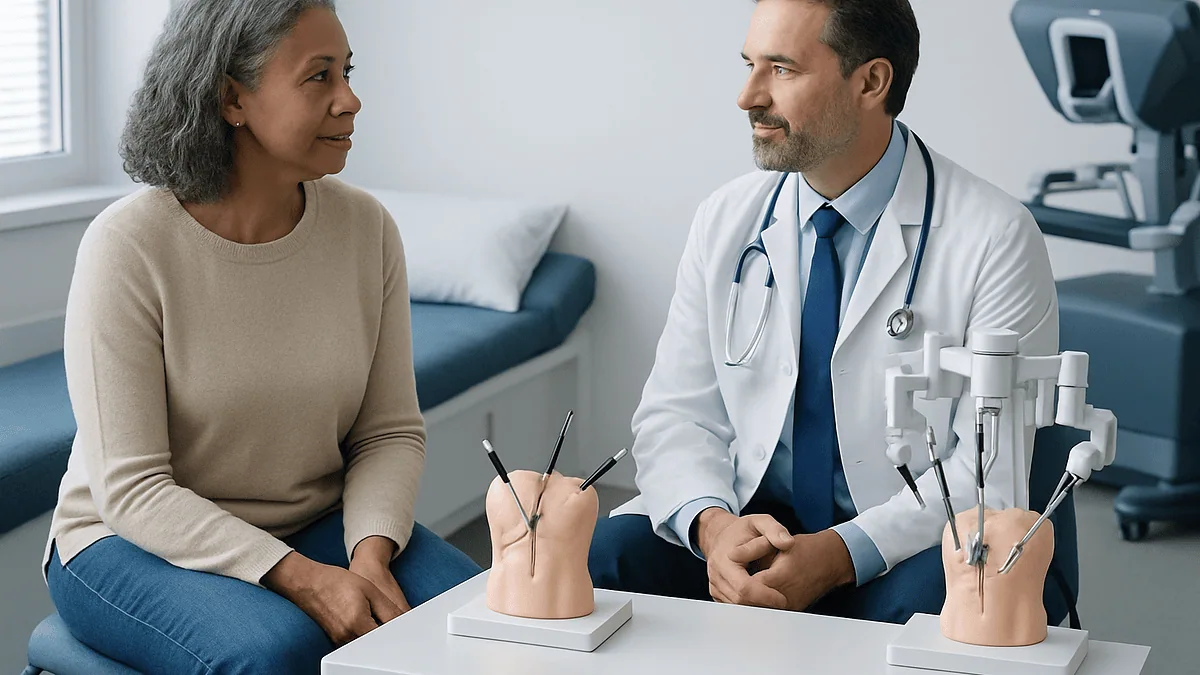
Laparoscopic and robotic surgery are both minimally invasive: the operation happens through several small cuts using a camera and long instruments. In laparoscopy the surgeon holds those instruments directly; in robotic surgery the surgeon controls them from a console, with wristed tips and a magnified 3D view. Current evidence shows broadly similar safety and recovery for most operations, so the surgeon's experience with the chosen technique usually matters more than the tool.
The consent form lists two options, and the nurse says the surgeon will explain. Then a friend mentions her gallbladder came out through the belly button, a cousin swears the robot did his prostate, and by evening you have eleven tabs open and no clearer idea what will actually be different once you are lying on the table.
That confusion is understandable. The phrase laparoscopic vs robotic surgery sounds like a contest between old and new, hand and machine. In reality the two approaches share almost everything a patient experiences: the same small incisions, the same gas-inflated abdomen, the same general anesthetic, and, for most operations, a very similar recovery.
What differs sits mostly on the surgeon’s side of the drape. This explainer walks through those differences honestly, separates what the evidence shows from what the marketing implies, and gives you the questions worth asking before anyone books a theater slot.
How laparoscopic vs robotic surgery actually works
Both techniques start the same way. After general anesthesia (medicine that keeps you fully asleep and pain-free), the surgeon makes a small cut, usually near the navel, and introduces carbon dioxide gas to lift the abdominal wall away from the organs. This gas-filled working space is called a pneumoperitoneum. According to the NHS, the incisions for laparoscopy are typically around 1 to 1.5 centimeters long, roughly the width of a fingertip.
Through these cuts go hollow tubes called trocars, which act as ports. A laparoscope, a thin telescope with a light and camera on the end, goes through one; long, slender instruments go through the others. The surgeon watches a video screen rather than looking directly into the body.
In conventional laparoscopy, the surgeon stands beside you and moves those instruments by hand. Each instrument is a rigid rod: push in, pull out, rotate, pivot at the abdominal wall. Because the port acts as a fulcrum, moving the handle left sends the tip right, a mirror effect surgeons train for years to make automatic.
In robotic surgery, the same kinds of ports are placed, but the instruments are docked to mechanical arms. The surgeon then sits at a console in the same room, looking into a viewer that shows a magnified, three-dimensional image, and moves hand controls. The system translates those movements to the instrument tips in real time. As Mayo Clinic and MedlinePlus both describe, the robot does not act on its own; every motion originates with the surgeon, and a bedside assistant and scrub team remain at the table throughout.
So the honest one-line summary: identical entry, identical goal, different way of holding the tools.
Same small cuts, different hands: what changes at the instrument tip
If the incisions and the gas are shared, where does the technology earn its name? Three places, all of them about control rather than access.
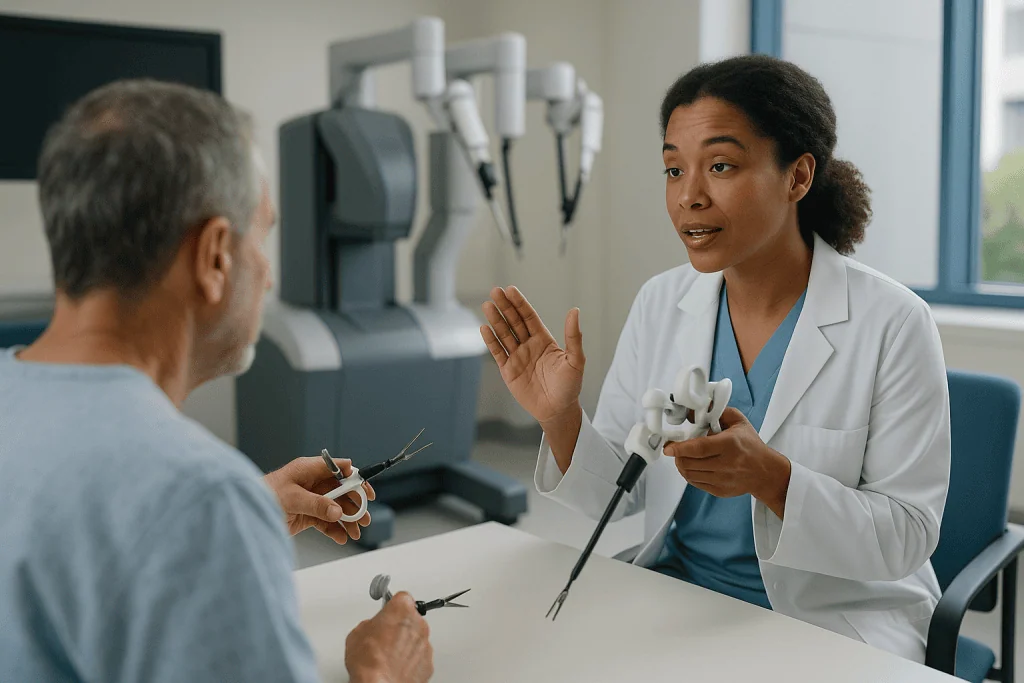
First, the wrist. Standard laparoscopic instruments have no joint at the tip; they open and close, and that is roughly it. Robotic instruments carry a small articulating joint that bends and rotates like a human wrist, which helps when sewing at awkward angles deep in the pelvis or behind an organ. Johns Hopkins describes this as instruments that move with greater range than the human hand can manage through a fixed port.
Second, the picture. Laparoscopy usually gives a high-definition but two-dimensional image on a screen across the room. The robotic console delivers a stereoscopic view, meaning each eye receives a slightly different image, so depth is perceived directly rather than inferred from shadows and instrument contact. Camera control also shifts from an assistant’s hands to the surgeon’s own controls.
Third, the filter. The system dampens the natural tremor in a surgeon’s hands and can scale movement, so a larger motion at the console produces a smaller, finer motion at the tip. Whether that translates into measurably better results for a given operation is exactly the question the next section tackles.
One thing does not change: the tissue. Sutures, staplers, energy devices that seal blood vessels, the anatomy itself; all are the same whether a hand or a mechanical arm is moving them. The robotic approach is best understood as laparoscopy with a different interface, not a different operation.
Which surgery is better, robotic or laparoscopic?
This is the question everyone types, and the truthful answer is less dramatic than either camp would like: for most common operations, the evidence does not show that one approach is clearly safer or produces clearly better results than the other.
Large comparative studies and systematic reviews, the pooled analyses that combine many trials, have examined procedures including gallbladder removal, hernia repair, hysterectomy, colorectal resection and prostatectomy. Across these, the recurring pattern is similar rates of complications, similar hospital stays and similar readmissions, with robotic cases often taking longer in the operating room, partly because of the time needed to position and dock the arms. Mayo Clinic frames the advantages of robotic surgery as benefits of minimally invasive surgery in general, compared with an open operation through a large incision: less pain, less blood loss, quicker recovery and smaller scars. Those advantages are real, but they belong to both small-cut techniques, not to the robot alone.
Where differences do appear, they tend to be operation-specific and modest. Procedures performed in confined spaces where suturing is difficult, such as the deep male pelvis, are the settings in which some studies report advantages for wristed instruments. For a straightforward gallbladder removal, there is little a robotic arm can add to what an experienced laparoscopic surgeon already does well.
Here is the opinion this magazine will stand behind, because the evidence supports it: the single strongest predictor of a good outcome is a surgeon who performs your specific operation often and is fully trained in the approach they are proposing. A skilled laparoscopist is a better bet than an occasional robotic user, and vice versa. Ask about the person, then about the platform.
Why do surgeons prefer robotic surgery?
Patients sometimes assume that if a surgeon leans toward the robotic option, they must believe it is safer for the patient. Often the reasons are more human than that, and worth understanding.

Ergonomics come first. Conventional laparoscopy asks a surgeon to stand for hours, arms raised, twisting to keep the screen in view while working against the fulcrum effect. Neck, shoulder and back strain among laparoscopic surgeons is well recognized. At a console the surgeon sits, forearms supported, eyes at a natural angle. A surgeon who is less fatigued in the fourth hour of a long cancer operation is a reasonable thing to want on your side.
Then there is the wrist. Certain steps, especially placing fine stitches at the bottom of the pelvis or reconnecting the urethra after removing a prostate, are genuinely awkward with straight instruments. Surgeons who do these steps daily often describe the articulated tip as making a hard task feel more natural.
Training pathways matter too. Many surgeons now complete residencies where robotic platforms are part of everyday practice, so the console is simply the environment they know best. Familiarity breeds fluency, and fluency is good for patients.
Institutional factors play a part as well. Where a system has been acquired, there is an understandable wish to use it, and some specialties have shifted almost entirely toward the robotic approach for particular operations.
None of these reasons is illegitimate. But notice that most describe the surgeon’s experience, not measured patient outcomes. A good answer to the question you should feel free to ask, why this approach for me, will explain which of these reasons applies to your operation specifically.
What is the downside of robotic surgery? The robotic surgery disadvantages people rarely hear
Every tool has trade-offs, and a fair explainer names them. MedlinePlus lists the specific risks of robotic surgery as broadly those of any minimally invasive operation, but a few issues are particular to the platform.
Loss of touch is the most discussed. In laparoscopy, the surgeon feels resistance through the instrument handle: the give of tissue, the tug of a stitch about to break. Most robotic systems transmit little or no force feedback, so surgeons learn to read tension visually. Experienced operators compensate well; less experienced ones may not, which is another reason case volume matters.
Time is a second. Setting up and docking the arms adds minutes before the operation proper begins, and comparative studies consistently report longer total operating times for robotic cases. Longer anesthesia is not automatically harmful, but for someone with fragile heart or lung function the treating team weighs it.
Positioning is a third. Once the arms are docked, the operating table generally cannot be tilted without undocking, so patients are placed in the required position at the outset, sometimes steeply head-down for pelvic work. Prolonged steep tilt can raise pressure in the eyes and face and, rarely, affect nerves in the arms or legs. Anesthesia teams monitor for this closely.
Technical failure is possible but uncommon; teams rehearse converting to conventional laparoscopy or an open incision if an instrument or the system malfunctions.
Finally, the marketing halo. A robot in the room does not make an operation appropriate that would otherwise be avoidable, nor does it lower the risk of the operation you actually need. Treat any implication otherwise with polite skepticism.
Why do they go through the belly button for laparoscopic surgery?
It is one of the most searched questions about keyhole surgery, and the answer is a small lesson in anatomy.
The umbilicus is where the umbilical cord once attached, and in adults it remains the thinnest point of the abdominal wall. Here the layers of muscle that wrap the rest of the abdomen part, leaving skin sitting almost directly on a tough fibrous sheet called the fascia and, beneath it, the peritoneum, the membrane lining the abdominal cavity. There is little fat and no muscle to cut through, so the first port can be placed with the least tissue trauma and the most predictable entry. MedlinePlus describes the standard laparoscopic approach as the surgeon making the initial cut below or through the navel to introduce the camera.
The cosmetic benefit is a welcome side effect. The navel is a natural fold, so the small scar tends to disappear into it. Most people cannot find their own umbilical port scar a year later.
The position is also practical. The navel sits roughly in the center of the abdomen, which gives the camera a panoramic view before the other ports are placed, and it is a convenient site through which to remove a specimen such as a gallbladder or appendix, sometimes after widening the cut slightly.
Robotic operations use the same logic; the camera port is often umbilical or close to it, with the arm ports arranged in an arc a hand’s breadth apart so the mechanical arms do not collide.
Two caveats. People with prior surgery near the navel, adhesions or an umbilical hernia may have their first port placed elsewhere. And the belly button itself gets cleaned thoroughly before surgery, which is why the pre-op checklist mentions it.
Who is usually offered which approach, and who is asked to wait
Approach follows anatomy, operation and surgeon before it follows patient preference, though preference is a legitimate voice in the room.
Laparoscopy remains the default for many high-volume operations: gallbladder removal, appendectomy, many hernia repairs, diagnostic looks at the pelvis, and a large share of gynecological procedures. These are operations that experienced laparoscopic surgeons perform quickly and well, and the NHS lists them among the standard uses of laparoscopy.
Robotic approaches are more commonly offered for operations that involve fine reconstruction in tight spaces or lengthy dissection, such as prostatectomy, partial kidney removal, some rectal and gynecologic cancer operations, complex hernias and certain bariatric procedures. Johns Hopkins describes robotic surgery as suited to complex procedures where precision in confined areas is helpful.
Either technique can be inappropriate for some people. Extensive previous abdominal surgery may have left scar tissue, called adhesions, that makes safe keyhole entry difficult. Severe heart or lung disease can make the gas pressure and steep positioning risky, because inflating the abdomen pushes up on the diaphragm and affects breathing and blood return to the heart. A very large tumor, active heavy bleeding, or an emergency where speed is everything may all point toward an open operation.
Some patients are asked to wait rather than choose. Uncontrolled diabetes, a recent chest infection, poorly controlled blood pressure, smoking, or nutritional problems can raise the risk of any operation, and a surgical team may reasonably delay to improve those first. Pregnancy changes the calculus too; laparoscopy is possible in pregnancy for urgent problems, but elective procedures are usually deferred.
These decisions rest with your treating team, who can see your scans and your history. Your job is to make sure they also hear your priorities.
Laparoscopic vs robotic surgery side by side
Sometimes a table says it faster than paragraphs. The comparison below reflects mainstream descriptions from Mayo Clinic, MedlinePlus, the NHS and Johns Hopkins, and it deliberately avoids claims the evidence does not support.
| Feature | Conventional laparoscopy | Robotic-assisted laparoscopy |
|---|---|---|
| Incisions | Several small cuts, typically about 1 to 1.5 cm (NHS) | Several small cuts of similar size; port layout arranged for arm clearance |
| Who moves the instruments | Surgeon, standing at the table | Surgeon, seated at a console in the same room; assistant at the table |
| Instrument tips | Rigid, no wrist | Articulated, wrist-like rotation |
| View | High-definition 2D screen | Magnified 3D through a viewer |
| Tactile feedback | Felt through the handle | Minimal or none; judged visually |
| Anesthesia | General | General |
| Operating time | Usually shorter | Often longer, including docking |
| Recovery vs open surgery | Faster, less pain | Faster, less pain; similar to laparoscopy in most studies |
| Complication rates | Similar for most procedures | Similar for most procedures |
| Conversion to open | Possible | Possible; may first convert to standard laparoscopy |
Read the two right-hand columns together and the picture is one of overlap far more than difference. The rows that genuinely separate the techniques, wristed tips, 3D vision and tactile feedback, describe the surgeon’s tools. The rows that describe your experience, incisions, anesthesia, pain and recovery, are nearly identical.
That is why this article keeps returning to one theme. For the patient on the table, the meaningful variable is rarely the platform. It is the operation itself, your own health, and the practiced hands directing whichever instrument is inside you.
What you will notice on the day: anesthesia, gas and positioning
From your side of the experience, both approaches feel almost the same, and knowing the sequence removes much of the fear.
You will be asked not to eat or drink for a period before surgery; the anesthesia team sets this window. In the anesthetic room a small cannula goes into a vein, monitors go on, and you drift off within a minute or so of the medicine being given. You will not be aware of anything that follows until you wake in recovery.
While you are asleep, the team positions you for the operation. For pelvic surgery this often means a head-down tilt, called the Trendelenburg position, so gravity moves the bowel out of the way. Padded supports and straps keep you safe, and in robotic cases the position is set before the arms are docked. Your abdomen is cleaned, including the navel, and sterile drapes are placed.
The carbon dioxide gas is the part people notice most afterward. Some inevitably remains in the abdomen, irritating the diaphragm; because the nerve that supplies the diaphragm shares roots with nerves to the shoulder, this is felt as shoulder-tip pain. MedlinePlus and the NHS both describe this as common and temporary, typically easing over a few days as the gas is absorbed.
When you wake, you will have small dressings or glue over each port site, possibly a slightly sore throat from the breathing tube, and a bloated feeling. Pain is usually managed with simple analgesics; the exact plan is set by your anesthesia team and adjusted to you.
Robotic or laparoscopic, this is the day as most patients live it. The console and the arms belong to the surgeon’s memory of the operation, not yours.
Robotic surgery vs laparoscopic recovery time: what the days and weeks after usually look like
Recovery after either technique follows the same arc, and it is driven far more by what was done inside than by how the instruments were held.
For minor or diagnostic procedures, many people go home the same day. The NHS notes that after a diagnostic laparoscopy, most people can return to normal activities within about five days, while recovery after a therapeutic laparoscopy depends on the operation performed. A gallbladder removal typically means a few days of tenderness and a week or two of gentle activity; a bowel resection or cancer operation means a hospital stay of several days and several weeks of gradual return.
The first three days are about gas and incisions. Shoulder-tip pain, a bloated abdomen and mild bruising around the ports are expected. Walking helps move the gas along and protects against blood clots. Small port wounds are usually closed with dissolving stitches or glue, and dressings can generally be removed after a day or two according to your team’s instructions.
Week one brings a return to light activity. The NHS advises avoiding driving until you can comfortably perform an emergency stop and have recovered from the anesthetic; your team and your insurer set the exact rule. Fatigue is common and normal; anesthesia and healing both take energy.
Weeks two to six vary with the operation. Heavy lifting is usually restricted while the deeper fascia heals, because that layer, not the skin, is what prevents a hernia at a port site.
Do studies show robotic patients recovering faster than laparoscopic ones? For most operations, no meaningful difference has been demonstrated; both recover faster than open surgery. Follow the timeline your own surgeon gives, and treat any online number, including these, as a range rather than a schedule.
Is robotic surgery safer than laparoscopic? Risks, conversion and alternatives
Safety deserves plain language. Both approaches share the general risks of abdominal surgery: bleeding, infection at a wound or inside the abdomen, injury to nearby organs such as bowel, bladder or blood vessels, blood clots in the legs or lungs, and reactions to anesthesia. MedlinePlus and the NHS list these for laparoscopy, and MedlinePlus applies the same list to robotic surgery. Serious complications after keyhole surgery are uncommon, but they are not zero with either tool.
Two risks are specific to the small-cut approach itself. One is injury during initial port placement, because the first instrument enters before the camera can see. Surgeons use techniques such as open entry at the navel or optical trocars to reduce this. The other is a hernia at a port site later, which is why lifting restrictions exist.
Conversion means switching, mid-operation, from keyhole to a larger open incision. It happens when adhesions block the view, bleeding needs direct control, or anatomy proves unexpectedly difficult. Conversion is a judgment, not a failure; surgeons will tell you beforehand that it is possible, and consent forms usually include it. In robotic cases, a team may first convert to conventional laparoscopy before considering open surgery.
Alternatives exist. Open surgery remains the right choice for some emergencies, some very large or invasive tumors, and some people whose heart or lungs will not tolerate gas and tilt. For certain conditions, watchful waiting, medicines, endoscopic procedures through natural openings, or interventional radiology techniques may be options worth discussing.
So, is robotic surgery safer? For most operations the honest answer is that it is comparably safe, not safer. The person to ask which is right for you is the surgeon who will do it.
What people often get wrong about the difference between laparoscopic and robotic surgery
Some myths are harmless. These ones shape decisions, so they are worth correcting.
The robot operates by itself. It does not. Nothing moves unless the surgeon moves it, and the system has no independent decision-making. Mayo Clinic and MedlinePlus are both explicit on this point. A more accurate term, and the one used in the medical literature, is robot-assisted surgery.
Robotic means smaller scars. The incisions are of similar size to standard laparoscopy and there are typically as many or more ports, because each mechanical arm needs its own entry. Scar differences between the two are trivial; the meaningful difference is between either of them and an open incision.
Robotic is always the newer, therefore better, option. Newer is not a clinical endpoint. For many common operations, comparative studies show equivalent outcomes with longer operating times for the robotic approach.
Laparoscopy is outdated. It remains the global workhorse of minimally invasive surgery and, in experienced hands, the standard for gallbladders, appendixes and many hernias and gynecological procedures.
The surgeon is in another building. The console sits in the same operating room, and the surgeon can be at the table within seconds. Remote surgery across distances remains experimental and is not routine care.
If a hospital has a robot, you should insist on it. The better question is whether your surgeon has deep experience in whichever approach they propose for your specific operation.
Keyhole means painless. Less pain than open surgery, yes. No pain, no. Expect a few days of gas discomfort and tenderness with either technique.
Questions to ask your care team before choosing an approach
A good consultation is a conversation, and the right questions often matter more than the right answers you bring from the internet. These are worth writing down.
- Which approach are you proposing for my operation, and what is the main reason for that choice in my case?
- How often do you perform this specific operation using this technique, and how often using the alternative?
- Is there anything about my anatomy, previous surgery or general health that makes one approach safer for me?
- What would make you convert to an open operation, and how likely is that for someone like me?
- How long do you expect the operation and the anesthetic to take?
- What position will I be in on the table, and are there risks from that position I should know about?
- What should the first three days feel like, and what would be unusual?
- When can I shower, drive, lift, return to work and exercise?
- Who will be at the table if you are at the console, and what is their role?
- What are the alternatives to surgery altogether, including waiting, and what happens if I do nothing for now?
Notice that only a couple of these questions are about technology. The rest are about you, the operation and the team. That balance is intentional.
One more thing worth saying aloud in the room: your priorities. If a slightly longer anesthetic worries you because of a heart condition, say so. If you would rather have the approach your surgeon uses most, say that too. Surgeons genuinely appreciate patients who are clear about what matters to them, and the final plan, which remains the team’s responsibility, is better for it.
When to call your doctor after laparoscopic or robotic surgery
Most recovery is uneventful. A few signs, though, should not wait for the scheduled follow-up appointment, and they apply equally after either technique. MedlinePlus and the NHS list these among the reasons to seek prompt medical attention after keyhole surgery.
Call your surgical team, or the emergency number you were given, the same day if you notice:
- Fever, chills or feeling generally unwell in a way that is getting worse rather than better.
- Abdominal pain that is increasing, spreading, or not controlled by the pain relief you were given.
- A wound that becomes increasingly red, hot, swollen, or leaks pus or cloudy fluid.
- Persistent vomiting, or being unable to keep fluids down.
- Not passing urine, or passing very little, for many hours.
- A swollen, painful or red calf, which can signal a blood clot.
Treat the following as emergencies and call emergency services rather than waiting for a callback: chest pain, sudden breathlessness, coughing up blood, fainting or collapse, heavy bleeding from a wound, or a rigid, severely painful abdomen. Sudden breathlessness with chest pain can mean a clot has traveled to the lungs, and it needs immediate assessment.
A bloated feeling, shoulder-tip discomfort, mild bruising and tiredness in the first few days are expected and not red flags. Shoulder pain that worsens sharply, or pain that seems out of proportion to how small the cuts are, is different and deserves a call.
If in doubt, ring. Surgical teams would far rather answer an unnecessary question than hear about a delayed one. Keep the contact details you were given at discharge somewhere visible, and make sure whoever is with you at home knows where they are.
Frequently asked questions
What is the difference between laparoscopic and robotic surgery?
The difference is in how the instruments are controlled, not in the size of the cuts. In laparoscopy the surgeon holds long instruments directly while watching a 2D screen. In robotic surgery the same kinds of instruments are attached to mechanical arms and the surgeon moves them from a console with a 3D view and wristed tips. Incisions, anesthesia and the operation performed inside are essentially the same.
Which surgery is better, robotic or laparoscopic?
Neither is better across the board. For most operations, systematic reviews show similar safety, complications and recovery, with longer operating times for robotic cases. Some complex procedures in tight spaces may benefit from wristed instruments. The surgeon’s experience with the chosen technique for your specific operation is the stronger predictor of a good outcome, so ask about that first.
What is the downside of robotic surgery?
The main downsides are reduced tactile feedback, longer set-up and operating time, and the need to fix the patient’s position before the arms are docked, sometimes in a steep head-down tilt. Technical malfunction is rare but possible, and teams plan for conversion to standard laparoscopy or open surgery. None of these makes robotic surgery unsafe; they are trade-offs your team weighs against the benefits.
Why do surgeons prefer robotic surgery?
Surgeons often prefer it for ergonomic reasons, since they sit with supported arms instead of standing for hours, and for the wristed instruments and 3D view that make fine suturing in confined spaces easier. Many were also trained on robotic platforms. These are genuine benefits for the operator, but they do not automatically translate into better patient outcomes for every operation.
Why do they go through the belly button for laparoscopic surgery?
The navel is the thinnest part of the abdominal wall, where skin sits almost directly on the fascia with no muscle to cut, so entry is safer and less traumatic. It is centrally placed for a panoramic camera view, and the scar hides in a natural fold. People with previous surgery near the navel or a hernia there may have the first port placed elsewhere.
Is robotic surgery safer than laparoscopic surgery?
Current evidence shows robotic surgery to be comparably safe rather than safer for most procedures. Both share the risks of any abdominal operation, including bleeding, infection, organ injury and blood clots, at similar rates in comparative studies. Both are associated with less pain and faster recovery than open surgery. Any specific advantage tends to be operation-dependent and modest.
Is robotic surgery vs laparoscopic recovery time really different?
For most operations, no meaningful difference in recovery has been shown. Both approaches recover faster than open surgery. The NHS notes that after a diagnostic laparoscopy most people resume normal activities within about five days, while recovery after larger operations depends on what was done inside rather than on which technique held the instruments. Follow the timeline your own team gives you.
Is the surgeon in the room during robotic surgery?
Yes. The console sits in the same operating room, usually a few steps from the table, and a trained assistant and scrub team stay beside you throughout. The surgeon can be at the table within seconds if needed. Remote surgery across long distances remains experimental and is not part of routine care.
What does shoulder pain after keyhole surgery mean?
It is usually leftover carbon dioxide gas irritating the diaphragm. The nerve supplying the diaphragm shares roots with nerves to the shoulder, so the brain reads the irritation as shoulder-tip pain. MedlinePlus and the NHS describe this as common and temporary, easing over a few days. Shoulder pain that worsens sharply or comes with fever or breathlessness should prompt a call to your team.
Can a keyhole operation turn into open surgery?
Yes, and it is called conversion. It happens when scar tissue blocks the view, bleeding needs direct control, or anatomy is unexpectedly difficult. Conversion is a safety decision, not a failure, and surgeons discuss the possibility beforehand. In robotic cases the team may first switch to conventional laparoscopy before deciding on an open incision.
References
- MedlinePlus Medical Encyclopedia: Robotic surgery
- MedlinePlus Medical Encyclopedia: Diagnostic laparoscopy
- NHS: Laparoscopy (keyhole surgery)
This article is for general information only and is not a substitute for professional medical advice. Please consult a qualified doctor about your individual situation.

More from the Blog

Is Gallbladder Surgery Different for Older Adults? How Age and Heart Conditions Shape the Plan
Gallbladder surgery is not fundamentally different for older adults, but the planning around it is. Surgeons weigh frailty, heart and lung conditions, medicines such…

Why Fecal Incontinence Happens: Muscle, Nerve and Stool Factors Specialists Look For
Fecal incontinence usually happens when one or more of three systems fails: the sphincter muscles that close the anus, the nerves that sense stool…

Laparoscopic Appendectomy Step by Step: Anesthesia, Three Small Incisions and Closing Up
A laparoscopic appendectomy removes the appendix through three small abdominal incisions under general anesthesia. The surgeon inflates the abdomen with carbon dioxide, inserts a…

Keeping a Bowel Diary Before Your Fecal Incontinence Appointment: What to Record and Why
A bowel diary before a fecal incontinence appointment is a dated record, usually kept for one to several weeks, of every bowel movement, leak…

What to Expect After Hemorrhoid Banding: The Falling-Off Stage and How Relief Builds
After hemorrhoid banding, most people feel a dull sense of fullness or pressure in the rectum for one to three days rather than sharp…

Hemorrhoidectomy Step by Step: Anesthesia, Removing the Hemorrhoid and the Dressing After
A hemorrhoidectomy is a same-day operation in which a surgeon removes swollen hemorrhoid tissue through the anus, usually under general or spinal anesthesia. The…