

Laser Treatment or Eye Drops for Glaucoma? How Ophthalmologists Decide the Sequence
Key Takeaways
- Selective laser trabeculoplasty works by stimulating the eye's drainage meshwork to function better, and its full pressure-lowering effect builds over a few weeks rather than immediately.
- In the UK LiGHT trial, roughly three in four people who started with laser rather than drops were still at their pressure target without any drops at three years, which led NICE to list laser as a first-line option.
- Laser and drops reached similar pressure targets in head-to-head research; the difference lies in daily burden, side effects and durability, not in raw pressure-lowering power.
- SLT is only an option when the drainage angle is open; narrow or closed angles call for a different laser, peripheral iridotomy, which creates a bypass opening in the iris.
- Some eye drop classes, particularly beta blockers, are absorbed into the bloodstream in amounts that can affect the heart and lungs, which is why prescribers ask about asthma and heart rhythm.
- Neither laser nor drops restores vision already lost to glaucoma, so lifelong monitoring of pressure, visual fields and the optic nerve is essential whichever option comes first.
For most people with newly diagnosed open-angle glaucoma or raised eye pressure, either pressure-lowering eye drops or a laser procedure called selective laser trabeculoplasty can be a reasonable first step. Recent UK guidance leans toward offering laser first when the drainage angle is open, while drops remain the usual choice when laser is unsuitable, has not lowered pressure enough, or the person prefers them. The treating ophthalmologist makes the final call.
The appointment was supposed to be about new reading glasses. Instead, a routine pressure check and a scan of the optic nerve turned into a conversation about glaucoma, a word most people associate with grandparents and small plastic bottles lined up on the bathroom shelf. Then came the surprise: the ophthalmologist mentioned a laser as a possible starting point, not a last resort.
That moment, weighing laser vs eye drops for glaucoma, has become common in eye clinics over the past decade. The evidence has shifted, and so has the way specialists talk about the order of treatment. Drops are no longer automatically first, and laser is no longer something saved for when drops fail.
What follows explains how each option works, what the trial data actually show, who tends to be offered which, and why the sequence is a clinical judgment rather than a rule. Every decision, as always, sits with the team looking after your eyes.
Laser vs eye drops glaucoma: why the order matters more than people expect
Glaucoma treatment is unusual in medicine. Nothing you do restores the vision already lost, so the whole enterprise is about protecting what remains, often for decades. That long horizon is exactly why the first move counts.
Start with drops, and you are committing to a daily routine that may run for the rest of your life. Start with laser, and you may postpone that routine for years, or you may find you need drops anyway. Neither path is wrong. Each has a different balance of convenience, side effects, follow-up and durability, and the balance changes depending on the type of glaucoma, how advanced it is and how the eye is built.
The scale of the problem makes the question far from academic. The World Health Organization counts roughly 7.7 million people worldwide living with moderate or severe distance vision impairment or blindness attributable to glaucoma, and many more have early disease without symptoms. Because early open-angle glaucoma is painless and the peripheral vision loss is gradual, most people are diagnosed at a routine eye exam rather than because something felt wrong.
Ophthalmologists, the medical doctors who specialize in eye disease and surgery, think about sequencing in terms of three questions. How much pressure reduction does this particular eye need? Which option is most likely to deliver that reduction reliably in this person? And what will this person realistically be able to sustain? The rest of this article walks through how those questions get answered, beginning with what the disease is doing in the first place.
What glaucoma actually is, and why eye pressure is the lever
Glaucoma is a group of conditions in which the optic nerve, the cable carrying visual signals from the eye to the brain, is progressively damaged. The nerve is made of more than a million fibers, and glaucoma thins them out from the edges inward, which is why side vision usually goes first and central reading vision last.

The best-established risk factor, and the only one treatment can currently change, is intraocular pressure: the fluid pressure inside the eye. The eye constantly makes a clear fluid called aqueous humor, which nourishes the front of the eye and then drains out through a mesh of tissue called the trabecular meshwork, located in the angle where the iris meets the cornea. When production and drainage are balanced, pressure stays steady. When drainage slows, pressure rises and the nerve suffers.
Two broad patterns matter for treatment choice. In open-angle glaucoma, the most common form in the United States and Europe, the drainage angle looks open but the meshwork itself has become less efficient, like a sink strainer slowly clogging. In angle-closure glaucoma, the iris physically blocks the angle, and pressure can climb sharply and quickly.
A nuance worth knowing: the number on the pressure gauge is not the diagnosis. Some people have pressures above the usual range for years without nerve damage, a state called ocular hypertension, while others develop glaucoma at pressures considered normal. The Mayo Clinic notes that this second group, normal-tension glaucoma, still benefits from lowering pressure further. The goal of every treatment, laser or drops, is the same: bring the pressure down to a target the ophthalmologist sets for that specific eye, then keep it there.
How does SLT laser work? The plain-language version
Selective laser trabeculoplasty, usually shortened to SLT, is an outpatient procedure that uses very short pulses of low-energy laser light aimed at the trabecular meshwork, the eye’s drainage mesh. The word “selective” refers to the fact that the laser targets pigmented cells in the meshwork while sparing the surrounding tissue.
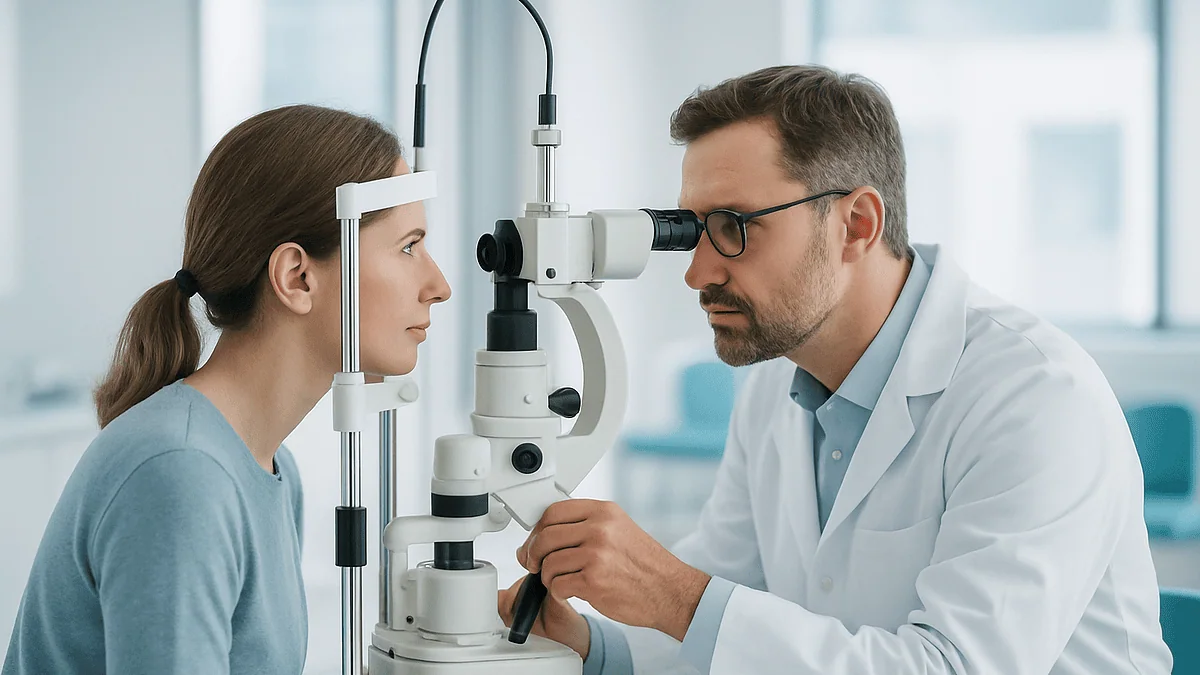
Here is what actually happens. You sit at a machine that looks much like the slit lamp used in a routine eye exam. Numbing drops are applied, and a small contact lens is placed on the eye to hold it steady and direct the beam. The ophthalmologist then delivers a series of pulses around the circumference of the drainage angle, typically covering the full 360 degrees. Most people describe a few clicks and occasional flashes of light rather than pain. The laser portion usually takes only minutes.
The mechanism is not a burn or a drilled hole, which surprises many people. The pulses trigger a biological response: pigmented meshwork cells absorb the energy, release signaling molecules, and the meshwork remodels over the following weeks so that fluid drains more easily. Because it is a biological effect rather than a mechanical one, the pressure-lowering benefit builds gradually. The Mayo Clinic notes that it can take a few weeks to see the full effect.
This also explains two of SLT’s characteristics. The effect can fade over time as the meshwork slowly returns toward its previous state, and because the tissue is not destroyed, the procedure can often be repeated. Neither point is a promise about how long it will last in any one eye; durability varies, and your team will monitor rather than assume.
How glaucoma eye drops work: the main classes and what they do
Eye drops lower pressure by adjusting the plumbing described earlier, either reducing how much aqueous fluid the eye makes or improving how fast it drains. Ophthalmologists group them by mechanism, and the class matters more than any individual product.
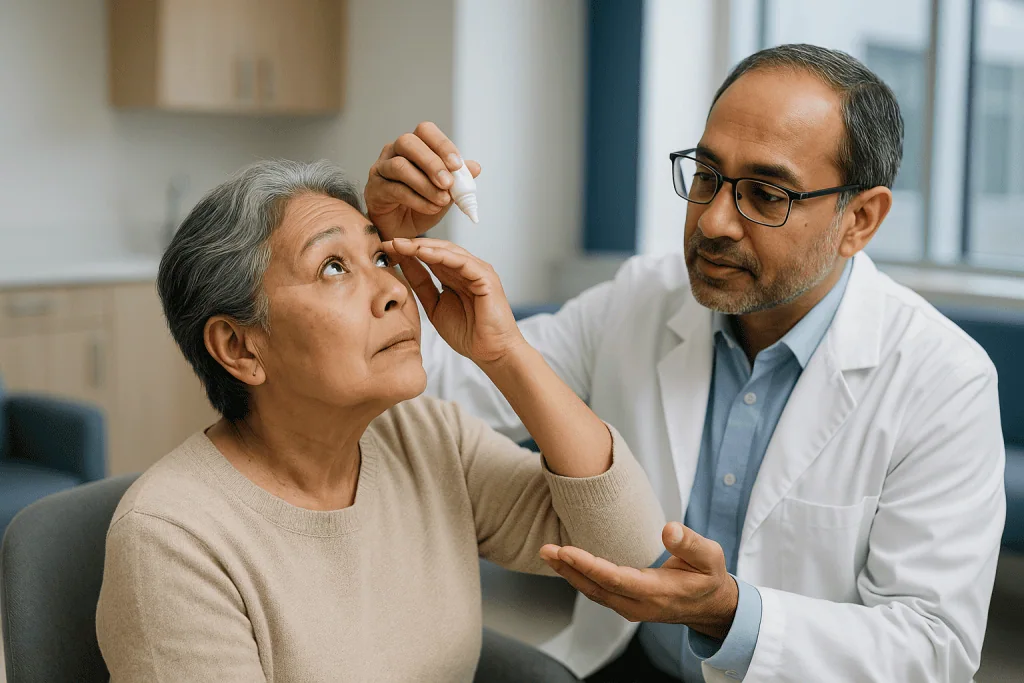
- Prostaglandin analogs increase drainage through a secondary outflow route beneath the meshwork. They are widely used as a first drop because they lower pressure substantially and are usually taken once daily, though the schedule is always the prescriber’s decision.
- Beta blockers reduce fluid production. They have been used for decades and are effective, but some of the medicine can be absorbed into the bloodstream, which is why people with asthma, slow heart rhythms or certain heart conditions are often steered elsewhere.
- Carbonic anhydrase inhibitors also cut production, working on an enzyme in the tissue that makes aqueous fluid.
- Alpha agonists do a little of both, reducing production and modestly improving outflow.
- Rho kinase inhibitors, the newest class, relax the trabecular meshwork itself to improve drainage through the main route.
Several of these are available as combination drops so that two mechanisms come in one bottle. Whatever the class, the effect appears within hours to days and wears off if the drops stop; the medicine is doing the work continuously, not fixing anything.
That distinction is the heart of the comparison. Drops are reliable when used exactly as prescribed, adjustable in strength, and reversible. They also depend entirely on a person’s ability to get a small droplet into the eye at the right time, every day, for years. As the NHS glaucoma guidance puts it, treatment is usually lifelong. The next section looks at what happens when researchers put the two approaches head to head.
Laser vs eye drops glaucoma: what the trial evidence shows
For years, the sequence was largely tradition: drops first, laser if drops fell short, surgery if both did. That changed mainly because of one large UK randomized trial, known as LiGHT (Laser in Glaucoma and Ocular Hypertension), published in The Lancet.
The trial enrolled more than 700 people newly diagnosed with open-angle glaucoma or ocular hypertension and randomly assigned them to start with either SLT or eye drops. Everyone was followed to the same pressure targets, with treatment escalated if the target was not met. At three years, health-related quality of life was similar in both groups. What stood out was the treatment burden: roughly three in four people who started with laser were still at their pressure target without any drops, and the laser group was less likely to have needed glaucoma surgery over that period.
Those results led NICE, the UK guideline body, to update its glaucoma recommendations so that 360-degree SLT is offered as a first-line option for people with newly diagnosed ocular hypertension or open-angle glaucoma, alongside a discussion of the alternatives.
A few caveats keep the picture honest. The trial did not show that laser protects vision better than drops; both approaches reached similar pressure control when escalation was allowed. Not everyone in the laser group stayed drop-free, and some needed a second laser session. Participants were newly diagnosed with relatively early disease, so the findings say little about people with advanced damage or unusual eye anatomy. And the trial was run in a system with structured follow-up, which is part of what makes a laser-first strategy safe.
So the honest summary is not “laser wins.” It is that laser first is a legitimate, evidence-backed starting point that can defer drops for many people, with drops remaining a fully effective route.
Who is usually offered laser first, and who is usually asked to wait
Because SLT works on the trabecular meshwork, the first requirement is straightforward: the drainage angle has to be open and visible. The ophthalmologist checks this with gonioscopy, an exam using a mirrored lens to look directly at the angle. If the angle is closed or very narrow, SLT is not the right laser, and a different procedure, described later, comes into play.
Beyond that, several situations tend to tilt the decision toward laser as an early step:
- Newly diagnosed open-angle glaucoma or ocular hypertension with mild to moderate pressure elevation, the population studied in the LiGHT trial.
- Difficulty using drops reliably, whether from arthritis, tremor, memory problems, a chaotic schedule or simply a strong preference to avoid a daily routine.
- Intolerance of drop side effects, or conditions such as asthma or certain heart rhythm problems that rule out some classes.
- Concerns about preservatives irritating an already dry or sensitive eye surface.
Other situations usually lead the team to hold laser back or choose drops first:
- Very high pressure needing a large, rapid reduction, where the gradual onset of SLT is too slow to be safe as the only measure.
- Advanced glaucoma with significant field loss, where the team may want the certainty of a tightly controlled pharmacological target, or may move toward surgery.
- Certain secondary glaucomas, such as those caused by inflammation inside the eye, where laser may be less effective or may aggravate the underlying problem.
- Eyes where the meshwork cannot be adequately seen or reached.
Preference matters too. Some people are reassured by a procedure they can see the results of on a pressure chart; others prefer the reversibility of a drop they can stop. The Cleveland Clinic and Mayo Clinic both frame the choice as shared decision-making, and that is how it should feel in the consulting room.
SLT laser for glaucoma versus daily drops: a side-by-side summary
Seeing the two options laid out together makes the trade-offs easier to hold in mind. The table below summarizes the general characteristics described by mainstream sources such as the NHS, Mayo Clinic and Cleveland Clinic. It is a map, not a verdict; individual experience varies.
| Feature | Selective laser trabeculoplasty (SLT) | Pressure-lowering eye drops |
|---|---|---|
| How it lowers pressure | Stimulates the drainage meshwork to work better | Reduces fluid production and/or improves outflow, depending on class |
| Where it happens | Outpatient clinic, single visit per treatment | At home, every day |
| Speed of effect | Gradual; full effect over a few weeks | Within hours to days |
| Durability | Can fade over months to years; often repeatable | Lasts only while drops are used consistently |
| Reversibility | Not reversible, though effect may wane | Fully reversible by stopping (only on medical advice) |
| Common short-term effects | Temporary blur, mild ache, transient pressure rise, inflammation | Redness, stinging, dry eye, eyelash and iris color changes with some classes |
| Whole-body effects | None expected | Possible with some classes, notably beta blockers |
| Depends on daily adherence | No | Yes |
| Suitable for closed angles | No; a different laser is used | Sometimes, as part of a broader plan |
Two rows deserve emphasis. “Depends on daily adherence” is where laser has its clearest practical edge, because a treatment nobody can miss is a treatment that keeps working. “Speed of effect” is where drops have theirs, which is why an eye with dangerously high pressure is usually brought down with medicine first, whatever the longer-term plan.
Notice also that neither column mentions vision improving. Both treatments aim to slow or halt further loss. Anyone promising that either one will bring back sight that glaucoma has taken is not describing the evidence.
Angle-closure glaucoma: when laser is not really optional
Everything so far has assumed an open drainage angle. In a meaningful minority of people, particularly those with shorter, more farsighted eyes and in some East Asian populations, the angle is narrow, and the iris can bow forward and block the meshwork entirely. This is angle-closure glaucoma, and it changes the conversation.
The laser used here is not SLT. It is laser peripheral iridotomy, which creates a tiny opening in the outer iris so that fluid can bypass the blockage and reach the drainage angle. Think of it as adding a relief valve rather than cleaning a filter. The procedure is also done at a slit-lamp style machine under numbing drops, and it is often performed on both eyes because the anatomy that puts one eye at risk usually affects the other.
For someone with narrow angles at risk of closure, iridotomy is generally the first intervention, with drops playing a supporting role. Drops alone cannot fix a mechanical blockage, though certain classes may be used to lower pressure while the laser is arranged or to reduce it beforehand.
Acute angle-closure, where the angle shuts suddenly, is an emergency. Pressure can rise to several times its normal level within hours, causing severe eye pain, headache, nausea, a red eye, blurred vision and halos around lights. The NHS lists these as reasons to seek urgent care the same day. In that setting the team typically uses medicines to bring pressure down quickly, then performs laser once the cornea is clear enough to see through.
Once the angle has been opened, some people’s pressure settles and they need nothing more; others have permanent meshwork damage from the episode and go on to need drops or SLT-type treatments later. The sequence, again, depends on the eye in front of the ophthalmologist, not on a fixed protocol.
What the days and weeks after SLT usually look like
People who choose laser first often want to know what the aftermath feels like, partly because the procedure is over so quickly that it can seem anticlimactic. The short answer, drawn from the Cleveland Clinic and Mayo Clinic descriptions, is that recovery is mild and the real work happens invisibly inside the eye.
On the day itself, vision is usually blurry for a few hours from the numbing drops, the contact lens and the bright light. Many people describe a dull ache or a feeling of grittiness that eases the same day. A pressure check is commonly done before you leave, because a small proportion of eyes react with a temporary spike in pressure in the first hours, which the team can treat if needed. Most people can go home the same day; arranging for someone else to drive is sensible because of the blur.
Over the first week, mild inflammation is expected as the meshwork responds. Some ophthalmologists prescribe a short course of anti-inflammatory drops; others prefer to let the inflammation run its course because it may be part of the mechanism. Follow your own team’s instructions, and do not add or stop anything on your own.
The pressure-lowering effect builds over the following weeks. The Mayo Clinic notes that the full effect can take a few weeks to appear, so the first meaningful pressure reading usually comes at a scheduled review rather than the next day. If you were already on drops before the laser, the team decides whether and when to reduce them based on that reading, never on how the eye feels.
If the target has not been reached, the options are a second laser session, adding a drop, or both. If it has, the plan becomes surveillance: regular pressure checks, periodic visual field tests and optic nerve imaging to confirm the disease is stable. That monitoring is lifelong and is the true safety net behind a laser-first approach.
Glaucoma eye drops side effects and the quiet problem of adherence
Drops are effective, and it is worth saying plainly that millions of people preserve their sight with them for decades. The difficulties are practical rather than pharmacological, and they are the main reason laser has climbed the sequence.
Side effects vary by class. Prostaglandin analogs can redden the eye, lengthen and darken lashes, and over years permanently darken a light-colored iris; the skin around the eye can also deepen in color and the eye socket can appear more hollow. Beta blockers are usually comfortable in the eye but can slow the heart, tighten the airways or blunt the warning signs of low blood sugar, which is why the prescriber asks about lungs, heart and diabetes. Carbonic anhydrase inhibitors often sting and can leave a metallic taste. Alpha agonists cause allergic-type redness and lid swelling in a meaningful number of users over time. Preservatives in many bottles irritate the surface of the eye, and the burden grows with each additional drop.
Then there is adherence, the medical term for taking medicine as prescribed. Glaucoma drops are hard to keep up with for reasons that have nothing to do with motivation: the disease is silent, so nothing reminds you; the bottle is small and the target is a moving eye; and the routine has no end date. The Johns Hopkins glaucoma guidance emphasizes that missed drops are one of the most common reasons pressure control fails, and the pressure returns quietly rather than with a warning symptom.
Helpful, evidence-neutral habits include linking the drop to a fixed daily anchor such as brushing teeth, pressing gently on the inner corner of the eye for a minute afterward to reduce drainage into the nose and bloodstream, and waiting several minutes between different drops so one does not wash out the other. If any of this proves unworkable, that is precisely the information your ophthalmologist needs when weighing laser.
When drops and laser are combined, and when surgery enters the picture
The title of this article poses a choice, but real glaucoma care is rarely either-or for long. Many people end up with both, and the order in which they arrive is what the ophthalmologist is really deciding.
A common pattern is laser first, then a single drop added months or years later when the laser effect fades and a repeat session is not enough. Another is a drop first, with SLT added when a second drop would be needed, on the reasoning that one laser session may achieve what a second bottle would, without the extra side effects. A third, in someone already using several drops, is laser as a way to reduce the number of bottles rather than to eliminate them. Each of these is a legitimate sequence described by the NHS and Mayo Clinic, and each is chosen for a specific reason.
Surgery becomes the conversation when pressure remains above target despite well-used drops and laser, or when damage is progressing and the team judges that the eye needs a lower pressure than medicine and laser can reliably deliver. The traditional operation, trabeculectomy, creates a new drainage channel under the upper eyelid. Tube shunt surgery places a small device to route fluid out of the eye. A newer family of minimally invasive glaucoma surgeries, often shortened to MIGS, uses tiny implants or incisions, frequently at the time of cataract surgery, and generally aims for a more modest pressure reduction with a gentler recovery.
Where SLT is not possible or has failed and drops are poorly tolerated, a different laser, cyclophotocoagulation, can reduce fluid production by treating the tissue that makes it. It is usually reserved for more advanced or difficult cases.
None of these steps is a failure of the earlier ones. Glaucoma is a slow, lifelong condition, and the plan is expected to evolve.
What people often get wrong about laser and drops for glaucoma
Misunderstandings about glaucoma treatment are common enough that correcting them is part of good care. Here are the ones ophthalmologists hear most.
“Laser fixes it, so I can stop coming in.” SLT lowers pressure; it does not end the disease, and its effect can fade. People who choose laser first need the same lifelong monitoring as people on drops. Skipping follow-up is the surest way to lose the advantage the laser gave.
“If I can see fine, my pressure must be fine.” Pressure and vision are separate. Open-angle glaucoma is painless and steals peripheral vision so slowly that the brain fills in the gaps. The Mayo Clinic notes that many people have no symptoms until the disease is advanced. Only measurement tells you where the pressure is.
“Laser is the strong option, drops are the weak one.” In head-to-head trials both reached similar pressure targets when escalation was allowed. The difference is in burden and durability, not in raw power. For a very high pressure, drops are in fact the faster tool.
“Laser is surgery and needs a hospital stay.” SLT and iridotomy are outpatient procedures done at a slit-lamp style machine under numbing drops, and most people go home within the hour.
“Drops are harmless because they only go in the eye.” Some classes are absorbed into the bloodstream in amounts that can affect the heart and lungs, which is exactly why the prescriber asks about your medical history.
“Either treatment will bring back the vision I lost.” Damaged optic nerve fibers do not regenerate. Every glaucoma treatment, laser, drops or surgery, is about protecting what remains.
“Glaucoma runs in my family, so treatment is pointless.” Family history raises risk and argues for earlier screening, not resignation. Detected early, pressure control preserves useful vision for most people over a lifetime.
Questions to ask your care team before choosing laser or drops
A good consultation about sequencing should leave you understanding why this option, for this eye, now. Bringing specific questions helps, and these are the ones that tend to unlock the most useful answers.
- What type of glaucoma do I have, and is my drainage angle open? This single answer determines whether SLT is even on the table.
- What pressure target have you set for my eyes, and how far above it am I now? The size of the gap shapes whether a gradual laser effect is safe as a first step.
- How much optic nerve damage or visual field loss is already present? Early disease and advanced disease often call for different sequences.
- If I start with laser, what happens if it does not reach the target? Ask about repeat sessions, adding drops and how soon the decision would be made.
- If I start with drops, which class are you considering and why? Ask what side effects to watch for and whether any of my other health conditions affect the choice.
- How will you judge whether the treatment is working, and how often will I be seen? Monitoring is the backbone of either path.
- Do I need someone to drive me home after laser, and will my vision be blurry?
- Are there activities, medicines or eye products I should avoid around the time of treatment?
- If I struggle with drops, what should I tell you, and how quickly?
- At what point would you start discussing surgery, and which type would you consider for me?
Write the answers down, or ask whether a companion can join the appointment. The choice between laser and drops is rarely urgent for open-angle disease, and the NHS explicitly encourages people to discuss the options before deciding. A few days to think, with the facts in hand, is entirely reasonable.
When to call your doctor: red-flag signs with glaucoma treatment
Most glaucoma care unfolds at scheduled visits, and most side effects of both laser and drops are mild and expected. A handful of situations, though, should not wait for the next appointment. If any of the following occur, contact your eye care team the same day, or seek emergency care if you cannot reach them.
- Sudden, severe eye pain, especially with headache, nausea or vomiting. The NHS identifies this cluster as the hallmark of acute angle-closure, which can damage the nerve within hours.
- A red, hard-feeling eye with blurred vision or halos around lights, particularly if it comes on quickly in dim light or in the evening.
- A sudden drop in vision in either eye, or a new shadow or curtain across part of the visual field.
- Worsening pain, light sensitivity or redness in the days after SLT or iridotomy rather than the expected gradual improvement, which could signal excessive inflammation or a pressure spike.
- Signs of a whole-body reaction to drops: new wheezing or shortness of breath, a noticeably slow or irregular heartbeat, fainting or unusual fatigue, especially after starting a beta blocker class drop.
- Marked eyelid swelling, itching or discharge that persists after a new drop, which may indicate allergy or infection.
- Any injury to the eye, or a fever with eye pain, after a procedure.
Less urgent but still worth a prompt call: you have missed several days of drops, you cannot get the drop into your eye, you have run out and cannot get more before your next review, or you notice a persistent change in the color of your iris or the skin around your eye. None of these is an emergency, but each is information that may change the plan, and the team would rather hear about it early.
One firm rule underlies everything: do not stop, restart or change any glaucoma medicine on your own, even if you have had laser and your pressure feels fine. Pressure has no feeling. Only your ophthalmologist, with a measurement in hand, can decide when a drop is no longer needed.
Frequently asked questions
Is laser or eye drops better as the first glaucoma treatment?
Neither is universally better; for newly diagnosed open-angle glaucoma or ocular hypertension both are reasonable first steps. Trial evidence shows similar pressure control, with laser reducing the need for daily drops in many people for several years. Drops act faster and are adjustable, which matters when pressure is very high. Your ophthalmologist weighs the type and stage of glaucoma, your eye’s anatomy and your preferences before recommending a sequence.
How does SLT laser work to lower eye pressure?
SLT delivers short, low-energy laser pulses to the trabecular meshwork, the mesh of tissue through which fluid drains from the eye. Pigmented cells absorb the energy and trigger a biological remodeling response that improves drainage over the following weeks. It does not burn a hole or destroy tissue, which is why the effect can fade over time and why the procedure can often be repeated when the ophthalmologist judges it appropriate.
What are the most common glaucoma eye drops side effects?
Side effects depend on the class. Prostaglandin analogs can cause redness, longer darker lashes and, over years, permanent darkening of a light iris. Beta blockers may slow the heart or tighten airways in susceptible people. Carbonic anhydrase inhibitors often sting and can cause a metallic taste, and alpha agonists can cause allergic redness. Preservatives irritate the eye surface with any class. Report persistent problems to your prescriber rather than stopping on your own.
Does SLT laser for glaucoma hurt, and how long does it take?
Most people describe SLT as uncomfortable rather than painful. Numbing drops are applied and a contact lens holds the eye steady while the ophthalmologist delivers pulses around the drainage angle; the laser portion usually takes only a few minutes. Afterward the eye may feel achy or gritty and vision is often blurry for a few hours. Arranging for someone else to drive home is sensible.
Can I stop my glaucoma drops after having laser treatment?
Only if your ophthalmologist tells you to, and only after a pressure measurement shows the laser has reached the target. The laser effect builds gradually over a few weeks, so drops are often continued until the first follow-up reading. Stopping early on your own risks a silent rise in pressure, because raised pressure produces no symptoms in open-angle glaucoma. Any change to drops is a decision for the prescribing clinician.
How long does SLT laser last for glaucoma?
It varies from eye to eye. The effect can wane over months to years as the drainage meshwork gradually returns toward its previous state. In the LiGHT trial, most people who started with laser were still at target without drops at three years, though some needed a repeat session. Because durability cannot be predicted for an individual, regular pressure checks continue for life regardless of how well the first treatment works.
What glaucoma treatment options exist if neither laser nor drops is enough?
When pressure stays above target despite well-used drops and laser, the ophthalmologist may discuss surgery. Options include trabeculectomy, which creates a new drainage channel; tube shunt surgery, which places a small drainage device; and minimally invasive glaucoma surgeries, often combined with cataract surgery. A different laser, cyclophotocoagulation, can reduce fluid production in advanced cases. Each carries its own risks and recovery, and the choice rests with the treating team.
Why can some people not have SLT laser for glaucoma?
SLT targets the drainage meshwork, so the angle must be open and visible on examination. People with narrow or closed angles need a different laser, peripheral iridotomy, instead. Certain secondary glaucomas caused by inflammation inside the eye respond poorly to SLT. Very high pressures needing rapid reduction, advanced disease, and eyes where the meshwork cannot be adequately seen are other reasons an ophthalmologist may recommend drops or surgery first.
Will laser or eye drops improve my vision?
No. Both treatments aim to lower eye pressure to slow or halt further optic nerve damage, not to restore what has been lost. Nerve fibers destroyed by glaucoma do not regenerate. Some people notice clearer vision after stopping an irritating drop, and blur after laser resolves within hours, but neither reverses the disease. Realistic expectations help: the goal is preserving useful vision for a lifetime.
What signs after glaucoma laser or starting drops need urgent attention?
Seek same-day care for sudden severe eye pain with headache or nausea, a red hard-feeling eye with halos around lights, or a sudden drop in vision, all of which can indicate acute angle-closure or a dangerous pressure spike. Worsening pain or light sensitivity days after laser, new wheezing, a very slow heartbeat or fainting after starting drops, and marked lid swelling or discharge also warrant a prompt call to your eye care team.
References
- Cleveland Clinic: Glaucoma
- National Eye Institute (NIH): Glaucoma
- World Health Organization: Blindness and vision impairment fact sheet
This article is for general information only and is not a substitute for professional medical advice. Please consult a qualified doctor about your individual situation.

More from the Blog

Hand Rejuvenation Recovery: Swelling, Bruising and Why Heavy Hand Use Waits a Few Days
After hand filler, mild swelling, tenderness and some bruising across the back of the hand are common and typically ease over several days to…

Caring for the Donor Site After a Skin Graft: Dressings, Discomfort and How It Heals
Skin graft donor site care means keeping the area where skin was taken clean, covered and moist while new skin grows back from below.…
Laser Resurfacing vs Microneedling for Acne Scars: How a Dermatologist Picks the Route
Neither laser resurfacing nor microneedling is universally better for acne scars. Fractional lasers tend to produce more change per session but bring longer downtime…

The Scar After Surgical Tattoo Removal: Sun Protection, Scar Care and How It Fades
A scar after surgical tattoo removal is permanent, but it usually changes a great deal over its first one to two years, typically shifting…

Before Eye Laser Treatment: Corneal Thickness, Eye Pressure and Stopping Contact Lenses
An eye exam before laser treatment measures far more than your glasses prescription. Clinicians map the cornea's shape, measure its thickness in micrometers, check…

What the Microscope Changes in Microsurgery: Repairing Vessels and Nerves Thinner Than a Hair
Microsurgery magnification lets a surgeon see and stitch structures roughly one millimeter across or smaller, such as facial nerve branches and the arteries that…