

LASIK, SMILE or PRK for Myopia: A Neutral Comparison of the Three Laser Routes

Key Takeaways
- LASIK, SMILE and PRK all reshape the stroma, the cornea's structural middle layer, by removing a sliver of tissue measured in thousandths of a millimeter; they differ mainly in how they reach it.
- SMILE is approved only for myopia with or without astigmatism, so anyone whose prescription includes farsightedness is limited to LASIK or PRK from the outset.
- Corneal thickness is measured, not negotiated: a thin cornea often overrules a patient's preference and steers the recommendation toward PRK or SMILE because neither uses a flap.
- Mayo Clinic reports that reduced tear production after LASIK commonly lasts around 6 months, and that it can take 2 to 3 months for vision to stabilize fully.
- Flap displacement, inflammation under the flap and epithelial ingrowth are complications unique to LASIK, while PRK carries the risk of corneal haze and a slower, less comfortable first week.
- Laser surgery changes only the cornea; the lifetime retinal risks that accompany higher myopia remain, so flashes, new floaters or a shadow across vision are emergencies at any point afterward.
LASIK, SMILE and PRK all treat myopia by using a laser to flatten the cornea so light focuses on the retina. LASIK lifts a thin flap and offers the fastest early recovery; PRK works on the surface, avoids a flap and heals more slowly; SMILE removes a tissue disc through a small incision. Visual results are broadly similar, so corneal thickness, dry eye, lifestyle and your surgeon's assessment usually decide.
The alarm goes off, you reach for the nightstand, and your fingers find everything except your glasses. By the time you locate them, a contact lens from yesterday is stuck to the bathroom tile. It is a small daily tax, and after enough mornings like this many people start typing the same question into a search bar: LASIK vs SMILE vs PRK for myopia, which one should I actually choose?
The honest answer is less dramatic than most clinic pages suggest. These three procedures are siblings, not rivals. They share a laser, a goal and a safety record built over decades, and they differ mainly in how they reach the tissue they need to reshape.
This explainer walks through what each route does, who tends to be steered toward which, what recovery looks like week by week, and where the evidence is solid, thin or still being gathered. The decision itself belongs to you and the ophthalmologist who examines your eyes; the aim here is that you arrive at that conversation already fluent.
How laser eye surgery for myopia actually works
Myopia, or nearsightedness, means the eye focuses incoming light slightly in front of the retina instead of on it, usually because the eyeball is a little too long or the cornea curves too steeply. Distant road signs blur; a book at arm’s length stays sharp. The cornea is the clear, dome-shaped window at the front of the eye, and it does most of the eye’s focusing before light ever reaches the lens inside.
Every laser refractive procedure exploits that fact. Glasses and contact lenses correct myopia by adding a lens in front of the cornea; laser surgery instead removes a thin, precisely shaped sliver of corneal tissue so the dome becomes fractionally flatter in the center. Light then lands where it should. The amount removed is tiny, measured in thousandths of a millimeter, and it is mapped in advance from scans of your individual cornea.
Two laser types do the work. An excimer laser is an ultraviolet laser that vaporizes tissue a sliver at a time without heating the surrounding cornea, and it is the reshaping tool in LASIK and PRK. A femtosecond laser is an infrared laser that fires in pulses lasting a millionth of a billionth of a second, creating clean cuts inside the cornea; it makes the LASIK flap and performs the entire SMILE procedure.
What a patient experiences is remarkably similar across all three. Anesthetic drops numb the surface, a small device holds the eyelids open, and you look at a fixation light while the laser works. According to Mayo Clinic, LASIK itself is usually finished within about 30 minutes for both eyes, with the laser running for well under a minute per eye. You stay awake, you feel pressure rather than pain, and you walk out the same day with someone else driving.
LASIK vs SMILE vs PRK for myopia: what each procedure does differently
Picture the cornea as a stack of layers: a thin surface skin called the epithelium, then the thick structural middle layer, the stroma, where the reshaping happens. The three procedures are three different ways of reaching the stroma.
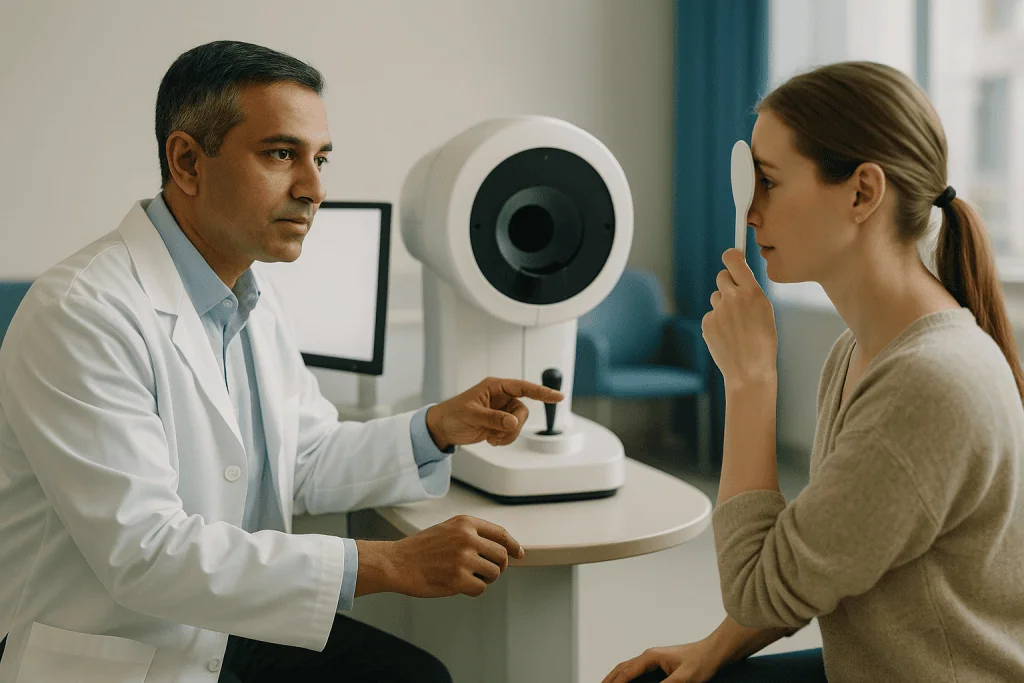
LASIK (laser-assisted in situ keratomileusis) creates a thin, hinged flap through the epithelium and the top of the stroma, most often with a femtosecond laser. The surgeon folds the flap back, the excimer laser reshapes the exposed stroma, and the flap is laid back in place where it adheres on its own without stitches. Because the surface skin stays largely intact, vision tends to clear quickly.
PRK (photorefractive keratectomy) skips the flap. The surgeon gently removes the epithelium from the central cornea, applies the excimer laser directly to the surface of the stroma, and places a soft bandage contact lens over the eye. The epithelium then regrows over several days, which is why PRK recovery is slower and more uncomfortable at first. LASEK and epi-LASIK are close variants that loosen and preserve the epithelial sheet rather than removing it.
SMILE (small incision lenticule extraction) uses only the femtosecond laser. It carves a thin, lens-shaped disc of stroma, called a lenticule, inside the cornea, then the surgeon draws that disc out through an incision a few millimeters wide at the edge. There is no flap to lift and no excimer laser. Cleveland Clinic notes that SMILE is approved for myopia with or without astigmatism, and not for farsightedness.
Same laser physics, same end result on paper. The practical differences, from first-day vision to dry eye to what happens if a correction needs touching up later, flow almost entirely from that question of how the stroma is reached.
Who is usually a candidate, and who is usually asked to wait
Candidacy is decided by a dilated eye examination, corneal mapping and a frank conversation about your health and habits, not by a questionnaire online. Still, the broad criteria are consistent across the NHS, Mayo Clinic and MedlinePlus, and they apply to all three procedures with minor shifts in emphasis.
Surgeons generally want to see an adult, usually 18 or older, whose prescription has been stable. Mayo Clinic frames stability as roughly a year without meaningful change, because operating on an eye that is still drifting means correcting a moving target. The cornea must be thick enough to leave a safe residual layer after tissue removal, and it must have a regular shape on topography scans; keratoconus, a condition in which the cornea thins and bulges into a cone, is a firm reason not to proceed with any of the three.
Certain situations lead to a recommendation to wait rather than a flat no. Pregnancy and breastfeeding are the classic example, since hormonal changes can temporarily alter refraction and tear film. A recent eye infection, an active flare of a dry eye condition, or a change in medicines known to affect healing can all push the date back by months.
Other factors tilt the choice between procedures. A thinner cornea or a job with a real risk of eye impact, such as contact sport or military service, often nudges the discussion toward PRK or SMILE because neither involves a flap that could be dislodged. Significant existing dry eye may steer away from LASIK. Conversely, someone who needs sharp vision within a day or two for work may lean toward LASIK, accepting its flap in exchange for speed.
Uncontrolled diabetes, autoimmune conditions that impair wound healing, cataract and advanced glaucoma are generally considered reasons to look at other options altogether. Your examining ophthalmologist weighs all of this together; no single factor decides on its own.
Can I get LASIK if I have high myopia?
Sometimes, but this is where the answer depends most heavily on your individual cornea. Prescriptions are measured in diopters, a unit of lens power; a larger negative number means stronger myopia. Correcting a higher number requires removing more corneal tissue, because the laser has to flatten the dome further. That single fact drives every limit.

Each laser platform carries a labeled range of correction approved by regulators, and surgeons also apply their own, usually more conservative, limits. The deciding calculation is residual stromal thickness: how much structural cornea remains after the flap (in LASIK) and the tissue removal are subtracted. Leave too little and the risk of ectasia rises. Ectasia is progressive thinning and bulging of the cornea after surgery, a rare but serious complication that can distort vision permanently. Mayo Clinic lists high prescriptions and thin corneas among the factors that raise this risk.
For moderate-to-high myopia with a thick, regular cornea, LASIK may be entirely reasonable. For the same prescription in a thinner cornea, PRK is often favored because it uses no flap and therefore consumes less tissue before the reshaping even begins. SMILE also avoids a flap and is frequently discussed for higher myopia within its approved range, though the long-term evidence base for SMILE at the upper end is shorter than for LASIK, simply because the technique is younger.
Beyond what any laser can safely do, the conversation shifts away from the cornea. The NHS describes lens-based surgery as an alternative: a phakic intraocular lens is an implant placed inside the eye in front of your natural lens, like a permanent internal contact lens, and refractive lens exchange replaces the natural lens altogether, in the same way as cataract surgery. Both carry their own risk profiles and are reserved for cases where laser reshaping is not appropriate.
Another point worth hearing clearly: high myopia stretches the back of the eye as well as the front. Laser surgery changes the cornea only. The slightly raised lifetime risk of retinal problems that accompanies high myopia remains, and routine dilated examinations stay part of your care whichever route you take.
Which eye surgery is best, LASIK or SMILE?
Neither, in any general sense. Head-to-head studies comparing the two, including meta-analyses indexed in PubMed, consistently find that both achieve very similar levels of uncorrected distance vision and refractive accuracy at a year. Where they differ is in the texture of the experience and in a few mechanistic trade-offs that matter more to some patients than to others.
LASIK tends to deliver clearer vision sooner, often within the first day, because the flap settles quickly and the central epithelium is never disturbed. SMILE patients commonly describe a slightly hazier first day or two while the pocket inside the cornea settles. That gap narrows within weeks.
Dry eye is the trade-off most often cited in SMILE’s favor. The LASIK flap cuts across corneal nerves around most of its circumference; the SMILE incision is a few millimeters wide and spares a larger share of those nerves. Several studies report less reduction in corneal sensation and milder dry eye symptoms in the early months after SMILE. Whether this translates into a meaningful difference at a year is less settled; some trials show the gap closing as nerves regenerate.
Flap-related risks belong to LASIK alone. Mayo Clinic lists flap problems, including displacement and inflammation under the flap, among LASIK’s specific complications. SMILE has no flap, which is one reason it is discussed for people who play contact sports.
LASIK has the longer track record, with outcomes tracked since the 1990s, and its enhancements, meaning touch-up procedures for residual blur, are relatively straightforward because the flap can be lifted again. SMILE enhancements are possible but usually require a surface procedure or a different approach. SMILE also cannot treat farsightedness.
So the question becomes personal. Fast visual recovery and the widest range of correctable prescriptions favor LASIK; a modest reduction in early dry eye and the absence of a flap favor SMILE. Your surgeon’s own experience with each technique is a legitimate factor too, and worth asking about directly.
Is PRK more reliable than LASIK? PRK vs LASIK: which is safer
“Reliable” and “safe” are doing different jobs in that question, so it helps to separate them. In terms of visual outcome, long-term studies find PRK and LASIK land in essentially the same place: comparable accuracy of correction and comparable rates of regression, which is a partial drift back toward myopia over years. On that measure neither is more reliable than the other.
Safety is where PRK’s advocates make their case. Because PRK creates no flap, the entire family of flap complications simply does not exist: no risk of the flap shifting after a knock to the eye, no inflammation under the flap, no flap-edge epithelial ingrowth. Removing less structural tissue also means a thicker residual cornea for any given prescription, which is why PRK is routinely preferred for thinner corneas.
The price for that structural simplicity is paid in the first week. The epithelium has to regrow across the treated zone, and MedlinePlus describes PRK recovery as taking longer than LASIK, with more discomfort in the initial days and vision that improves over weeks rather than hours. Light sensitivity, watering and a gritty sensation are expected, and most surgeons prescribe drops to manage inflammation and prevent infection during that window; the regimen is set by the prescribing clinician and varies.
Historically PRK carried a risk of corneal haze, a faint clouding of the healing surface that could soften vision. Modern techniques, including the routine use of a medicine applied during surgery to calm the healing response, have made significant haze uncommon, though it remains on consent forms for good reason.
A fair summary: PRK removes one category of risk and trades it for a slower, less comfortable recovery. For someone with a thin cornea, dry eyes, or a life that involves eye impacts, that trade often makes sense. For someone with ample corneal thickness who needs to function at work within days, LASIK’s speed may outweigh the flap. Both sit comfortably within mainstream guideline practice.
Comparison table: LASIK vs SMILE vs PRK for myopia at a glance
Tables flatten nuance, so treat this one as a map of the terrain rather than a verdict. Each cell reflects typical findings reported by the NHS, Mayo Clinic, Cleveland Clinic and MedlinePlus; individual experiences vary with prescription, corneal anatomy and healing.
| Feature | LASIK | SMILE | PRK |
|---|---|---|---|
| How the stroma is reached | Hinged flap lifted | Small incision, lenticule removed | Surface epithelium removed |
| Lasers used | Femtosecond plus excimer | Femtosecond only | Excimer only |
| Treats | Myopia, hyperopia, astigmatism | Myopia, with or without astigmatism | Myopia, hyperopia, astigmatism |
| Early visual recovery | Typically fastest, often within a day | Slightly slower than LASIK, days | Slowest, improves over weeks |
| First-week comfort | Mild irritation | Mild irritation | More discomfort while epithelium regrows |
| Flap-related risks | Present | None | None |
| Early dry eye | More common | Often milder | Variable |
| Suitability for thinner corneas | Less favorable | Intermediate | More favorable |
| Enhancement later | Flap can be relifted | Usually surface procedure | Repeat surface treatment |
| Length of published follow-up | Longest | Shortest | Long |
Two rows deserve emphasis. The “treats” row rules SMILE out for anyone whose prescription includes farsightedness, regardless of other preferences. The “suitability for thinner corneas” row is the one most likely to overrule a patient’s initial choice, because corneal thickness is measured, not negotiated.
Notice what the table does not contain: a column for visual outcome at one year. That omission is deliberate. Across mainstream reviews, the three procedures reach broadly similar end points for appropriately selected patients, which is exactly why the surrounding factors carry so much weight.
LASIK vs SMILE recovery time: what the first days and weeks usually look like
The hours right after any of the three procedures feel similar: watery, light-sensitive, slightly stinging eyes and a strong urge to rub them that you must resist. Mayo Clinic advises against rubbing because it can shift a LASIK flap before it has sealed; for SMILE and PRK the risk is to the healing surface. Most people go home, take a nap, and wear plastic shields at night; the NHS suggests shields may be needed for up to a week.
After LASIK, vision is often usable by the next morning, and a follow-up check within a day or two confirms the flap is seated. Driving resumes only when your surgeon confirms you meet the legal standard. Mayo Clinic notes that fluctuation is normal and that it can take 2 to 3 months for vision to settle fully.
SMILE follows a slightly softer curve. The first day can feel like looking through a faint mist as the interface inside the cornea clears; by the end of the first week most people report crisp distance vision, and stabilization follows a timeline similar to LASIK. Because there is no flap, restrictions around rubbing and impact are generally shorter.
PRK asks for more patience. The bandage contact lens stays in for several days while the epithelium regrows, and MedlinePlus describes functional vision returning over days to weeks, with gradual sharpening for a month or more. The first three days are the hardest, with light sensitivity and discomfort that drops are prescribed to manage. Many people plan a week off screens.
Across all three, the NHS lists restrictions that typically run for a few weeks: no swimming or hot tubs, no eye makeup, no dusty or smoky environments, and caution with contact sports until cleared. Lubricating drops are usually recommended frequently in the early months, with the schedule set by your care team rather than by a package insert.
Dry eye, halos and night vision: the side effects people ask about most
These are the three symptoms that fill forums, and they are also the three that most patients experience to some degree in the early weeks. Understanding the mechanism makes them less unsettling.
Dry eye after laser surgery is largely a nerve story. The cornea is one of the most densely innervated tissues in the body, and those nerves tell the lacrimal glands when to produce tears. Cutting through them, whether with a LASIK flap, a SMILE incision or PRK surface removal, temporarily blunts that signal. Mayo Clinic describes a temporary decrease in tear production that commonly lasts around 6 months after LASIK, sometimes longer, and the NHS lists dry eyes among the usual side effects that typically settle over a few months. People with pre-existing dry eye tend to notice it more, which is why it features in the pre-operative screening.
Halos, glare and starbursts around lights at night arise because the treated zone of the cornea has a boundary, and in dim light the pupil enlarges and may let light in across that edge. Larger pupils and higher corrections make this more likely. Mayo Clinic notes that these disturbances are common for a few days to weeks after LASIK and usually fade; a minority of people report a persistent degree of them, most often mild. Older laser profiles were more prone to this; modern treatments use larger, smoother optical zones.
Fluctuating sharpness during the day is a third, less discussed effect, and it tracks the tear film. A dry surface scatters light; a blink and a drop often restore clarity. This improves as the nerves recover.
None of these is a sign that something went wrong, but all of them should be reported at your follow-up visits, where your care team can distinguish ordinary healing from something that needs attention.
Rare but serious complications, explained without alarm
Serious complications after laser refractive surgery are uncommon, and most of the ones that do occur are treatable when caught early. Knowing their names means you will recognize them if they appear on a consent form or in a conversation with your surgeon.
Infection is possible after any procedure that disturbs the corneal surface. PRK carries a slightly higher early window of vulnerability because the epithelium is absent for several days; LASIK and SMILE seal faster. Antibiotic drops prescribed by your team are the main defense, along with keeping water and makeup away from the eye.
Flap complications belong to LASIK. Mayo Clinic describes the possibility of the flap folding or shifting, inflammation beneath it, and epithelial cells growing underneath its edge. These usually show up within the first days and can often be corrected by repositioning or cleaning the flap.
Ectasia, the progressive thinning and bulging mentioned earlier, is the complication surgeons fear most because it can permanently distort vision. It is rare, and the pre-operative scans that rule out thin or irregular corneas exist primarily to prevent it. When it does occur, treatments such as corneal cross-linking, which strengthens the cornea with a light-activated vitamin, can stabilize it.
Undercorrection, overcorrection and regression are the more mundane disappointments. The laser removes exactly what was planned, but each cornea heals a little differently, and a small residual prescription can remain or return over years. Mayo Clinic lists these among the known outcomes; enhancement procedures are possible for many, after the eye has stabilized and if enough corneal thickness remains.
Loss of best-corrected vision, meaning vision that cannot be fully restored even with glasses, is rare across all three procedures according to the NHS. Haze after PRK and persistent severe dry eye are the other long-tail concerns. A good consent conversation names each of these plainly; so should this article.
Does insurance cover LASIK, SMILE or PRK?
Usually not, and the reason is classification rather than clinical merit. Most health plans and public systems treat laser refractive surgery as elective, because glasses and contact lenses already correct myopia safely. The NHS, for instance, states that laser eye surgery is generally not available on the NHS for refractive error alone. In the United States, the picture is similar: standard medical plans typically exclude refractive surgery, while some vision benefit plans or employer programs offer negotiated arrangements. The only way to know is to read your own policy or call your insurer, and to ask the surgical practice what documentation they provide.
There are exceptions worth asking about. Some plans consider coverage when a medical condition prevents the wearing of contact lenses or glasses, or when the surgery is part of treatment for an injury or a corneal irregularity. These cases are individually reviewed and require a letter from the treating ophthalmologist.
In the US, flexible spending accounts and health savings accounts can often be used for laser vision correction because it is a qualified medical expense; your plan administrator can confirm the rules that apply to you. This explainer deliberately does not quote any figures, because the amounts vary widely by region, by technique and by what is bundled into a quote, and because a number pulled from one setting tells you nothing about another.
One practical note on what a quote should make transparent: whether follow-up visits, the drops prescribed after surgery, and any enhancement procedure within a stated period are included. Those are legitimate questions for the practice’s administrative staff, separate from the clinical conversation with your surgeon. Coverage is a financial fact about your plan, not a signal about which of the three procedures suits your eyes, and it is worth keeping the two conversations apart.
What people often get wrong about LASIK vs SMILE vs PRK
“After laser surgery I will never need glasses again.” Laser surgery corrects the myopia you have today. It does not stop presbyopia, the age-related stiffening of the lens that makes near focus harder from the mid-40s onward; Mayo Clinic specifically notes that reading glasses may still be needed with age. Some people also experience regression over years and consider an enhancement.
“SMILE is newer, so it must be better.” Newer means less long-term data, not more safety. SMILE’s advantages in early dry eye and flap avoidance are real; its disadvantages include a narrower range of treatable prescriptions and a less straightforward enhancement pathway.
“PRK is the old-fashioned option.” PRK predates LASIK, but it remains a first choice for thin corneas and high-impact lifestyles precisely because it is structurally simpler. The NHS and MedlinePlus both describe it as a current, standard procedure.
“The surgery fixes everything about a nearsighted eye.” It reshapes the cornea. The elongated eyeball behind it, and the slightly elevated lifetime risk of retinal detachment that goes with higher myopia, do not change. Regular dilated eye examinations continue.
“You feel the laser.” Anesthetic drops numb the surface; patients describe pressure, a faint smell, and bright lights, not pain. PRK discomfort comes later, during epithelial healing.
“Dry eye after LASIK is permanent.” For most people it is a months-long phase tied to nerve recovery. Persistent severe dry eye occurs in a minority, and screening is designed to identify those at higher risk beforehand.
“Any surgeon gets the same results with any technique.” Outcomes depend on careful patient selection and on the surgeon’s familiarity with the chosen procedure. It is reasonable to ask how often a surgeon performs each of the three.
Questions to ask your care team
A consultation moves fast, and it is easy to leave with a scan printout and no idea what it meant. These questions keep the conversation anchored to your eyes rather than to a brochure.
- What is my corneal thickness, and how much would remain after each procedure you are considering for me?
- Does my corneal map show any irregularity that rules one option in or out?
- Which of LASIK, SMILE or PRK would you recommend for my prescription and why, and which would you not do for me?
- How do you measure and treat dry eye before surgery, and does my tear film change your recommendation?
- What size is my pupil in dim light, and how does that affect my risk of halos?
- Given my age, how soon might I need reading glasses, and is monovision, correcting one eye for distance and one for near, something you would discuss?
- What is your own experience with each technique, and which do you perform most often?
- What does the follow-up schedule look like over the first year?
- If my result is slightly under- or overcorrected, what is the enhancement pathway, and when would it be considered?
- Which of my current medicines or health conditions could affect healing?
- What symptoms should prompt me to contact you the same day?
- What is included in the written plan: drops, visits, shields, enhancement policy?
Write the answers down. A surgeon who welcomes this list is telling you something useful about how the rest of the relationship will go. And if the answer to any question is “we’ll decide on the day,” it is fair to ask for the reasoning in advance.
When to call your doctor
Ordinary healing is uncomfortable but predictable: grittiness, watering, light sensitivity and fluctuating sharpness that improve day by day. A change in that direction is reassuring. A change in the opposite direction is the signal to pick up the phone.
Seek care the same day, or go to urgent eye care if your surgeon’s practice is closed, if you notice any of the following:
- Pain that is increasing rather than easing, especially after the first day or two, or pain that drops do not touch.
- A sudden drop in vision, new blurring that is clearly worse than the previous day, or vision that was clear and has become cloudy.
- Increasing redness, a thick or colored discharge, or an eyelid that is swelling shut; these can indicate infection.
- After LASIK, a sensation that something has shifted following a rub, a knock or waking up, or a sudden change in vision in one eye; the flap may have moved.
- A feeling that something is stuck in the eye that persists after the bandage lens has been removed or after the first few days of PRK.
- New flashes of light, a shower of floaters, or a shadow or curtain across part of your vision at any point after surgery. These are warning signs of retinal detachment, which is unrelated to the laser but more common in myopic eyes, and it is an emergency.
- Marked light sensitivity that returns after it had settled, or a persistently watering, aching eye weeks after the procedure.
Infection and flap displacement are far easier to manage in the first hours than after a weekend of waiting. Surgical practices expect calls like these; a late-night message about a symptom that turns out to be nothing is a routine part of their work, not an imposition.
Beyond the surgical window, keep your scheduled follow-ups even when vision feels perfect, and continue routine dilated examinations for life. Myopia reshapes the whole eye, and the laser only touched the front of it.
Alternatives when laser surgery is not the right fit
Not everyone who wants laser surgery is a good match for it, and not everyone who is a match wants it. Both are reasonable positions, and the alternatives are solid.
Glasses and contact lenses remain the standard, fully reversible correction for myopia. Modern daily disposable contacts reduce the infection risks of older lens types, and specialized rigid lenses can correct corneas too irregular for laser treatment. Orthokeratology, overnight rigid lenses that temporarily flatten the cornea so you see clearly by day, is another non-surgical option for some adults; its effect reverses when the lenses are stopped.
When laser reshaping is unsuitable because of a thin cornea or a very high prescription, lens-based surgery enters the discussion. A phakic intraocular lens, described by the NHS as a lens implanted inside the eye while keeping your natural lens, corrects the myopia from within and leaves the cornea untouched. It carries different risks, including effects on the eye’s internal pressure and on the natural lens over years, and it requires lifelong monitoring. Refractive lens exchange removes the natural lens and replaces it with an artificial one; it is usually reserved for older adults, particularly those already developing early cataract, because it also removes the ability to change focus.
For people whose main complaint is near vision in their 40s and 50s, no myopia procedure addresses the underlying presbyopia, and the conversation shifts to monovision, multifocal lens implants or simply reading glasses.
The thread running through all of this is that laser surgery is one tool among several, chosen because a specific eye and a specific life make it the sensible one. The examination determines the options; the person living with the eyes makes the final choice together with the treating team.
Frequently asked questions
Which eye surgery is best, LASIK or SMILE?
Neither is best in general; studies find similar visual results at a year. LASIK clears vision faster and treats a wider range of prescriptions, and its flap can be relifted for a touch-up. SMILE avoids a flap, spares more corneal nerves and is linked with milder early dry eye in several studies, but it cannot treat farsightedness and has a shorter published follow-up record. Your corneal scans and your surgeon’s experience usually decide.
Can I get LASIK if I have high myopia?
Sometimes, if your cornea is thick and regular enough to leave a safe residual layer after the larger amount of tissue removal that a high prescription requires. Each laser has an approved range, and surgeons apply conservative limits because thin residual corneas raise the risk of ectasia. For higher prescriptions or thinner corneas, PRK, SMILE or a lens implant may be discussed instead.
Is SMILE eye surgery for high myopia a good option?
It can be, within the approved range for the technique, because SMILE removes a tissue disc without creating a flap and so preserves more structural cornea than LASIK for the same correction. Early dry eye also tends to be milder. The trade-offs are a slightly slower first-day recovery, a less direct enhancement pathway if residual blur remains, and fewer years of long-term outcome data than LASIK.
Is PRK more reliable than LASIK?
Long-term visual outcomes are broadly comparable, so PRK is not more reliable in terms of accuracy. It is structurally simpler: no flap means no flap complications and more residual cornea, which is why it is favored for thin corneas and high-impact lifestyles. The cost is a slower, more uncomfortable first week while the surface epithelium regrows, and a small risk of corneal haze.
Do LASIK vs PRK long term results differ?
Published long-term follow-up shows similar refractive accuracy and similar rates of regression, a gradual partial return of myopia over years, for the two procedures. The differences cluster in the early period: PRK heals more slowly and uncomfortably, LASIK carries flap-specific risks. By a year and beyond, most comparisons find the two groups seeing about the same, with enhancement options available for either if needed.
Does insurance cover LASIK?
Usually not, because laser refractive surgery is classed as elective; the NHS states it is generally not provided for refractive error alone, and standard US medical plans typically exclude it. Some vision benefit plans offer arrangements, and in the US flexible spending or health savings accounts can often be used. Exceptions exist when a medical condition prevents wearing glasses or contacts, so check your own policy directly.
How long does it take to see clearly after LASIK, SMILE or PRK?
LASIK vision is often usable by the next day; SMILE typically takes a few days to sharpen; PRK improves over days to weeks as the epithelium regrows, according to MedlinePlus. Mayo Clinic notes that fluctuation is normal for all three and that full stabilization can take 2 to 3 months. Driving resumes only when your surgeon confirms you meet the legal standard.
Will I still need reading glasses after laser surgery for myopia?
Probably, eventually. Laser surgery corrects the myopia present now but does not prevent presbyopia, the age-related stiffening of the eye’s lens that makes near focus harder from the mid-40s onward. Mayo Clinic notes reading glasses may still be needed with age. Some people discuss monovision, correcting one eye for distance and one for near, with their surgeon as a way to delay that.
Which procedure causes the least dry eye?
SMILE is most often associated with milder early dry eye, because its small incision cuts fewer corneal nerves than a LASIK flap, which severs nerves around most of its circumference. Whether that advantage persists beyond the first year is less certain, as nerves regenerate after all three procedures. Pre-existing dry eye matters more than technique, which is why tear film is assessed before any recommendation.
Is laser eye surgery permanent, and can it be redone?
The tissue removed does not grow back, so the corneal reshaping is permanent, though the eye can drift slightly over years and age-related changes continue. Enhancement procedures are possible for many people if a residual prescription remains, provided enough corneal thickness is left. After LASIK the flap can be relifted; after SMILE or PRK a surface treatment is the usual route.
References
- NHS: Laser eye surgery and lens surgery
- MedlinePlus: LASIK eye surgery
- NIH National Eye Institute: Refractive errors
This article is for general information only and is not a substitute for professional medical advice. Please consult a qualified doctor about your individual situation.
Add us as a Preferred Source to see more of our trusted health content across Google Search, AI Overviews and Discover.

Planning This Treatment in Turkey
Our full guide for international patients: techniques, hospital stay, recovery and cost.
More from the Blog
Smart Lens Recovery: Drops, Adaptation Weeks and When Both Eyes Work Together
Smart lens recovery, meaning recovery after a multifocal or trifocal intraocular lens is implanted during cataract or lens-replacement surgery, usually involves a protective shield…
How Long Does a Black Eye Last? Healing Stages by Color and Signs That Need Care
A typical black eye lasts about 2 to 3 weeks, according to NHS guidance. Swelling peaks within the first two days, the bruise darkens…
How Conjunctivitis Spreads and Runs Its Course: Viral, Bacterial and Allergic Pink Eye
Conjunctivitis spreads mainly by touch: infected tears or discharge reach the fingers, then a towel, pillow, doorknob or another person's eye. Viral pink eye…

Adapting to a Multifocal Lens: Why the Brain Needs Weeks and What Helps
Adapting to a multifocal lens usually takes weeks rather than days because the lens splits incoming light into several focal points at once, and…
What Retinal Scans Reveal in Diabetic Retinopathy: Swelling, Leaks and New Vessels
A diabetic retinopathy OCT scan is a painless light-based imaging test that produces a cross-section of the retina, the light-sensing layer at the back…

Which Eye Laser Treatment Fits Which Prescription? A Plain Guide to the Main Options
No single eye laser treatment fits every prescription. LASIK, PRK and lenticule extraction (SMILE) all reshape the cornea to treat nearsightedness, farsightedness and astigmatism,…