

Porcelain Veneers for International Patients: Two Visits, Temporaries and Follow-Up

Key Takeaways
- The two-visit pattern exists because a dental laboratory fabricates the ceramic between preparation and bonding; it is standard everywhere, not a travel package.
- Temporary veneers protect exposed dentin and hold tooth position, but they are deliberately weak, so you need a named plan for who re-cements one if it comes off far from the practice.
- The try-in before cementation is the only moment shade can still be changed; porcelain cannot be bleached once bonded, while your natural teeth will keep changing color.
- Cleveland Clinic gives a typical veneer lifespan of around a decade or more with good care, and night-time grinding, which Mayo Clinic notes often goes unnoticed, is a leading reason ceramic chips earlier.
- The CDC advises anyone receiving care abroad to secure complete written records and arrange follow-up before leaving, because complications frequently appear after returning home.
- The 4-8-10 rule is a marketing shorthand for how many teeth show in a smile, not a clinical guideline; whitening plus one or two veneers often matches better than ten.
Porcelain veneers are usually completed over two clinical visits: the first covers examination, consent, tooth preparation, impressions or digital scans and temporary veneers; the second, after a laboratory interval that commonly runs from about one to several weeks, covers try-in and bonding. International patients also need a clear plan for living with temporaries between visits and for follow-up, bite adjustments and emergencies once home. The treating dental team decides what is appropriate.
She has a chipped front tooth, a mirror she has stopped trusting, and a travel itinerary with exactly nine days blocked out. Somewhere in a message thread a coordinator has written “two visits” as if that settles everything. It does not. Between those two visits sit a dental laboratory, a set of plastic temporaries, an unfamiliar pharmacy and a long flight. After the second visit sits the rest of her life with those teeth.
The phrase people type, porcelain veneers abroad two visits, hides the real question: what happens in the gaps? Who looks at a sore gum on day four? Who adjusts a high spot on the bite a month later, when the dentist who bonded the veneers is four time zones away?
This explainer walks through the whole arc, from the first examination to the long tail of care, with the evidence laid out plainly and the decisions left where they belong: with the dentist who examines your mouth.
How do porcelain veneers abroad in two visits actually work?
A porcelain veneer is a thin shell of dental ceramic, often thinner than a fingernail, bonded to the front face of a tooth to change its color, shape or apparent alignment. Almost everywhere in the world the treatment is organized around two clinical appointments, and the reason is practical rather than commercial: a dental laboratory sits between them.
At the first appointment the dentist examines the teeth and gums, confirms the plan, and in most cases removes a thin layer of enamel, the hard mineral coating of the tooth, so the finished veneer does not sit proud of the neighboring teeth. An impression (a mold) or a digital scan records the prepared teeth. Temporary veneers are then fitted to protect the preparations and give the patient something to smile with.
The laboratory fabricates the ceramic shells. At the second appointment the dentist does a try-in, seating each veneer with a trial paste to check fit, shade and shape before anything is permanent. Only then is each veneer bonded with a resin cement hardened by a curing light, followed by a careful check of how the upper and lower teeth meet (Cleveland Clinic).
So the two-visit pattern is the ordinary architecture of the procedure, not a schedule invented for travelers. What changes for the international patient is everything in between and afterwards: how long the laboratory interval is, who manages a loose temporary on day three, who sees a sensitive tooth at week four. Some practices shorten the gap using in-office milling, which can allow a one- or two-day sequence for suitable cases. Whether that is suitable depends on how many teeth are involved, how demanding the shade match is, and how much time the clinician wants for the patient to live with and comment on the design.
What happens at the first visit: examination, consent and preparation
The first visit is where the quality of the whole episode is decided, and it is the part most likely to be rushed when the clock is set by a return flight. A thorough first appointment has four jobs.
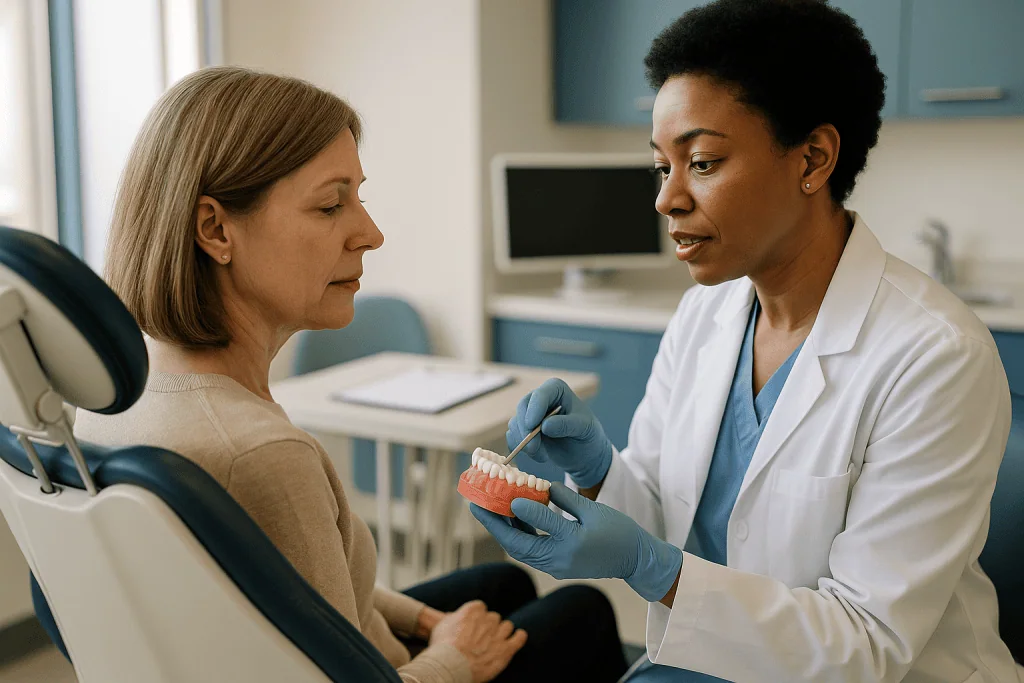
The first is diagnosis. Veneers are a cosmetic restoration; they do not treat decay, gum disease or a cracked root. Cleveland Clinic and NHS guidance both describe examination and, where indicated, radiographs (X-rays) before any cosmetic work, so that active disease is treated first rather than sealed under ceramic. Gum disease, infection of the tissues supporting the teeth, is a common reason for a plan to pause (NIH, NIDCR).
The second job is design. Many clinicians use a wax model or a digital mock-up, sometimes transferred to the mouth as a temporary “trial smile”, so the patient can see proposed length and shape before any enamel is removed. Enamel does not regrow; this step protects you from a design you have not approved.
The third is consent. Consent means being told, in language you understand, what will be done, what could go wrong, what the alternatives are, and what happens if you do nothing. Across a language barrier this takes longer, not less time.
The fourth is the preparation itself, usually under local anesthetic, followed by impressions or scans and temporaries. Shade selection happens here too, ideally with teeth hydrated and in natural light, because dehydrated teeth look lighter for several hours.
If a schedule compresses those four jobs into a single morning, that is worth a direct question. The treating dentist decides the pace, but you are entitled to understand why.
Veneers abroad and temporary teeth: why the temporaries matter
A temporary veneer is a provisional cover, usually acrylic or composite resin, placed over the prepared tooth until the ceramic arrives. People treat it as a cosmetic placeholder. Clinically it does three things that matter more than appearance.
It protects the prepared surface. Where enamel has been reduced, the underlying dentin, the softer tissue beneath enamel, may be partly exposed. Dentin contains microscopic tubules that connect toward the nerve, which is why prepared teeth can feel sharp sensations to cold, sweet or air (Cleveland Clinic). The temporary seals much of that.
It holds position. Teeth drift surprisingly quickly when a contact with the neighbor is lost. A temporary keeps the space the laboratory measured.
It tests the design. If the temporaries are built to the proposed shape, the gap between visits becomes a trial period. Speech, lip comfort and how the edges feel against the lower lip are all useful feedback for the final shade and contour.
Temporaries are deliberately weaker than final veneers so they can be removed. For someone staying in a hotel, that fragility is the practical problem. A lost or cracked temporary is not usually a medical emergency, but it leaves the tooth sensitive and vulnerable, and a stranger’s dental surgery is harder to find on a Sunday in an unfamiliar city.
Before leaving the first visit, ask what you should do if a temporary comes off, where you would be seen, and whether your own dentist at home is willing to re-cement a temporary if the gap between visits spans a journey home. Avoid very hard, sticky or chewy food, be gentle with floss (pull it through sideways rather than snapping it up), and keep gums clean, because inflamed gums at the second visit make bonding harder and bleeding compromises the cement seal.
The second visit: try-in, bonding and the bite check
The second visit is where the ceramic meets the mouth, and the most valuable minutes are the ones before the cement is mixed. After the temporaries are removed and the teeth are cleaned, each veneer is seated with a water-based or glycerine try-in paste. This is the only moment when shade can be fine-tuned, because the cement shade subtly changes the final color, and when marginal fit, the junction between ceramic and tooth, can be checked with magnification. Look in natural light. Say what you see. Once bonded, a veneer cannot be lightened.
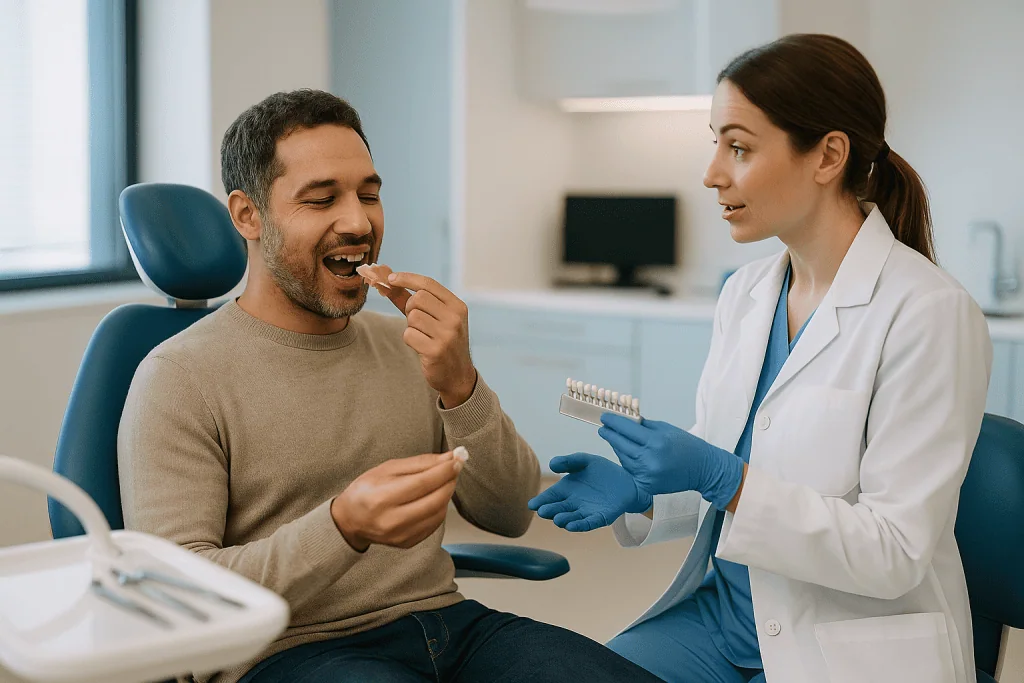
Bonding itself is chemistry under a rubber dam or careful isolation: the enamel is etched with a mild acid to create a microscopic texture, a bonding agent is applied, the resin cement is loaded, the veneer is seated, excess is cleaned, and a curing light hardens the cement. Moisture or blood contamination at this stage is the classic reason for later debonding, which is why healthy gums from a disciplined temporary phase matter.
The last step is occlusion, the way upper and lower teeth meet in closing and sliding. The dentist marks contacts with articulating paper and adjusts high spots. A veneer that takes too much load in a sideways grinding movement is the one most likely to chip (Cleveland Clinic).
Here the international timeline shows its weakness. Local anesthetic blunts your sense of bite for hours. Many clinicians like a short review a few days to weeks later to re-check contacts once muscles and sensation have settled. For a patient flying home the next morning, that review has to be arranged elsewhere, or it does not happen. Who performs it, and whether they will accept the task, is a question to settle before the first visit, not after the second.
Who are veneers usually for, and who is usually asked to wait?
Veneers are usually considered for cosmetic concerns on otherwise healthy front teeth: discoloration that does not respond to whitening, small chips, worn edges, minor spacing or mild rotation (Cleveland Clinic; NHS). They work best when there is enough enamel for bonding, because resin cement bonds far more predictably to enamel than to dentin.
Several groups are commonly asked to wait, or to consider a different route.
- Active gum disease or untreated decay. Bleeding, inflamed gums and cavities are treated first; cosmetic work on an unstable foundation tends to fail early (NIH, NIDCR).
- Heavy grinding or clenching. Bruxism, the habit of grinding or clenching teeth, often during sleep, loads thin ceramic in exactly the way that fractures it. Mayo Clinic describes night-time bruxism as frequently unnoticed by the person doing it. Clinicians may want this assessed and managed, often with a night guard, before or alongside veneers.
- Insufficient enamel or large existing fillings. Teeth already heavily restored may be better served by crowns, which cover the whole tooth.
- Significant crowding or bite problems. Veneers can mask mild misalignment; they cannot correct a bite. Orthodontics first is a common recommendation.
- Expectations that ceramic cannot meet. A very bright, uniform shade on a face it does not suit, or a wish to “fix everything” in one trip, are reasons for an honest conversation rather than a prescription.
Adolescents are generally asked to wait until teeth and gum lines have settled. The decision in every case belongs to the examining dentist, who can see the enamel thickness, the bite and the gum health that no questionnaire captures.
How long to stay abroad for veneers? A realistic timeline
Nobody can promise a timeline, because the laboratory interval and the number of teeth vary. What follows are typical spans described in mainstream patient information, offered as planning context rather than a schedule.
| Stage | What typically happens | Typical span | Who you need access to |
|---|---|---|---|
| Consultation and planning | Examination, radiographs, mock-up, consent | Often a separate day before preparation | Treating dentist |
| Preparation and temporaries | Enamel reduction, scans, provisionals | One appointment, sometimes two for many teeth | Treating dentist |
| Laboratory interval | Ceramic fabricated; patient wears temporaries | Commonly about one to several weeks; shorter with in-office milling (Cleveland Clinic) | Someone who can re-cement a temporary |
| Try-in and bonding | Fit, shade, cementation, bite adjustment | One appointment | Treating dentist |
| Early review | Re-check bite and gums once anesthetic and swelling settle | Days to a few weeks after bonding | Treating dentist or an agreed local dentist |
| Long-term maintenance | Hygiene visits, guard checks, repair of chips | Ongoing; routine dental check-ups as advised (NHS) | Your regular dentist |
Two patterns emerge. A single trip has to hold the laboratory interval inside it, which means either a longer stay or a compressed laboratory step. A two-trip plan spreads the visits but means flying with temporaries, which is where the fragility question in the earlier section becomes real.
General medical-travel safety applies regardless of the dental details. The CDC advises travelers seeking care abroad to arrange written records, confirm follow-up before leaving, and understand that complications may present after return. On long flights, moving regularly, staying hydrated and avoiding prolonged immobility are standard clot-prevention basics for anyone, not specific to dental patients (CDC). None of this is a recommendation to travel; it is what careful planning looks like if you already have.
What the first days and weeks after bonding usually look like
The honeymoon with new veneers is often preceded by a few slightly odd days. Knowing what is ordinary makes it easier to spot what is not.
Sensation. Cold or sweet sensitivity is common in the first days to weeks, especially where preparation reached dentin, and typically settles as the tooth’s nerve calms (Cleveland Clinic). Sensitivity that worsens over time, wakes you at night or lingers for minutes after the stimulus is gone is a different pattern and belongs in the red-flag section below.
Feel. The teeth may seem large or “foreign” to the tongue and lips. Speech, particularly “s” and “f” sounds, can take a few days to adapt if edge length changed. Most people stop noticing within a couple of weeks; persistent lisping suggests the edges need review.
Bite. A spot that feels high when you close, or a tooth that aches on chewing, usually means a contact needs a small adjustment. This is quick in the chair and a nuisance if the chair is in another country. It is the single most common reason an early review is useful.
Gums. Mild tenderness where the margins were cleaned is normal for a few days. Red, puffy gums that bleed on brushing at week two usually point to excess cement left at the margin or to plaque, both of which a dentist can address.
Habits. Avoid biting fingernails, pens, ice or hard crusts with front teeth. Use a non-abrasive toothpaste and floss daily; the tooth beneath a veneer can still decay at the margin. If a night guard was recommended for grinding, start wearing it as instructed; ceramic that survives the first week can still fracture in month six under an unprotected clench (Mayo Clinic).
What are the risks of porcelain veneers? What the evidence shows
Veneers are a well-established restoration with a long track record, and most complications are mechanical rather than medical. Patient information from Cleveland Clinic and the NHS consistently lists the same handful.
Irreversibility. Where enamel is removed, the tooth will always need a veneer or similar restoration. “No-prep” or minimal-prep approaches exist for selected teeth, but they are not suitable for every case and can look bulky if misapplied.
Sensitivity. Usually temporary. Occasionally a tooth that was already stressed develops inflammation of the nerve requiring root canal treatment, the removal of the nerve tissue and sealing of the canal. Patient sources describe this as uncommon but possible.
Chipping and fracture. Thin ceramic is strong in compression and brittle at edges. Grinding, nail-biting and hard foods are the usual culprits. Chips may sometimes be polished or repaired with composite; larger fractures mean a new veneer.
Debonding. A veneer can come off intact, most often when bonding was compromised by moisture or when it sits largely on dentin. Re-bonding is often possible if the veneer is undamaged and retrieved.
Gum changes. Over-contoured margins or retained cement can inflame gums; recession over years may expose a dark line at the margin.
Shade mismatch. Ceramic does not whiten. If surrounding teeth are later bleached, or if the shade chosen was brighter than the face carries, the mismatch is permanent until replacement.
How long veneers last is a frequent question. Cleveland Clinic gives a typical figure of roughly a decade or more with good care, while noting that bite, habits and hygiene change the number for any individual. Treat that as a range describing populations, not a warranty for your mouth. For a patient far from the treating dentist, the practical risk is not that complications are more likely; it is that each one is harder to get seen quickly.
What are the alternatives to porcelain veneers?
Any honest veneer consultation includes the options that are not veneers, because the least invasive route that meets the goal is usually the right one.
Doing nothing, for now. Cosmetic concern is not disease. If teeth are healthy, waiting carries no medical cost and preserves every option, including enamel.
Tooth whitening. Professional bleaching lifts many types of discoloration without touching tooth structure. The NHS notes it is a dental procedure that should be carried out or supervised by a registered dental professional, and that results fade and may need topping up. It does not change shape or close gaps.
Composite bonding. Tooth-colored resin is sculpted directly onto the tooth to repair chips, close small gaps or reshape edges, often with little or no enamel removal and in a single visit. It stains and wears faster than ceramic and typically needs more frequent repair or replacement, but it is reversible in a way porcelain is not (Cleveland Clinic).
Orthodontics. Braces or clear aligners move teeth rather than masking them. For crowding, spacing or rotation this treats the cause, often followed by whitening, and leaves enamel intact. It takes months rather than weeks.
Crowns. A crown covers the whole tooth. For teeth with large fillings, cracks or heavy wear, a crown may be more durable than a veneer, at the cost of more tooth reduction.
Enameloplasty. Minor reshaping of edges with polishing instruments can even out small irregularities in minutes, within the limits of enamel thickness.
Combinations are common: alignment first, whitening second, then composite or a small number of veneers only where needed. A plan that reaches for ten veneers before mentioning any of the above deserves a question about why.
Veneers abroad follow up: who looks after you once you are home?
Follow-up is the part of international dental care that no itinerary shows and that evidence on medical travel consistently flags. The CDC’s guidance for travelers seeking care abroad stresses obtaining complete written records and arranging follow-up care in advance, precisely because complications often appear after the patient has returned (CDC).
For veneers, follow-up has three layers.
Early review. The bite check and gum check in the days to weeks after bonding. If the treating dentist cannot do it, someone must. Many dentists at home will see a patient for an examination and minor adjustment; some are understandably cautious about taking responsibility for work they did not plan. Ask before you go, not after.
Routine maintenance. Veneered teeth still need hygiene visits and check-ups at whatever interval your dentist advises (NHS). Margins are where plaque gathers and decay starts. A hygienist should know the teeth are veneered so polishing pastes and instruments are chosen accordingly.
Repair and replacement. A chip in year four or a debond in year seven will be handled by whoever is nearest. Repair is far easier when records exist.
What to carry home:
- A written treatment summary listing which teeth were veneered and how much preparation was done.
- The ceramic type and shade, and the cement used.
- Pre- and post-treatment radiographs and photographs.
- Instructions for a night guard if one was made, and the guard itself.
- A named contact and a stated process for complications, including what happens if a veneer fails within whatever period the practice specifies.
The NHS, in its guidance on cosmetic treatment abroad, points out that if something goes wrong, remedial care at home may not be straightforward and may fall outside what public services routinely provide. That is a planning fact, not a verdict on anyone’s work.
What is the 4-8-10 rule for veneers, and does it matter?
The “4-8-10 rule” is a planning shorthand used by some cosmetic dentists, not a clinical guideline, and it is worth knowing both what it means and how little weight it carries.
The numbers refer to how many upper teeth typically show when a person smiles and therefore how many veneers would be needed for a uniform result: four (the central and lateral incisors), eight (adding the canines and first premolars) or ten (extending to the second premolars). Someone with a narrow smile that shows only the front teeth might be offered four; someone with a broad smile that displays back to the premolars might be told ten so that the color does not change halfway along.
The logic is real: a bright ceramic shade on four teeth beside six natural, slightly yellower teeth can look worse than no treatment. The problem is the direction of reasoning. The rule starts from the number of veneers and works backward. Good planning starts from the problem and asks what the smallest intervention is. If the goal is color, whitening the whole arch and veneering only the chipped tooth may give a better match than ten veneers. If the goal is alignment, orthodontics may need none.
You will not find the 4-8-10 rule in guidance from the NHS, Cleveland Clinic or any national body; it appears in marketing and training material rather than in evidence reviews. Treat it as a conversation opener. The useful questions behind it are: how many of my teeth show when I smile naturally and when I laugh, how will the shade be matched to the teeth that are not treated, and what is the plan for keeping untreated teeth looking like the treated ones over time. A dentist who answers those three in detail has done the thinking the rule only gestures at.
What people often get wrong about getting porcelain veneers abroad
“Two visits means two days.” Two visits is the clinical minimum for a laboratory-made veneer; the interval between them is the laboratory’s time, not yours to compress. A one-week trip either includes a genuinely short laboratory turnaround or trades away review time. Ask which.
“Veneers are a whitening treatment.” They are a shape-and-surface treatment that happens to be white. Ceramic does not bleach, so the shade chosen is the shade you keep. Natural teeth around it will continue to change color with age and coffee (Cleveland Clinic).
“They last forever.” Patient information describes a typical lifespan of around a decade or more with good care, after which replacement is likely (Cleveland Clinic). Every replacement involves removing old ceramic and often a little more tooth.
“No-prep veneers mean no risk.” Minimal-preparation veneers preserve enamel, which is good, but they suit only certain teeth and can look thick or trap plaque at the gum line if used where reduction was needed.
“Veneered teeth can’t decay.” The ceramic cannot; the tooth at the margin can, and so can the back of the tooth, which is not covered. Hygiene matters more after veneers, not less.
“A night guard is optional.” For anyone who grinds, it is the single most protective thing they can do for thin ceramic. Mayo Clinic notes that many people with sleep bruxism are unaware of it until a partner or dentist points out the signs.
“If something goes wrong, I’ll just go back.” A debond on a Tuesday evening does not wait for a flight. The question is who sees you locally, and whether they have your records.
“Some country does them best.” No body of evidence ranks nations for veneer quality. Outcomes track the individual clinician’s training, planning, laboratory and follow-up, which exist in every country and are absent in every country.
Questions to ask your care team before the first visit
A good dental team expects questions and answers them without hurry. If the answers come from a sales coordinator rather than the clinician who will treat you, ask for the clinician. These are the ones that matter most, grouped by stage.
Before anything is done
- Which of my concerns could be addressed with whitening, bonding or alignment instead of veneers, and why do you recommend veneers?
- How many teeth, and how much enamel will be removed from each? Is a minimal-preparation approach appropriate for any of them?
- Will I see a mock-up or trial smile before preparation, and can I ask for changes?
- Do I have signs of grinding, gum disease or decay that need treating first?
About the interval
- How long will the laboratory need, and where is the laboratory?
- If a temporary comes off or cracks while I am away from the practice, what exactly should I do, and who will see me?
- Will I be flying with temporaries, and is there anything specific to avoid?
About the second visit and afterwards
- Will there be a try-in where I can see the shade in natural light before bonding?
- When should the bite be re-checked, and if I have left, who will do it?
- Will I need a night guard, and will it be made and fitted before I leave?
- What records will I take home, in what format and in which language?
- What is your process if a veneer chips or comes off in the first year, and who covers remedial treatment near where I live?
Write the answers down. The value of this list is not in asking it once but in comparing what was promised with what is scheduled. Where the two disagree, the schedule is usually the honest one.
When to call your doctor
Most post-veneer symptoms are mild and settle on their own. A small number need prompt attention, and distance makes it more important, not less, to act early. Contact the treating dentist, your own dentist, or an urgent dental service if you notice any of the following.
- Pain that is worsening rather than easing after the first few days, or pain that wakes you at night. Normal post-preparation sensitivity fades; nerve inflammation builds (Cleveland Clinic).
- Sensitivity to heat, or cold sensitivity that lingers for more than a few seconds after the stimulus is removed. Both patterns can signal an irritated or dying nerve.
- Swelling of the gum, face or jaw, a bad taste, or a pimple-like bump on the gum near a treated tooth. These suggest infection and need same-day assessment.
- A veneer or temporary that comes off or breaks. Keep the piece in a clean container; many intact veneers can be re-bonded.
- A bite that feels high or a tooth that hurts when you chew, persisting beyond the first day or two.
- Bleeding gums that do not improve with gentle brushing after a week, or gums that look purple or recede from the margin.
- A sharp edge cutting the tongue or lip that you cannot avoid.
Seek emergency medical care, not just dental care, for fever with facial swelling, swelling that makes it hard to swallow or breathe, or spreading redness, because dental infections can occasionally extend into the neck and airway (MedlinePlus).
None of this is a reason to delay a scheduled review while you “wait and see”. If you are between countries, the nearest registered dentist can examine, take a radiograph and stabilize the situation; the full records you carried home are what make that visit efficient. The decision about what to do next always rests with the clinician who examines you.
Frequently asked questions
How many visits do porcelain veneers take when done abroad?
Usually two clinical visits, the same as anywhere: one for examination, consent, enamel preparation, scans and temporaries, and one for try-in and bonding. A planning consultation and an early review of the bite are often additional appointments. Some practices use in-office milling to shorten the laboratory interval, but whether that suits your case is a decision for the treating dentist based on the number of teeth and the complexity of the shade match.
How long do I have to stay abroad for veneers in two visits?
Long enough to cover the laboratory interval between preparation and bonding, which patient sources describe as commonly running from about one to several weeks, plus ideally a few days afterwards for a bite check once anesthetic has worn off (Cleveland Clinic). Shorter stays depend on faster laboratory methods or on splitting the treatment into two trips with temporaries in between. Your dentist sets the realistic span.
What are the temporary teeth like while waiting for veneers abroad?
Temporary veneers are acrylic or composite covers shaped like the planned result but intentionally weaker so they can be removed. They protect prepared enamel and dentin from sensitivity, keep teeth from drifting, and let you test the proposed shape in daily life. Hard, sticky or chewy foods and snapping floss can dislodge them, so ask in advance who will re-cement one if it comes off while you are away from the practice.
Which country does the best porcelain veneers?
No country does. There is no body of evidence ranking nations for veneer outcomes, and mainstream guidance does not attempt one. Quality depends on the individual clinician’s diagnosis and planning, the laboratory’s skill, the care taken at bonding, and whether follow-up is arranged. Those factors vary within every country far more than between them. Judge the clinician and the plan, not the flag on the website.
Is it a good idea to travel to another country for dental veneers?
That is a personal decision no article can make, and this one does not recommend it. The NHS and CDC both point out that care abroad shifts responsibility for follow-up and complications onto the patient, that records may be hard to obtain, and that remedial treatment at home may not be straightforward. If you are considering it, the questions in this article about temporaries, review and records are the ones that protect you.
What is the 4-8-10 rule for veneers?
It is a shorthand some cosmetic dentists use for how many upper teeth typically show in a smile, and therefore how many veneers would be needed for a uniform shade: four incisors, eight including canines and first premolars, or ten including second premolars. It is not a clinical guideline and does not appear in NHS or Cleveland Clinic guidance. Good planning asks what the smallest intervention is, which is often fewer veneers combined with whitening.
Do celebrities have veneer teeth?
Nobody can tell from a photograph, and speculating about an individual’s dental work is neither evidence nor good manners. Very even, bright smiles can result from veneers, crowns, bonding, whitening, orthodontics or simply good genetics and lighting. Only the person and their dentist know. What the question usually reveals is a wish for a particular look; bring the photo to your consultation and ask what would achieve something similar on your own teeth.
Who handles veneers abroad follow up once I am home?
Someone must be named before you leave. Early bite and gum checks, routine hygiene visits and future repairs will fall to whoever is nearest. Many dentists at home will examine and adjust, but some are cautious about work they did not plan, so ask your regular dentist in advance. Carry complete written records, radiographs and photographs, as the CDC advises for any care abroad, so a local clinician can act efficiently.
Can I fly straight after veneers are bonded?
There is no medical barrier to flying after a routine veneer bonding, which does not involve surgery or sedation. The practical concern is that local anesthetic masks bite problems for hours, so a high spot may only become obvious once you are airborne. Many clinicians prefer a short review before departure. On any long flight, moving regularly and staying hydrated are standard clot-prevention basics for all travelers (CDC).
How long do porcelain veneers last?
Cleveland Clinic describes a typical lifespan of roughly a decade or more with good care, while noting that grinding, nail-biting, hard foods and gum health change the number for any individual. That is a population range, not a guarantee. Replacement eventually involves removing old ceramic and sometimes a little more tooth, which is one reason to use the smallest number of veneers that meets the goal.
References
- Cleveland Clinic: Dental Veneers
- NHS: Cosmetic surgery abroad
- NIH National Institute of Dental and Craniofacial Research: Gum Disease
This article is for general information only and is not a substitute for professional medical advice. Please consult a qualified doctor about your individual situation.

More from the Blog
Flying After Wisdom Teeth Removal: Timing Your Return Trip Around the Healing Socket
Most dental sources describe the first 24 hours after wisdom tooth removal as the period for bleeding control and the first three to five…
When Composite Bonding Chips or Stains: Repair, Polish or Replace?
A chipped composite bonding can often be repaired by adding fresh resin to the existing material after the dentist roughens and re-bonds the surface,…
Who May Suit Teeth Veneers? Bite, Enamel Thickness and Grinding Habits Explained
People most often considered for teeth veneers have healthy gums, little or no untreated decay, enough natural enamel to bond to, and a bite…
Laser Dentistry Myths: Does a Laser Replace Every Drill and Every Injection?
No. Dental lasers can remove some decay, reshape gum tissue and treat certain gum pockets, and research suggests they may reduce the need for…

Eating After a Tooth Extraction: Soft Foods, Straws to Avoid and Getting Back to Normal
After a tooth extraction, most people eat cool or lukewarm soft foods for the first 24 hours, move to semi-soft foods over the next…

How Gum Graft Surgery Treats Gum Recession: Where the Tissue Comes From and How It Is Placed
A gum graft procedure treats gum recession by moving a small piece of soft tissue onto the exposed root and thin gum margin so…