

Preparing for Femto LASIK: Contact Lens Breaks, Corneal Mapping and Makeup Rules

Key Takeaways
- Contact lenses temporarily mold the cornea, so surgeons typically ask for about two weeks out of soft lenses and three weeks or more out of toric or rigid lenses before mapping and surgery.
- Corneal topography produces a color contour map of the eye's surface and is the main screening tool for keratoconus, a thinning condition that rules out LASIK.
- Femto LASIK replaces a blade with a femtosecond laser to create the corneal flap, but the reshaping itself is still done by an excimer laser programmed from your corneal map.
- No eye makeup, creams, lotion or perfume the day before and the day of surgery, and no eye makeup for at least a week afterward, protects the flap from debris and infection.
- The procedure is done awake with numbing drops, typically takes 30 minutes or less for both eyes, and produces pressure and a brief dimming of vision rather than pain.
- Functional vision usually returns within a day or two, but vision can fluctuate for two to three months and dry eye symptoms commonly persist for weeks to months before settling.
Femto LASIK preparation usually means pausing contact lenses for a period set by your surgeon, commonly about two weeks for soft lenses and longer for rigid or toric lenses, so the cornea returns to its natural shape before corneal mapping. Skip eye makeup, creams and perfume the day before and on the day of surgery, arrange a ride home, and follow your team's own pre-op instructions.
The instruction that catches most people off guard is not the laser. It is the sentence a coordinator says almost in passing: “Glasses only from now on, please.” For someone who has slipped in contact lenses every morning since high school, two or three weeks of fogged-up frames and rain on the lenses feels like a strange way to start a procedure that promises less fuss, not more.
Yet that lens break sits at the heart of femto lasik preparation, along with a detailed map of the cornea and a short list of rules about mascara, lotion and eye cream. None of it is arbitrary. Each step exists because the laser reshapes tissue that is roughly half a millimeter thick, and a measurement taken on a cornea still molded by a contact lens is a measurement taken of the wrong eye.
This explainer walks through what the weeks before femto LASIK usually involve, why each rule exists, what the evidence says about pain and healing, and which symptoms afterward deserve a same-day phone call.
What actually happens during femto LASIK
LASIK reshapes the cornea, the clear front window of the eye, so that light focuses more sharply on the retina at the back. Two lasers do two different jobs. The first, a femtosecond laser, fires pulses lasting a few quadrillionths of a second to create a thin hinged flap in the surface of the cornea. In older LASIK this flap was cut with a fine oscillating blade called a microkeratome; “femto” simply means the laser has replaced the blade for that step. Mayo Clinic and Cleveland Clinic both describe this bladeless flap as the defining feature of the technique.
Once the flap is lifted, a second laser, an excimer laser, removes a precise amount of tissue from the exposed layer beneath. Nearsighted eyes have the center flattened slightly. Farsighted eyes have the periphery treated so the center becomes relatively steeper. Astigmatism, an uneven curvature that blurs at every distance, is smoothed by treating some meridians more than others. The pattern comes from your corneal map, which is why that map is taken so carefully.
The flap is then laid back into place. It adheres on its own within minutes and needs no stitches. According to Mayo Clinic, the whole procedure typically takes 30 minutes or less for both eyes, with the lasers themselves active for well under a minute per eye. You are awake throughout. Numbing drops keep the surface comfortable, a small device holds the lids open, and a suction ring steadies the eye while the flap is made. Most people describe pressure and dimming of vision during those seconds rather than pain.
Everything that follows in this article exists to make those two laser passes land on accurate numbers.
Who femto LASIK is usually for, and who is asked to wait
Surgeons assess candidacy on stability, anatomy and general health rather than on how badly someone wants to ditch their glasses. Mayo Clinic lists the common starting points: adults, typically over 18, whose prescription has held steady for at least a year, whose corneas are thick and regular enough to remove tissue safely, and whose eyes are otherwise healthy.

A number of situations lead to a recommendation to wait or to consider another route. Pregnancy and breastfeeding change hormone levels that can shift the prescription and dry the eye, so most teams ask people to delay until several months after either has finished. A prescription that has changed within the past year is a reason to recheck later rather than treat a moving target. Very high prescriptions may exceed what can be corrected without thinning the cornea too far.
Some findings shift the conversation away from LASIK altogether. Keratoconus, a condition in which the cornea thins and bulges into a cone shape, is a firm contraindication because a flap can accelerate that weakening; corneal mapping is the main tool that catches early or hidden cases. Significant dry eye, active eye infection, uncontrolled diabetes, certain autoimmune conditions that slow healing, and some medicines that affect wound healing or tear production are all discussed openly at the assessment. Cleveland Clinic also notes that unusually large pupils and a history of herpes infection in the eye warrant careful consideration.
None of these are judgments. They are the reasons a good evaluation takes an hour or more and sometimes ends with the words “not this procedure, not yet” or “a different procedure may suit your eyes better.” That decision belongs to the surgeon who has examined you, not to a website, and not to a friend whose eyes happen to differ from yours.
Femto LASIK preparation: how long to stop wearing contacts before LASIK
A contact lens sits on the cornea like a gentle mold. Wear one long enough and the tissue flattens or steepens slightly to match it, a reversible change ophthalmologists call corneal warpage. Take the lens out and the cornea drifts back toward its natural shape over days or weeks. If the laser is programmed from measurements taken while the cornea is still warped, the treatment is aimed at a shape that will not exist a month later.
That is why the contact lens break is the single most consequential piece of femto lasik preparation you control yourself. Mayo Clinic advises switching to glasses full time for a period before both the evaluation and the surgery, with the exact length set by your surgeon and depending on lens type. Cleveland Clinic gives commonly cited ranges: about two weeks for soft lenses, and at least three weeks for toric soft lenses, which correct astigmatism and press unevenly, and for rigid gas-permeable lenses, which reshape the cornea more strongly.
| Lens type | Commonly cited break before mapping and surgery | Why the difference |
|---|---|---|
| Soft spherical (daily or monthly) | About 2 weeks | Thin, flexible; mild warpage that resolves fairly quickly |
| Soft toric (astigmatism) | 3 weeks or more | Thicker zones press unevenly on the cornea |
| Rigid gas-permeable | 3 weeks or more, sometimes longer | Firm material reshapes the cornea more strongly |
| Orthokeratology (overnight reshaping) | Often several weeks to months, surgeon-directed | Designed to change corneal shape deliberately |
Ranges above are drawn from Mayo Clinic and Cleveland Clinic patient guidance; your own surgeon may ask for longer, and some repeat the corneal map until two readings match. If the wait feels punishing, that is a sign the lenses were doing more shaping than you realized.
What corneal topography before LASIK measures, and why it can change the plan
Corneal topography is a photograph of shape rather than color. The instrument projects rings of light onto the cornea and analyzes how they reflect, producing a colored contour map, much like an elevation map of a hillside, showing where the surface is steeper or flatter across thousands of points. Many centers pair it with tomography, which scans the front and back surfaces together and calculates thickness across the whole cornea rather than at a single spot.
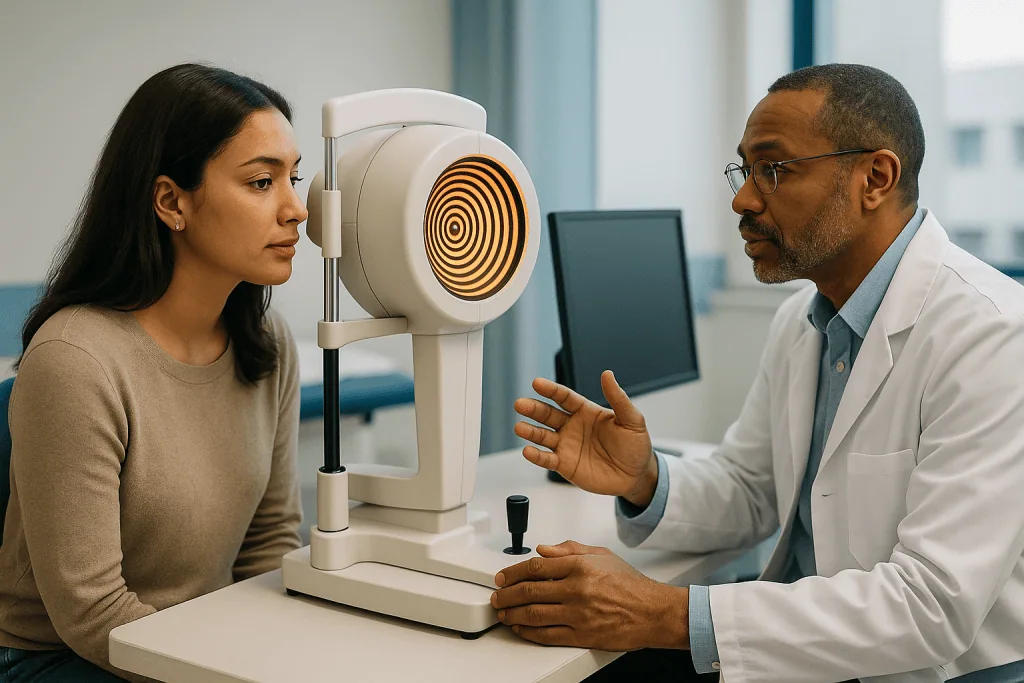
Three things come out of that map. First, the exact astigmatism pattern that the excimer laser will be asked to smooth. Second, the thickness available for treatment, since the surgeon must leave a sufficient bed of untouched tissue beneath the flap to keep the cornea structurally sound. Third, and most importantly, any hint of irregular thinning or asymmetric steepening that suggests early keratoconus or another ectatic condition. Cleveland Clinic describes this screening as one of the main reasons the evaluation is more involved than a routine glasses check.
Topography is also how the surgeon confirms the contact lens break has worked. A cornea still recovering from lens wear produces a map that shifts between visits. Two maps that agree, taken a week or more apart, tell the team the surface is stable. If they disagree, most surgeons will simply wait and repeat rather than proceed; an extra week in glasses is a small price for aiming at the right shape.
Other measurements usually happen the same day. Wavefront analysis records how light travels through the whole optical system. Pupil size is measured in dim light. Tear film quality and quantity are checked, because a dry surface distorts every optical reading and predicts more discomfort afterward. Expect dilating drops, several hours of blurry near vision, and a strong recommendation not to drive yourself home from the assessment.
The rest of the pre-op assessment: dilation, thickness and honest history
Beyond the map, the evaluation looks a lot like the most thorough eye exam you have ever had. The surgeon or optometrist measures your refraction twice, once as you normally see and once after dilating drops relax the focusing muscle, because that relaxed reading is the truer baseline for laser programming. Pachymetry, a painless ultrasound or optical measurement of corneal thickness, confirms the numbers from tomography. The pressure inside the eye is checked, the retina is examined through the dilated pupil, and the surface is stained with a harmless orange dye so any dry patches light up under blue light.
The conversation matters as much as the machines. Bring a list of every medicine and supplement you take, including anything for acne, allergies, mood or hormones, since several classes affect tear production or wound healing and the surgeon needs to know. Mention any history of cold sores or shingles near the eye, any autoimmune diagnosis, any keloid scarring, and any relative with keratoconus. None of these automatically disqualifies you; all of them shape the plan.
Be candid about your job and hobbies too. People who box, wrestle or play contact sports face a slightly higher risk of flap displacement from a direct blow, and some surgeons steer them toward a flapless technique. Night drivers and pilots have specific concerns about glare and halos. A surgeon who knows you read spreadsheets all day can set expectations about dryness in the early weeks.
Expect to sign consent forms that spell out risks in plain terms. Reading them at home, not in the chair, is a reasonable request. The assessment ends with a plan, a date and written femto lasik preparation instructions specific to you; those written instructions override anything general, including this article.
Makeup before LASIK surgery: what to skip and for how long
The makeup rules read like fussiness until you picture the mechanics. A flap is lifted from the surface of the eye and laid back down. Anything that can migrate under it, from a flake of mascara to a smear of moisturizer carried by a tear, can lodge beneath the flap or feed an infection. Cleveland Clinic and Mayo Clinic both ask patients to arrive with a clean face: no eye makeup, no face cream, no lotion and no perfume on the day of surgery, and most surgeons extend that to the evening before so residue has time to clear from the lash line.
Removing eye makeup properly the night before is part of the job. Old mascara and liner collect along the lash roots and in the meibomian glands, the tiny oil glands along the lid margin that keep tears from evaporating. A gentle lid scrub, followed by rinsing with plain water, clears debris that a quick wipe leaves behind. Skip lash extensions and false lashes in the run-up; adhesives shed particles and make the lids harder to clean.
Afterward, the restriction continues. Cleveland Clinic advises avoiding eye makeup for at least a week; some surgeons ask for two, and many suggest opening a fresh mascara rather than returning to a tube that may carry bacteria from before surgery. Face makeup that stays well away from the lids is usually permitted sooner, provided you are not rubbing the eyes to apply or remove it. Rubbing is the real enemy in the first weeks, because the flap, although adhered, is still knitting at its edges.
Perfume and hairspray have a different rationale: aerosols and vapors irritate a surface that has just been treated and can interfere with the laser’s environment. A plain, unscented morning is all that is asked.
LASIK pre op instructions for the final 48 hours
The last two days are mostly about logistics and restraint. Your surgeon’s written instructions come first; the points below reflect what Mayo Clinic, Cleveland Clinic and NHS guidance describe as typical.
Eat normally unless told otherwise. LASIK uses numbing drops rather than general anesthesia, so fasting is rarely required, and arriving with stable blood sugar makes lying still easier. Alcohol is commonly discouraged the night before because it dehydrates the eye surface and can interact with any relaxing medicine offered on the day. Caffeine is a judgment call; a small coffee is fine for most people, but a jittery eye is harder for the tracking laser to follow, so this is a poor morning for a third espresso.
Arrange a driver. Vision is blurry and light-sensitive for hours afterward, and some centers offer a mild sedative that makes driving unsafe regardless. Plan to go straight home and sleep, with dark glasses for the ride.
- Lay out loose, comfortable clothing without lint-shedding fabrics near the face.
- Have any prescribed eye drops already at home, understood and labeled.
- Clear the following day of work, screens and childcare if you can.
- Confirm the time, the address and who is collecting you.
Tell the team about anything new: a cold, a stye, a cold sore, a new medicine. Any active infection anywhere near the eye typically postpones surgery, and it is far better to reschedule than to operate on an inflamed surface. Keep your glasses handy for the journey in; you will not need them on the way out, but you may want a case to carry them home. If a pre-op wash or lid cleanser has been recommended, use it exactly as instructed and nothing more.
How painful is femto LASIK?
The honest answer is that the procedure itself is largely painless, and the hours afterward are uncomfortable in a way most people describe as gritty, stinging or watery rather than sharp. Anesthetic drops numb the corneal surface within a minute or two. What remains are sensations rather than pain: the cool splash of the drops, the firm pressure of the suction ring as the flap is made, a brief dimming or blackout of vision during those seconds, then a faint clicking and a smell some people liken to singed hair while the excimer laser works. The smell is tissue vapor and is expected.
Mayo Clinic describes the post-operative pattern plainly: burning, itching and a sensation of something in the eye for a few hours, with watering and light sensitivity, easing substantially after a sleep. Over-the-counter pain relief is sometimes suggested by the surgical team; what to take and whether to take it is their call, not a recommendation here. Protective shields worn while sleeping stop reflexive rubbing during the itchy phase.
Discomfort that intensifies rather than settles is the exception and is covered in the red-flag section below. A useful comparison: many people who have had both say the first evening after LASIK feels like a long day in a chlorinated pool or a windy beach, while a flapless surface procedure such as PRK tends to be sorer for longer because the surface layer regrows over several days.
Anxiety amplifies every sensation, and the femto step, with its pressure and momentary darkness, is the part most likely to startle. Ask your surgeon to narrate what is happening as it happens. Knowing that the dimming lasts seconds and means the ring is doing its job turns an alarming moment into a mildly odd one.
What the day of surgery looks like, minute by minute
Most people are at the center for two to three hours, though the lasers run for a fraction of that. On arrival, a technician repeats a few key measurements, often including topography, to confirm nothing has shifted since the assessment. You review consent again, confirm which eye or eyes are being treated, and change into a cap and gown. A relaxing tablet may be offered; accepting it is optional and its use is entirely at the team’s discretion.
In the laser suite you lie on a bed that swings between the two lasers. Drops numb the eye, the lids are cleaned, and a speculum, a small spring device, holds them open so blinking is not something you have to think about. The surgeon centers the femtosecond laser, applies the suction ring, and creates the flap; vision dims, pressure builds for perhaps twenty to thirty seconds, then releases. The bed moves. You are asked to look at a blinking fixation light while the excimer laser tracks tiny eye movements and treats the exposed tissue, usually for less than a minute. Mayo Clinic notes the whole session for both eyes typically runs 30 minutes or less.
The flap is smoothed back, checked, and left to adhere. Drops go in. Clear shields are taped over the eyes, and you sit in recovery for a short while so the surgeon can look at the flap position under a microscope before you leave.
Vision on the way out is hazy, like looking through a steamy shower door, and bright light is unpleasant. Dark glasses, a quiet car and a dark bedroom are the plan. Sleeping for a few hours is the most useful thing you can do that afternoon; it gets you past the peak of the gritty phase and protects the flap while it settles.
How long does it take to heal from femto LASIK, and how many days should you rest?
Healing after LASIK happens on three timescales, and confusing them causes most of the worry. The flap seals in hours. Functional vision returns in a day or two. Fine stability takes weeks to months.
Mayo Clinic describes blurry, hazy vision on the first day that clears substantially by the next morning for most people, with a follow-up visit typically within 24 to 48 hours to check the flap and measure vision. Cleveland Clinic notes that many people return to work within a day or two, though screen-heavy jobs feel dry and tiring at first. Full stabilization is slower: Mayo Clinic puts the window at two to three months, during which glare, halos around lights at night and fluctuating clarity are common and usually fade. Dry eye symptoms are expected in the early weeks because the flap temporarily cuts corneal nerves that signal the eye to make tears; both Mayo Clinic and NHS guidance describe this as usually settling over months, and lubricating drops are typically part of the plan.
As for rest, the first 24 hours matter most, with eyes closed as much as possible. After that, the rules are about protection rather than bed rest. Cleveland Clinic and Mayo Clinic advise avoiding eye rubbing, eye makeup for at least a week, swimming pools and hot tubs for a couple of weeks or as your surgeon directs, and contact sports for longer, since a blow can dislodge the flap before it fully knits. Gentle walking the next day is fine; the flap is not disturbed by movement, only by pressure and contamination.
Follow-up visits are usually scheduled around one week, one month and several months. Stability at those visits, not the calendar, is what tells the surgeon healing is complete, and any residual correction is a decision for that team.
Risks and alternatives, in plain clinical terms
LASIK is among the most studied elective procedures in medicine, and its risks are well characterized without being trivial. Mayo Clinic groups them into the common and temporary, the uncommon and treatable, and the rare and serious.
Dry eye and night-vision disturbances such as glare, halos and starbursts fall into the first group; they are frequent in the early months and usually improve, though a minority of people report lasting dryness. Under-correction or over-correction, meaning vision that is better but not as sharp as hoped, sits in the second group and may prompt a discussion about glasses for specific tasks or an enhancement procedure once healing is complete. Flap complications, including wrinkles or debris beneath the flap, are uncommon and often correctable by the surgeon repositioning or rinsing under it.
The rare serious risks include infection, inflammation under the flap, and corneal ectasia, a progressive weakening and bulging of the cornea. Ectasia is the risk that corneal mapping is designed to screen for, which is why an abnormal map is treated as a reason to stop rather than to proceed cautiously. Vision loss is very rare but is disclosed because it is possible.
Alternatives exist and are worth asking about. PRK removes the surface layer instead of creating a flap and suits thinner corneas or high-contact occupations, at the cost of a sorer, slower first week. SMILE removes a lenticule of tissue through a small incision without a full flap. Implantable lenses correct high prescriptions without removing corneal tissue. And glasses or contact lenses remain entirely valid choices; declining surgery is not a failure of nerve. Which option fits your eyes is a judgment for the surgeon who has mapped them.
What people often get wrong about femto LASIK preparation
The most common mistake is treating the contact lens break as negotiable. People wear lenses “just for the weekend” or “only for the wedding” a few days before mapping, then wonder why the surgeon wants another visit. Even a single day of wear can nudge the corneal surface, and a rigid lens can do so for weeks. Mayo Clinic’s guidance to switch to glasses full time means full time.
Another myth is that femtosecond LASIK requires no preparation because it is “bladeless and safer.” The femto laser changes how the flap is made; it changes nothing about the need for a stable, accurately mapped cornea. The excimer laser that does the reshaping is programmed from the same measurements as before.
Many people assume they will be asleep. LASIK is done awake with numbing drops, because the tracking laser needs you to look at a fixation light. A mild sedative may be offered, but you will hear, feel pressure and be asked to hold still.
“Perfect vision the next morning” is a frequent expectation and an unfair one. Most people see well enough to function within a day or two, but Mayo Clinic describes fluctuation for two to three months. Judging the result in the first week is judging a cake before it has cooled.
Skipping the makeup rule “because it’s just a little concealer” underestimates how much product migrates with tears. And finally, the belief that LASIK removes the need for reading glasses in later life is mistaken: presbyopia, the age-related stiffening of the lens inside the eye, is unrelated to the cornea and arrives regardless. A good surgeon will raise this before you do.
Questions to ask your care team
Come to the assessment with questions written down; dilated eyes make notes hard to read afterward. The list below is a starting point rather than a script, and the answers should come from the surgeon who will operate, not from a coordinator or a brochure.
- Based on my corneal map and thickness, am I a straightforward candidate, a borderline one, or better suited to a different procedure?
- How long do you want me out of contact lenses before the map and before surgery, given the type I wear, and will you repeat the map to confirm stability?
- Did my topography show anything irregular, and how did you rule out early keratoconus?
- How much corneal tissue will remain untouched after treatment, and how does that compare with your usual safety margin?
- What is your specific rule on eye makeup, creams and lash extensions before and after, and for how long?
- Which of my medicines or health conditions affect healing or dryness, and should I discuss any of them with the prescribing doctor beforehand?
- What will the first evening feel like, and what should I do about discomfort or light sensitivity?
- When will I be seen after surgery, and who do I call outside office hours if something feels wrong?
- How do you handle under-correction or regression if my vision is not where we hoped once healing is complete?
- What is my realistic expectation for night driving and screen work in the first month?
Notice how many of these circle back to femto lasik preparation: the lens break, the map, the makeup rule. The quality of the answers tells you a great deal about the care you will receive. A surgeon who explains why two maps must agree, and who is willing to postpone, is demonstrating the caution that protects your eyes.
When to call your doctor
Some discomfort is expected, and knowing the difference between ordinary healing and a problem removes most of the anxiety of the first week. Mild grittiness, watering, light sensitivity and hazy vision on the first day, followed by steady improvement, are the normal course described by Mayo Clinic and NHS guidance. Fluctuating clarity, dryness and halos at night over the following weeks are also within the expected range.
Call your surgical team the same day, or the after-hours line they gave you, if you notice any of the following:
- Pain that worsens after the first day rather than easing, or severe pain at any point
- A sudden drop in vision, or vision that was clearing and then deteriorates
- Increasing redness, discharge, or a lid that is swelling and hard to open
- A sensation that something has moved or shifted on the eye surface, especially after a bump, rub or fall
- New sensitivity to light that is markedly worse than the day before
- Any injury to the eye in the first weeks, even one that seems minor
These signs can indicate infection, inflammation beneath the flap, or flap displacement, all of which are far easier to manage when caught early. Do not wait for a scheduled visit and do not try to rinse or manipulate the eye yourself. If you cannot reach your surgical team and symptoms are severe, an emergency department can examine you and contact an ophthalmologist.
Before surgery, the same principle applies: a new cold sore, stye, pink eye or any eye injury in the days before your date is a reason to call and ask whether to postpone. A short delay costs a little patience. Operating on an inflamed or infected eye costs far more.
Frequently asked questions
How long do I need to stop wearing contacts before LASIK?
Commonly about two weeks for soft spherical lenses and at least three weeks for toric or rigid gas-permeable lenses, according to Cleveland Clinic guidance, with your surgeon setting the exact period. The break lets the cornea return to its natural shape before corneal mapping. Many surgeons repeat the map and proceed only when two readings agree, so wearing lenses even briefly during the break can delay your date.
Do and don'ts before LASIK: what matters most?
Do stay out of contact lenses for the full period your surgeon sets, arrive with a clean face, arrange a driver and bring a complete medicine list. Don’t wear eye makeup, cream or perfume on the day, don’t drink alcohol the night before, and don’t hide a cold sore, stye or new medicine from the team. Written instructions from your own surgeon override any general list.
How painful is femto LASIK?
The procedure itself is largely painless because anesthetic drops numb the corneal surface. You feel pressure from the suction ring and see vision dim briefly while the flap is made. Afterward, Mayo Clinic describes a few hours of burning, itching, watering and light sensitivity that ease markedly after sleep. Pain that worsens after the first day is not typical and should prompt a call to your surgeon.
How long does it take to heal from femto LASIK?
The flap seals within hours, most people see well enough to function within a day or two, and Mayo Clinic notes that vision can take two to three months to stabilize fully. Dry eye and night glare are common in the early weeks and usually fade over months. Your surgeon judges healing by stability at follow-up visits rather than by a fixed number of days.
How many days should I rest after LASIK eye surgery?
The first 24 hours are the ones that matter, with eyes closed as much as possible. Cleveland Clinic notes many people return to work within a day or two. After that, rest is about protection rather than lying down: no rubbing, no eye makeup for at least a week, and no swimming, hot tubs or contact sports for the period your surgeon specifies, since these threaten the flap.
What does corneal topography before LASIK actually check?
It maps the curvature of the corneal surface at thousands of points, producing a colored contour image that shows astigmatism pattern, tissue thickness and any irregular steepening or thinning. Its most important job is screening for keratoconus and related conditions, which make LASIK unsafe. Surgeons also compare maps taken on different days to confirm the contact lens break has allowed the cornea to stabilize.
Can I wear makeup before LASIK surgery?
Not on the day of surgery, and most surgeons ask you to stop the evening before as well, according to Mayo Clinic and Cleveland Clinic guidance. Eye makeup, creams, lotion and perfume can migrate beneath the corneal flap or irritate the treated surface. Remove old mascara and liner thoroughly with a gentle lid clean, skip lash extensions in the run-up, and avoid eye makeup for at least a week afterward.
What LASIK pre op instructions are typical for the day itself?
Eat a normal meal unless told otherwise, skip alcohol the night before, arrive with a clean face and no perfume, wear comfortable clothing, and bring someone to drive you home. Tell the team about any cold, cold sore, eye infection or new medicine. Expect repeat measurements, a consent review, numbing drops, roughly 30 minutes of laser time for both eyes, and a couple of hours at the center overall.
Why would a surgeon ask me to wait or choose a different procedure?
Common reasons include a prescription that has changed within the past year, pregnancy or breastfeeding, thin or irregular corneas, significant dry eye, active infection, uncontrolled diabetes and some autoimmune conditions or medicines that slow healing. Keratoconus rules LASIK out entirely. Alternatives such as PRK, SMILE or implantable lenses may suit some of these situations, and staying with glasses or contacts is always a valid choice.
Will femto LASIK stop me needing reading glasses later in life?
No. LASIK reshapes the cornea to correct distance vision, nearsightedness, farsightedness/">farsightedness and astigmatism. Presbyopia, the age-related stiffening of the lens inside the eye that makes close reading harder from the mid-forties onward, is a separate process and arrives regardless of corneal surgery. Your surgeon should discuss this before treatment and can outline the options that exist for near vision at that stage.
References
- Cleveland Clinic: LASIK Eye Surgery
- NHS: Laser eye surgery and lens surgery
- MedlinePlus: LASIK eye surgery
This article is for general information only and is not a substitute for professional medical advice. Please consult a qualified doctor about your individual situation.

More from the Blog
Diabetic Retinopathy Stage by Stage: How Retinal Damage Advances and When Treatment Begins
Diabetic retinopathy is graded in four stages: mild, moderate and severe nonproliferative retinopathy, in which small retinal blood vessels leak and close, followed by…
Who Can Wear Contact Lenses? Dry Eye, Astigmatism and Allergies at the Fitting Exam
Most people who need vision correction can wear contact lenses, including many with dry eye, astigmatism and seasonal allergies, provided a fitting exam confirms…

Preparing for LASEK: Contact Lens Breaks, Corneal Thickness Checks and Planning Days Off
LASEK preparation usually involves three things: pausing contact lenses for a period your surgeon sets (often a few weeks, longer for rigid lenses) so…

How Eye Alignment Is Measured: The Tests Behind a Strabismus Disorder Diagnosis
Eye alignment is measured with a short set of clinic tests. The cover test, in which one eye is covered while the examiner watches…

What PRK Results Usually Look Like Once Healing Finishes and How Long They Hold
PRK reshapes the cornea after its surface layer is removed, so vision is blurry for the first several days and sharpens gradually rather than…

What Injections for Macular Degeneration Can Realistically Do: Slowing Loss, Not Undoing It
Injections for wet macular degeneration block a growth signal that makes fragile new blood vessels leak under the retina. In large trials, most treated…