

Preparing for LASEK: Contact Lens Breaks, Corneal Thickness Checks and Planning Days Off

Key Takeaways
- LASEK reshapes the cornea without cutting a flap, which is why it is often chosen for thinner corneas and higher-impact lifestyles, and why the first week is slower than after LASIK.
- Contact lenses temporarily mould the cornea, so surgeons ask for a lens-free period before both the assessment scans and the surgery, with rigid lenses needing longer than soft ones.
- Pachymetry measures corneal thickness, roughly half a millimeter at the center, so the surgeon can confirm enough tissue remains after the planned treatment.
- The pre-operative assessment usually includes corneal mapping, dilated refraction, pupil measurement and tear film tests, and typically takes longer than the laser procedure itself.
- Surface epithelium generally regrows over the first several days under a bandage lens, and most people plan about a week away from screen-heavy work.
- A Cochrane review found no clear difference in visual outcomes between LASEK and PRK, so procedure choice should rest on your measurements rather than on marketing claims.
LASEK preparation usually involves three things: pausing contact lenses for a period your surgeon sets (often a few weeks, longer for rigid lenses) so the cornea returns to its natural shape; a detailed eye assessment that includes measuring corneal thickness and mapping its curvature; and planning several days to about a week away from demanding visual work while the eye surface heals.
The appointment letter sits on the kitchen counter next to a half-used box of daily lenses, and the question it raises is oddly practical: when exactly do I stop wearing these? That is where lasek preparation begins for most people, not with the laser itself but with a calendar, a contact lens case, and a growing list of small logistics.
LASEK, short for laser-assisted subepithelial keratectomy, is a surface laser procedure that reshapes the front of the eye without cutting a flap into the cornea. Because it works on the surface, the days after it feel different from what friends who had LASIK may describe, and the preparation is a little different too.
This article walks through what the pre-operative checks measure, why the contact lens break is not a formality, and how people realistically plan time off. Every decision here, including whether LASEK is the right procedure at all, sits with your treating team; the aim is to help you arrive at those conversations informed.
What actually happens during LASEK, in plain language
The cornea is the clear dome at the front of the eye, and it does most of the eye’s focusing. Its outermost layer, the epithelium, is a thin skin of cells that regrows constantly, a bit like the surface of your lips. Beneath it lies the stroma, the thick structural layer that gives the cornea its shape.
In LASEK, the surgeon applies a dilute alcohol solution to loosen the epithelium, gently moves that sheet of cells to one side, and then uses an excimer laser, a cold ultraviolet laser that removes tissue with sub-micron precision, to reshape the stroma underneath. The loosened epithelium is floated back into place, and a soft bandage contact lens is placed over the eye to protect it while the surface heals (NHS).
That single detail, no flap, is what separates LASEK from LASIK. In LASIK a thin hinged flap of cornea is cut and lifted, the laser treats the tissue beneath, and the flap is laid back down. LASIK eyes are usually comfortable within hours; surface procedures such as LASEK and its close relative PRK take longer to settle, because the eye has to rebuild its surface layer rather than simply re-seal a flap (Cleveland Clinic).
The laser portion itself lasts under a minute per eye. The whole visit, with drops, positioning and checks, commonly takes an hour or two. You lie on your back, look at a fixation light, and the system tracks small eye movements. Numbing drops mean the procedure is not painful, though many people describe pressure and an odd smell as tissue is treated (Mayo Clinic).
Who LASEK is usually for, and who is usually asked to wait
Surgeons tend to suggest a surface procedure like LASEK when a flap is undesirable. The commonest reasons are a cornea on the thinner side, a prescription that would leave too little tissue after a flap, or a lifestyle with a high risk of eye impacts, since there is no flap to dislodge later (NHS). People with a history of dry eye are sometimes steered toward surface treatment as well, although evidence that it is gentler on tear function is mixed.

General eligibility mirrors other laser vision correction. Adults whose glasses prescription has been stable for at least a year, and in some guidance closer to two, are the usual candidates; a still-changing prescription means the result would drift (Mayo Clinic; NHS). Most surgeons want people to be over 18, and many prefer the early twenties, when growth-related changes in the eye have finished.
Several groups are commonly asked to wait or to consider alternatives:
- People who are pregnant or breastfeeding, because hormonal shifts can temporarily change the cornea and the prescription.
- Anyone with active eye disease, such as untreated infection, uveitis, or advanced dry eye.
- People with keratoconus, a condition in which the cornea thins and bulges into a cone shape; removing tissue can make it worse.
- Those with poorly controlled diabetes or autoimmune conditions that impair healing.
- People taking medicines known to affect corneal healing, which the surgeon will review individually.
Being asked to wait is not a rejection. It usually means the team wants a stable, healthy eye before it commits to an irreversible change. Only the assessing ophthalmologist can make that call, and it depends on your measurements, not on general rules.
LASEK preparation: why the contact lens break comes first
Here is the mechanism people are rarely told. A contact lens rests on the cornea all day, and even a well-fitting soft lens presses gently on that living tissue. Over months and years the cornea adapts, flattening slightly under the lens and sometimes developing tiny irregularities. Rigid gas-permeable lenses, which hold their shape rather than draping over the eye, mould the cornea more firmly, and the effect can persist for weeks after the last wear.
The laser treatment is planned from measurements of your cornea taken to a fraction of a micron. If those measurements are taken while the cornea is still “remembering” a lens, the plan is built on a shape that will not exist a month later. The result is a treatment that is technically precise and clinically wrong. That is why surgeons ask you to remove lenses not just before surgery, but before the assessment visit itself (Mayo Clinic).
Two other things happen during the break. The tear film, the thin liquid layer that keeps the eye surface smooth, has a chance to recover from lens-related dryness, which improves both the measurements and post-operative comfort. And any low-grade inflammation of the eyelids or conjunctiva linked to lens wear can settle, lowering infection risk at the time of surgery.
Practically, this means digging out glasses you may not have worn in years. If your prescription has changed, an updated pair is worth arranging early, because you will rely on them through the break and for some days after the procedure. People who find glasses a nuisance sometimes shorten the break on their own; the honest advice is that this trades a few weeks of inconvenience for a risk that the treatment misses its target.
How long to stop wearing contacts before LASEK?
There is no single universal number, and any article that gives you one without a caveat is simplifying. The interval depends on the lens type, how many years you have worn them, and what the surgeon sees on the initial scan. Mayo Clinic’s guidance for laser vision correction is that contact lenses are usually stopped at least a few weeks before both the evaluation and the surgery, and that rigid lenses generally require a longer pause than soft ones (Mayo Clinic).
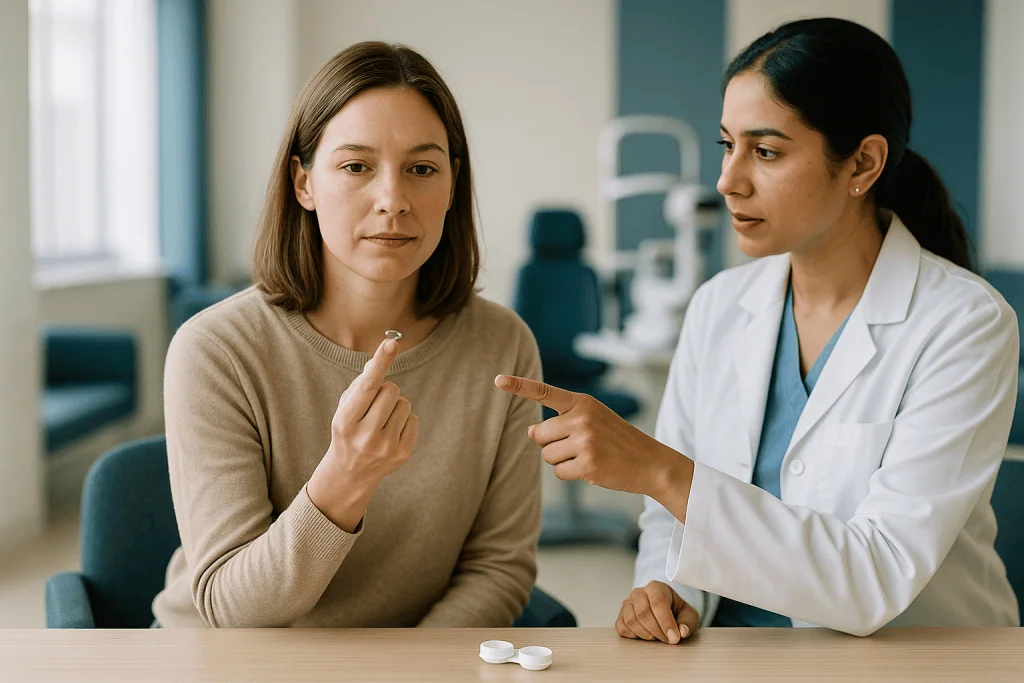
In practice, clinics usually stagger the requirement by lens category, from soft daily disposables at the shorter end through soft toric lenses for astigmatism, to rigid gas-permeable and older hard lenses at the longer end, sometimes a month or more. Long-term rigid lens wearers occasionally need repeat corneal mapping a few weeks apart to confirm the shape has stopped changing before a treatment plan is finalized.
A useful way to think about it: the break is over when the cornea is stable, not when a set number of days has passed. Your surgeon is looking for two scans that agree with each other.
What if you slip and wear lenses for a wedding or a work presentation? Tell the team. A single afternoon in soft lenses early in the break may not matter much; the same thing two days before surgery, or in rigid lenses, may mean re-measuring or rescheduling. Nobody will scold you, but they cannot correct for what they do not know.
If you have never worn contact lenses, this step does not apply, though the assessment itself is identical. And if you wear a lens in one eye only, the break still applies to that eye and the other is measured as normal.
Corneal thickness for laser eye surgery: what the check measures and why it matters
The cornea is remarkably thin, roughly half a millimeter at its center, about the thickness of five sheets of printer paper stacked together. Laser vision correction works by permanently removing a small amount of that tissue to change its curve. The more shortsightedness or astigmatism being corrected, the more tissue must go. So the first question a surgeon asks the scan is simple: how much is there to begin with, and how much will be left?
The measurement is called pachymetry. Modern clinics use either an ultrasound probe that touches the numbed eye for a moment, or, more commonly now, optical scanners that map thickness across the whole cornea without contact. The scan takes seconds. What matters is the result: a thickness map that shows whether the center is within a comfortable range and whether the cornea thins unevenly toward one side, which can be an early hint of keratoconus (Cleveland Clinic).
Why does LASEK, specifically, care about thickness? Because it does not cut a flap, it preserves more structural tissue than LASIK for the same prescription. A flap consumes a portion of the cornea’s depth that then contributes little to strength; surface treatment avoids that. This is precisely why people whose corneas measure on the thinner side, or whose prescriptions are higher, are often offered LASEK or PRK rather than LASIK (NHS).
Thickness is not judged in isolation. Surgeons weigh it against the planned tissue removal, the shape map, and your age, because a cornea that is thin but regular and stable is a different proposition from one that is thin and steepening. If the numbers fall outside the surgeon’s comfort zone, the recommendation may be a different procedure entirely or no laser at all. That conversation, uncomfortable as it can be, is the safety check working as intended.
The other pre-operative tests: mapping, pupils, tears and a dilated exam
Thickness is one number. The rest of the assessment builds a three-dimensional picture of your eye, and it typically takes longer than the surgery itself.
Corneal topography, sometimes called mapping, projects a pattern of light onto the cornea and reads how it reflects, producing a color-coded contour map, much like elevation lines on a hiking map. Tomography does the same for the back surface of the cornea. These maps catch subtle irregularities that no glasses test can find.
A refraction, the familiar “better or worse?” lens test, is repeated, often twice: once as you see now and once after dilating drops relax the focusing muscle so the true prescription cannot be masked by effort. Dilation also lets the ophthalmologist examine the retina and optic nerve, because laser surgery is only sensible in an otherwise healthy eye (MedlinePlus).
Pupil size is measured in dim light. Very large pupils in low light have historically been linked with more glare and halos at night after treatment, and the surgeon uses the measurement to plan the treatment zone.
Tear film tests assess how quickly your tears evaporate and how much the eye produces. Dry eye is one of the most common complaints after any laser vision correction, and knowing where you start helps the team decide whether to treat dryness first (Mayo Clinic).
Expect to be asked about your general health, medicines, allergies, previous eye problems, and what you do for work and leisure. Expect blurred near vision for several hours after dilation, so arrange a lift home and do not plan on driving. Bring your current glasses, any old prescriptions you can find, and a written list of questions.
LASEK vs PRK vs LASIK: preparation and recovery at a glance
People often arrive having read that LASEK is “better” or “worse” than the alternatives. The evidence does not support strong claims in either direction. A Cochrane systematic review comparing LASEK with PRK for shortsightedness found no clear difference in visual outcomes and rated the available evidence as low quality (Cochrane Database of Systematic Reviews, via PubMed). The differences that matter for preparation are structural, not promotional.
| Feature | LASEK | PRK | LASIK |
|---|---|---|---|
| How the surface is handled | Epithelium loosened with alcohol, moved aside, replaced | Epithelium removed and left to regrow | Hinged flap cut into stroma, lifted, replaced |
| Bandage contact lens afterward | Usually, for several days | Usually, for several days | Not usually |
| Discomfort in the first days | Common; gritty, light-sensitive | Common; gritty, light-sensitive | Usually mild, settles within a day |
| Visual recovery | Gradual, over one to several weeks | Gradual, over one to several weeks | Often functional within a day |
| Suits thinner corneas | Often considered | Often considered | Less often |
| Flap-related risks later | None | None | Possible, though uncommon |
| Contact lens break beforehand | Required | Required | Required |
Timelines in the table reflect typical ranges described by the NHS and Cleveland Clinic; individual recovery varies and no clinician can promise where you will fall within them.
The takeaway for planning is that LASEK and PRK belong in the same category. If a friend had LASIK and was back at a desk the next morning, that experience is not a template for you. Surface procedures buy structural advantages at the cost of a slower, sometimes uncomfortable first week.
LASEK recovery time and how many days off work people actually plan
The honest answer is that most people need more time than they expect, and the amount depends heavily on what your job asks of your eyes.
The first two or three days after LASEK are typically the hardest. The surface layer is regrowing under the bandage lens, and until it knits back together the eye feels gritty, watery and sensitive to light. Reading, screens and bright rooms are unpleasant. Cleveland Clinic describes the epithelium in surface procedures as regrowing over roughly the first several days, with the bandage lens usually removed at a follow-up visit around that time (Cleveland Clinic).
Vision then improves in stages rather than all at once. The NHS notes that recovery from surface laser treatments is slower than from LASIK and that it can take a few weeks before vision settles, with some people noticing fluctuation for longer (NHS).
Translating that into a calendar:
- Desk and screen work: many people plan about a week, sometimes returning part-time or with larger fonts and frequent breaks in the second week.
- Physically active or outdoor jobs: often a week or more, plus eye protection when back, because dust and wind bother a healing surface.
- Driving: only once your surgeon confirms you meet the legal vision standard, which for surface procedures is frequently longer than a week.
- Jobs with fine visual demands, such as detailed inspection or night driving: discuss this individually; fluctuating vision and halos may last weeks.
Book the surgery when the following week is genuinely light. Avoid scheduling it just before travel, exams, a house move or an event where you must look and feel your best. If you can, have both eyes treated at a point when a partner, friend or relative can help with cooking, medication timing and driving for the first few days. Recovery is not dangerous, but it is tiring, and planning generously makes it far more tolerable.
The week before and the day of surgery: practical steps
Most of the final week is about reducing infection risk and keeping the eye surface clean and calm.
Makeup deserves its own mention. Mascara, eyeliner and eye creams leave a film of particles along the lash line that can migrate onto the eye surface. Surgeons commonly ask that eye makeup be stopped for a day or more before the procedure and avoided for a period afterward while the surface heals (Mayo Clinic). Lash extensions and heavy lotions on the face are worth raising with the team as well.
Medicines are reviewed individually. You will usually be asked to bring a complete list, including supplements and over-the-counter products, so the surgeon can check for anything that affects healing or tear production. Never stop a prescribed medicine on your own in anticipation of surgery; if a change is needed, the surgeon coordinates it with the prescribing clinician.
Eye drops are a standard part of aftercare. Typically these include an antibiotic drop to lower infection risk while the surface is open, an anti-inflammatory drop to control healing responses and reduce haze, and preservative-free lubricants for comfort. Your team will give you a written schedule; follow it as written and ask if anything is unclear. Have the drops at home before surgery day so you are not searching for them with sore eyes.
On the day itself, wear comfortable clothes without a high collar, skip perfume and hair products, eat normally unless told otherwise, and arrive with someone who can drive you home; you will not be able to see clearly enough to drive yourself (MedlinePlus). Bring dark sunglasses, your glasses, and a hat with a brim if it is bright. The eye will feel fine while the numbing drops last and increasingly scratchy once they wear off, so plan to be home before that happens.
What the first days and weeks after LASEK usually look like
Day one is often a blur, literally. Many people describe leaving the clinic seeing shapes and colors but not detail, with a strong urge to close their eyes. Sleeping through much of the first afternoon is common and reasonable. The bandage lens does a lot of quiet work here, shielding raw surface cells from the blink.
Days two and three tend to be the peak of discomfort. Light sensitivity means blinds down and sunglasses indoors. Tearing, a foreign-body sensation and mild aching are expected. Your team will have advised on managing discomfort; the point of the anti-inflammatory and lubricating drops is to make this stretch bearable, not to remove every sensation. Screens are possible in short bursts for some people and intolerable for others.
Around the end of the first week, the bandage lens is usually removed at a check, and comfort typically improves noticeably once the epithelium has closed (Cleveland Clinic). Vision at this point is often usable but not sharp, and it can shift from morning to evening.
Weeks two through four bring steady clearing. Halos around lights at night and some dryness are common and usually ease over this period, though they can persist longer in some people (NHS). Swimming, hot tubs, dusty environments and rubbing the eyes are generally off-limits until your surgeon clears them, because the new surface is still maturing beneath the skin.
Follow-up visits continue for months. A few people develop a fine haze in the treated tissue as it remodels; it is usually mild and monitored rather than treated, and it is one reason the anti-inflammatory drops are continued for a while. Final vision is judged at several months, not several days, which is why patience in the early weeks is part of the process rather than a sign something has gone wrong.
Risks and alternatives, stated plainly
Any procedure that permanently changes the cornea carries risks, and preparing well includes understanding them without either panic or dismissal.
The most common issues after surface laser treatment are dry eye, which can last weeks to months and occasionally longer; glare, halos or starbursts around lights at night; and under- or over-correction, where the prescription does not land exactly where planned and glasses, or in some cases a second treatment, are considered (Mayo Clinic). Corneal haze is more specific to surface procedures and is usually mild. Infection is uncommon but serious, which is why the antibiotic drops and hygiene advice matter most in the first week while the surface is open.
Less common but important: delayed healing of the epithelium, regression of the effect over time, and, rarely, weakening of the cornea leading to progressive bulging, which is the scenario the thickness and shape checks are designed to prevent. Some people also find that their vision, while measurably good, is not as crisp as with glasses, particularly in low light. The NHS is direct that laser eye surgery cannot guarantee freedom from glasses and that people over the age of about forty will still need reading glasses as the lens inside the eye stiffens with age (NHS).
Alternatives exist and deserve a fair hearing. Continuing with glasses or contact lenses is a valid choice. LASIK suits many people whose corneas are thick enough. Small-incision lenticule extraction, a keyhole technique that removes a disc of tissue from within the cornea, is another laser option. For higher prescriptions or corneas unsuited to laser, implantable lenses placed inside the eye are sometimes offered. Each has its own risk profile, and a surgeon who explains why LASEK fits your eye better than the others is doing exactly what the assessment is for.
What people often get wrong about LASEK preparation
“The contact lens break is just clinic policy.” It is the single most important variable you control. Lens-moulded corneas produce inaccurate maps, and inaccurate maps produce inaccurate treatments. The break is measurement science, not bureaucracy (Mayo Clinic).
“Daily disposables don’t count.” They press more gently than rigid lenses, but they still shape the cornea and dry the surface. Surgeons ask for a pause with every lens type; only the length differs.
“I’ll be back at work the next day, like my colleague after LASIK.” Surface procedures rebuild the epithelium rather than re-seating a flap. That is why the first week is slower and less comfortable, and why planning a lighter week is realistic rather than pessimistic (Cleveland Clinic).
“A thin cornea means I can’t have laser treatment.” Sometimes true, often not. Thinner corneas are one of the main reasons LASEK or PRK is chosen over LASIK. What rules laser out is a cornea that is thin and irregular or progressive, and only the scans can tell the difference.
“LASEK is the safer, better version.” The systematic review evidence comparing LASEK with PRK does not show a clear winner, and comparisons with LASIK involve trade-offs rather than a hierarchy (Cochrane, via PubMed). The right procedure is the one that fits your measurements.
“Once it’s done, I’ll never need glasses.” Laser treatment addresses the prescription you have now. It does not stop the age-related stiffening of the eye’s internal lens that leads to reading glasses in midlife, and it does not guarantee a glasses-free result in every case (NHS).
“Blurry vision at day five means it failed.” Fluctuating, hazy vision in the first weeks is the normal course of surface healing. Sudden worsening, increasing pain or discharge is a different matter, covered below.
Questions to ask your care team before you book
A good assessment is a two-way conversation. These questions tend to surface the information people later wish they had asked about.
- Based on my thickness and shape maps, why are you recommending LASEK rather than LASIK, PRK or another option, and what would change your mind?
- How long should I stop wearing my specific lenses before the assessment, and again before surgery? Will you re-scan to confirm my cornea has stabilized?
- How much corneal tissue will my prescription require you to remove, and how much will remain?
- What did my tear film tests show, and should dry eye be treated before we proceed?
- What is your plan if my vision ends up under- or over-corrected? Is enhancement possible with my measurements, and after what interval?
- What will the eye drops schedule look like, for how many weeks, and who do I contact if I react badly to one?
- Realistically, for someone with my job and commute, how many days should I plan away from work, and when can I expect to meet the driving standard?
- What symptoms in the first week are expected, and which ones should prompt a same-day call?
- How many follow-up visits are planned, and over what period?
- If I develop haze or persistent dryness, how is that managed?
- Will I still need reading glasses later, given my age, and how does that fit with the correction you are planning?
Write the answers down or bring someone to take notes, because dilating drops make reading difficult afterward. If any answer feels rushed, it is reasonable to ask for a second consultation before committing. Informed consent means understanding, not just signing, and a team that welcomes questions is giving you useful information about how they will handle your care afterward (MedlinePlus).
When to call your doctor
Discomfort, watering, light sensitivity and fluctuating vision are expected in the first days after LASEK. Certain changes are not, and they need same-day contact with your surgical team or, out of hours, urgent eye care. Do not wait for a scheduled follow-up if you notice any of the following.
- Pain that is getting worse rather than better after the first two or three days, or severe pain that is not eased by the measures your team advised.
- Vision that was improving and then suddenly deteriorates, or a new dark area, shadow or curtain in your sight.
- Increasing redness, especially with thick yellow or green discharge, which can signal infection on a healing surface.
- The bandage contact lens falling out, shifting or feeling as though it is folded, before your scheduled removal visit.
- Any injury to the eye, including a poke or rub, in the first weeks.
- Marked swelling of the eyelids, fever, or feeling generally unwell alongside eye symptoms.
- A sudden shower of floaters or flashes of light, which are not typical of corneal healing and need prompt assessment.
Infection after laser vision correction is uncommon, but when it occurs early treatment protects sight, and the team would far rather see you for a false alarm than miss a real one (Mayo Clinic). Keep the clinic’s emergency number and your drops list somewhere you can find them without reading fine print.
Before surgery, call if you develop conjunctivitis, a cold sore near the eye, a stye, or any new eye symptom in the days leading up to your appointment; operating on an inflamed eye is usually postponed. And if you have worn your lenses during the required break, say so. Rescheduling a measurement is a minor inconvenience; treating a mismeasured cornea is not.
Frequently asked questions
How long do I have to stop wearing contacts before LASEK?
Usually at least a few weeks before both the assessment and the surgery, with rigid gas-permeable lenses needing a longer pause than soft lenses, according to Mayo Clinic guidance for laser vision correction. The exact interval is set by your surgeon and may be extended if repeat corneal scans show the shape is still changing. Wearing lenses during the break should always be disclosed.
What corneal thickness is needed for laser eye surgery?
There is no single cut-off; surgeons judge thickness alongside the amount of tissue your prescription requires, the regularity of the corneal shape, and your age. Because LASEK does not cut a flap, it preserves more structural tissue than LASIK for the same correction, which is why thinner corneas are often steered toward surface procedures. Only your own scans can answer this.
What is the difference between LASEK vs PRK?
Both are surface procedures that reshape the cornea without a flap. In LASEK the epithelium is loosened with dilute alcohol, moved aside and replaced; in PRK it is removed and left to regrow. A Cochrane systematic review found no clear difference in visual outcomes between them, with low-quality evidence. Preparation, discomfort and recovery timelines are broadly similar.
What is the typical LASEK recovery time before I can see clearly?
The surface layer typically regrows over the first several days, and vision then improves gradually over one to several weeks, according to Cleveland Clinic and the NHS. Some fluctuation, dryness and night-time halos can last longer. Final results are judged at several months. These are typical ranges, not promises, and your surgeon will track your individual progress at follow-up visits.
How many days off work should I plan after LASEK?
Many people plan about a week away from screen-heavy or detail-heavy work, since the NHS notes recovery from surface laser treatments is slower than from LASIK. Physically active or dusty jobs may need longer plus eye protection. Driving is only permitted once your surgeon confirms you meet the legal standard. Discuss your specific job with the team before booking.
Can I wear eye makeup before LASEK?
Surgeons usually ask you to stop eye makeup for at least a day before surgery and to avoid it for a period afterward, because particles along the lash line can reach the healing surface and raise infection risk. Lash extensions, eye creams and heavy face lotions are worth mentioning at your assessment so the team can advise on timing.
Does LASEK hurt during or after the procedure?
During the procedure, numbing drops mean most people feel pressure rather than pain. Afterward, once the drops wear off, a gritty, watery, light-sensitive feeling is common for the first two or three days while the epithelium heals under a bandage lens. Discomfort typically eases noticeably after the surface closes. Your team will advise on managing this period.
Why do I need a dilated eye exam before LASEK?
Dilating drops relax the eye’s focusing muscle so the true prescription can be measured without being masked by effort, and they let the ophthalmologist examine the retina and optic nerve. Laser surgery is only sensible in an otherwise healthy eye. Expect blurred near vision for several hours afterward, so arrange transport and do not plan to drive.
Who is usually asked to wait before having LASEK?
People whose glasses prescription is still changing, those who are pregnant or breastfeeding, anyone with active eye infection or inflammation, and people with keratoconus or poorly controlled conditions affecting healing are commonly asked to wait or to consider other options. Most surgeons also prefer adults whose prescription has been stable for at least a year, and sometimes two.
Will I still need reading glasses after LASEK?
Quite possibly, yes, as you reach midlife. Laser treatment corrects the prescription you have now but does not stop the age-related stiffening of the lens inside the eye that causes difficulty focusing up close. The NHS notes that laser eye surgery cannot guarantee freedom from glasses. Ask your surgeon how this fits with the correction being planned for you.
References
- NHS – Laser eye surgery and lens surgery
- Cleveland Clinic – LASIK eye surgery
- MedlinePlus – LASIK eye surgery
This article is for general information only and is not a substitute for professional medical advice. Please consult a qualified doctor about your individual situation.

More from the Blog

How Eye Alignment Is Measured: The Tests Behind a Strabismus Disorder Diagnosis
Eye alignment is measured with a short set of clinic tests. The cover test, in which one eye is covered while the examiner watches…

What PRK Results Usually Look Like Once Healing Finishes and How Long They Hold
PRK reshapes the cornea after its surface layer is removed, so vision is blurry for the first several days and sharpens gradually rather than…

What Injections for Macular Degeneration Can Realistically Do: Slowing Loss, Not Undoing It
Injections for wet macular degeneration block a growth signal that makes fragile new blood vessels leak under the retina. In large trials, most treated…

What Cornea and External Disease Specialists Treat: Infections, Pterygium and Dystrophies
A cornea and external disease specialist is an ophthalmologist with extra fellowship training in the clear front window of the eye and the surface…
What Chalazion Removal Involves: Numbing, the Incision Inside the Eyelid and the Patch
A chalazion removal procedure is a short outpatient operation for a blocked oil gland in the eyelid. The lid is numbed with a local…
How Corneal Repair Is Done: Sutures, Tissue Glue, Membrane Grafts and Transplant Options
Corneal repair is matched to the depth and cause of the damage. Small scratches are usually left to heal under protection; cuts and perforations…