

Reading Your Glaucoma Treatment Plan: Target Pressure, Follow-Up Intervals and What to Ask

Key Takeaways
- Target pressure is set individually below the level at which your nerve was damaged, so a reading of 18 mmHg can be reassuring for one person and a warning for another.
- Every glaucoma treatment works by either reducing fluid production or improving drainage; none restores vision already lost.
- Follow-up visits cluster closely after any change in treatment and spread out once pressure, OCT and visual fields have stayed stable across several checks.
- Closing the eye for one to two minutes and pressing the inner corner after each drop reduces the amount of medicine that reaches the bloodstream and the risk of systemic side effects.
- Steroids in any form, and some cold, allergy and bladder medicines in people with narrow angles, can raise eye pressure, so every prescriber should know you have glaucoma.
- Sudden severe eye pain with headache, halos, blurred vision and nausea suggests an acute angle-closure attack and needs emergency care the same day.
A glaucoma treatment plan usually sets a target eye pressure, chosen individually to slow damage to the optic nerve, and a follow-up interval for rechecking pressure, the nerve and the visual field. Useful questions include what your target is and why, how your team will know treatment is working, which side effects to expect, and which symptoms need urgent care. Your treating team makes and adjusts every decision.
The letter arrives a week after the appointment. Two pages, mostly abbreviations. Somewhere in the middle: “IOP 24 mmHg, target 16, review 3 months.” The person reading it at the kitchen table has no eye pain, no blurred vision, nothing to point to. And yet a plan now exists for an eye that feels perfectly fine.
That gap, between how the eye feels and what the plan says, is where most of the good questions to ask about glaucoma treatment come from. Glaucoma rarely announces itself. The nerve at the back of the eye loses fibers quietly, usually from the edges of vision inward, long before anyone notices a missing patch.
So the plan does the noticing for you. It is built around two numbers and one habit: a pressure to aim for, an interval for checking, and a routine of drops or procedures to get there. This article walks through each line, in plain language, so the next appointment feels like a conversation rather than a lecture.
Questions to ask about glaucoma treatment start with one number: your target pressure
Eye pressure, written on your report as IOP, stands for intraocular pressure: the pressure of the clear fluid inside the front of the eye, measured in millimeters of mercury (mmHg). Most healthy eyes sit somewhere between 10 and 21 mmHg, a range described by Cleveland Clinic, although plenty of eyes outside that band are fine and some inside it are not.
A target pressure is different from a normal pressure. It is the level your ophthalmologist believes will slow or stop further damage in your particular eye. Two people can arrive with the same reading and leave with different targets. The clinician weighs how much nerve damage has already happened, how quickly it seems to be progressing, your age, the thickness of your cornea, family history and how the other eye is behaving.
Think of it as a working hypothesis rather than a verdict. If the nerve keeps deteriorating even when pressure sits at target, the target comes down. If years pass with stable scans, the team may hold steady rather than chase a lower figure that would demand more medication.
That is why the single most useful question is not “Is my pressure normal?” but “What is my target, why that number, and what would make you change it?” The answer tells you how your clinician is thinking. It also reframes every future reading: 18 mmHg is reassuring for someone with a target of 20 and a warning sign for someone with a target of 14.
Write the target down. Ask for it at each visit. Over time you will hear whether the plan is holding or whether the goalposts are moving, and either way you will understand why.
How glaucoma treatment actually works inside the eye
The eye makes a watery fluid, called aqueous humor, behind the iris. That fluid flows forward, nourishes the lens and cornea, and drains out through a sieve-like tissue in the angle where the iris meets the cornea. The National Eye Institute describes the balance simply: when fluid leaves more slowly than it arrives, pressure rises.
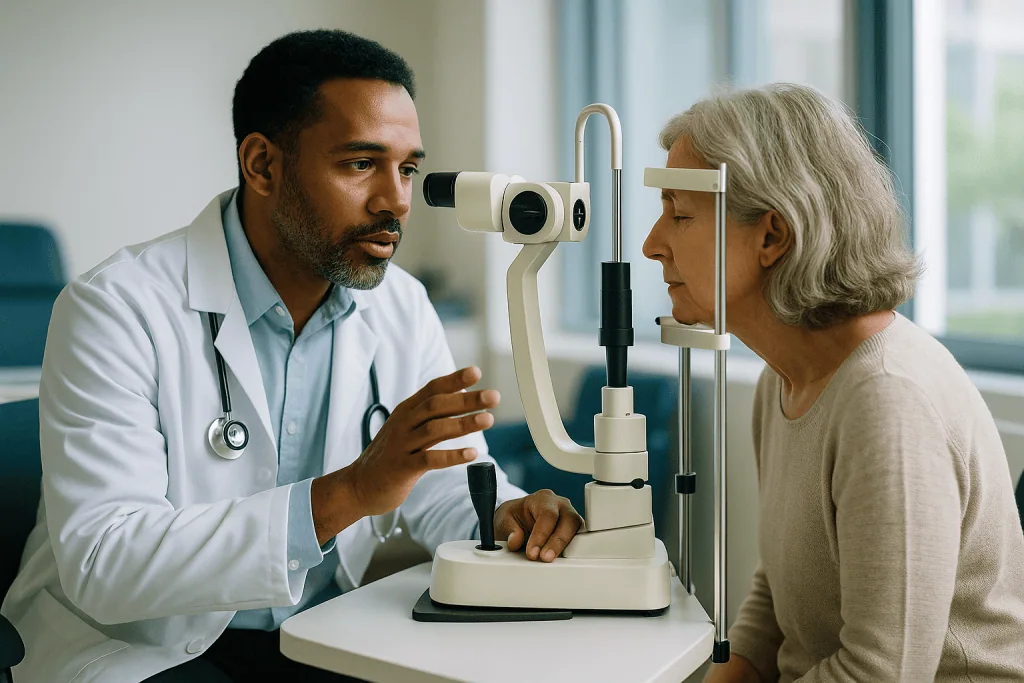
Raised pressure squeezes the optic nerve, the cable of more than a million fibers that carries images from the retina to the brain. Fibers that die do not grow back. Every glaucoma treatment, from the first drop to the most involved surgery, shares a single mechanism: lower the pressure so that fewer fibers are lost each year.
There are only two ways to do that. Reduce how much fluid the eye produces, or improve how well it drains. Some medicines do one, some the other, and some plans combine both. Laser procedures generally open up drainage. Surgery creates a new drainage route when the natural one cannot be made to work well enough.
One detail surprises many people. Glaucoma can occur at pressures inside the so-called normal range, a form sometimes called normal-tension glaucoma. In these eyes the nerve appears unusually vulnerable, yet lowering pressure further still slows the damage, which is why treatment is offered even when the reading looks unremarkable.
The corollary matters just as much: treatment protects what remains. Vision already lost to glaucoma does not return, as the NHS and Mayo Clinic both make clear. The plan is measured by what does not happen over the coming decades, which is a strange thing to be grateful for and the whole point of the follow-up schedule.
Who is usually treated straight away, and who is asked to wait and watch
Not everyone with a high reading starts treatment. Some people have raised pressure but a healthy-looking nerve and full visual field; clinicians call this ocular hypertension. Others have a nerve that looks slightly suspicious on a scan, with pressure that is fine; they may be labeled a glaucoma suspect. In both situations the team may propose monitoring rather than medication, repeating tests over months to see whether anything changes.
Watching is an active decision, not neglect. Starting lifelong drops for an eye that may never develop damage brings side effects and cost in time and attention without clear benefit. The Mayo Clinic notes that the doctor weighs the risk of damage against the burden of treatment, and that some people with raised pressure are simply followed closely.
Treatment usually begins promptly when the picture is clearer: visible nerve damage on examination or imaging, matching gaps on the visual field test, or pressure high enough that damage seems likely regardless. Advanced disease at diagnosis tends to earn a lower target and a more assertive plan, because there is less nerve left to spare.
Angle-closure glaucoma sits in a category of its own. Here the drainage angle is physically narrowed or blocked, and an acute attack can raise pressure sharply within hours. The NHS lists this among conditions needing urgent care, and even eyes with narrow angles that have not yet closed may be offered a laser procedure to prevent an attack.
If you have been asked to wait, a fair question is: “What result at the next visit would tip you toward treatment?” If you have been started straight away, the mirror image applies: “What would need to be true for us to step down?” Both answers reveal the threshold your clinician is working to.
How often do you need glaucoma follow-up appointments?
The follow-up interval on your plan is a statement about uncertainty. Shorter gaps mean your team wants to see the effect of a change quickly or is worried about the pace of loss. Longer gaps mean the picture has been stable long enough to trust.

Intervals tend to follow a pattern. After a diagnosis, a new medicine or a procedure, visits cluster more closely so the team can confirm the pressure has actually dropped and that side effects are tolerable. The Mayo Clinic notes that it may take several attempts to find the right medicine or combination, and each adjustment restarts the clock. Once pressure sits at target and scans repeat without change, the spacing widens. Glaucoma follow-up is lifelong, as the NHS emphasizes, because the disease can drift years after it appeared controlled.
A few factors pull the interval shorter regardless of how well things seem to be going: advanced damage already present, a target that has been hard to reach, only one functioning eye, or a visual field that has changed since last time. Pregnancy, new medical conditions and starting steroid treatment for another problem can also prompt an earlier review, since steroids in any form can raise eye pressure.
It helps to know what each visit is for. Some appointments measure pressure only; others include imaging and visual field testing, which take longer and are scheduled less often. Ask which tests the next visit will include so you can plan the time.
If a visit is postponed, ask whether the gap is safe or whether pressure should be checked in the meantime. And if you notice anything new between appointments, the schedule is not a reason to wait; it is a floor, not a ceiling.
The tests at each visit and what the numbers mean
A glaucoma appointment can feel like a series of small puzzles. Each test answers a different question.
Tonometry measures eye pressure, either with a gentle puff of air or a tiny probe that touches the numbed cornea. Because pressure varies through the day, a single reading is a snapshot; your clinician looks at the trend across visits rather than one figure.
Pachymetry measures corneal thickness. A thin cornea can make the tonometer underestimate pressure and is itself linked to higher risk, so this number helps your team interpret every pressure reading that follows.
Gonioscopy uses a special lens to look at the drainage angle and classify glaucoma as open-angle or angle-closure. That classification shapes the whole treatment path, so it is worth asking which type you have.
Optical coherence tomography, usually shortened to OCT, is a scan that measures the thickness of the nerve fiber layer at the back of the eye in microns. Thinning over time is one of the earliest signs of progression, often visible before you notice anything.
The visual field test, sometimes called perimetry, maps what you can see while staring at a central point and pressing a button when lights appear. The printout shows shaded areas where sensitivity is reduced. Two summary numbers usually appear: one describing overall sensitivity compared with people your age, another describing how patchy the loss is. Results vary with fatigue and attention, which is why clinicians rely on several tests before declaring a change real.
The Mayo Clinic and MedlinePlus both describe this combination as the standard workup. A useful question: “Which of these tests changed since last time, and by how much?” Stability across all of them is the quiet good news the plan is designed to deliver.
What are the side effects of glaucoma eye drops, and which ones matter?
Drops are usually the first line of glaucoma treatment, and they work by the two mechanisms already described. Prostaglandin analogues increase fluid outflow. Beta blockers, alpha agonists and carbonic anhydrase inhibitors mainly reduce fluid production. Rho kinase inhibitors improve drainage through the natural pathway. Miotic drops narrow the pupil and open the angle. Which class you are on, and why, is a reasonable question for any visit.
Side effects tend to sort into two groups. Local effects, listed by the Mayo Clinic, include stinging, redness, blurred vision for a few minutes, darkening of the iris or eyelid skin, and longer or thicker eyelashes with prostaglandin drops. These are usually nuisance-level, though iris color change is permanent and worth knowing about in advance.
Systemic effects are the ones to watch. Drops drain through the tear duct into the nose and throat, where they enter the bloodstream. Beta blocker drops can slow the heart rate, lower blood pressure, worsen asthma or cause fatigue and low mood. Alpha agonists can bring dry mouth and drowsiness. Carbonic anhydrase inhibitors may leave a metallic taste. Tell the prescriber about lung, heart or kidney conditions before starting, and tell your other doctors what eye drops you use.
Technique reduces both groups. The Mayo Clinic advises closing the eye for one to two minutes after each drop and pressing gently on the inner corner, near the nose, so less medicine drains away; and waiting at least five minutes between different drops so the second does not wash out the first.
If a side effect is troubling, do not stop on your own. Pressure can climb quickly without protection. Call and describe the problem; there is usually another class to try, and the decision belongs with the prescribing clinician.
Laser and surgery: where each option sits in a glaucoma plan
Procedures are not a sign that something went wrong. They are additional tools for the same goal, and some clinicians offer laser treatment early, alongside or instead of drops, particularly for people who struggle with daily medication. The NHS describes laser and surgery as options when drops are unsuitable or insufficient, and increasingly as a first-line choice in some open-angle cases.
| Approach | What it does | Usual place in the plan | Worth asking |
|---|---|---|---|
| Laser trabeculoplasty | Treats the drainage meshwork so fluid leaves more easily | Early option or add-on in open-angle glaucoma; effect may fade over years and can be repeated in some cases | How will we know it worked, and when is pressure rechecked? |
| Laser iridotomy | Makes a tiny opening in the iris so fluid can reach the angle | Narrow or closed angles, to prevent or relieve an attack | Does this replace drops or run alongside them? |
| Minimally invasive glaucoma surgery (MIGS) | Small implants or channels that boost natural drainage | Mild to moderate disease, often combined with cataract surgery | What pressure reduction is realistic for my eye? |
| Trabeculectomy | Creates a new drainage flap under the eyelid | Moderate to advanced disease when other steps are insufficient | What does recovery involve and how many visits? |
| Tube shunt | A small drainage device routes fluid to a reservoir under the conjunctiva | Complex or previously operated eyes | What are the specific risks in my case? |
Every procedure carries risks: pressure that drops too low or not enough, inflammation, bleeding, infection, cataract progression and the need for further surgery. The Mayo Clinic lists these in neutral terms, and your surgeon should, too, with numbers that apply to eyes like yours rather than averages. Ask what the alternative is if you choose not to proceed, and what happens to the follow-up interval afterward. The choice, and its timing, rests with you and the treating team together.
What the first weeks after a treatment change usually look like
Whether the change is a new drop, a laser session or an operation, the weeks that follow have a rhythm.
The first task is confirming the pressure moved. Most drops begin lowering pressure within hours to days, but the clinician needs a reading taken when the medicine has reached a steady effect, so a recheck is typically scheduled in the following weeks rather than the following day. After laser trabeculoplasty the effect builds gradually, and the team usually waits several weeks before judging it, which is why the plan may say “review pressure” with no other test.
The second task is watching for side effects. Local irritation from drops often eases as the eye adapts; if it does not, or if breathing, heart rate or mood changes appear, that is a call, not a wait. After surgery, expect a schedule of close visits: the surgeon adjusts stitches, medications or drainage in the early period to keep pressure within range while the eye heals. Blurred vision, mild ache and a red, watery eye are common early; worsening pain or sudden vision loss are not, and belong in the red-flag list later in this article.
The third task is habit. New drops are easy to forget. Linking them to something fixed, such as brushing teeth or a phone alarm, helps, and so does telling the clinician honestly how many you missed. Pressure measured after a week of skipped drops tells the team nothing useful about the medicine.
Keep a short log: date, which eye, any symptoms. Bring it. Over a few visits the log and the pressure readings together show whether the change earned its place in the plan.
Can you lower eye pressure naturally? What the evidence actually shows
People search this question more than almost any other about glaucoma, usually hoping to avoid drops. The honest answer has two parts: some everyday habits nudge pressure, and none of them replaces treatment.
The Mayo Clinic’s lifestyle guidance is the most concrete mainstream source. Regular moderate exercise, such as brisk walking, may lower pressure in open-angle glaucoma; the effect is modest and fades if the exercise stops. Positions that place the head below the heart, including some inverted yoga poses, temporarily raise pressure and are best discussed with your clinician. Drinking large volumes of fluid quickly, around a quart in a short time, can transiently raise pressure, so spreading fluids through the day is sensible. Sleeping with the head raised about 20 degrees has been shown to lower nighttime pressure in some studies. Limiting large amounts of caffeine is also mentioned.
Notice the words: modest, temporary, some studies. These are reasonable habits, not a treatment plan.
Supplements are a separate matter. Products marketed for eye pressure, including various herbal extracts and vitamins, lack evidence from well-designed trials that they slow glaucoma damage, and the Mayo Clinic states plainly that herbal remedies are not a substitute for proven treatment. Some interact with prescribed medicines. If you take any, list them for your team.
A more useful framing is protective rather than curative language: what can I do so the prescribed treatment works as well as possible? Take drops consistently, use good technique, keep appointments, manage blood pressure and diabetes with your other doctors, and do not smoke. Those are the natural measures with the strongest support, and they cost nothing but attention.
Precautions worth taking when you live with glaucoma
Most of daily life carries on unchanged, but a handful of precautions genuinely matter.
Tell every clinician you have glaucoma. Corticosteroids in any form, whether eye drops, inhalers, creams, tablets or injections, can raise eye pressure in susceptible people, and a prescriber who knows can monitor or choose alternatives. If you have narrow angles, some medicines used for allergies, colds, bladder problems or depression can widen the pupil and precipitate closure; your ophthalmologist can tell you whether this applies to you.
Carry a current list of your eye drops. Emergency departments, anesthetists and pharmacists need it, and so does the eye clinic when you are seen by someone new.
Driving depends on vision standards set by your licensing authority, which usually look at the visual field across both eyes together. The NHS notes that people with glaucoma may need to inform the driving authority and that many continue to drive safely. Ask your clinician directly whether your field results meet the standard, and repeat the question if a test shows change.
Protect the eyes physically. Blunt injury can raise pressure or complicate a previously operated eye; wraparound glasses for racket sports and yard work are a small habit with a clear payoff.
Family members matter, too. The NHS points out that first-degree relatives of someone with glaucoma have a higher risk and should have regular eye examinations from around age 40, and earlier if advised. Telling siblings and adult children is one of the most protective things a person with glaucoma can do.
Finally, keep the follow-up. Missed appointments are the most common way a controlled eye quietly becomes an uncontrolled one, because there is no symptom to bring you back.
What is the outlook for glaucoma with treatment?
The question people most want answered is the one clinicians are most careful about, and for good reason. The outlook depends on how much nerve was already lost at diagnosis, how quickly it is being lost, how well pressure can be held at target and for how many years, and how consistently the plan is followed.
What mainstream guidance does say is encouraging in its shape, if not in exact numbers. The NHS states that if glaucoma is diagnosed and treated early, further damage can usually be prevented or slowed enough that vision is preserved for life. The National Eye Institute describes treatment as protecting remaining sight and notes that most people who follow their treatment plan keep useful vision.
Two facts sit alongside that. Vision already lost does not come back, so the outlook is about holding a line rather than regaining ground. And glaucoma is a slow disease in most people; the aim is that the rate of loss stays slower than the rate of aging, so the nerve outlasts the person who owns it.
This is why your clinician will resist promising a percentage. Trial figures describe groups with particular pressures, ages and stages, not one eye. A more answerable version of the question is: “Based on my scans so far, how fast is my glaucoma changing, and is that pace one you would expect to affect my daily vision in my lifetime?” Many people are relieved by the answer. Those who are not get a clearer idea of why the plan is as intensive as it is.
Either way, the trend on your OCT and visual field over the next few visits will tell you more than any general statistic could.
What people often get wrong about glaucoma treatment
“My eyes feel fine, so the drops must be working.” Open-angle glaucoma has no symptoms until late, and drops do not change how the eye feels. Only measurement tells you anything; comfort is not information.
“My pressure was normal, so I can’t have glaucoma.” Damage occurs at normal pressures in a meaningful share of people, which is why the nerve and field are examined regardless of the reading, as MedlinePlus notes.
“The treatment will bring my vision back.” It will not. Lost fibers stay lost. Treatment is measured in what stays the same, which is the harder thing to appreciate and the reason follow-up feels uneventful when it is going well.
“Being sent for laser or surgery means the drops failed and things are bad.” Procedures are tools, not verdicts. Some clinicians offer laser first; some people prefer a procedure to a lifetime of daily drops. The stage of disease, not the type of treatment, describes how serious things are.
“Once pressure hit target, I’m done.” Pressure drifts, medicines lose effect, lasers wear off and eyes change. Follow-up is lifelong precisely because a good reading today says little about five years from now.
“Reading, screens or eye strain caused this.” Glaucoma is driven by pressure, anatomy, age, family history and vascular factors. Screen time may tire the eyes, but it does not raise pressure or damage the nerve.
“I can skip drops when I run low and catch up later.” Pressure rises within a day or two of stopping many drops; there is no catching up. A gap in supply is a phone call to the clinic or pharmacy, not a pause.
Correcting these ideas is worth doing out loud with your clinician, because each one shapes whether the plan actually gets followed.
Questions to ask about glaucoma treatment at your next visit
Bring these on paper or on your phone. Not every question fits every visit; choose the ones that match where you are in the plan.
About the diagnosis
- Which type of glaucoma do I have, open-angle or angle-closure, and does the other eye show signs?
- How much damage is there already, and is it mild, moderate or advanced?
About the target
- What is my target pressure and why that number?
- What would make you lower or relax it?
- Is my pressure being read reliably, given my corneal thickness?
About treatment
- Which class of medicine am I on, and what is it doing inside the eye?
- Which side effects should I expect, which mean I should call, and what alternatives exist?
- Are laser or surgical options relevant to me now, later, or not at all, and what are the risks in my case?
- What happens if I miss a dose, run out or lose the bottle while traveling?
About follow-up
- How often will I be seen, which tests happen at each visit, and how will you decide when to change the interval?
- Which results changed since last time, and by how much?
- How fast does my glaucoma appear to be progressing?
About daily life
- Do my visual fields meet the driving standard?
- Which of my other medicines or health conditions affect my eye pressure?
- Should my relatives be screened, and from what age?
End with the question that saves the most trouble: “Who do I call, and how, if something changes between visits?” Write the answer next to your target pressure. Together those two lines are the heart of the plan.
When to call your doctor
Glaucoma is usually slow, which makes the fast exceptions easy to miss. Treat the following as reasons for same-day contact with your eye team, or emergency care if you cannot reach them.
An acute angle-closure attack, described by the NHS and Mayo Clinic, typically brings sudden severe pain in one eye, a headache on the same side, a red eye, blurred vision, rainbow-colored halos around lights, and often nausea or vomiting. Pressure can rise sharply within hours and threaten the nerve quickly. This is an emergency at any hour.
After surgery or laser, call promptly for pain that increases rather than settles, a sudden drop in vision, thick discharge, a rapidly reddening eye, or a sensation that the eye is unusually soft or hard. Post-operative infection is uncommon but moves fast, and early treatment matters.
With eye drops, seek help urgently for wheezing or breathlessness, a very slow or irregular pulse, fainting, or swelling of the face or lips. Call within a day or two for persistent stinging, itchy swollen eyelids, or any symptom that makes you tempted to stop; the prescriber can switch classes, and stopping without cover lets pressure climb.
Between visits, report any new dark or missing patch in your vision, sudden flashes or a shower of floaters, or a curtain across part of the field. These are not typical of glaucoma progression, which is gradual, and may point to a separate retinal problem that needs its own urgent assessment.
And if a routine appointment has been delayed or missed, ring rather than wait. The plan works only when the measurements keep coming. Every decision about what to change, and when, belongs with the team who knows your eye.
Frequently asked questions
How is a glaucoma target eye pressure chosen?
It is set individually, below the pressure at which your optic nerve appears to have been damaged. Clinicians weigh how advanced the damage is, how quickly it is progressing, your age, corneal thickness and family history. Eyes with more damage usually receive lower targets. The number is revised if scans keep changing at the current target or if it proves stable for years.
How often should glaucoma follow-up appointments happen?
It depends on how stable your eye is. Visits are closer together after diagnosis or any change in treatment so the team can confirm pressure has dropped and side effects are tolerable, and further apart once pressure, nerve imaging and visual fields have held steady across several checks. Follow-up is lifelong; ask your clinician what interval applies to you and why.
What are the most common side effects of glaucoma eye drops?
Local effects such as stinging, redness, brief blurring, darker eyelid skin, longer lashes and, with prostaglandin drops, permanent iris darkening are the most common. Less often, drops absorbed through the tear duct can affect breathing, heart rate, blood pressure or energy, especially beta blocker types. Report troubling effects rather than stopping; another class can usually be tried by the prescriber.
Can you lower eye pressure naturally without drops?
Some habits nudge pressure modestly: regular moderate exercise, avoiding head-down positions, spreading fluid intake through the day, limiting large amounts of caffeine and sleeping with the head slightly raised. The effects are small and temporary, and no lifestyle change or supplement has been shown to replace prescribed treatment. Discuss any changes with your eye care team rather than swapping them for drops.
What is the prognosis for glaucoma with treatment?
For most people diagnosed before advanced damage and treated consistently, further loss can be slowed enough to preserve useful vision for life, according to the NHS and National Eye Institute. Vision already lost does not return. Your own outlook depends on stage at diagnosis, how well pressure is held at target and how reliably follow-up continues, so ask your clinician about your specific rate of change.
What precautions should I take if I have glaucoma?
Tell every clinician about your diagnosis, because steroids and some other medicines can raise eye pressure. Carry a list of your eye drops, use protective eyewear for sports and yard work, keep every follow-up appointment even when the eye feels fine, and ask whether your visual fields meet driving standards. Encourage close relatives to have regular eye examinations, since risk runs in families.
Does being referred for laser or surgery mean my glaucoma is severe?
Not necessarily. Laser treatment is offered early in some open-angle cases, sometimes before or instead of drops, and minimally invasive procedures are often combined with cataract surgery for mild to moderate disease. Trabeculectomy and tube shunts are more often reserved for eyes where other steps have not held pressure at target. The stage of nerve damage, not the type of treatment, describes severity.
Why does my clinician repeat the visual field test before changing treatment?
Visual field results vary with fatigue, attention and learning the test, so a single worse result may not reflect real change. Clinicians usually look for the same pattern of loss to repeat across two or more tests, alongside optic nerve imaging, before concluding the disease has progressed. This avoids intensifying treatment on the basis of a bad day at the machine.
What happens if I miss my glaucoma eye drops for a few days?
Pressure typically rises within a day or two of stopping most drops, and there is no way to catch up on missed doses. Restart as prescribed at the next scheduled time, tell your clinician how many doses were missed so pressure readings are interpreted correctly, and call the clinic or pharmacy promptly if you have run out. Never double up without advice.
Which glaucoma symptoms need emergency care?
Sudden severe pain in one eye with headache, redness, blurred vision, halos around lights and nausea or vomiting suggests acute angle-closure glaucoma and needs same-day emergency care. After surgery, worsening pain, sudden vision loss or discharge also require urgent contact. Wheezing, a very slow pulse or fainting after using drops should be treated as urgent as well.
References
This article is for general information only and is not a substitute for professional medical advice. Please consult a qualified doctor about your individual situation.

More from the Blog

When Do Glaucoma Drops Give Way to Laser or Surgery? How Treatment Usually Escalates
Glaucoma drops usually give way to laser or surgery when eye pressure stays above the target the eye specialist has set, when visual-field or…

Questions to Ask Your Retina Specialist About Macular Degeneration Injections and Follow-Up
Before macular degeneration injections begin, ask your retina specialist what type and stage of AMD you have, which scans confirmed it, how the anti-VEGF…
Steroid Injection vs Surgical Removal for a Chalazion: How Doctors Weigh the Two
For a chalazion that has not settled with warm compresses, doctors usually choose between a corticosteroid injection into the lump and surgical drainage under…

Before Your Conjunctivitis Appointment: Lenses Out, Makeup Off and Which Details to Bring
Before a conjunctivitis appointment, take out contact lenses and switch to glasses, skip eye makeup so the examiner can judge redness, lid margins and…
Will You Be Awake During Eye Surgery? Drops, Blocks, Sedation and General Anesthesia
Most adults are awake for eye surgery. Cataract, glaucoma and many laser procedures are usually done with numbing drops or a local anesthetic injection…
Does a Robot Operate on Your Eye Alone? Robotic Ophthalmology Myths, Put Right
No. Today, no robot performs eye surgery on its own. In every approved procedure, a trained ophthalmologist makes the decisions and controls the instruments.…