

Robotic vs Conventional Eye Surgery: Where Computer Assistance Helps and Where It Does Not

Key Takeaways
- In laser-assisted cataract surgery a computer-guided laser makes the corneal incisions, the capsule opening and lens fragmentation; the surgeon still removes the lens and implants the artificial one by hand.
- A Cochrane review of randomized trials found no clear difference in visual outcomes or complication rates between femtosecond laser-assisted and conventional cataract surgery, with the evidence graded low quality.
- The NHS estimates a serious complication in around 1 in 50 cataract operations and permanent sight loss in around 1 in 1,000, figures that apply to the operation as a whole rather than to one method.
- Corneal scarring, a pupil that will not widen, deep-set eyes and difficulty lying still are common reasons an eye is steered toward the conventional method instead of laser docking.
- True robotic eye surgery, where a motorized instrument filters hand tremor, is being studied mainly for retinal membrane peeling and sub-retinal injections and is not a routine menu option.
- Recovery is the same for both cataract methods: blurry vision for a few days, drops for several weeks as directed, and full healing over roughly 4 to 8 weeks according to the NHS and Mayo Clinic.
Robotic and laser-assisted eye surgery hand certain cutting and measuring steps to a computer-guided device, while the surgeon still plans and completes the operation. For cataracts, randomized trials pooled in a Cochrane review found no clear difference in vision or complication rates between laser-assisted and conventional surgery. Computer assistance is most useful for precision and repeatability; it does not replace surgical judgment, and true robotic eye surgery remains largely investigational.
The consent form has an extra line on it. Under the operation she expected, cataract surgery on the left eye, there is a second option with a box to tick: laser-assisted. The nurse says it is entirely her choice. Her daughter, reading over her shoulder, has already typed robotic vs manual eye surgery into her phone and is scrolling through a dozen confident headlines that disagree with one another.
That small moment plays out in clinic corridors every day. People are asked to choose between a method they can picture, a surgeon with steady hands and a microscope, and one that sounds like the future. What rarely gets explained is what the machine actually does, which steps it takes over, which it leaves alone, and whether any of it shows up in how well you see afterward.
This explainer walks through that honestly. Some of the technology is genuinely clever. Some of it is clever in ways that have not yet translated into better outcomes for patients. Knowing the difference is what lets you ask a good question and hear a straight answer.
What does robotic vs manual eye surgery actually mean?
Start with a correction to the vocabulary, because the labels do most of the misleading. Manual eye surgery does not mean old-fashioned. Modern cataract surgery is performed under a high-powered microscope with a handheld ultrasound probe, tiny self-sealing incisions and a folding artificial lens. The word manual simply means the surgeon’s hands guide every instrument in real time.
Robotic, as it is used in advertising and in everyday conversation, covers three quite different things. The first, and by far the most common, is femtosecond laser-assisted cataract surgery. A femtosecond laser fires pulses so brief that they separate tissue by forming microscopic bubbles rather than by heat, and a computer aims those pulses using a live scan of your eye. The second is image guidance: software that measures the eye and projects alignment marks into the surgeon’s microscope view. The third is true robotics, where a motorized instrument holder moves a needle or forceps inside the eye while the surgeon steers it from a controller. That last category is real, but it lives mostly in research studies of retinal surgery, not in routine cataract operating rooms.
One thing unites all three. No device operates the eye on its own. The surgeon decides what to do, confirms every plan on screen, sits at the microscope and finishes the operation by hand. When someone asks whether the robot or the surgeon does the surgery, the accurate answer is that the surgeon does, with a tool that performs a few steps more consistently than a hand can. Keeping that picture in mind makes every comparison that follows easier to judge.
How conventional cataract surgery works, step by step
A cataract is the eye’s natural lens turning cloudy. Surgery replaces that lens with a clear artificial one, and the conventional method used worldwide is called phacoemulsification, which means breaking the lens up with ultrasound and vacuuming the pieces out.
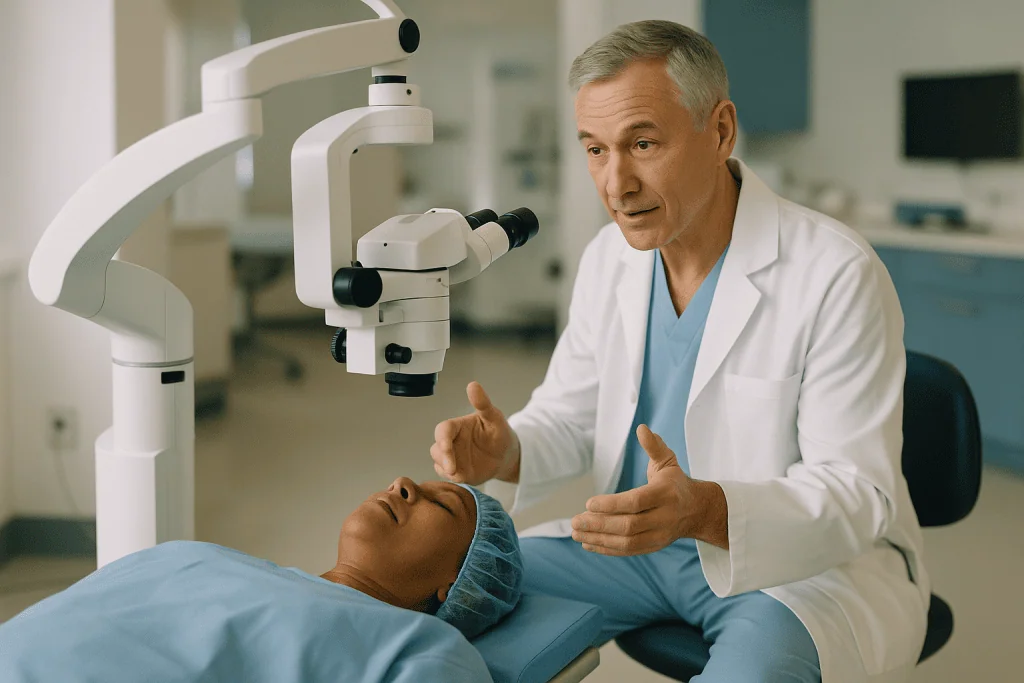
Here is what happens on the day. Drops numb the surface and widen the pupil; most people stay awake and see light and movement but not detail. Through an incision at the edge of the cornea, the clear front window of the eye, the surgeon opens a circular hole in the thin capsule that wraps the lens. That opening, called a capsulotomy, is made by hand with fine forceps and is one of the most skill-dependent moments of the whole procedure. Next the ultrasound probe enters, breaks the cloudy lens into fragments and draws them out. The capsule is left in place as a hammock, and a folded artificial lens, the intraocular lens, is slid through the same small incision where it unfolds into position. The incision usually seals itself without stitches.
According to the NHS, the operation typically takes 30 to 45 minutes and is done as a day case, meaning you go home the same day. Mayo Clinic describes the same outpatient pattern, with one eye treated at a time and the second eye scheduled once the first has settled.
Everything above is what the word manual refers to. The surgeon controls the incision, the capsulotomy, the ultrasound energy and the lens placement, adjusting continuously to what the eye does. Laser and robotic systems do not change the goal of this operation. They change who, or what, performs two or three of these steps.
What actually happens when a computer assists
In laser-assisted cataract surgery the day begins slightly differently. You lie beneath the laser unit and a soft suction ring, sometimes called a docking interface, gently holds the eye still and couples it to the machine. A built-in scanner maps the cornea, the lens and the capsule in three dimensions. The surgeon reviews that map on a screen, adjusts the planned cuts and confirms them.
The laser then does three jobs in a matter of seconds. It makes the corneal incisions, it cuts the circular capsulotomy to the planned size and position, and it scores the cloudy lens into segments so it softens and breaks apart more readily. The ring is released and the operation moves to the microscope, either in the same room or next door. From that point on it is conventional surgery: the surgeon lifts the pre-cut capsule, uses the ultrasound probe to remove the lens pieces and places the artificial lens by hand. Laser-assisted, in other words, means laser-started.
Image guidance works at the microscope itself. Software matches a photograph of your eye taken before surgery to the live view and overlays a line showing where a toric lens, one designed to correct astigmatism, should be rotated. It replaces ink marks drawn on the eye with a digital reference.
True robotic systems are different in kind. The surgeon operates a controller and the robot moves the instrument inside the eye, filtering the natural tremor of a human hand and scaling large hand movements into very small tip movements. That property matters enormously in the retina, where target layers are thinner than a sheet of paper, which is why most robotic eye surgery research sits there rather than at the front of the eye.
Robotic vs manual eye surgery: what the trials show for cataracts
People searching for the most successful type of cataract surgery deserve a plain answer: for a routine cataract, laser-assisted and conventional phacoemulsification have not been shown to produce different vision. That is the finding of a Cochrane systematic review, the most rigorous type of evidence summary, which pooled randomized trials comparing the two methods. Reviewers reported no clear difference in visual outcomes or in complication rates, and they graded the overall quality of the evidence as low, largely because trials were small and short.
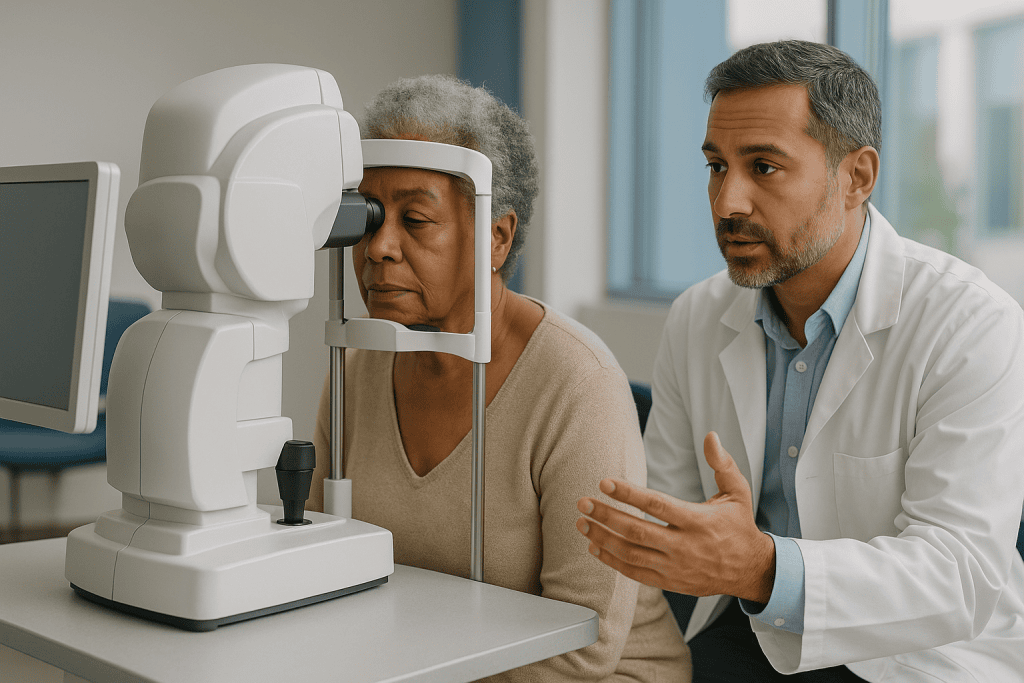
Laboratory-style measurements did differ in some studies. Laser capsulotomies were more consistently round and centered, and some trials recorded less ultrasound energy used to remove the lens. Those are reasonable things to want. The honest position is that they have not translated into a measurable improvement in what patients can read on the eye chart or in how many eyes run into trouble.
Fully robotic cataract surgery, where a motorized system performs the intraocular steps, has no comparable body of randomized evidence in routine care. Claims that it is better than either standard approach are, at present, claims rather than findings.
So what does predict a good result? The health of the rest of the eye, especially the retina and the optic nerve, the accuracy of the measurements used to choose the artificial lens power, the surgeon’s experience with the method they are using, and how promptly any complication is recognized. Those factors dwarf the difference between a hand-cut and a laser-cut capsule. The NIH’s National Eye Institute describes cataract surgery as one of the most common and safest operations performed, and that description applies to the conventional method the evidence was built on.
Where computer assistance genuinely helps
Skepticism about marketing should not tip into dismissing the engineering, because there are places where a computer-guided instrument does something a hand cannot.
Repeatability is the clearest. A laser capsulotomy is the same diameter and the same shape every time, centered on a scan rather than on a surgeon’s estimate. Certain artificial lenses, particularly multifocal designs that split light into near and distance focus, are thought to be more sensitive to sitting slightly off-center, so a predictable capsule opening is a plausible advantage in those specific cases even if trials have not yet proven it.
Energy is another. Pre-softening a dense, hard cataract with the laser can reduce the ultrasound time needed to remove it, and ultrasound energy is what stresses the delicate cells lining the inside of the cornea. Whether that reduction protects the cornea in a way a patient would notice remains under study, but the mechanism is sound.
Alignment matters for astigmatism. When a toric lens must be rotated to within a few degrees of a target axis, an image-guided overlay gives the surgeon a steadier reference than an ink dot that can smudge.
In the retina, the case is stronger still. The natural tremor in even a highly trained hand is on the same scale as the membranes surgeons peel from the retinal surface. A robot that filters tremor and scales motion lets an instrument hold perfectly still against the retina for far longer than a human can, which is exactly what is needed when injecting a treatment beneath the retina or lifting a membrane without tearing it. That is not marketing. It is why early human trials of robotic retinal surgery were designed in the first place.
Where it does not help, and why the surgeon still matters most
Now the other side of the ledger, which matters more for the person holding the consent form.
A laser cannot choose your lens. The single decision with the largest effect on how you see after cataract surgery is the power and type of artificial lens, and that rests on measurements taken before the day and on a conversation about what you want from your vision. No amount of cutting precision compensates for a lens that leaves you more shortsighted than expected.
A laser cannot manage the unexpected. If the capsule tears, if the pupil shrinks, if lens material slips backward, the response is entirely human, moment to moment, under the microscope. Surgeons who are adept at handling those events are what protects eyes, and that skill is unrelated to whether a laser was used ten minutes earlier.
A laser adds steps. Docking, scanning and planning lengthen the total time, and the laser’s effect on the iris can cause the pupil to constrict before the surgeon begins the hand-performed part, which makes that part harder rather than easier for some eyes. Early series also described small tags or irregularities at the edge of laser capsulotomies. Techniques have improved, but the point stands: a new tool brings its own learning curve.
Above all, computer assistance has not been shown to change the outcomes patients care about in routine cataract surgery. That is not a failure of the technology so much as a reflection of how good the conventional operation already is. When a procedure already restores clear vision in the great majority of otherwise healthy eyes, there is little room left for a device to improve on, and any small gain is hard to detect.
Laser cataract surgery vs traditional: a side-by-side summary
The table below compares the two established cataract methods and, for context, the truly robotic systems being studied in retinal surgery. It is a summary of what each approach involves, not a scorecard; the evidence section above explains why no column wins.
| Feature | Conventional phacoemulsification | Femtosecond laser-assisted | Robot-assisted (retina, research) |
|---|---|---|---|
| Who performs the cuts | Surgeon by hand | Computer-aimed laser for incisions and capsulotomy; surgeon completes the rest | Surgeon steers a motorized instrument |
| Lens removal | Ultrasound probe by hand | Laser pre-softens; ultrasound probe by hand | Not applicable |
| Artificial lens placement | Surgeon by hand | Surgeon by hand | Not applicable |
| Visual outcome in trials | Established standard | No clear difference from conventional in a Cochrane review | Early human studies; no comparative trials in routine care |
| Complication rate in trials | Established standard | No clear difference from conventional | Under study |
| Extra steps for the patient | None | Suction docking and scan before surgery | Longer setup, general anesthesia often used |
| Eyes that may not suit it | Very few | Corneal scarring, small pupils, difficulty lying still or docking | Determined within study protocols |
| Availability | Widespread | Selected centers; often an added charge | Research centers only |
Two lessons sit in this table. First, the middle column shares almost every row with the first, because the operation is fundamentally the same with a different opening act. Second, the final column belongs to a different conversation altogether. If a retinal surgeon ever raises robotic assistance with you, it will be in the context of a clinical study with its own consent process, not as a menu option.
Who is usually offered computer assistance, and who is asked to wait
Cataract surgery itself is generally offered when cloudiness interferes with daily life, reading, driving, recognizing faces, rather than at any fixed level on the eye chart. The NHS makes that point plainly: the operation is recommended when the cataract affects what you can do, and mild cataracts that are not troubling you can simply be monitored. The choice between methods only arises once surgery is on the table.
Surgeons who use laser assistance tend to suggest it in a few situations. People choosing a toric or multifocal artificial lens, where alignment and centration are thought to matter more. Eyes with very dense cataracts, where laser pre-softening may reduce ultrasound time. Occasionally, eyes with weakened support fibers around the lens, where a controlled capsulotomy is attractive. These are reasoned preferences, and it is fair to ask your surgeon which of them applies to you and what evidence backs it.
Some eyes are usually steered toward the conventional method instead. Laser light has to reach the lens, so a scarred or cloudy cornea can block it. A pupil that does not widen well leaves too little room for the laser to work safely. Deep-set eyes, narrow eyelid openings or previous eye surgery can make docking difficult. People who cannot lie flat, keep still for the scan or tolerate the suction ring, whether because of anxiety, tremor, neck problems or breathing difficulty, are often better served by the shorter conventional workflow. Certain glaucoma situations also prompt caution, because suction briefly raises pressure inside the eye.
None of these is a judgment about you. They are anatomical and practical fits, and the treating team weighs them alongside your own priorities before recommending one path.
What is the downside of robotic surgery for the eye?
Every added machine adds something to go wrong, and honest counseling names those things.
Docking is the first. The suction ring that steadies the eye causes a temporary rise in eye pressure and can leave a red patch on the white of the eye from small burst blood vessels. Both are usually harmless and short-lived, but they are new experiences that conventional surgery does not include. Laser energy near the iris can trigger the pupil to shrink, and a small pupil makes the hand-performed stage of surgery more demanding. Total time in the surgical suite is longer, because the laser stage precedes rather than replaces the microscope stage.
Access is another. Laser platforms are not available everywhere, and in many settings the laser stage is an added charge that routine insurance may not cover. This article deliberately gives no figures, but you should expect to ask.
For true robotic systems, the downsides are those of any early technology: bulky equipment, longer setup, loss of the tactile feel a surgeon has through their own fingers, and a thin evidence base. Those are reasons such systems remain in trials.
Then there are the risks that no method removes. The NHS estimates the risk of a serious complication from cataract surgery at around 1 in 50 cases, most of which can be treated with medicine or further surgery, and a very small risk, around 1 in 1,000, of permanent loss of sight in the treated eye. Cleveland Clinic and MedlinePlus list the same core complications: infection, bleeding, swelling of the retina or cornea, retinal detachment and a later clouding of the capsule behind the artificial lens called posterior capsule opacification, the most common of them and treatable with an outpatient laser procedure. Those figures describe cataract surgery as a whole; trials have not shown that laser assistance moves them.
Beyond cataracts: robotic retinal surgery and laser vision correction
Two other corners of eye surgery show what computer assistance looks like when it is either indispensable or genuinely new.
Laser vision correction is the case where the computer has been standard for decades. Procedures that reshape the cornea to reduce the need for glasses use an excimer laser, a computer-controlled ultraviolet laser that removes tissue a fraction of a hair’s width at a time according to a map of your prescription. Nobody markets this as robotic because there is no manual alternative; a surgeon could not sculpt a cornea by hand to that tolerance. Femtosecond lasers create the corneal flap in many of these procedures for the same reason. Here the honest comparison is not machine versus hand but one laser platform versus another, and differences are small.
Retinal surgery is the opposite: hands have always done it, and robots are the newcomer. The retina is the light-sensing lining at the back of the eye, and some of its diseases are treated by peeling a membrane thinner than cling film from its surface or by injecting a treatment into the space beneath it. Human hand tremor is on the same scale as those structures. Robotic systems that filter tremor and scale a centimeter of hand movement into a fraction of a millimeter at the instrument tip have been used in first-in-human trials for exactly those tasks, and they are being studied as a delivery method for gene therapies that must be placed under the retina with minimal disturbance.
The takeaway for a patient is that robotic retinal surgery is a serious research field with a clear rationale, and it is not something you can currently choose from a list. If it becomes relevant to your care, it will arrive as a study invitation with a detailed explanation of what is known and what is not.
What the following days and weeks usually look like
Whichever method starts the operation, recovery follows the same course, because the eye heals from the same small incision and the same lens exchange.
The first day is often the strangest. Mayo Clinic notes that vision may be blurry at first as the eye adjusts, and colors can look startlingly bright because the yellowed cataract is gone. A gritty or itchy sensation, mild aching and watering are common. Most people go home with a clear shield to wear at night and a schedule of anti-inflammatory and antibiotic drops chosen by the surgical team; how long you use them is their decision, based on how the eye settles.
In the first week or two, the NHS advises against rubbing the eye, getting soap or shampoo in it, swimming, strenuous exercise and dusty environments. Reading, television, light walking and desk work are usually fine as soon as you feel able. A follow-up check within the early days or weeks is standard so the team can confirm pressure is normal and the lens is sitting well.
Full recovery is measured in weeks. The NHS describes most people returning to normal activities within a few weeks and full recovery taking around 4 to 6 weeks; Mayo Clinic puts complete healing at often within eight weeks. New glasses, if you need them, are typically prescribed once the eye has stabilized rather than immediately. If the second eye also has a cataract, it is usually scheduled after the first has settled so the team can learn from how the first eye responded.
People who had laser docking may notice a red patch on the white of the eye that fades over a couple of weeks. That is the only recovery difference between methods most patients ever report.
What people often get wrong about robotic vs manual eye surgery
Myths gather quickly around anything with the word robotic in it. These are the ones surgeons hear most, corrected.
The robot does the operation. It does not. In laser-assisted cataract surgery the laser performs three preparatory cuts and the surgeon does everything else; in research robotic systems the surgeon controls every movement. There is no autonomous eye surgery in clinical practice.
Laser means no cutting. The laser cuts. It does so with light instead of a blade, but incisions in the cornea and an opening in the capsule are still made, and the ultrasound probe still enters the eye afterward.
Laser cataract surgery is the same as laser vision correction. They share a type of laser and nothing else. One replaces the cloudy lens inside the eye; the other reshapes the cornea on its surface and does not treat cataract at all.
Conventional surgery is outdated. Phacoemulsification is a microsurgical technique performed through an incision a few millimeters wide with real-time ultrasound and a folding implant. It is the method the trial evidence is built on and the one used for the vast majority of cataract operations worldwide.
Paying extra buys a better result. A Cochrane review found no clear difference in visual outcome or complications between laser-assisted and conventional surgery. An added charge is paying for a different workflow, not a demonstrated improvement in vision.
Robotic means risk-free. The NHS figure of around 1 in 50 for serious complications applies to cataract surgery generally, and nothing in the trial evidence shows that a laser stage lowers it. Any method has risks, and the person best placed to explain yours is the surgeon who has examined your eye.
Questions to ask your care team
A good consultation about method choice is less about the machine and more about your eye. These questions tend to produce useful answers.
- Which method do you recommend for my eye, and what about my anatomy or my lens choice drives that recommendation?
- Which steps of my operation would the laser or device perform, and which would you perform by hand?
- What does the evidence show about visual outcomes and complications for this method compared with the conventional one?
- How many procedures have you performed with the method you are suggesting, and how does your own experience compare across both?
- Is there anything about my cornea, pupil size, eye shape or ability to lie still that makes one method a poorer fit?
- Which artificial lens are you proposing, what will my vision likely be like for distance and near afterward, and will I need glasses for some tasks?
- If a complication occurred, how would it be handled on the day, and would the plan differ between methods?
- Does the laser stage carry an additional charge, and is it optional?
- How long should I expect to use drops, and when will I be seen again?
- When can I drive, return to work and exercise, and what should prompt me to call before my scheduled follow-up?
Write the answers down or bring someone to listen with you. Surgeons generally welcome these questions; a clear, evidence-anchored answer is a good sign, and so is a surgeon who says plainly that the trials do not show a difference and then explains why they still favor one approach for you. The decision about method, lens and timing rests with you and your treating team together, and there is no version of it that a headline can make for you.
When to call your doctor after any eye surgery
Recovery from cataract or retinal surgery is usually uneventful, but a small number of complications need prompt attention, and they present the same way regardless of whether a laser or robot was involved. The NHS advises contacting your surgical team or seeking urgent care straight away if any of the following develop.
- Sudden loss or marked worsening of vision, especially if vision had been improving and then declines.
- Increasing pain in or around the eye, particularly pain that is not eased by the simple pain relief your team suggested.
- Increasing redness of the eye, a sticky or pus-like discharge, or eyelid swelling that is getting worse rather than better.
- New flashes of light, a shower of new floaters, or a shadow or curtain spreading across part of your vision, which can signal a retinal tear or detachment.
- Severe eye pain with headache, nausea or vomiting, which can indicate a sharp rise in eye pressure.
- Any injury to the operated eye, or a sensation that something has shifted inside it.
Infection inside the eye, called endophthalmitis, is uncommon but serious and tends to declare itself in the first days to weeks after surgery with pain, redness and falling vision. Time matters; do not wait for a scheduled appointment if these signs appear, and do not assume that a laser-assisted operation makes them less likely.
Before surgery, the signal to seek an eye examination is simpler: vision that no longer lets you do what you need to do, whether that is reading medication labels, driving safely or seeing faces across a room. A clinician can determine whether a cataract or something else is responsible, and only after that examination does the question of method arise. Every decision about whether, when and how to operate belongs to you and the team who has looked at your eye.
Frequently asked questions
Is robotic cataract surgery better than regular cataract surgery?
Not according to the trials available. What is usually marketed as robotic cataract surgery is femtosecond laser-assisted surgery, and a Cochrane review pooling randomized trials found no clear difference from conventional phacoemulsification in vision or complications. Fully robotic cataract surgery has no comparable evidence in routine care. Your surgeon’s experience, the accuracy of your lens measurements and the health of your retina influence results far more than the method that starts the operation.
Is laser cataract surgery more effective than manual cataract surgery?
Laser-assisted surgery produces more consistently shaped capsule openings and may use less ultrasound energy, but those advantages have not translated into measurably better eyesight or fewer complications in randomized trials. The Cochrane review that summarized them graded the evidence as low quality and found no clear difference. Effective is the right word for both methods; superior is not yet supported for either.
What is the downside of robotic surgery on the eye?
Laser assistance adds a suction docking step that briefly raises eye pressure and can leave a red patch on the white of the eye, can cause the pupil to shrink before the surgeon’s part begins, lengthens total procedure time, is not available everywhere and often carries an added charge. True robotic systems add bulk, setup time and a thin evidence base, which is why they remain in trials. The core risks of eye surgery are unchanged by either.
Which type of cataract surgery is the most successful?
Conventional phacoemulsification and laser-assisted surgery have shown equivalent visual outcomes in pooled randomized trials, so neither can honestly be called more successful for a routine cataract. The NIH’s National Eye Institute describes cataract surgery as one of the safest and most common operations, and that record was built on the conventional method. Success depends mainly on the eye’s overall health, correct lens selection and the surgeon’s skill with whichever method they use.
Does the robot perform the operation by itself?
No. In laser-assisted cataract surgery the laser performs three planned cuts after the surgeon reviews and confirms them on a scan, and the surgeon then completes the operation by hand under a microscope. In research robotic systems for retinal surgery, the surgeon controls every movement through a console while the robot filters tremor. No autonomous eye surgery exists in clinical practice.
Is laser cataract surgery the same as laser vision correction?
They are different operations that happen to share a type of laser. Laser cataract surgery removes the cloudy lens inside the eye and replaces it with an artificial one. Laser vision correction reshapes the surface of the cornea to reduce the need for glasses and does nothing to a cataract. One can have both in a lifetime, but they treat different problems in different parts of the eye.
Is robotic retinal surgery available now?
Only within research studies. Robotic systems that filter hand tremor and scale movements have been used in first-in-human trials to peel delicate retinal membranes and to inject treatments beneath the retina, and they are being explored as a way to deliver gene therapies. If a retinal surgeon ever suggests it, it will come as an invitation to a clinical study with its own consent process, not as a standard option.
Does laser-assisted cataract surgery hurt less or heal faster?
Recovery is essentially the same. Both methods use numbing drops, involve small self-sealing incisions and lead to a few days of blurry, gritty vision followed by gradual settling over weeks. The NHS describes full recovery taking around 4 to 6 weeks and Mayo Clinic notes complete healing often within eight weeks, for cataract surgery generally. The suction docking used in laser surgery can leave a temporary red patch that conventional surgery does not.
Can everyone have laser-assisted cataract surgery?
No. The laser needs a clear path to the lens and enough room to work, so corneal scarring, a pupil that will not dilate, deep-set eyes or a narrow eyelid opening can rule it out. People who cannot lie flat or hold still for the scan and docking, and some with glaucoma where a brief pressure rise is a concern, are usually offered the conventional method instead. Your surgeon decides fit after examining your eye.
Should I choose a surgeon because they offer laser or robotic surgery?
Choose based on experience, clear communication and how well the recommended lens and method match your eye and your goals, not on the equipment list. Trials show no visual advantage for laser assistance in routine cataracts, so a surgeon who explains that plainly and then gives a specific reason for their recommendation is giving you good care. The decision belongs to you and your treating team together.
References
- NHS: Cataract surgery
- MedlinePlus: Cataract removal
- Cleveland Clinic: Cataract surgery
- NIH National Eye Institute: Cataract surgery
This article is for general information only and is not a substitute for professional medical advice. Please consult a qualified doctor about your individual situation.

More from the Blog

Life After LASEK: Sunglasses, Screens and Why Surface Healing Deserves Extra Patience
After LASEK surgery, sun protection means wearing UV-blocking, preferably wraparound, sunglasses outdoors from the first day, keeping them on through the weeks when the…

What to Expect From an Intraocular Lens: Distance, Near and the Glasses You May Still Need
An intraocular lens replaces the eye's natural lens, usually after cataract removal, and is set to focus at a chosen distance. Most people see…

Straight Lines Suddenly Look Wavy: Why Macular Degeneration Patients Get Same-Week Reviews
Sudden distortion in macular degeneration, where straight lines bend or ripple over hours to days, can signal that the dry form has converted to…

What Happens During a Retinal Injection Appointment: Numbing, the Injection and Aftercare
During a retinal injection appointment, your vision and eye pressure are checked, the eye is numbed with anesthetic drops or gel, the surface is…

How ReLEx SMILE Reshapes the Cornea Through a Keyhole Incision
SMILE eye surgery works by using a femtosecond laser to cut a thin, lens-shaped disc of tissue, called a lenticule, inside the cornea, then…

What Ultrasound and OCT Show Before Retina Surgery and How the Images Shape the Plan
Before retina surgery, two imaging tests do most of the work. Optical coherence tomography (OCT) gives a cross-section of the retina, showing whether the…