

Skin Surveillance After Basal Cell Carcinoma: How Often Checks Happen and What Is Examined
Key Takeaways
- Follow-up after basal cell carcinoma watches for two different things: regrowth at the treated site and, more often, a new tumor elsewhere on sun-damaged skin.
- A pooled analysis of older studies estimated that about 44 in 100 people developed a second non-melanoma skin cancer within three years of their first, which is why surveillance continues for life.
- Checks are typically closer together in the first few years, often every 6 to 12 months, and then yearly, with the interval set by the treating team according to individual risk.
- The examination is visual and tactile, usually including a dermatoscope, and does not normally involve scans or blood tests because basal cell carcinoma rarely spreads.
- The NHS 2 week urgent referral standard applies mainly to suspected melanoma and squamous cell carcinoma; basal cell carcinoma is usually referred through a routine pathway because it is slow-growing.
- A skin sore that has not healed after four weeks is the NHS benchmark for seeking a clinical opinion, whether it is at the old scar or somewhere new.
After treatment for basal cell carcinoma, most people are asked to return for a skin examination every 6 to 12 months for several years and then yearly, although the exact interval is set by the treating team according to individual risk. At each visit the clinician inspects the treated scar for signs of regrowth and examines the rest of the skin, because second basal cell carcinomas are common.
The stitches came out weeks ago. The pink line beside her nose has faded to something only she notices in the bathroom mirror, and the pathology letter said the tumor was fully removed. So when the appointment reminder for a follow-up skin check arrives, the first thought is not gratitude. It is: why? What is left to look at?
That question sits at the center of basal cell carcinoma follow up skin checks, and the honest answer has two parts. The first is that a treated basal cell carcinoma can, in a minority of cases, regrow at or near the same site, sometimes quietly beneath a healed scar. The second, and larger, reason is that the skin which produced one such tumor has usually had decades of sun exposure and is more likely to produce another somewhere else.
What follows is a plain account of how often those checks tend to happen, what the clinician is actually doing, and what the evidence does and does not tell us.
Why do you need follow-up skin checks after basal cell carcinoma?
Basal cell carcinoma is a cancer that begins in the basal cells, the small round cells at the bottom of the outer skin layer that replace older cells as they wear away. It is the most common form of skin cancer; the NHS notes that it accounts for roughly 75 in every 100 skin cancers diagnosed in the UK. It grows slowly and, according to Mayo Clinic, only rarely spreads to other parts of the body. Those two facts are reassuring, and they also explain why follow-up is structured the way it is.
Because spread is uncommon, follow-up after basal cell carcinoma does not usually involve scans or blood tests. The surveillance is almost entirely visual and tactile, done on the skin itself. Two things are being watched for.
The first is recurrence, which simply means the original tumor growing back. Basal cell carcinomas can extend microscopic roots beyond the visible lesion, and if a few cells remain after treatment they can regrow over months or years, sometimes under the scar where they are harder to see. Mayo Clinic lists recurrence as a recognized possibility even after apparently complete treatment.
The second is a new, unrelated basal cell carcinoma elsewhere. This is the more frequent event. A pooled analysis of older studies published in Archives of Dermatology estimated that about 44 in every 100 people developed a second non-melanoma skin cancer within three years of their first. The exact figure varies by population and era, and modern sun protection may shift it, but the direction of the finding is consistent across the literature: one basal cell carcinoma is a marker for sun-damaged skin that needs watching.
Seen that way, the appointment is less about the healed spot beside the nose and more about the whole canvas.
How often do basal cell carcinoma follow up skin checks happen?
There is no single schedule that every clinician follows, and any article that gives you one number is simplifying. What most dermatology guidance shares is a shape rather than a fixed calendar: visits are closer together in the first years after treatment, when the risk of recurrence is highest, and spread out afterward.
In practice that usually means a full-skin examination every 6 to 12 months for the first several years, then once a year for life. Mayo Clinic and Cleveland Clinic both advise regular skin examinations by a clinician after a diagnosis of basal cell carcinoma, with the interval tailored to the individual. Some people with a single small, low-risk tumor that was completely excised are seen annually from the start. Others, particularly those with multiple tumors, a weakened immune system or a tumor in a high-risk location, may be seen every 3 to 6 months at first.
Why the front-loading? Most recurrences declare themselves within the first few years. The scar is also still maturing during that window, and clinicians want to become familiar with what your normal healed skin looks like so that a subtle change stands out later.
Why not stop after five years? Because the risk of a new basal cell carcinoma does not fall to zero. The skin damage that produced the first one is cumulative and permanent, and new tumors continue to appear across a lifetime. That is why the recommendation is typically to continue yearly checks indefinitely rather than to discharge people completely.
Your own interval should come from the team that treated you. If you are not sure what it is, or the appointments seem to have lapsed, ask. A schedule only works if someone is keeping it.
What actually happens during a follow-up skin check?
Most people are surprised by how ordinary the visit is. There is no preparation beyond arriving without heavy makeup, nail polish or hair products that could hide skin, and it helps to remove jewelry.
You will usually be asked to undress to your underwear and put on a gown. The clinician then works methodically over the whole body surface: scalp (parting the hair), face, ears, neck, chest, back, arms, hands, fingers and nails, legs, feet, soles and between the toes. Areas that rarely see sun are still included, because basal cell carcinoma occasionally arises there. You may be asked to lift your arms, turn, or stand so the backs of the legs can be seen. Genital skin is generally examined only with your agreement, and you can ask for a chaperone at any point.
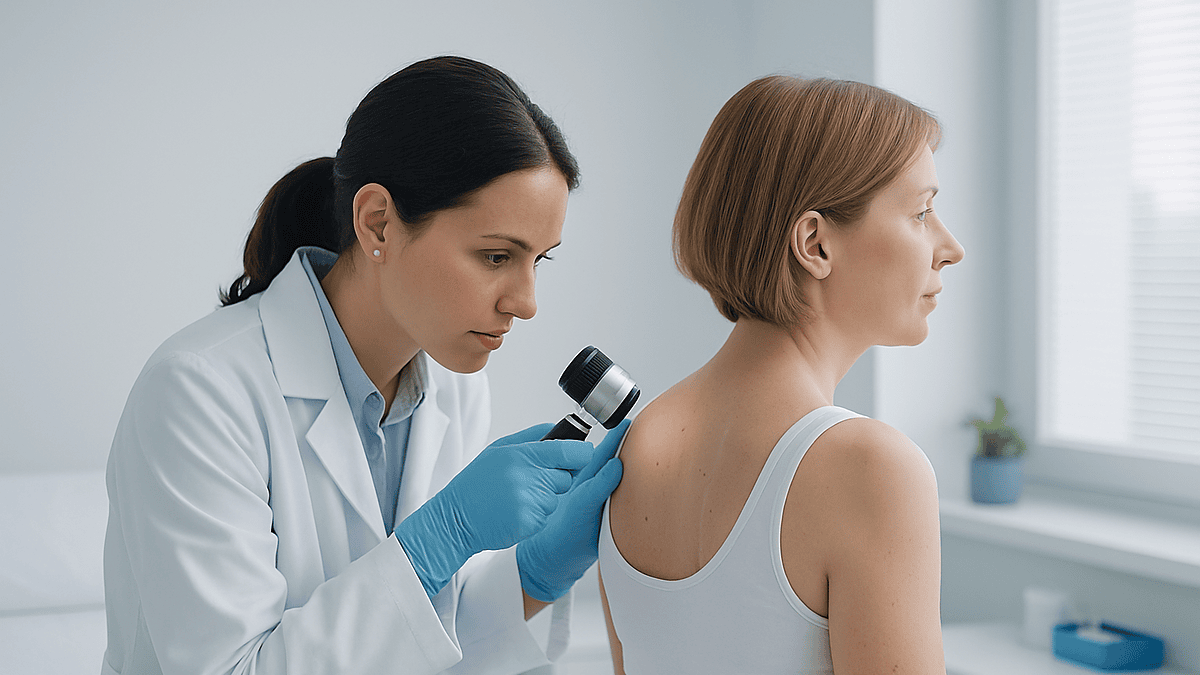
Along the way the clinician often uses a dermatoscope, a handheld magnifier with a polarized light that lets them see structures just beneath the surface, including fine blood vessels and pigment patterns. Mayo Clinic describes this kind of examination as the first step in evaluating any suspicious spot. It is painless, and it typically involves the instrument being pressed lightly against the skin, sometimes with a drop of gel.
Expect to be asked questions too: whether anything has bled, itched or changed; whether new spots have appeared; whether you have noticed anything at the old site. Your answers matter because you see your skin every day and the clinician sees it twice a year.
The whole examination usually takes 10 to 20 minutes. If nothing needs attention, that is the visit. If something does, the next step is a biopsy, which means removing a small sample for a pathologist to examine, and that can often be done the same day with local anesthetic.
What is the dermatologist looking for at the treated scar?
A healed scar is not blank space to a trained eye. The clinician is comparing what is there now with what should be there, and several changes prompt a closer look.
Recurrent basal cell carcinoma most often appears as a new firmness, lump or pearly nodule within or at the edge of the scar. It may also show as a spot that keeps breaking down, crusting or bleeding long after the wound should have settled, or as a translucent, slightly raised area with fine visible blood vessels. Under the dermatoscope, patterns that do not belong in mature scar tissue, such as branching vessels or small blue-gray clumps, raise concern even when the surface looks bland.
The scar is also touched, not just viewed. Some recurrences grow downward and outward beneath the surface before they change anything visible, so palpation for a deep thickening is part of the check. This is one reason self-examination, valuable as it is, does not fully replace a clinical visit.
Timing shapes the interpretation. In the first few months a scar is expected to be pink, a little raised and sometimes itchy; those are signs of normal healing, not of trouble. Cleveland Clinic notes that scars continue to remodel for many months. A change that appears after the scar has settled, or a spot that heals and then reopens, is a different story.
If the treating team suspects regrowth, they will generally recommend a biopsy rather than guess. Recurrent tumors are sometimes treated differently from first tumors, often with a technique that checks the margins under a microscope during the procedure, but the choice depends on the site, size and pathology, and rests with the clinician who has seen the tissue.
Can a dermatologist tell if you have skin cancer just by looking?
Often they can form a strong suspicion, and sometimes a near certainty, but the diagnosis itself comes from the pathologist. Understanding that distinction saves a lot of anxiety in the waiting room.
Basal cell carcinoma has a set of classic appearances that experienced clinicians recognize quickly: a pearly or waxy bump, a flat flesh-colored or brown scar-like patch, or a sore that bleeds, scabs and returns. Dermoscopy sharpens the picture by revealing features beneath the surface. Mayo Clinic describes the process as examination first, followed by a skin biopsy when a lesion looks suspicious.
What looking cannot reliably do is distinguish every subtype, confirm how deep a tumor extends, or rule out a look-alike. Several harmless things imitate basal cell carcinoma, including enlarged oil glands, certain moles and slow-healing scratches, and a few more serious conditions can imitate it too. A biopsy settles the question and also tells the team which growth pattern is present. That matters because some subtypes, described as infiltrative or morpheaform, spread more widely under the skin and are treated more cautiously than the common nodular type.
So when a clinician says “I think this is a basal cell, let’s take a sample,” they are not hedging. They are following the standard sequence that avoids both under-treating a cancer and over-treating something benign.
A related question is whether a clinician can tell you at the follow-up visit that you are definitely clear. They can tell you that nothing suspicious is visible or palpable today, which is meaningful and reassuring. They cannot promise that nothing will appear before the next visit, which is exactly why the next visit exists.
Who needs closer dermatologist follow up after skin cancer, and who is asked to wait longer?
Risk is not evenly distributed, and follow-up schedules are meant to reflect that. When a team decides how often to see you, several factors weigh on the decision.
People generally placed in a higher-risk group, and seen more often, include those who have already had more than one basal cell carcinoma; those whose tumor was in a high-risk area such as the central face, ears, lips or eyelids, where recurrence is harder to detect and to treat; those whose pathology showed an aggressive growth pattern or involved margins; and those with a suppressed immune system, whether from organ transplant medication, certain blood cancers or other causes. Mayo Clinic identifies immune suppression, prior radiation exposure and a personal or family history of skin cancer as recognized risk factors, and each tends to push follow-up toward the closer end of the range.
People with a rare inherited condition that predisposes to many basal cell carcinomas, sometimes called basal cell nevus syndrome, are typically followed in a specialized way from a young age.
At the other end are people whose single, small, well-defined tumor was removed with clear margins from a low-risk site such as the trunk or limb, who have fair-to-average sun damage and no immune problems. They may be asked to attend once a year, or in some systems to perform self-examination with open access to return if anything changes. Being asked to wait longer between visits is not neglect; it is a judgment that more frequent checks would not change outcomes for you.
None of these categories is fixed. A new tumor, a change in medication or a new medical diagnosis can move someone from one group to another, and the schedule should move with them.
How often skin check after basal cell carcinoma: a summary table
The table below summarizes the general shape of surveillance that many clinicians use. It is a guide to what people commonly experience, not a prescription, and your own team may reasonably differ from it.
| Situation | Typical check interval | What is emphasized |
|---|---|---|
| First 1–2 years after any basal cell carcinoma | Every 6–12 months | Scar assessment, full-skin survey, teaching self-examination |
| Years 3–5, single low-risk tumor, clear margins | Every 12 months | Full-skin survey for new lesions |
| Beyond 5 years, low risk | Every 12 months, sometimes longer with self-checks | New primary tumors, sun-damage review |
| Multiple prior tumors, high-risk site or aggressive subtype | Every 3–6 months initially, then per team | Palpation of scar, dermoscopy of surrounding skin |
| Immune suppression (for example after transplant) | Every 3–6 months, often indefinitely | All skin cancer types, including squamous cell carcinoma |
| Inherited predisposition syndromes | Individualized, often frequent from youth | Multiple new tumors, coordinated specialist care |
Two patterns are worth pointing out. First, the interval shortens with risk, but it rarely disappears altogether; even the lowest-risk row keeps some form of annual contact. Second, the emphasis shifts over time from the scar to the rest of the skin. In the first year the treated site is the main concern. By year five it is a small part of a much larger survey.
If your experience does not match the table, that is not a warning sign. It usually means your team knows something specific about your tumor or your health that a general table cannot capture.
What do the weeks and months after basal cell carcinoma treatment usually look like?
Surveillance starts before the first formal follow-up appointment, in the wound-care phase, and knowing the normal arc helps you tell healing from trouble.
In the first one to two weeks after surgical removal, the site is covered, kept clean and often a little sore. Stitches are usually removed within that window, with facial stitches often coming out sooner than those on the back or legs, where skin is under more tension. Bruising and mild swelling are expected, especially around the eyes. Cleveland Clinic describes this early period as one of routine wound care with instructions provided by the treating team.
Between roughly two and eight weeks, the scar is pink or red, may feel firm or lumpy, and can itch. Numbness around a surgical site is common and usually improves over months as small nerves regrow. Some people are offered a wound review during this period, particularly after larger repairs or skin grafts.
Over the following six to twelve months the scar softens, flattens and fades toward skin color. Mayo Clinic notes that scars continue to change for up to a year. This is also when the first formal follow-up skin check typically happens, often around the 6-month mark, so the clinician can see the settled scar and examine everything else.
If treatment was not surgery but a topical cream, a freezing treatment or radiation, the early weeks look different. Creams and freezing often cause redness, crusting and weeping that looks worse before it looks better; radiation produces a reaction that peaks in the weeks after the course ends. Each has its own expected course, and the team providing it should tell you what a normal reaction looks like so that an abnormal one is recognizable.
How to check your own skin between visits without turning it into a diagnosis
Self-examination is the bridge between appointments, and most clinicians encourage it. The purpose is not to work out what a spot is. It is to notice change early enough that a clinician can decide.
A practical rhythm is once a month, in good light, after a shower. Use a full-length mirror and a hand mirror, and ask a partner or family member to look at your back, scalp and the backs of your ears if you can. Work in the same order each time so nothing is skipped, and pay particular attention to sun-exposed skin: face, ears, neck, scalp, forearms, backs of the hands and lower legs.
Look at the treated scar and feel it gently for any new firmness. Then survey everything else for something that was not there before or that has changed. In basal cell carcinoma the changes people most often describe are a small shiny or pearly bump, a pink patch that looks a little like a scar but was never injured, a spot that bleeds with minimal contact, and a sore that seems to heal and then breaks down again. Mayo Clinic and MedlinePlus both describe these patterns. None of them proves anything on its own; several harmless conditions look similar, which is precisely why the next step is a clinical opinion rather than a conclusion.
Photographs help. A dated picture on your phone of the scar and of any mole or patch you are unsure about gives you and your clinician an objective comparison months later, and turns “I think it looks different” into evidence.
Finally, keep the threshold for calling low. A visit that ends with “that is nothing to worry about” is a good use of everyone’s time.
How urgent is it to remove a basal cell carcinoma, and what is the 2 week rule for skin cancer?
People often hear that basal cell carcinoma is slow-growing and wonder whether a new or recurrent one can wait a few months. The honest answer is that it is rarely an emergency and should not be ignored either.
Basal cell carcinoma does grow slowly, typically over months to years, and Mayo Clinic notes that it rarely spreads to other organs. What it does do, if left alone, is enlarge locally. A tumor that could have been removed with a small excision can, over time, destroy surrounding skin, cartilage or bone, especially on the nose, ear or around the eye. The cost of delay is usually a bigger operation and a bigger scar rather than a threat to life, but on the face that is not a small cost.
The “2 week rule” is a UK health service standard rather than a medical fact about tumors. Under it, a general practitioner who suspects cancer refers the patient to a specialist to be seen within two weeks. For skin, the NHS applies this urgency mainly to suspected melanoma and squamous cell carcinoma, which can spread. Suspected basal cell carcinoma is usually referred through a routine pathway with a longer wait, precisely because it is so unlikely to metastasize.
For someone already under follow-up, the practical implication is simple: report a suspicious change promptly, expect that the team will arrange assessment in a timeframe appropriate to the concern, and do not panic if that timeframe is weeks rather than days. The NHS advice to see a doctor about any skin lesion that has not healed after four weeks is a useful benchmark for when “keep an eye on it” should become “get it looked at”.
What people often get wrong about basal cell carcinoma follow up skin checks
Misunderstandings cluster around this topic, and some of them lead people to skip appointments or worry more than they need to.
The first is that a clear pathology report means the matter is closed. Clear margins are excellent news about that tumor. They say nothing about the rest of your skin, and the pooled data cited earlier suggest new tumors are common in the years that follow. Follow-up is about the second event, not a lack of confidence in the first treatment.
The second is the opposite error: that basal cell carcinoma is “not really cancer”. It is a genuine malignancy. It is a slow one that seldom spreads, and Mayo Clinic is explicit about both points, but it invades and destroys local tissue if left, and it deserves the same steady attention as any other cancer diagnosis.
The third is that follow-up involves scans. For basal cell carcinoma it almost never does. Imaging is reserved for the rare large, deep or neglected tumor where the team needs to know whether bone or nerve is involved.
The fourth is that sunscreen now is pointless because the damage is done. Cumulative damage cannot be undone, but ultraviolet exposure continues to add to it, and reducing exposure lowers the chance of new tumors and of pre-cancerous sun spots. The Mayo Clinic prevention guidance applies with greater, not lesser, force after a diagnosis.
The fifth is that any bump in a scar means recurrence. Most do not. Scars form small cysts, trapped hairs and thickened tissue as they heal, and the clinician’s job is to sort those from the few that matter. Report the bump; do not pre-decide what it is.
Finally, some assume follow-up is only for the elderly. Basal cell carcinoma is increasingly diagnosed in people in their thirties and forties, and younger people have more decades ahead in which new tumors can appear.
Basal cell carcinoma second skin cancer risk: what lowers the odds of another one?
Once the follow-up schedule is set, the most useful thing within your control is reducing further ultraviolet damage. The evidence here is consistent, and the mechanism is straightforward: ultraviolet light damages DNA in skin cells, and basal cell carcinoma arises when that damage accumulates faster than the cell can repair it.
Mayo Clinic’s prevention guidance is a practical starting point. Avoid the midday sun, which in many places runs from about 10 a.m. to 4 p.m. when ultraviolet intensity peaks. Use a broad-spectrum sunscreen with a sun protection factor of at least 30 on exposed skin every day, not only on beach days, and reapply after swimming or sweating. Wear clothing that covers the arms and legs, a hat with a brim wide enough to shade the ears and neck, and sunglasses. Avoid tanning beds entirely; they deliver concentrated ultraviolet light and are linked to skin cancer of all types.
Two points deserve emphasis for people who have already had a tumor. The first is that incidental exposure adds up: the commute, the school run, the walk to lunch. Daily habits matter more than holidays. The second is that the ears, scalp, lips and backs of the hands are frequently missed, and they are frequent sites of new tumors.
Beyond sun protection, tell your follow-up clinician about any actinic keratoses, the rough, scaly pre-cancerous patches that indicate heavily sun-damaged skin. Treating them is part of managing the field of damage, and their number is one of the signals clinicians use when deciding how closely to follow you.
Some people ask about supplements or medications to prevent new tumors. Research is ongoing in this area, and any decision about preventive treatment is one for the treating team, weighing the evidence against individual risk.
Questions to ask your care team about follow-up
The follow-up appointment is short, and it goes better when you arrive with questions. These are the ones that tend to unlock the most useful conversations.
- What subtype of basal cell carcinoma did I have, and does that change how often I should be seen?
- Were the margins clear, and if not, what is the plan for the area?
- How often do you want to see me over the next five years, and who is responsible for booking those visits?
- What should the scar look and feel like at this stage, and what change at the scar should prompt a call before the next appointment?
- Do I have actinic keratoses or other signs of sun damage that need treatment or monitoring?
- Am I in a higher-risk group for any reason, such as medication that affects my immune system?
- How should I examine my own skin, and how often?
- If I find something between visits, who do I contact and how quickly can I be seen?
- Are there any treatments to lower my risk of new tumors that are appropriate for me?
- Should anyone in my family be more careful about skin checks because of my diagnosis?
Write the answers down or ask if you can record them. Two answers in particular are worth having on paper: your recommended interval, and the exact route for getting seen early. Many people who miss a recurrence or a new tumor did not lack vigilance; they lacked a clear way to act on it.
If English is not your first language, or you have hearing or memory difficulties, ask for an interpreter or bring someone with you. Surveillance is a long relationship, and it works best when both sides understand each other from the start.
When to call your doctor
Between scheduled basal cell carcinoma follow up skin checks, certain changes should prompt a call rather than a wait for the next appointment. None of these confirms cancer, and most turn out to be benign, but each is a reason for a clinician to look.
Contact your care team if the treated scar develops a new lump, firmness or pearly bump; if it bleeds, crusts or breaks open after it had healed; or if it becomes persistently painful, red or warm, which can also indicate infection, particularly in the early weeks.
Elsewhere on the skin, report any sore or spot that has not healed after four weeks, a benchmark the NHS uses for seeking advice; a new shiny, translucent or waxy bump; a flat scar-like patch where there was no injury; a spot that bleeds with minimal contact; or any mole that has changed in size, shape or color, since melanoma is also more common in people with a history of skin cancer.
Seek urgent care the same day for signs of a wound infection spreading rapidly, such as expanding redness with fever or feeling unwell, or for bleeding from a wound that does not stop with 15 minutes of firm pressure.
If you have a weakened immune system, the threshold for calling should be lower still, because tumors can grow faster and behave less predictably. Your team should have told you how to reach them; if you are not sure, your family doctor is the right first call and can arrange the referral.
Every one of these decisions, from whether to biopsy to how to treat what is found, sits with the clinicians who know your history. Your job is to notice and to report. Theirs is everything after that.
Frequently asked questions
How often skin check after basal cell carcinoma is normal?
Most people are seen every 6 to 12 months for the first several years and then once a year, although the schedule is individualized. People with multiple tumors, high-risk sites such as the central face, aggressive subtypes or a suppressed immune system are often seen every 3 to 6 months at first. Ask your treating team to write down the interval they recommend for you.
Can a dermatologist tell if you have skin cancer just by looking?
Often they can form a strong suspicion, particularly with a dermatoscope, but a definite diagnosis requires a biopsy examined by a pathologist. Several harmless conditions imitate basal cell carcinoma, and the biopsy also reveals the growth pattern, which shapes treatment. Mayo Clinic describes examination followed by biopsy as the standard sequence for any suspicious lesion.
What are the basal cell carcinoma recurrence signs at a scar?
The changes clinicians look for are a new lump, firmness or pearly bump within or beside the scar, a spot that bleeds or crusts after the wound had healed, or a translucent area with fine visible blood vessels. Normal early healing also produces pinkness and lumpiness, so timing matters. Report any change and let the clinician decide whether a biopsy is needed.
How urgent is it to remove a basal cell carcinoma?
It is rarely an emergency but should not be left indefinitely. Basal cell carcinoma grows slowly and, per Mayo Clinic, rarely spreads to other organs, yet it enlarges locally and can destroy skin, cartilage or bone over time, especially on the face. Prompt assessment usually means a smaller procedure and a smaller scar than one delayed by months or years.
What is the 2 week rule for skin cancer?
It is a UK health service standard under which a general practitioner who suspects cancer refers the patient to be seen by a specialist within two weeks. For skin, the NHS applies this urgent pathway mainly to suspected melanoma and squamous cell carcinoma. Suspected basal cell carcinoma is usually referred routinely because it is so unlikely to spread.
What are the warning signs of basal cell carcinoma people are told to report?
Mayo Clinic and MedlinePlus describe a pearly or waxy bump, a flat flesh-colored or brown scar-like patch, a sore that bleeds, scabs and returns, a pink growth with a slightly raised edge, and a spot that bleeds easily. None of these is diagnostic on its own; harmless conditions can look identical, so the right response is a clinical opinion rather than self-diagnosis.
Does basal cell carcinoma follow-up include scans or blood tests?
Almost never. Because basal cell carcinoma rarely spreads beyond the skin, surveillance is a physical examination of the skin itself, often with a dermatoscope. Imaging is reserved for the uncommon large, deep or long-neglected tumor where the team needs to know whether underlying bone or nerve is involved.
What is the basal cell carcinoma second skin cancer risk?
It is substantial. A pooled analysis of older studies in Archives of Dermatology estimated that about 44 in 100 people developed a second non-melanoma skin cancer within three years of the first. Figures vary between populations and eras, but the consistent finding that new tumors are common is the main reason surveillance continues for life rather than ending after a set period.
Is dermatologist follow up after skin cancer needed if the margins were clear?
Yes. Clear margins are good news about that particular tumor, but they say nothing about the rest of the skin, which has had the same sun exposure. Follow-up after a clear result is mostly about detecting new tumors early and, in the first years, confirming the scar remains settled. Your team will set the interval according to your risk.
Can I stop follow-up after five years without a new tumor?
That is a decision for your treating team, and many clinicians prefer to continue at least yearly checks indefinitely because new basal cell carcinomas can appear decades after the first. Some lower-risk people are moved to self-examination with open access to return if something changes. Whatever is agreed, monthly self-checks and daily sun protection remain worthwhile.
References
This article is for general information only and is not a substitute for professional medical advice. Please consult a qualified doctor about your individual situation.

More from the Blog
How Acute Myelogenous Leukemia Treatment Is Planned When Time Matters
Acute myelogenous leukemia treatment is usually planned within days of diagnosis because immature blood cells can crowd the bone marrow quickly. The care team…
Living With Chronic Graft-Versus-Host Disease: Skin, Eye Dryness and Long-Term Follow-Up
Living with chronic GVHD means the donor's immune cells keep reacting against your own tissues, most often the skin, mouth and tear glands, for…
Recovering After Lung Cancer Surgery: Breathing Exercises, Walking and Chest Drains
After lung cancer surgery, recovery usually rests on three habits: slow deep breaths, often with an incentive spirometer, taken several times every waking hour;…
Wilms Tumor Diagnosis and Staging: What Imaging, Kidney Tests and Pathology Tell the Team
Wilms tumor diagnosis and staging usually begins with an abdominal ultrasound, followed by CT or MRI of the abdomen and a chest CT to…
Flying Home After a Mastectomy: Drains, Compression and How Long International Patients Stay
There is no guideline that fixes a single safe interval for flying after a mastectomy. Surgical teams generally prefer that drains are out, which…

Supplements, Herbal Products and Chemotherapy: Why Your Oncologist Asks Before You Start
Oncologists ask about supplements during chemotherapy because some vitamins, herbs and extracts can change how chemotherapy drugs are absorbed, broken down or cleared, raise…