

Smart Rings Compared: Galaxy Ring, Ultrahuman and Oura: What They Measure Well

Key Takeaways
- All three rings share the same core sensor stack of optical pulse, skin temperature and motion, so the real differences are software, phone compatibility and data access, not hardware.
- Overnight resting heart rate is the most reliable number a ring produces, typically within a few beats of a clinical monitor because the finger is still during sleep.
- In a polysomnography comparison, a ring detected about 96 percent of true sleep but under half of wake periods, so restless nights are often logged as longer than they were.
- Sleep stage labels agreed with a lab roughly 51 to 65 percent of the time, which makes a 20-minute deep-sleep difference between nights indistinguishable from error.
- None of the Galaxy Ring, Oura Ring or Ultrahuman Ring Air records an ECG, so none can detect atrial fibrillation; an oddly variable pulse is a prompt for a clinical test, not a finding.
- The Samsung Galaxy Ring pairs only with Android phones while Oura and Ultrahuman work with both platforms, which is often the deciding factor before any sensor is considered.
The Samsung Galaxy Ring, Oura Ring and Ultrahuman Ring Air all use an optical sensor on the finger to track resting heart rate, nighttime heart rate variability, skin temperature trends and total sleep time, and small validation studies suggest these are their most dependable outputs. Sleep stages, blood-oxygen trends and readiness scores are estimates rather than diagnoses, and none of the three replaces a clinical test.
At a Sunday brunch recently, three people at the same table twisted a plain metal band on an index finger and compared numbers before anyone compared pancakes. One wore the Samsung Galaxy Ring, one an Oura, one an Ultrahuman. All three had a “score” for the night. None of them could say what the score was built from.
That scene explains the search spike. Smart rings were a niche for a decade, then a major phone maker entered the category in July 2024 and turned a curiosity into a mainstream question. As of mid-2025, the comparison query sits alongside blood pressure and sleep apnea in what readers ask us about wearables, and the sharpest version of the question is not “which is best” but “which numbers can I trust?”
That is the question this piece answers, metric by metric, with the evidence graded rather than assumed.
What does the Samsung Galaxy Ring actually do?
Strip away the marketing and the Samsung Galaxy Ring is a titanium band containing three things: an optical heart-rate sensor, a skin-temperature sensor and an accelerometer, which is a tiny motion detector that senses how the ring moves in space. Everything the companion app shows you is calculated from those three streams.
From them, the ring produces a Sleep Score with estimated sleep stages, a daily Energy Score that blends sleep, resting heart rate and recent activity, continuous heart rate during the day and heart rate variability (HRV) overnight. HRV is the natural variation in the gap between one heartbeat and the next, measured in milliseconds. Skin temperature is logged during sleep and used for cycle predictions in the health app. Walking and running can be detected automatically, and the ring will nudge you after long stretches of sitting.
Two features deserve a plain-language note. Snoring detection does not come from the ring at all; it uses the phone microphone placed near the bed. And high or low heart-rate alerts flag a resting rate outside a threshold you set; they are notifications, not a medical finding.
Equally important is what it does not do. There is no electrocardiogram (ECG), the electrical heart tracing that smartwatches use to look for atrial fibrillation. There is no blood pressure. There was no blood-oxygen reading at launch. And it pairs only with Android phones, with some functions reserved for the manufacturer’s own handsets. The ring is a quiet, screenless data logger for sleep and recovery, which is both its appeal and its ceiling.
What changed recently in the smart ring market
Three dated shifts explain why this comparison is trending now.

First, the category gained a household name. The Samsung Galaxy Ring went on sale globally in July 2024, the first finger wearable from a company that already ships tens of millions of watches and phones a year. Rings stopped being something only athletes and sleep enthusiasts owned.
Second, the incumbent answered. Oura’s fourth-generation ring arrived in October 2024 with a smooth inner surface, more sensor pathways and expanded sizing, and the company kept publishing the kind of validation work that most wearable makers avoid. The peer-reviewed comparison of an earlier Oura model against polysomnography, the overnight sleep-lab test that records brain waves, eye movement, muscle tone and breathing, remains one of the few independent-style benchmarks in the field (PubMed). Polysomnography is the reference standard every consumer sleep claim should be judged against.
Third, the subscription question split the field. Ultrahuman’s Ring Air positioned itself around no mandatory membership and optional add-on features, while Oura kept a membership model for full data access. That business difference, more than any sensor, now drives a large share of the “which ring” searches.
What has not changed matters just as much. None of the three rings is cleared by a medical regulator to diagnose anything. Resting heart rate norms, 60–100 beats per minute for most adults according to the American Heart Association, are the same whether a ring or a nurse measures them (American Heart Association). The devices got better and more numerous. The medicine underneath them stayed put.
How a smart ring measures your body from a finger
Every metric on every ring begins with a flicker of light. The sensor uses photoplethysmography (PPG), which means shining green, red or infrared LEDs into the skin and measuring how much light bounces back. Each heartbeat pushes a pulse of blood through the finger, blood absorbs light, and the reflected signal dips in rhythm with your pulse. Count the dips and you have heart rate. Measure the spacing between them precisely and you have HRV.
The finger is a genuinely good place for this. The palm side of a finger has dense blood vessels close to the surface and far less hair and pigment interference than the wrist, which is why hospital pulse oximeters clip onto fingertips rather than forearms. Rings also sit tighter and move less during sleep than a watch strap, and sleep is when the most useful ring data is gathered.
Temperature is simpler: a thermistor on the inner surface logs skin temperature many times an hour. Skin temperature is not core body temperature; it swings with room temperature, blankets and alcohol. The rings handle this by tracking your personal baseline over weeks and reporting deviations from it, not absolute values.
The accelerometer does the rest. Stillness plus a slow, steady pulse reads as sleep. Rhythmic motion reads as walking. Combine motion, pulse and temperature patterns and an algorithm guesses sleep stage. That word, guesses, is accurate. A ring never sees brain waves, so every stage label is an inference from the body’s indirect signals. Understanding that one fact makes the rest of this comparison far easier to judge.
Galaxy Ring vs Oura vs Ultrahuman Ring: the side-by-side table
Specifications change with firmware and new models, so treat the table as a snapshot of the current generation rather than a permanent record. The pattern it shows, though, has held for several years: the hardware is more alike than different, and the real distinctions are in software, phone compatibility and how data is unlocked.
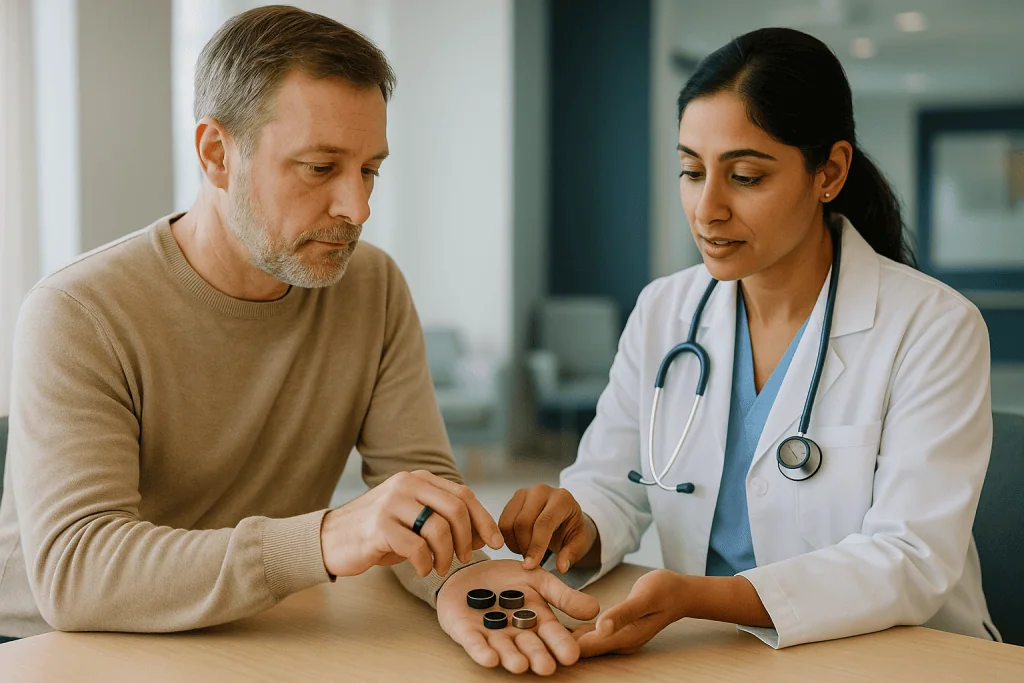
| Feature | Samsung Galaxy Ring | Oura Ring 4 | Ultrahuman Ring Air |
|---|---|---|---|
| Sensors | Optical PPG, skin temperature, accelerometer | Optical PPG (incl. infrared), skin temperature, accelerometer | Optical PPG (incl. infrared), skin temperature, accelerometer |
| Sleep staging | Yes (estimated) | Yes (estimated, published PSG comparison) | Yes (estimated) |
| Nightly HRV and resting HR | Yes | Yes | Yes |
| Blood-oxygen trend | Not offered at launch | Yes, overnight trend | Yes, overnight trend |
| Snoring detection | Via phone microphone | No | No |
| ECG or blood pressure | No | No | No |
| Battery (manufacturer claim) | Up to about 7 days, size dependent | Up to about 8 days | Roughly 4–6 days |
| Phone compatibility | Android only; some features need the maker’s phones | iOS and Android | iOS and Android |
| Subscription for full data | No | Membership required | No; optional add-ons |
Read across the rows and one truth stands out: no ring measures something the others fundamentally cannot. The sensor stack is near identical. What differs is how each company turns the same light pulses into scores, how transparent it is about accuracy and which phone sits in your pocket. That is why the rest of this article grades metrics rather than brands.
Sleep tracking: what rings measure well and what they estimate
Sleep is where rings earn their keep, and also where the biggest overclaims live. Separate the two.
Total sleep time and bedtime consistency are the dependable part. Because a ring senses stillness and a slowing pulse directly, it is good at knowing roughly when you fell asleep and when you got up. In the polysomnography comparison indexed on PubMed, an earlier Oura model correctly identified about 96 percent of true sleep as sleep. Where it struggled was the opposite direction: it caught under half of wake periods during the night, meaning quiet lying-awake time often gets logged as sleep. Expect your ring to flatter your total slightly on restless nights.
Sleep stages are the estimated part. In the same study, agreement with the lab was around 65 percent for light sleep, about 51 percent for deep sleep and roughly 61 percent for REM, the dreaming stage with rapid eye movements. Those figures mean a ring is right about stage more often than a coin flip, but not by a margin that justifies planning your life around “only 40 minutes of deep sleep.” Newer algorithms report better numbers in manufacturer studies, which have not all been independently replicated.
How does this translate to daily use? Trust the trend lines: average sleep duration across a month, how often you cross the 7-hour threshold the Centers for Disease Control and Prevention recommends for adults (CDC), and whether late caffeine or alcohol reliably shortens your nights. Treat individual stage percentages and night-to-night Sleep Scores as weather, not climate. The Galaxy Ring, Oura and Ultrahuman differ in how they package this, but the underlying physics limits all three in the same way.
Heart rate and HRV: the strongest numbers a smart ring produces
If you want the single metric most worth watching, it is overnight resting heart rate, and the ring is an excellent place to collect it.
Optical heart rate is well validated when the body is still, and nothing is stiller than a sleeping finger. Nightly resting heart rate on all three rings is typically within a few beats of a chest strap or clinical monitor. That matters because resting heart rate is a real physiological signal. A persistent climb of five to ten beats above your personal baseline often appears with the start of an infection, after heavy alcohol, during overtraining or when sleep is cut short. A gradual fall over months tends to accompany improved aerobic fitness.
HRV is the trickier sibling. Higher variability between beats generally reflects stronger activity of the parasympathetic nervous system, the “rest and digest” branch, and lower variability appears with stress, illness and fatigue. Rings measure HRV only during sleep, which is actually the right call: daytime HRV is contaminated by movement, posture and conversation. The caveat is the number itself. Normal HRV spans an enormous range between healthy people, and an individual value means almost nothing without weeks of your own baseline. Compare yourself with yourself, never with a friend or an online chart.
Daytime heart rate during exercise is the weak spot. Grip a dumbbell or a handlebar and finger blood flow changes, so readings can lag or drop during workouts. A chest strap remains the better tool for training zones.
Finally, no ring in this comparison records an ECG, so none can detect atrial fibrillation, the irregular rhythm linked to stroke risk. A ring may show an oddly variable pulse; only an ECG can name the rhythm.
Temperature, cycles, blood oxygen and snoring: trend tools, not tests
Skin temperature is quietly one of the more useful ring signals, provided you accept what it is. A thermistor on the finger cannot tell you your core temperature or confirm a fever. What it can do is show a deviation from your personal nightly baseline, and that deviation tracks two real biological patterns.
The first is the menstrual cycle. Resting temperature rises by roughly a third to half a degree Celsius after ovulation and stays elevated until the next period begins. All three rings use this shift, combined with heart rate and HRV changes, to estimate cycle phase and predict periods. The predictions improve with months of data and can be thrown off by illness, travel and alcohol. They are informational and are not a validated method of contraception.
The second pattern is illness. Many users notice a temperature deviation alongside a raised resting heart rate a day before symptoms start. Research on this is largely observational and company-affiliated, so the honest grade is “plausible and promising,” not proven.
Blood oxygen, or SpO2, is the estimated percentage of hemoglobin carrying oxygen. Oura and Ultrahuman report an overnight average and a graph of dips, with infrared light doing most of the work. These are trend indicators. Finger position, cold hands and skin tone all affect optical oxygen readings, and the devices are not cleared as medical oximeters. Repeated large overnight dips are a reason to raise sleep-disordered breathing with a clinician, not a diagnosis of it.
Snoring detection on the Galaxy Ring relies on the phone microphone. Snoring alone is common and often harmless. Loud snoring with pauses, gasping or heavy daytime sleepiness is a different matter, covered under the doctor section below.
Steps, workouts and daily activity on a finger
Here the honest grade drops a notch. Rings count movement with an accelerometer, and fingers move for reasons that have nothing to do with walking: typing, cooking, gesturing while talking. Steps are therefore noisier than on a hip-worn pedometer or even a watch, and the three rings can disagree with each other by a meaningful margin on the same walk.
Workout detection follows the same logic. The Galaxy Ring auto-detects walking and running after several minutes of consistent motion; Oura and Ultrahuman do similar, and all three let you log other activities manually. Cycling, rowing and strength training are poorly captured because the hands are either gripping something or barely moving. Calorie estimates layer a population formula on top of noisy input, so they are the least trustworthy number on any screen.
Where activity data does have value is in the opposite direction: inactivity. Long sedentary stretches are easy for a ring to recognize, and the gentle reminders to move are supported by a strong body of observational research linking prolonged sitting to cardiovascular risk. The American Heart Association’s general guidance of at least 150 minutes of moderate activity a week is a better target than any ring’s proprietary points.
A practical takeaway: use the ring to answer “did I move today, and did I sit for three hours straight?” rather than “did I burn 437 calories?” The first question it can answer with confidence. The second it cannot, and neither can any other consumer wearable. The ring’s design brief is recovery and sleep; a sports watch with GPS remains the right instrument for training load.
What the evidence actually says about smart rings
Grading the evidence requires separating three distinct questions, because the answers differ sharply.
Question one: do rings measure what they claim? Here the evidence is moderate for some metrics and weak for others. Validation studies comparing rings with polysomnography and clinical heart monitors exist, mostly small (dozens of participants, often healthy young adults, frequently with company involvement). They consistently show good agreement for total sleep time and resting heart rate, fair agreement for sleep stages and overnight HRV trends, and limited data for SpO2 and step counts on the finger. Independent replication across diverse ages, body sizes and skin tones is thin.
Question two: does wearing a ring change behavior? The evidence is observational and mixed. People who track sleep often report sleeping more consistently, but self-selection muddies the water: people who buy rings already care about sleep. No large randomized trial has tested a smart ring against no ring.
Question three: does wearing a ring improve health outcomes, such as fewer heart events or better blood pressure? There is no randomized evidence for this. None. Any claim that a ring “improves health” is extrapolation, not finding.
Finally, a documented downside. Sleep clinicians describe orthosomnia, a preoccupation with achieving perfect sleep data that itself worsens sleep through anxiety and clock-watching. Case reports and small series support it as a real phenomenon. The Mayo Clinic’s overview of sleep disorders notes that worrying about sleep is a recognized driver of insomnia (Mayo Clinic).
In one sentence: rings are reasonably accurate thermometers of trend, unproven as medicine, and occasionally harmful to the anxious.
What finger should you wear the Galaxy Ring on?
The manufacturer recommends the index finger, and so do its two rivals, and the reasoning is physiological rather than aesthetic. The index finger offers a broad, flat pad of skin against the sensor, strong blood flow and relatively little movement during sleep. The middle finger is the next best choice. Little fingers and thumbs are poor candidates: the thumb flexes constantly and the little finger is thinner, which weakens the optical signal.
Which hand matters less than fit, but the non-dominant hand has advantages. It is less likely to grip tools, carry bags or bang against door frames, which protects both the sensor and the finish. Users who lift weights often move the ring to the other hand or remove it during sessions, since heavy gripping can mark the titanium and interrupt readings.
Fit is the detail that determines whether your data is any good. The sensors must sit against the palm side of the finger, snug enough not to spin but loose enough to slide over the knuckle. Fingers swell overnight, in heat and after salty meals, and shrink in cold, so all three companies ship a plastic sizing kit and ask you to wear a sample size for a day or two before ordering. The Galaxy Ring ships in roughly sizes 5 through 13, with larger options added later; Oura covers about 4 to 15 and Ultrahuman about 5 to 14.
If readings go missing or HRV looks wildly erratic, the ring was probably loose and rotated. A gap you can slide a fingernail into on the palm side is usually the culprit. Sizing is boring. It is also the single cheapest way to improve accuracy on every metric.
Ring vs smartwatch: what is the point of a Samsung Galaxy Ring?
A fair question, especially from someone already wearing a watch. The point is not that a ring measures more. It measures less, and that is the design choice.
Consider what a watch does badly. Watches get taken off at night because they are bulky, need charging or glow. The best recovery data, overnight resting heart rate and HRV, is exactly what is lost when the watch sits on the nightstand. A ring weighs two to five grams, has no screen, runs for days and is rarely removed, so it quietly captures the nights a watch misses. For sleep and recovery tracking, consistency beats sophistication.
Consider also what a watch does that a ring cannot. Smartwatches offer ECG rhythm checks, on-wrist blood-oxygen spot checks, GPS, notifications and, on some models, regulator-cleared features such as sleep-apnea risk screening. If the medical features are what you want, the watch is the right category. The Galaxy Ring, Oura and Ultrahuman Ring Air are all explicitly wellness devices without an ECG.
There is a less measurable argument too. A ring never buzzes. For people who found a watch turned every meeting into a glance at their wrist, the absence of a screen is the feature. Some wear both: watch by day for training, ring at night for recovery, with the health app merging the data.
So the honest answer to “what is the point” is specific. A ring is for someone who wants years of uninterrupted sleep and resting-heart trends with almost no effort, who does not need medical-grade rhythm checks and who will not be derailed by a bad score. If that description fits, it is a sensible instrument. If not, a watch or no device at all may serve better.
Common myths about smart rings, corrected
Viral claims cluster around five ideas. Each deserves a correction grounded in what the devices can and cannot sense.
“My ring diagnosed sleep apnea.” It did not. Sleep apnea is repeated collapse of the airway during sleep, diagnosed by a sleep study that measures airflow, effort and oxygen together. A ring can show snoring, oxygen dips or restless sleep, all of which are reasons to be tested. The Galaxy Ring, Oura and Ultrahuman Ring Air are not cleared to detect the condition.
“Low HRV means my heart is unhealthy.” HRV varies hugely between healthy people and drops temporarily after a late dinner, a glass of wine or a hard workout. A single low night is noise. Only a sustained fall from your own baseline is worth noting, and even then it is a prompt to rest or ask, not a diagnosis.
“The deep-sleep number is exact.” Stage estimates agree with a sleep lab roughly half to two-thirds of the time. A 20-minute difference between two nights is within the error of the method.
“Rings measure blood pressure.” None of these three does. Blood pressure requires a cuff or a validated cuffless device with calibration; optical pulse alone cannot give it.
“The battery will die in a year and the ring is landfill.” This one carries a grain of truth. Lithium batteries lose capacity with charge cycles, and ring batteries are sealed and not user-replaceable. Expect run time between charges to shorten over two to three years. That is a durability trade-off worth knowing before purchase, not a safety fear.
Underlying every myth is the same confusion: mistaking an estimate for a measurement. Keep that distinction and the scores become useful again.
Is the Galaxy Ring worth getting? An evidence-first way to decide
Setting aside price, which has no place in a health article, “worth it” comes down to three honest questions about you rather than the hardware.
Do you want what rings measure well? If your goal is to see whether you actually get seven hours, whether your resting heart rate creeps up when you drink, or how your cycle tracks month to month, a ring delivers that with less friction than any other device. If you want ECG rhythm checks, GPS pace or regulator-cleared screening, you want a watch.
Which phone do you own? This is the bluntest filter. The Samsung Galaxy Ring works only with Android and reserves some functions for its maker’s phones. Oura and the Ultrahuman Ring work with both major platforms. For an iPhone owner, the Galaxy Ring is simply not a candidate.
How do you react to a bad number? People who treat a low score as information tend to benefit. People who treat it as a verdict can slide into orthosomnia, lying awake worrying about the lying awake. Be honest about which camp you fall in. A ring in a drawer measures nothing; a ring causing anxiety measures the wrong thing.
Two smaller considerations round it out. Subscription models differ, and that affects how much of your own data you can see long term. Battery capacity will fade over years, as with every sealed wearable.
None of this makes any ring a medical decision. It is a lifestyle instrument. For a stable, trend-focused user with the right phone, it is a good one. The evidence supports that modest claim and no bigger one.
When to see a doctor about what your ring shows
A ring can raise a question; only a clinician can answer it. The following patterns are worth a conversation, and some are worth urgent care regardless of what any device says.
Seek emergency help immediately for chest pain or pressure, fainting, severe breathlessness, or a racing or pounding heartbeat accompanied by dizziness or confusion. Do not wait to check an app.
Book an appointment soon if you notice:
- A resting heart rate persistently above 100 or below 50 beats per minute, especially with tiredness, dizziness or breathlessness, outside of athletic training.
- Repeated high or low heart-rate alerts, or a pulse the ring records as highly irregular night after night. The Mayo Clinic describes atrial fibrillation as a common irregular rhythm that raises stroke risk and often causes no symptoms; it is confirmed with an ECG, not an optical sensor (Mayo Clinic).
- Loud snoring with witnessed pauses in breathing, gasping or choking, morning headaches or falling asleep during the day. These are the recognized warning signs of obstructive sleep apnea, and a sleep study is the route to a diagnosis.
- Large or frequent overnight blood-oxygen dips reported by Oura or Ultrahuman, particularly alongside the symptoms above.
- A sustained drop in HRV or rise in skin temperature lasting more than a few days with fever, night sweats, unexplained weight loss or fatigue.
- Sleep anxiety: if checking the score has become compulsive or you dread bedtime, tell your clinician. Insomnia treatments exist, and a break from the device may be part of the plan.
Bring the app data if it helps describe a pattern, but let the clinician decide what it means. Never adjust a prescribed medicine because of a ring reading. The Cleveland Clinic’s plain explanation of HRV is a good primer to share before that conversation (Cleveland Clinic).
Frequently asked questions
What does the Samsung Galaxy Ring do?
The Samsung Galaxy Ring tracks sleep duration and estimated stages, overnight resting heart rate and heart rate variability, skin temperature trends for cycle predictions, and basic activity such as walking and running, using an optical sensor, a thermometer and a motion sensor. It produces a Sleep Score and Energy Score in the companion app. It has no ECG, no blood pressure and no blood-oxygen reading at launch, and it works only with Android phones.
What is the point of a Samsung Galaxy Ring if I have a smartwatch?
The point is uninterrupted overnight data. Watches are often removed at night, which loses the most useful recovery signals, resting heart rate and HRV. A screenless ring that runs for days is worn continuously, so trends build without effort. A watch still wins for ECG, GPS, notifications and regulator-cleared health features; many people use both and let the health app merge the data.
What finger should you wear the Galaxy Ring on?
The index finger of your non-dominant hand is the recommended position, with the middle finger as a second choice. The index finger gives a broad skin surface, strong blood flow and little movement during sleep, which improves optical readings. Fit matters more than finger: the sensor side should sit snugly against the palm side without spinning, so use the plastic sizing kit for a day before ordering.
Is the Galaxy Ring worth getting?
It is a sensible choice for an Android user who wants effortless, long-term trends in sleep duration, resting heart rate and temperature and who treats a low score as information rather than a verdict. It is not suited to iPhone owners, to anyone wanting ECG rhythm checks or GPS training data, or to people who find sleep tracking makes them anxious. It is a wellness tool, not a medical device.
How accurate is the Ultrahuman Ring compared with Oura and the Galaxy Ring?
The Ultrahuman Ring Air uses the same type of optical, temperature and motion sensors as its rivals, so its physical accuracy ceiling is similar: good for resting heart rate and total sleep time, fair for sleep stages and HRV trends, limited for steps and blood-oxygen estimates. Oura has the most published validation against sleep-lab testing. Independent head-to-head studies across all three rings are scarce, so brand-level accuracy rankings should be treated cautiously.
Can a smart ring detect sleep apnea?
No. Sleep apnea is diagnosed with a sleep study that measures airflow, breathing effort and oxygen together. A ring can show snoring, overnight oxygen dips or restless sleep, which are reasons to ask a clinician about testing, but none of the Galaxy Ring, Oura or Ultrahuman is cleared to detect the condition. Loud snoring with pauses, gasping or daytime sleepiness warrants a medical appointment regardless of any score.
Can the Galaxy Ring detect atrial fibrillation?
It cannot. Atrial fibrillation is an irregular heart rhythm confirmed by an electrocardiogram, and none of the three rings in this comparison records one. The Galaxy Ring can send a notification when resting heart rate goes above or below a threshold you set, and it may show an unusually variable pulse, but naming the rhythm requires an ECG from a smartwatch with that feature or a clinic.
Why is my HRV so low compared with other people?
Because HRV varies enormously between healthy individuals and is strongly influenced by age, genetics and fitness, comparing your number with someone else’s tells you almost nothing. The useful comparison is with your own baseline over several weeks. A temporary dip after alcohol, a late meal, illness or hard training is normal. Only a sustained fall from your personal average, especially with symptoms, is worth raising with a clinician.
Does the Galaxy Ring measure blood oxygen or blood pressure?
The Galaxy Ring offered no blood-oxygen metric at launch and does not measure blood pressure; no smart ring in this comparison measures blood pressure, which requires a cuff or a calibrated validated device. Oura and Ultrahuman report an overnight blood-oxygen trend and dips using infrared light. These are trend indicators affected by finger position, cold hands and skin tone, not clinical oximeter readings.
Do smart rings make you sleep better?
The evidence is observational and mixed. Many users become more consistent about bedtimes once they see the data, but people who buy rings already care about sleep, so cause and effect are hard to separate, and no large randomized trial has tested a ring against no ring. For a minority, close tracking triggers orthosomnia, anxiety about perfect sleep data that worsens sleep. If scores cause worry, a break from tracking is reasonable.
References
This article is for general information only and is not a substitute for professional medical advice. Please consult a qualified doctor about your individual situation.

More from the Blog

Palliative Chemotherapy: What the Term Means
Palliative chemotherapy is chemotherapy given with the aim of controlling a cancer rather than curing it. Its goals are to shrink or slow tumors,…
How Radiotherapy Works and How Long Sessions Take
A single external radiotherapy session usually takes about 10 to 30 minutes, and the beam itself is switched on for only a few minutes…
Whoop vs Oura: What Each Measures Well, Where They Disagree and How Accurate the Sleep Data Are
Whoop and Oura both estimate sleep and recovery from an optical pulse sensor, and both detect whether you are asleep or awake with roughly…

AI Symptom Checkers and ChatGPT Medical Advice: How Accurate Are They, Really?
AI symptom checkers and chatbots such as ChatGPT are reasonably good at flagging emergencies and at listing plausible causes, but they are not reliable…

AI in Radiology: How Algorithms Read Mammograms and CT Scans, and Why a Radiologist Still Signs the Report
AI in radiology means software trained on large image datasets that flags suspicious areas on mammograms and CT scans, sorts urgent cases to the…
Deep Brain Stimulation: What It Is and How Long It Lasts
Deep brain stimulation is a surgical treatment in which thin electrodes are placed in specific areas of the brain and connected to a small…